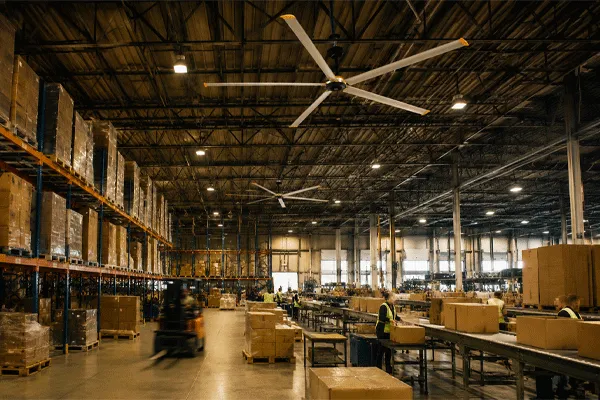
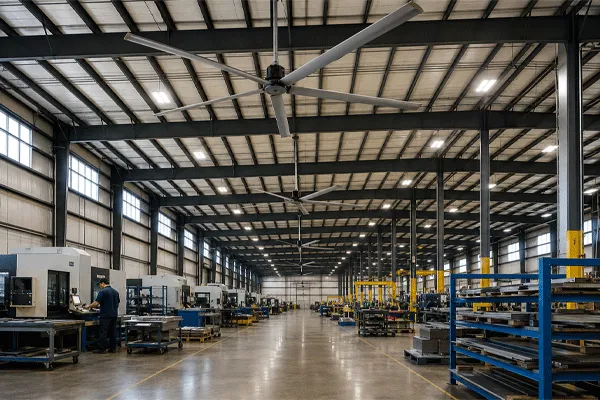
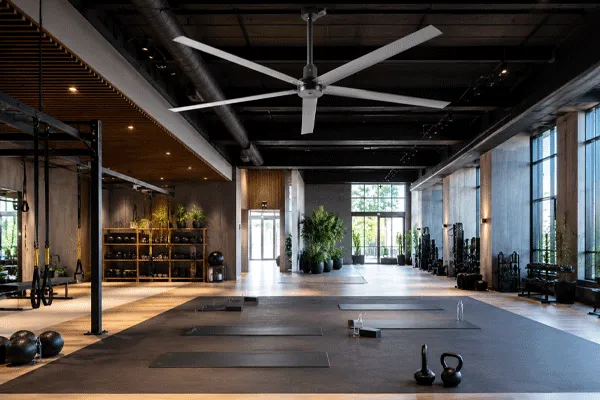
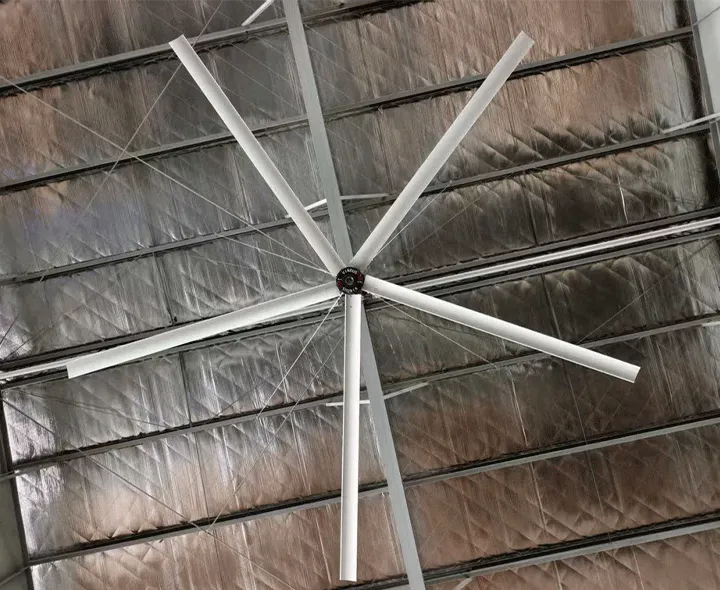
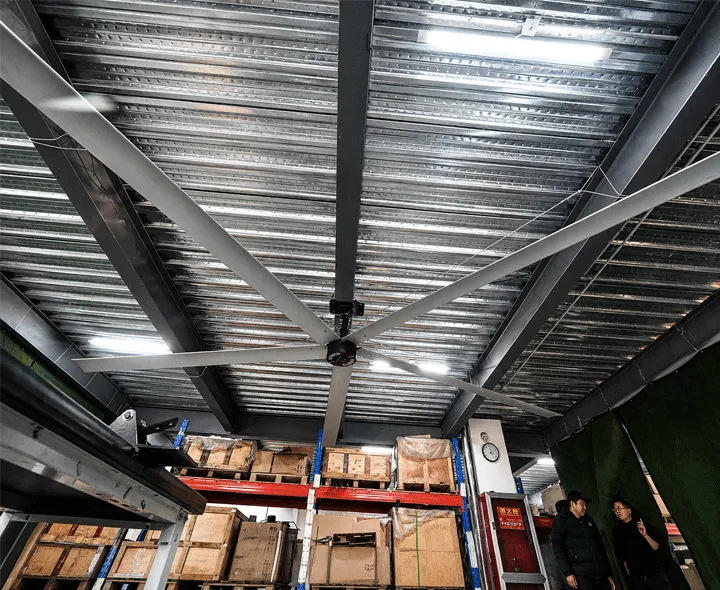
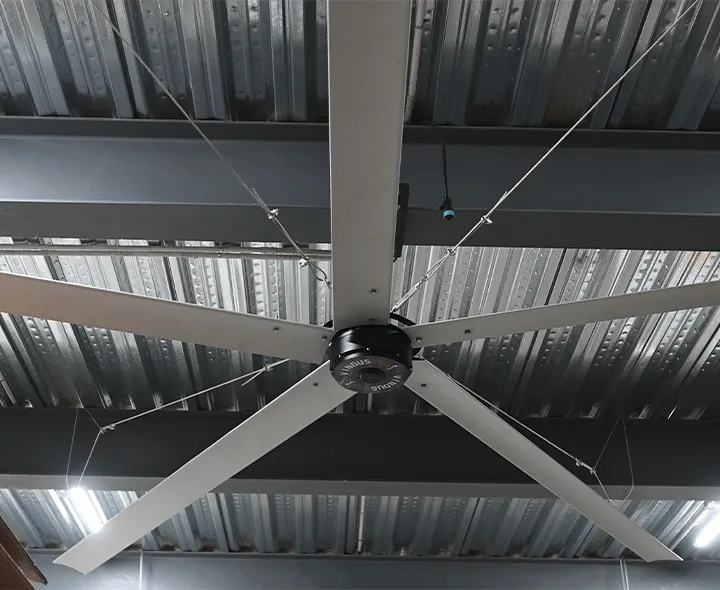
Áreas de produção quentes, ventilação insuficiente e fluxo de ar irregular podem tornar o trabalho na fábrica desconfortável e aumentar os custos operacionais. Instalar os ventiladores errados pode deslocar o calor sem resolver o problema real. Uma abordagem melhor é adequar cada equipamento de resfriamento e ventilação às necessidades de sua zona de produção.
O melhor sistema de ventiladores de refrigeração industrial para uma fábrica combina diferentes tecnologias de ventiladores de acordo com o layout do edifício e as condições de trabalho. Os ventiladores HVLS proporcionam ampla circulação de ar, os ventiladores axiais e de exaustão auxiliam na ventilação, os sopradores centrífugos lidam com o fluxo de ar em dutos e os ventiladores direcionais portáteis fornecem refrigeração direcionada.
Seleção de ventiladores de refrigeração industrial para fábricas e armazéns: adequação de sistemas HVLS, de exaustão e de sopradores a cada zona
1. Por que uma fábrica precisa de mais de um ventilador de refrigeração industrial?
Uma instalação de manufatura raramente tem um único requisito uniforme de temperatura ou fluxo de ar. Uma área de montagem pode precisar de movimentação suave de ar para os trabalhadores, enquanto uma estação de soldagem exige ventilação de exaustão local. Uma linha de embalagem pode precisar de condições ambientais estáveis, e uma área de carga pode precisar de um forte fluxo de ar direcionado.
Usar um único tipo de ventilador industrial em todo o edifício pode criar problemas. Um grande ventilador de teto pode melhorar o conforto em uma área de produção aberta, mas não consegue captar vapores diretamente de um ponto de soldagem. Da mesma forma, um ventilador de exaustão pode remover o ar quente, mas não proporciona automaticamente um fluxo de ar confortável em cada posto de trabalho.
É por isso que a refrigeração industrial deve começar pela função de cada área, e não pelo número de ventiladores necessários.
Um plano prático de refrigeração para fábricas normalmente considera quatro objetivos:
- Resfriamento geral: melhore o conforto em grandes áreas ocupadas.
- Refrigeração local: Direcionar o ar para os trabalhadores ou postos de trabalho específicos.
- Extração na fonte: Remover calor, fumaça, vapores e outros poluentes próximos à sua fonte.
- Reposição de ar: Fornecer ar de reposição adequado para equilibrar o sistema de ventilação.
Estes objetivos podem exigir diferentes sistemas de refrigeração trabalhando em conjunto.
Por exemplo, uma grande fábrica pode usar ventiladores HVLS para movimentação geral do ar, ventiladores direcionais montados na parede para postos de trabalho específicos e um sistema separado de exaustão e ar de reposição para ventilação de processos.
O resultado é uma abordagem mais organizada para o gerenciamento do ar, em vez de adicionar equipamentos sempre que os funcionários relatam que uma área está quente.
2. Como identificar as fontes de calor de uma fábrica antes de escolher um ventilador de refrigeração?
Antes de comprar um ventilador de refrigeração, identifique onde o calor entra no edifício e onde os trabalhadores sentem o maior desconforto.
As fontes comuns de calor industrial incluem:
- Fornos e estufas
- Equipamentos de soldagem e corte
- Máquinas de moldagem por injeção
- Equipamentos de processamento de metais
- Tubulações de vapor e linhas de produção aquecidas
- Compressores e equipamentos elétricos
- Calor solar que entra através de telhados e paredes
Diferentes fontes criam problemas diferentes. O calor radiante de um forno não é o mesmo que o ar quente retido próximo a um teto industrial alto. Um ventilador portátil pode ajudar um trabalhador a se sentir mais confortável, mas não removerá o calor radiante proveniente de uma superfície sem isolamento.
Uma avaliação adequada do local deve registrar a temperatura do ar, a umidade, o calor radiante, a atividade dos trabalhadores e a movimentação de ar existente. Para ambientes exigentes, uma avaliação da Temperatura de Globo de Bulbo Úmido (WBGT) pode ajudar a avaliar a exposição ao calor no local de trabalho.
Avaliação das fontes de calor da fábrica
| Área da fábrica |
Problema comum |
Abordagem recomendada |
| Linhas de montagem |
Movimentação de ar irregular |
Ventiladores HVLS e direcionais |
| Postos de soldagem |
Fumos e calor localizado |
Ventilação de exaustão local |
| Áreas de fornos |
Calor radiante e de processo |
Blindagem térmica e exaustão |
| Áreas de embalagem |
Ar quente e estagnado |
Circulação geral e ventilação |
| Docas de carregamento |
Acúmulo local de calor |
Ventiladores móveis direcionais |
| Salas elétricas |
Calor dos equipamentos |
Refrigeração e ventilação projetadas |
O ponto importante é simples: identifique a fonte de calor antes de escolher o equipamento.
Isso evita compras desnecessárias e ajuda os engenheiros a criar um plano de fluxo de ar que atenda tanto ao conforto dos trabalhadores quanto aos requisitos de produção.
3. Quando os ventiladores HVLS são a escolha certa para a refrigeração industrial?
Os ventiladores HVLS são projetados para movimentar grandes volumes de ar em amplas áreas internas a velocidades de rotação relativamente baixas.
Ao contrário de um pequeno ventilador de teto, um ventilador HVLS cria uma ampla coluna de ar que se move para baixo e se espalha pelo piso. Isso ajuda a reduzir as zonas de ar estagnado e proporciona uma movimentação de ar mais uniforme em grandes edifícios industriais.
Eles são especialmente úteis em:
- Grandes instalações de fabricação
- Fábricas de montagem automotiva
- Armazéns e centros de distribuição
- Oficinas de metalurgia
- Large maintenance garages
- Open production halls
For factories with high ceilings, warm air can collect near the roof. An appropriately selected HVLS fan can help mix this warm air with cooler air below, supporting destratification during heating seasons.
What makes an HVLS system suitable for large factories?
A large industrial ceiling fan should be evaluated according to:
- Building dimensions and ceiling height.
- Required air movement at worker level.
- Roof structure and mounting conditions.
- Production equipment and overhead obstructions.
- Motor technology and power consumption.
- Operating schedules and control requirements.
Vindus provides several HVLS product series for different building conditions. The Vindus HVLS fan product range includes P680, P730, P780, E680, and E730 models.
For a large industrial production floor, the right diameter and installation arrangement should be determined through an engineering review rather than selecting the biggest available model.
HVLS fans are particularly useful when the objective is to improve overall air circulation. They should not be treated as replacements for local exhaust or required fresh-air ventilation.
4. When Should a Factory Use an Axial Fan or Exhaust Fan?
An axial fan moves air in a relatively straight direction through the fan. Its design is suitable for applications that require air movement with relatively low static pressure.
Common applications include:
- General wall ventilation
- Roof ventilation
- Air intake and exhaust openings
- Equipment cooling
- Local air movement
- Make-up air systems
An exhaust fan serves a different purpose from an ordinary cooling fan. It removes indoor air and helps replace it with outdoor or conditioned make-up air.
This distinction is important in manufacturing facilities.
For example, a factory producing metal parts may generate heat, fumes, and airborne contaminants. A general air circulation fan can move air around the building, but it cannot safely replace a properly designed extraction hood at a pollutant source.
General ventilation vs. local exhaust
| Sistema |
Main function |
Aplicação típica |
| Ventilador axial |
Straight-through air movement |
Wall and roof ventilation |
| Ventilador de exaustão |
Remove indoor air |
General air replacement |
| Local exhaust |
Capture pollutants at source |
Welding and chemical processes |
| Ventilador HVLS |
Broad indoor air circulation |
Large production areas |
When selecting an axial fan, check airflow capacity, static pressure, duct resistance, noise, and installation conditions. A fan that delivers a high volume of air under free-air conditions may perform differently when connected to a duct or filter.
5. When Do Centrifugal Fans, Blowers, and Duct Fans Make Sense?
Some factory cooling and ventilation applications require more than free-air movement.
A duct system, filter, long pipeline, or air treatment unit creates resistance. The equipment must generate enough pressure to move the required air through that system.
This is where centrifugal fans and blowers become important.
Unlike an axial fan, a centrifugal fan uses a rotating impeller to move air outward. Its design can support higher static pressure requirements, depending on the impeller type and operating point.
Typical applications include:
- Dust collection systems
- Industrial filtration
- Fume extraction ductwork
- Process air supply
- Air handling equipment
- Material drying and cooling systems
How should you compare these fan technologies?
| Equipamento |
Movimento do ar |
Typical use |
| Ventilador axial |
Straight-through flow |
General ventilation |
| Ventiladores centrífugos |
Pressure-based airflow |
Ducts and filtration |
| Industrial blower |
Higher-pressure air delivery |
Process and pneumatic applications |
| Duct fans |
Air movement through ducts |
Ventilation networks |
| Ventilador de teto HVLS |
Broad, low-speed circulation |
Grandes espaços abertos |
When selecting equipment, pay attention to the fan curve rather than relying only on the advertised airflow.
A ventilation engineer should calculate the system resistance and confirm the required operating point. This is particularly important when the system contains filters, bends, long ducts, or capture hoods.
A blower is not automatically a better cooling fan. It is simply designed for a different airflow task.
Seleção de ventiladores de refrigeração industrial para fábricas e armazéns: adequação de sistemas HVLS, de exaustão e de sopradores a cada zona
6. Where Do Pedestal Fans, Drum Fans, Floor Fans, and Wall-Mount Units Fit?
Not every factory has enough overhead clearance for an HVLS fan in every area. Some production zones also require more focused air movement.
Portable and directional fans can help fill these gaps.
Pedestal fans are useful when operators need adjustable airflow at a workstation. They can be moved between production positions, although their floor footprint must be considered.
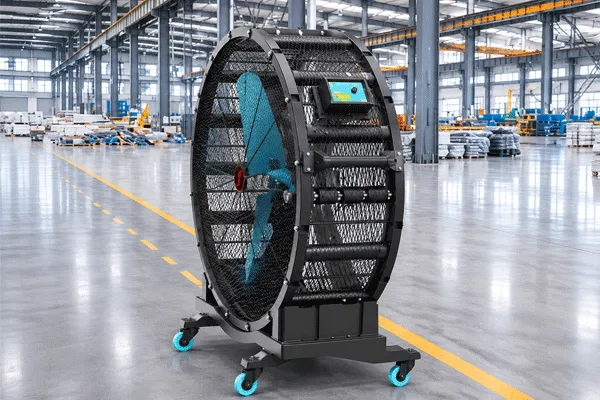
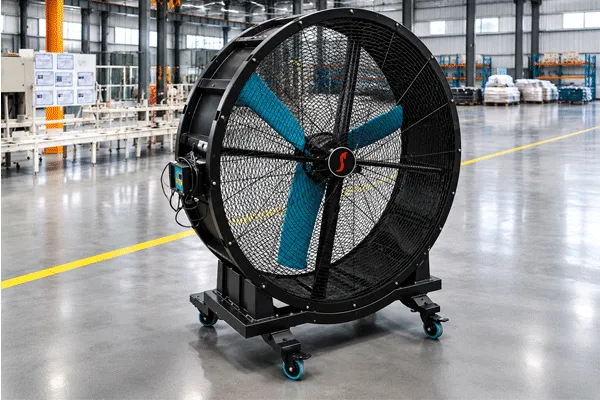
Drum fans provide concentrated airflow and are often used for temporary cooling, maintenance, and areas where flexible positioning is important.
Floor fans work well in selected low-level areas, while wall-mounted industrial fans keep equipment away from busy walkways.
Which directional fan should you choose?
| Tipo de ventilador |
Principal vantagem |
Suitable application |
| Ventilador de pedestal |
Adjustable height and direction |
Individual workstations |
| Ventilador de tambor |
Strong directional airflow |
Temporary cooling |
| Floor fan |
Portable local air movement |
Maintenance areas |
| Wall-mounted fan |
Saves floor space |
Fixed production zones |
| Mobile directional fan |
Flexible positioning |
Changing work areas |
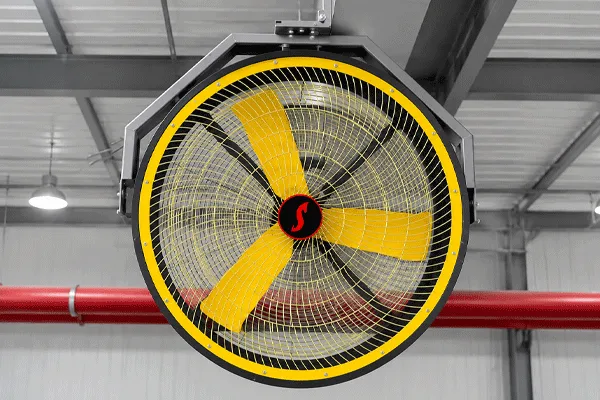
Vindus offers dedicated directional industrial fan products in addition to its HVLS range.
The C100 is a 36-inch mobile or wall-mounted industrial fan designed for targeted airflow. The C150 is a larger mobile directional model designed for higher-capacity airflow in open workspaces and loading areas.
Explore os C100 mobile or wall-mounted industrial fan e C150 large-format mobile directional fan for more product details.
These products can support an industrial cooling plan where a large ceiling fan alone cannot reach every work zone.
7. Are Evaporative Cooling Fans and Misting Fans Suitable for Every Factory?
Evaporative cooling fans use water evaporation to lower the temperature of the air. They can be useful in hot, dry environments where humidity is relatively low.
However, they are not suitable for every industrial application.
Adding moisture to indoor air can create problems in facilities that require controlled humidity, dry surfaces, or stable product conditions.
Por exemplo:
- Metal processing may require moisture control to reduce corrosion risks.
- Packaging operations may need stable humidity.
- Electrical production may require controlled environmental conditions.
- Food processing may have strict hygiene and moisture-management requirements.
Misting fans can provide localized cooling in suitable environments, but operators must evaluate water quality, humidity, floor conditions, and equipment protection.
A cooling fan should not create a new problem while trying to solve an existing one.
Before selecting evaporative cooling systems, check:
- Local outdoor temperature and humidity.
- Indoor humidity limits.
- Product sensitivity to moisture.
- Water supply and treatment requirements.
- Floor drainage and slip risks.
- Maintenance and cleaning needs.
For some industrial environments, ordinary air movement combined with properly designed ventilation is a more suitable option.
The best solution depends on the process, not just the climate.
8. How Do Ventilation, Make-Up Air, and Air Circulation Work Together?
An effective factory cooling system must consider both the air entering the building and the air leaving it.
When exhaust equipment removes indoor air, replacement air must enter through designed intake openings or a mechanical make-up air system.
If exhaust capacity greatly exceeds the available replacement air, the building may develop excessive negative pressure. This can affect doors, airflow paths, and ventilation performance.
The opposite problem can also occur. Poor exhaust capacity may allow heat, humidity, or pollutants to accumulate.
A balanced factory air management strategy
| System component |
Main responsibility |
| Fãs HVLS |
General air circulation |
| Axial supply fans |
Outdoor air delivery |
| Exaustores |
Indoor air removal |
| Local exhaust hoods |
Capture at pollutant sources |
| Make-up air units |
Replace extracted air |
| Centrifugal blowers |
Support ducted airflow |
| Climatização |
Temperature and humidity control |
The goal is to create effective air circulation without allowing contaminated air to spread into clean production zones.
For example, an industrial facility may use HVLS fans in an open assembly area while maintaining dedicated local exhaust near welding equipment.
The ventilation design should also consider air quality, production requirements, building pressure, and worker positions.
An industrial and commercial building may use similar fan technologies, but the final airflow arrangement must reflect the specific activities taking place inside.
9. How Should You Compare Industrial Cooling Systems and Operating Costs?
The lowest purchase price does not always mean the lowest long-term cost.
A poorly selected fan may consume more electricity, fail to deliver useful airflow, or require frequent repairs. A more suitable system may have a higher initial cost but provide better operating flexibility.
When comparing cooling systems, consider the following:
| Evaluation factor |
What to check |
| Initial investment |
Equipment and accessories |
| Consumo de energia |
Rated and actual operating power |
| Airflow performance |
Output at the required operating point |
| Instalação |
Structural and electrical work |
| Manutenção |
Inspection and replacement requirements |
| Controlos |
Variable-speed and automatic operation |
| Environmental suitability |
Dust, humidity, temperature, and corrosion |
| Service |
Warranty and spare parts |
A simple way to estimate annual fan electricity consumption is:
Annual Energy Consumption (kWh) = Power (kW) × Operating Hours per Day × Operating Days
For example, a 0.6 kW fan running 8 hours per day for 300 days consumes:
0.6 × 8 × 300 = 1,440 kWh per year.
This is an illustrative calculation. Actual consumption depends on operating speed, control settings, and operating conditions.
For large projects, compare the total power consumption of the proposed system rather than evaluating one fan in isolation.
Smart controls can also help match operation to production schedules. The Sistema de controle inteligente HVLS FanBrain supports centralized control, temperature-based operation, scheduling, and independent fan groups.
This allows factory managers to manage different production zones without running every fan at the same speed all day.
Seleção de ventiladores de refrigeração industrial para fábricas e armazéns: adequação de sistemas HVLS, de exaustão e de sopradores a cada zona
10. How Can You Build a Factory Cooling Fan Plan with the Right Supplier?
A successful cooling project starts with a clear understanding of the factory.
Antes de solicitar uma cotação, prepare:
- Building length, width, and height.
- Roof structure and available mounting positions.
- Production equipment and heat sources.
- Employee working areas.
- Existing exhaust and ventilation equipment.
- Required airflow and environmental conditions.
- Electrical supply and operating hours.
- Dust, moisture, and process-related requirements.
A reliable manufacturer should review these details before recommending equipment.
At Vindus, we specialize in HVLS fans, industrial ceiling fans, commercial ceiling fans, large industrial fans, and intelligent airflow control systems. As a Sino-US joint venture manufacturer and solution provider, we support global B2B customers with airflow solutions for manufacturing facilities, warehouses, logistics centers, commercial buildings, and other large spaces.
Our product portfolio includes large HVLS ceiling fans as well as mobile and wall-mounted directional fans. This makes it possible to consider both broad-area air movement and targeted cooling within one factory airflow plan.
However, applications such as local fume extraction, centrifugal filtration, and process exhaust should be coordinated with the appropriate ventilation equipment suppliers and engineering professionals.
The objective is not to install the largest number of fans. It is to select the right equipment for each zone.
Planning a new factory or upgrading an existing cooling system? Share your floor plan, ceiling height, heat sources, and ventilation requirements with our team. We can help evaluate suitable HVLS and directional fan configurations for your facility.
Visite o nosso manufacturing application page ou contact Vindus for an industrial cooling fan consultation.
Perguntas frequentes
What is the best industrial cooling fan for a factory?
It depends on the application. HVLS fans are suitable for broad air circulation in large open spaces. Axial fans support general ventilation, while centrifugal fans and blowers are used for ducted systems and higher-pressure applications. Directional fans are useful for localized cooling.
Can HVLS fans replace industrial exhaust fans?
No. HVLS fans circulate indoor air, while exhaust fans remove indoor air. They perform different functions and may work together as part of a complete ventilation plan.
What is the difference between an axial fan and a centrifugal fan?
An axial fan moves air along the direction of its shaft and is commonly used for general ventilation. A centrifugal fan moves air outward through an impeller and is suitable for systems that require higher static pressure, such as ducts and filtration.
Are evaporative cooling fans suitable for manufacturing facilities?
They can work in hot, dry environments, but their suitability depends on indoor humidity, product sensitivity, and process requirements. Moisture-sensitive manufacturing operations should evaluate the risks before installing evaporative equipment.
Can one industrial fan system cool an entire factory?
A single fan type may not meet every requirement in a complex factory. Large open areas may benefit from HVLS fans, while production stations, exhaust points, and ducted processes need their own airflow solutions.
What should I provide when requesting an industrial cooling fan quotation?
Provide building dimensions, ceiling height, production layout, heat sources, existing ventilation equipment, electrical information, and the locations where employees need additional airflow. This information helps engineers develop a more suitable proposal.
Principais conclusões
- Factory cooling should be planned according to production zones and actual airflow requirements.
- HVLS fans are suitable for broad air circulation in large open industrial spaces.
- Axial fans and exhaust fans support general ventilation and air replacement.
- Centrifugal fans and blowers are suitable for ducted systems that require static pressure.
- Pedestal fans, drum fans, floor fans, and wall-mounted units provide localized airflow.
- Evaporative cooling and misting fans require careful evaluation of humidity and process conditions.
- Make-up air, exhaust capacity, and indoor air circulation should be considered together.
- Compare industrial fan systems using actual airflow, power consumption, installation requirements, and maintenance costs.
- Choose a supplier that understands factory conditions and can provide appropriate engineering support.
Looking for a practical industrial cooling fan solution for your factory? Contact Vindus Fans to discuss your production layout, airflow requirements, and suitable fan configurations.