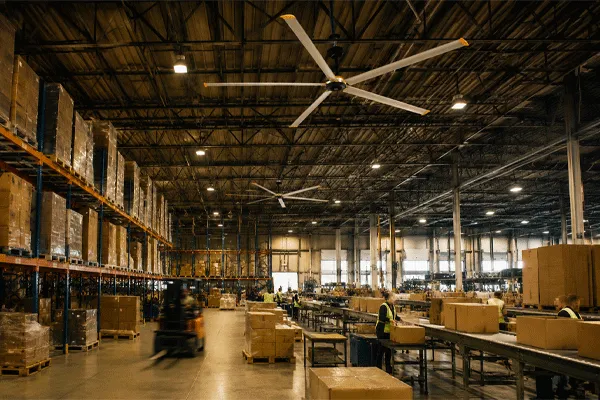
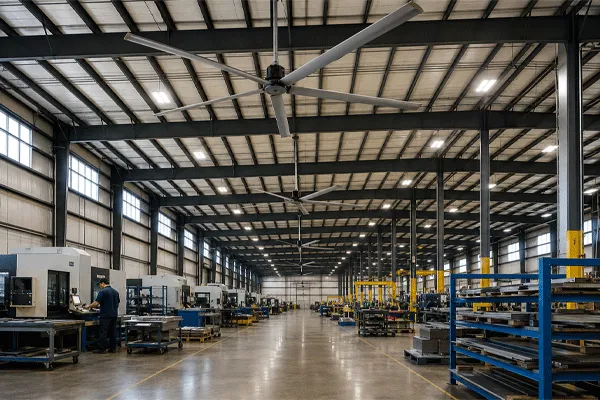
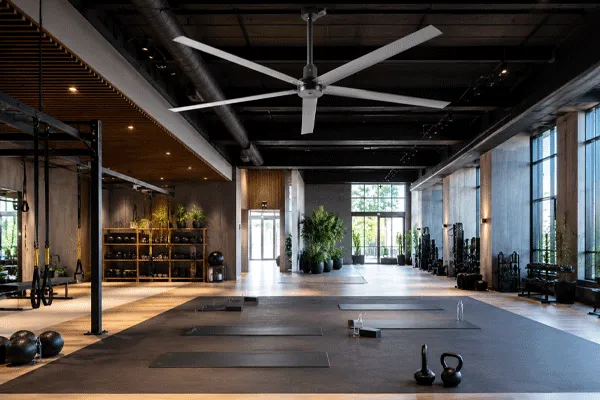
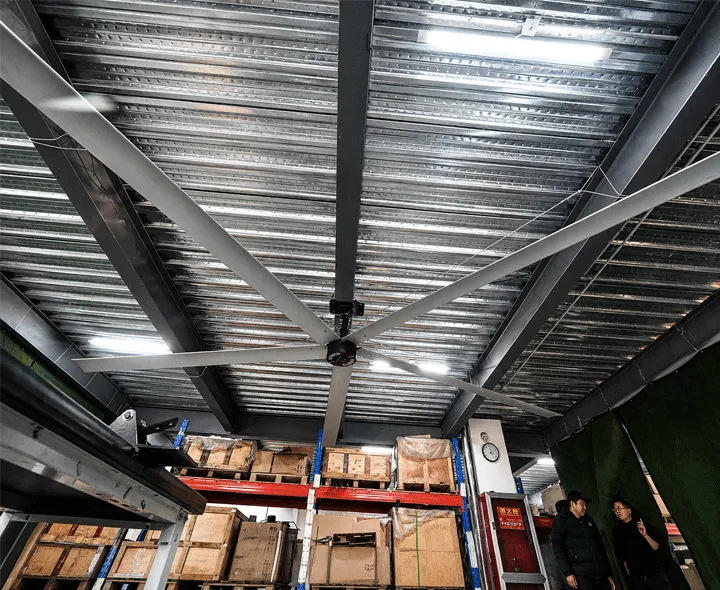
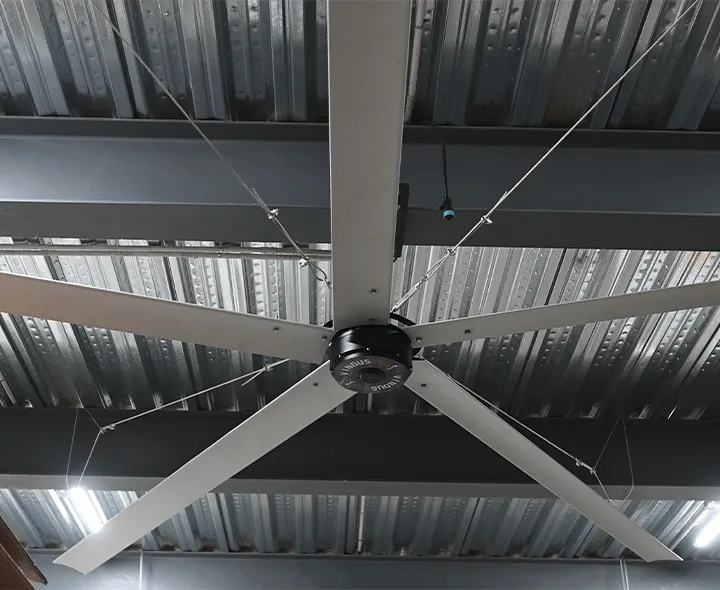
Aree di produzione calde, ventilazione insufficiente e flusso d'aria non uniforme possono rendere il lavoro in fabbrica scomodo e aumentare i costi operativi. L'installazione di ventilatori sbagliati può spostare il calore senza risolvere il vero problema. Un approccio migliore consiste nell'abbinare ciascun dispositivo di raffreddamento e ventilazione alle esigenze della propria zona di produzione.
The best industrial cooling fan system for a factory combines different fan technologies according to the building layout and working conditions. HVLS fans provide broad air circulation, axial and exhaust fans support ventilation, centrifugal blowers handle ducted airflow, and portable directional fans provide targeted cooling.
Scelta dei ventilatori industriali di raffrescamento per fabbriche e magazzini: abbinare sistemi HVLS, estrattori e soffianti a ciascuna zona
1. Perché una fabbrica ha bisogno di più di un ventilatore industriale di raffreddamento?
Uno stabilimento produttivo raramente presenta un unico requisito uniforme di temperatura o flusso d'aria. Un'area di assemblaggio può necessitare di un leggero movimento dell'aria per i lavoratori, mentre una postazione di saldatura richiede una ventilazione di aspirazione localizzata. Una linea di confezionamento può necessitare di condizioni ambientali stabili e un'area di carico può richiedere un forte flusso d'aria direzionale.
Using one industrial fan type throughout the building can create problems. A large ceiling fan may improve comfort across an open production floor, but it cannot capture fumes directly from a welding point. Similarly, an exhaust fan can remove hot air, but it does not automatically provide comfortable airflow at every workstation.
Ecco perché il raffrescamento industriale dovrebbe partire dalla funzione di ciascuna area anziché dal numero di ventilatori necessari.
Un piano pratico di raffrescamento per la fabbrica considera normalmente quattro obiettivi:
- Raffrescamento generale: migliorare il comfort in ampie aree occupate.
- Local cooling: Direct air toward workers or specific workstations.
- Aspirazione alla fonte: rimuovere calore, fumo, esalazioni e altri inquinanti in prossimità della loro sorgente.
- Reintegro dell'aria: fornire un'adeguata aria di compensazione per bilanciare il sistema di ventilazione.
Questi obiettivi possono richiedere diversi sistemi di raffreddamento che lavorano insieme.
Ad esempio, una grande fabbrica può utilizzare ventilatori HVLS per il movimento generale dell'aria, ventilatori direzionali montati a parete per specifiche postazioni di lavoro e un sistema separato di estrazione e aria di reintegro per la ventilazione di processo.
Il risultato è un approccio più organizzato alla gestione dell'aria, anziché aggiungere apparecchiature ogni volta che i dipendenti segnalano che un'area risulta calda.
2. Come identificare le fonti di calore in fabbrica prima di scegliere un ventilatore di raffrescamento?
Prima di acquistare un ventilatore di raffrescamento, individua dove il calore penetra nell'edificio e dove i lavoratori avvertono il maggior disagio.
Le fonti di calore industriali più comuni includono:
- Fornaci e forni
- Attrezzature per saldatura e taglio
- Macchine per lo stampaggio a iniezione
- Apparecchiature per la lavorazione dei metalli
- Tubazioni del vapore e linee di produzione riscaldate
- Compressori e apparecchiature elettriche
- Calore solare che penetra attraverso tetti e pareti
Different sources create different problems. Radiant heat from a furnace is not the same as warm air trapped near a high industrial ceiling. A portable fan may help a worker feel more comfortable, but it will not remove the radiant heat coming from an uninsulated surface.
Una corretta valutazione del sito dovrebbe registrare la temperatura dell'aria, l'umidità, il calore radiante, l'attività dei lavoratori e il movimento dell'aria esistente. Per gli ambienti impegnativi, una valutazione della temperatura a bulbo umido e a globo (WBGT) può aiutare a valutare l'esposizione al calore sul luogo di lavoro.
Valutazione delle fonti di calore nella fabbrica
| Area della fabbrica |
Problema comune |
Approccio consigliato |
| Linee di montaggio |
Movimento dell'aria non uniforme |
Ventilatori HVLS e direzionali |
| Postazioni di saldatura |
Fumes and localized heat |
Ventilazione di aspirazione localizzata |
| Aree dei forni |
Calore radiante e di processo |
Schermatura dal calore ed estrazione |
| Aree di imballaggio |
Aria calda e stagnante |
General circulation and ventilation |
| Loading docks |
Accumulo di calore localizzato |
Mobile directional fans |
| Locali elettrici |
Calore delle apparecchiature |
Raffrescamento e ventilazione ingegnerizzati |
The important point is simple: identify the heat source before choosing the equipment.
Ciò evita acquisti superflui e aiuta gli ingegneri a definire un piano dei flussi d'aria che supporti sia il comfort dei lavoratori sia le esigenze produttive.
3. Quando i ventilatori HVLS sono la scelta giusta per il raffrescamento industriale?
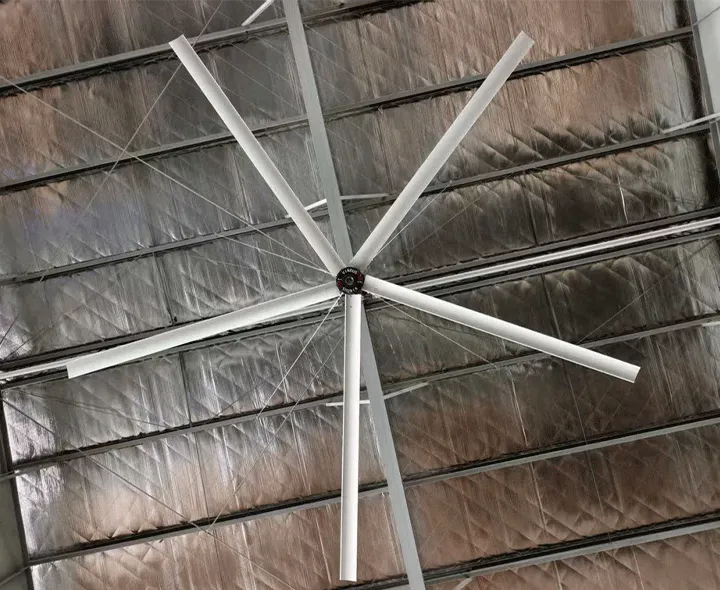
I ventilatori HVLS sono progettati per spostare grandi volumi d'aria in ampi ambienti interni a velocità di rotazione relativamente basse.
Unlike a small ceiling fan, an HVLS fan creates a wide column of air that moves downward and spreads across the floor. This helps reduce stagnant zones and provides more consistent air movement throughout large industrial buildings.
They are especially useful in:
- Large manufacturing facilities
- Stabilimenti di assemblaggio automobilistico
- Magazzini e centri di distribuzione
- Officine metalmeccaniche
- Grandi officine di manutenzione
- Capannoni di produzione a pianta aperta
Negli stabilimenti con soffitti alti, l'aria calda può accumularsi vicino al tetto. Un ventilatore HVLS opportunamente selezionato può contribuire a mescolare quest'aria calda con l'aria più fresca sottostante, favorendo la destratificazione durante le stagioni di riscaldamento.
What makes an HVLS system suitable for large factories?
Un grande ventilatore industriale a soffitto deve essere valutato in base a:
- Dimensioni dell'edificio e altezza del soffitto.
- Movimento dell'aria richiesto a livello dei lavoratori.
- Roof structure and mounting conditions.
- Apparecchiature di produzione e ostacoli sospesi.
- Tecnologia del motore e consumo energetico.
- Orari di funzionamento e requisiti di controllo.
Vindus offre diverse serie di prodotti HVLS per differenti condizioni degli edifici. La Vindus HVLS fan product range include i modelli P680, P730, P780, E680 ed E730.
Per un ampio reparto di produzione industriale, il diametro corretto e la disposizione di installazione dovrebbero essere determinati tramite una valutazione ingegneristica, anziché scegliere il modello più grande disponibile.
I ventilatori HVLS sono particolarmente utili quando l'obiettivo è migliorare la circolazione generale dell'aria. Non devono essere considerati sostituti dell'aspirazione localizzata o della ventilazione richiesta di aria fresca.
4. Quando uno stabilimento dovrebbe utilizzare un ventilatore assiale o un estrattore d'aria?
Un ventilatore assiale sposta l'aria in direzione relativamente rettilinea attraverso il ventilatore stesso. La sua struttura è adatta ad applicazioni che richiedono la movimentazione dell'aria con una pressione statica relativamente bassa.
Common applications include:
- General wall ventilation
- Roof ventilation
- Air intake and exhaust openings
- Equipment cooling
- Local air movement
- Make-up air systems
An exhaust fan serves a different purpose from an ordinary cooling fan. It removes indoor air and helps replace it with outdoor or conditioned make-up air.
This distinction is important in manufacturing facilities.
For example, a factory producing metal parts may generate heat, fumes, and airborne contaminants. A general air circulation fan can move air around the building, but it cannot safely replace a properly designed extraction hood at a pollutant source.
General ventilation vs. local exhaust
| System |
Main function |
Applicazione tipica |
| Ventilatore assiale |
Straight-through air movement |
Wall and roof ventilation |
| Exhaust fan |
Remove indoor air |
General air replacement |
| Local exhaust |
Capture pollutants at source |
Welding and chemical processes |
| Ventilatore HVLS |
Broad indoor air circulation |
Large production areas |
When selecting an axial fan, check airflow capacity, static pressure, duct resistance, noise, and installation conditions. A fan that delivers a high volume of air under free-air conditions may perform differently when connected to a duct or filter.
5. When Do Centrifugal Fans, Blowers, and Duct Fans Make Sense?
Some factory cooling and ventilation applications require more than free-air movement.
A duct system, filter, long pipeline, or air treatment unit creates resistance. The equipment must generate enough pressure to move the required air through that system.
This is where centrifugal fans and blowers become important.
Unlike an axial fan, a centrifugal fan uses a rotating impeller to move air outward. Its design can support higher static pressure requirements, depending on the impeller type and operating point.
Typical applications include:
- Dust collection systems
- Industrial filtration
- Fume extraction ductwork
- Process air supply
- Air handling equipment
- Material drying and cooling systems
How should you compare these fan technologies?
| Attrezzatura |
Movimento dell'aria |
Typical use |
| Ventilatore assiale |
Straight-through flow |
General ventilation |
| Ventilatori centrifughi |
Pressure-based airflow |
Ducts and filtration |
| Soffiante industriale |
Higher-pressure air delivery |
Process and pneumatic applications |
| Ventilatori da condotto |
Air movement through ducts |
Ventilation networks |
| Ventilatore da soffitto HVLS |
Broad, low-speed circulation |
I grandi spazi aperti |
When selecting equipment, pay attention to the fan curve rather than relying only on the advertised airflow.
A ventilation engineer should calculate the system resistance and confirm the required operating point. This is particularly important when the system contains filters, bends, long ducts, or capture hoods.
A blower is not automatically a better cooling fan. It is simply designed for a different airflow task.
Scelta dei ventilatori industriali di raffrescamento per fabbriche e magazzini: abbinare sistemi HVLS, estrattori e soffianti a ciascuna zona
6. Where Do Pedestal Fans, Drum Fans, Floor Fans, and Wall-Mount Units Fit?
Not every factory has enough overhead clearance for an HVLS fan in every area. Some production zones also require more focused air movement.
Portable and directional fans can help fill these gaps.
Pedestal fans are useful when operators need adjustable airflow at a workstation. They can be moved between production positions, although their floor footprint must be considered.
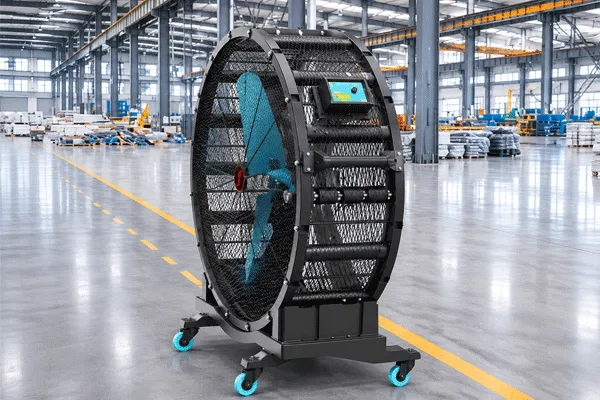
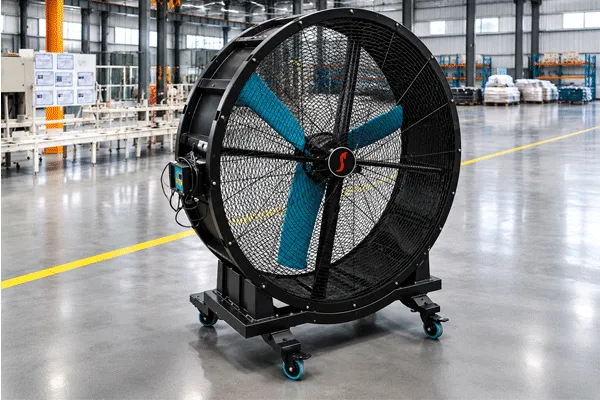
Drum fans provide concentrated airflow and are often used for temporary cooling, maintenance, and areas where flexible positioning is important.
Floor fans work well in selected low-level areas, while wall-mounted industrial fans keep equipment away from busy walkways.
Which directional fan should you choose?
| Tipo di ventilatore |
Vantaggio principale |
Suitable application |
| Ventilatore a piantana |
Adjustable height and direction |
Individual workstations |
| Ventilatore a tamburo |
Forte flusso d'aria direzionale |
Temporary cooling |
| Floor fan |
Portable local air movement |
Maintenance areas |
| Wall-mounted fan |
Saves floor space |
Fixed production zones |
| Mobile directional fan |
Flexible positioning |
Changing work areas |
Vindus offers dedicated directional industrial fan products in addition to its HVLS range.
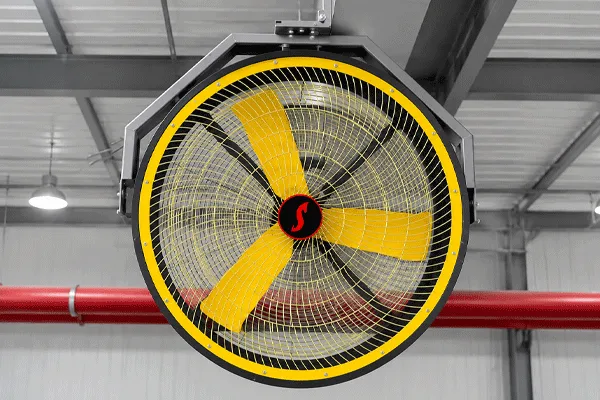
The C100 is a 36-inch mobile or wall-mounted industrial fan designed for targeted airflow. The C150 is a larger mobile directional model designed for higher-capacity airflow in open workspaces and loading areas.
Esplora il C100 mobile or wall-mounted industrial fan E C150 large-format mobile directional fan for more product details.
These products can support an industrial cooling plan where a large ceiling fan alone cannot reach every work zone.
7. Are Evaporative Cooling Fans and Misting Fans Suitable for Every Factory?
Evaporative cooling fans use water evaporation to lower the temperature of the air. They can be useful in hot, dry environments where humidity is relatively low.
However, they are not suitable for every industrial application.
Adding moisture to indoor air can create problems in facilities that require controlled humidity, dry surfaces, or stable product conditions.
For example:
- Metal processing may require moisture control to reduce corrosion risks.
- Packaging operations may need stable humidity.
- Electrical production may require controlled environmental conditions.
- Food processing may have strict hygiene and moisture-management requirements.
Misting fans can provide localized cooling in suitable environments, but operators must evaluate water quality, humidity, floor conditions, and equipment protection.
A cooling fan should not create a new problem while trying to solve an existing one.
Before selecting evaporative cooling systems, check:
- Local outdoor temperature and humidity.
- Indoor humidity limits.
- Product sensitivity to moisture.
- Water supply and treatment requirements.
- Floor drainage and slip risks.
- Maintenance and cleaning needs.
For some industrial environments, ordinary air movement combined with properly designed ventilation is a more suitable option.
The best solution depends on the process, not just the climate.
8. How Do Ventilation, Make-Up Air, and Air Circulation Work Together?
An effective factory cooling system must consider both the air entering the building and the air leaving it.
When exhaust equipment removes indoor air, replacement air must enter through designed intake openings or a mechanical make-up air system.
If exhaust capacity greatly exceeds the available replacement air, the building may develop excessive negative pressure. This can affect doors, airflow paths, and ventilation performance.
The opposite problem can also occur. Poor exhaust capacity may allow heat, humidity, or pollutants to accumulate.
A balanced factory air management strategy
| System component |
Main responsibility |
| Ventilatori HVLS |
General air circulation |
| Axial supply fans |
Outdoor air delivery |
| Ventilatori di scarico |
Indoor air removal |
| Local exhaust hoods |
Capture at pollutant sources |
| Make-up air units |
Replace extracted air |
| Centrifugal blowers |
Support ducted airflow |
| Riscaldamento, ventilazione e condizionamento (HVAC) |
Temperature and humidity control |
The goal is to create effective air circulation without allowing contaminated air to spread into clean production zones.
For example, an industrial facility may use HVLS fans in an open assembly area while maintaining dedicated local exhaust near welding equipment.
The ventilation design should also consider air quality, production requirements, building pressure, and worker positions.
An industrial and commercial building may use similar fan technologies, but the final airflow arrangement must reflect the specific activities taking place inside.
9. How Should You Compare Industrial Cooling Systems and Operating Costs?
The lowest purchase price does not always mean the lowest long-term cost.
A poorly selected fan may consume more electricity, fail to deliver useful airflow, or require frequent repairs. A more suitable system may have a higher initial cost but provide better operating flexibility.
When comparing cooling systems, consider the following:
| Evaluation factor |
What to check |
| Initial investment |
Equipment and accessories |
| Consumo energetico |
Rated and actual operating power |
| Airflow performance |
Output at the required operating point |
| Installazione |
Structural and electrical work |
| Manutenzione |
Inspection and replacement requirements |
| Controlli |
Variable-speed and automatic operation |
| Environmental suitability |
Dust, humidity, temperature, and corrosion |
| Manutenzione |
Warranty and spare parts |
A simple way to estimate annual fan electricity consumption is:
Annual Energy Consumption (kWh) = Power (kW) × Operating Hours per Day × Operating Days
For example, a 0.6 kW fan running 8 hours per day for 300 days consumes:
0.6 × 8 × 300 = 1,440 kWh per year.
This is an illustrative calculation. Actual consumption depends on operating speed, control settings, and operating conditions.
For large projects, compare the total power consumption of the proposed system rather than evaluating one fan in isolation.
Smart controls can also help match operation to production schedules. The Sistema di controllo intelligente HVLS FanBrain supports centralized control, temperature-based operation, scheduling, and independent fan groups.
This allows factory managers to manage different production zones without running every fan at the same speed all day.
Scelta dei ventilatori industriali di raffrescamento per fabbriche e magazzini: abbinare sistemi HVLS, estrattori e soffianti a ciascuna zona
10. How Can You Build a Factory Cooling Fan Plan with the Right Supplier?
A successful cooling project starts with a clear understanding of the factory.
Before requesting a quotation, prepare:
- Building length, width, and height.
- Roof structure and available mounting positions.
- Production equipment and heat sources.
- Employee working areas.
- Existing exhaust and ventilation equipment.
- Required airflow and environmental conditions.
- Electrical supply and operating hours.
- Dust, moisture, and process-related requirements.
A reliable manufacturer should review these details before recommending equipment.
At Vindus, we specialize in HVLS fans, industrial ceiling fans, commercial ceiling fans, large industrial fans, and intelligent airflow control systems. As a Sino-US joint venture manufacturer and solution provider, we support global B2B customers with airflow solutions for manufacturing facilities, warehouses, logistics centers, commercial buildings, and other large spaces.
Our product portfolio includes large HVLS ceiling fans as well as mobile and wall-mounted directional fans. This makes it possible to consider both broad-area air movement and targeted cooling within one factory airflow plan.
However, applications such as local fume extraction, centrifugal filtration, and process exhaust should be coordinated with the appropriate ventilation equipment suppliers and engineering professionals.
The objective is not to install the largest number of fans. It is to select the right equipment for each zone.
Planning a new factory or upgrading an existing cooling system? Share your floor plan, ceiling height, heat sources, and ventilation requirements with our team. We can help evaluate suitable HVLS and directional fan configurations for your facility.
Visitate il nostro manufacturing application page O contact Vindus for an industrial cooling fan consultation.
Domande frequenti
What is the best industrial cooling fan for a factory?
It depends on the application. HVLS fans are suitable for broad air circulation in large open spaces. Axial fans support general ventilation, while centrifugal fans and blowers are used for ducted systems and higher-pressure applications. Directional fans are useful for localized cooling.
Can HVLS fans replace industrial exhaust fans?
No. HVLS fans circulate indoor air, while exhaust fans remove indoor air. They perform different functions and may work together as part of a complete ventilation plan.
What is the difference between an axial fan and a centrifugal fan?
An axial fan moves air along the direction of its shaft and is commonly used for general ventilation. A centrifugal fan moves air outward through an impeller and is suitable for systems that require higher static pressure, such as ducts and filtration.
Are evaporative cooling fans suitable for manufacturing facilities?
They can work in hot, dry environments, but their suitability depends on indoor humidity, product sensitivity, and process requirements. Moisture-sensitive manufacturing operations should evaluate the risks before installing evaporative equipment.
Can one industrial fan system cool an entire factory?
A single fan type may not meet every requirement in a complex factory. Large open areas may benefit from HVLS fans, while production stations, exhaust points, and ducted processes need their own airflow solutions.
What should I provide when requesting an industrial cooling fan quotation?
Provide building dimensions, ceiling height, production layout, heat sources, existing ventilation equipment, electrical information, and the locations where employees need additional airflow. This information helps engineers develop a more suitable proposal.
Punti chiave
- Factory cooling should be planned according to production zones and actual airflow requirements.
- HVLS fans are suitable for broad air circulation in large open industrial spaces.
- Axial fans and exhaust fans support general ventilation and air replacement.
- Centrifugal fans and blowers are suitable for ducted systems that require static pressure.
- Pedestal fans, drum fans, floor fans, and wall-mounted units provide localized airflow.
- Evaporative cooling and misting fans require careful evaluation of humidity and process conditions.
- Make-up air, exhaust capacity, and indoor air circulation should be considered together.
- Compare industrial fan systems using actual airflow, power consumption, installation requirements, and maintenance costs.
- Choose a supplier that understands factory conditions and can provide appropriate engineering support.
Looking for a practical industrial cooling fan solution for your factory? Contact Vindus Fans to discuss your production layout, airflow requirements, and suitable fan configurations.