Michael Danielsson | CEO, Vindus Fans | Published/Updated: August 21, 2026
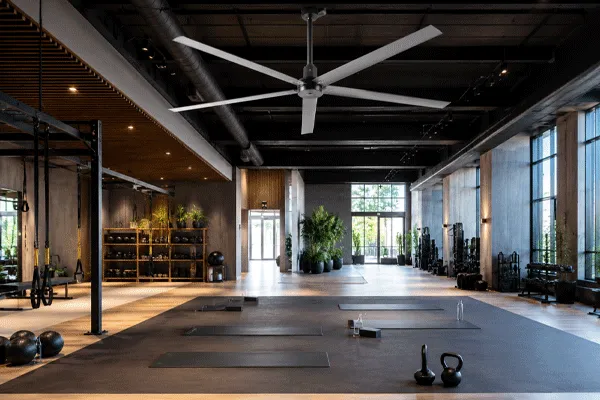
HVLS fans cool gyms, fitness centers and sports venues by moving large volumes of air slowly across the floor at low noise levels. In facilities with 20 to 33 ft ceilings, 16 ft and 18 ft fans cover courts and training floors while running quietly enough for classes and spectator events.
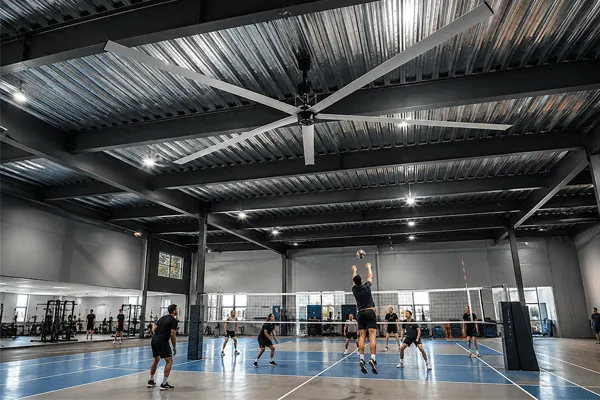
HVLS Fans for Gyms, Fitness Centers and Sports Venues
Why a gym is not just another large space
In a warehouse, nobody looks up. Air movement either reaches the pick face or it does not, and the fan is a piece of infrastructure that succeeds by being ignored.
A fitness facility inverts almost every assumption in that sentence. Members are directly beneath the fan, often lying on a mat looking straight at it. They are stationary for long periods in some zones and moving hard in others. Occupancy swings from six people at 10am to two hundred at 6pm, then to a full spectator crowd on a Saturday. And the acoustic floor is far lower than industrial: a fan that disappears into a warehouse’s background noise becomes the loudest object in a room where an instructor is trying to be heard over a playlist.
Those four conditions — proximity, variable exertion, swinging occupancy, low acoustic tolerance — are what should drive the specification. Coverage area matters, but it is not the hard part here.
The zones behave differently
Treating a fitness facility as one open volume is the most common specification error in this category. A single floor typically contains four or five environments with incompatible requirements.
| Zone |
What occupants are doing |
Air movement requirement |
Constraint that governs |
| Cardio floor |
Sustained high exertion, stationary |
Highest sustained air movement in the building |
Members will ask for more, not less |
| Free weights and strength |
Intermittent exertion, frequent rest periods |
Moderate, steady |
Draft on a sweating body between sets reads as cold |
| Studio / group fitness |
Varies extremely by class type |
Must swing from near-still to high within the same room |
Instructor audibility during low-intensity segments |
| Court / competition floor |
Play, plus stationary spectators at the perimeter |
Moderate on court, low at seating |
Ball flight in badminton, table tennis, volleyball |
| Mezzanine and stretch areas |
Low exertion, often lying down |
Basso |
Direct downdraft on a resting body |
The pattern is that the cardio floor and the studio want opposite things at 7am, and the same thing at 6pm. Independent zone control is not a premium feature in this building type, it is the thing that makes a single system serve both.
Ball sports deserve a specific warning. Shuttlecocks are affected by air movement that occupants cannot feel at all. Any facility hosting badminton, and to a lesser degree table tennis and indoor volleyball, needs the ability to reduce or stop fans over the playing surface during competition while keeping them running elsewhere. Design this in from the start; retrofitting zone separation after the complaints start is expensive.
The quiet requirement, stated properly
“Quiet” is the most-claimed and least-evidenced property in this category, so it is worth being precise about what can and cannot be said.
Sound levels are not published per Vindus model. A decibel figure without its measurement distance, height and speed setting is not comparable between suppliers, and publishing a headline number invites exactly that false comparison. What can be stated is where the noise in a large fan comes from, and which of those sources a given design removes.
A large fan produces sound from three places: the motor, the aerodynamics of the blades passing through air, and — in gearbox-driven designs — the mesh of the reduction gearset. The P730 Series uses a permanent magnet synchronous motor with direct drive, which removes the third source entirely. Low tip speed keeps the second one down; that is inherent to the category, and it is why a 16 ft fan turning slowly is quieter than a small fan moving comparable air.
For a gym specification, the useful question is not peak sound at maximum speed. It is behaviour at the low and middle of the range, because that is where the fan will spend most of its operating hours. Ask any supplier for measured figures at the speeds you will actually run, at occupant head height, and require the measurement conditions in writing. AMCA 230-15 and ANSI/ASHRAE 216P are the standards that make performance figures comparable; Vindus product performance follows both.
One more acoustic point that gets missed: gear oil eventually degrades, and a gearbox that has gone quiet-then-noisy is a mid-season service call in a building full of members. Removing the gearbox removes that failure mode along with the noise source.
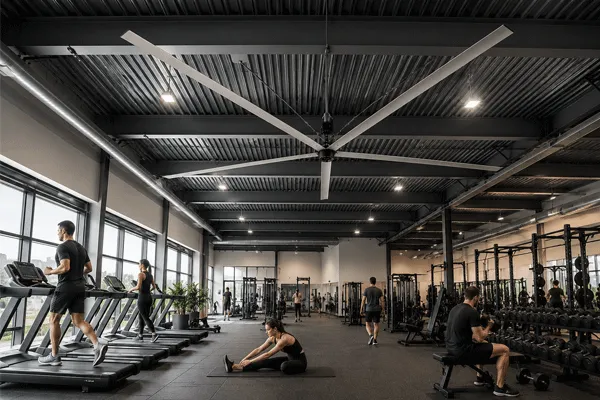
HVLS Fans for Gyms, Fitness Centers and Sports Venues
P730 Series specifications
The P730 is the Vindus series matched to typical gym, studio and sports hall ceiling heights.
| Specification |
P730 Series |
| Diametro |
16 ft and 18 ft |
| Ceiling height range |
20–33 ft |
| Tipo di motore |
PMSM (permanent magnet synchronous) |
| Power draw at maximum speed |
Under 1,000 W |
| Drive |
Direct drive, no gearbox |
| Operator interface |
Floor-level integrated HMI |
| Cabling |
Single ceiling-to-floor cable |
| Controllare |
FanBrain™ control with integrated VFD; BAS integration and multi-unit centralised control supported |
| Rated CFM |
Not published per model; issued during quotation under AMCA 230-15 / ANSI/ASHRAE 216P |
| Sound level (dB) |
Not published per model |
| Ingress protection rating |
Not published per model |
| Safety compliance |
CE, CB, EN, IEC |
Four things on this table matter more in a gym than they would elsewhere.
The floor-level HMI. In a facility where the right fan speed changes between a 6am spin class and a 2pm quiet period, control at height means control that never gets used. A duty manager will adjust a floor-level interface; nobody books a lift to change a setting.
Multi-unit centralised control with zoning. This is what lets the court group run independently of the cardio group. Specify the zone map at design stage, not after installation.
Under 1,000 W at maximum speed. Fitness facilities run long hours, and the fans in them run far more annual hours than in a single-shift industrial building. The power figure compounds accordingly.
16 ft versus 18 ft. Both sit in the same 20–33 ft height band and share drive, control and cabling. The 18 ft covers more floor per unit and suits open sports halls; the 16 ft gives more placement flexibility in facilities cut up by mezzanines, rigs and studio walls. Where a mezzanine overhangs the main floor, the height under it usually falls outside this series entirely and needs a smaller one.
What direct drive changes over a decade of operation
Against the gearbox-driven fans still commonly sold into this category, the differences show up in facilities operations rather than in the airflow spec.
| Ownership item |
Direct drive (PMSM) |
Gearbox-driven |
| Scheduled tasks |
Fastener torque check, blade and hub inspection |
The same, plus gear oil change and seal inspection |
| Consumables to stock |
None |
Gear oil, seals |
| Service visits requiring lift access |
Inspection only |
Inspection plus oil service |
| Service disruption to members |
Inspection window only |
Additional closures for oil service |
| Risk below the unit |
None from the drivetrain |
Oil seepage onto a training floor or mat |
| Noise sources to diagnose |
Motor, aerodynamic |
Motor, aerodynamic, gear mesh |
| Mass at the mounting point |
Lower for equivalent diameter |
Higher for equivalent diameter |
The seepage row reads as a housekeeping detail until you picture where it lands. Oil on a rubber gym floor is a slip hazard on a surface people run and lift on, and it arrives without warning during opening hours.
I led development of direct drive HVLS models at MacroAir before the approach was common in this category. The reasoning was ownership-side then and applies unusually well here: a facility that cannot close for maintenance benefits disproportionately from equipment with fewer scheduled interventions.
Working around what is already on the ceiling
Gym ceilings are crowded, and the obstruction map is what determines fan positions.
- Measure clear height to the lowest structural obstruction, not to the roof deck. In sports halls this is frequently a truss or a lighting run, not the structure itself.
- Map the rigging.Basketball hoop hoists, climbing walls, batting cage tracks, gymnastic rigs, retractable seating, AV trusses and speaker clusters. Anything that moves needs its swept path marked, not just its parked position.
- Locate lighting.Fans mounted near light fixtures can produce a strobing shadow effect on the floor below, which is unpleasant and occasionally worse than unpleasant for members with light sensitivity. Offset fan positions from fixtures rather than centring both on the same grid.
- Note the sprinkler layout.Clearance to heads and any required interlock are determined by the authority having jurisdiction and your fire protection design. Settle this before mounting positions are fixed.
- Mark the acoustic-sensitive positions.Where the instructor stands, where the PA speakers point, where a microphone is used.
- Identify the humid zones.Pool halls, adjacent wet areas and shower corridors have different material and ingress requirements from a dry training floor.
- Confirm structural capacity in writing.A structural engineer’s determination of static, dynamic and torsional load at the mounting point, obtained before hardware is ordered.
Step 3 is the one nobody anticipates and everybody notices afterwards.
Edge cases and misreadings
Expecting temperature reduction. HVLS fans do not lower air temperature. They produce convective and evaporative cooling on skin, which is why they work well on people who are sweating, and they mix stratified air. In an empty studio at 9pm, they cool nothing.
Humid facilities and pool halls. High humidity reduces evaporative cooling effectiveness, so the perceived benefit is smaller than on a dry training floor. These environments also need material and ingress specification against the actual exposure. Since per-model IP ratings are not published, confirm suitability during quotation rather than assuming.
Two large fans placed too close. Overlapping columns interfere and produce a turbulent zone delivering less useful floor-level movement than either fan alone. In a sports hall, symmetry is visually tempting and aerodynamically wrong.
Fighting the HVAC. If diffusers were positioned assuming still air, adding large-scale circulation changes their throw. In facilities where the HVAC was designed around a specific supply pattern, coordinate the two rather than treating the fans as an independent project.
Mirrors and visual comfort. Studio walls are frequently mirrored, and a fan reflected in a mirror directly in a participant’s sightline during floor work is a distraction that surfaces in member feedback rather than in commissioning.
Ceilings under 20 ft. Below the P730 range, mezzanine undersides and lower studio ceilings need a different series, and below roughly 10 ft the category stops working at all because the air column has no distance to develop.
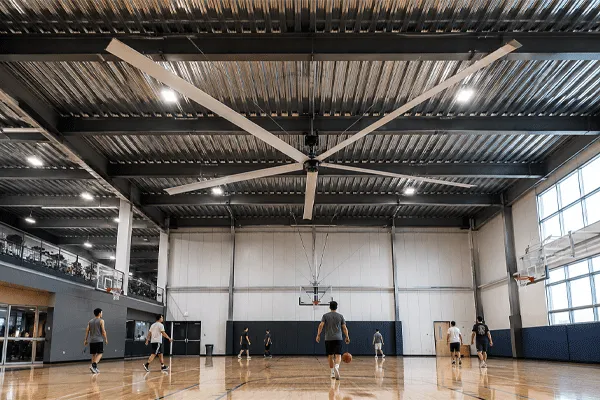
HVLS Fans for Gyms, Fitness Centers and Sports Venues
Where the case is weaker
Straight about the limits:
- In facilities with a genuine cooling load, HVLS reduces and extends mechanical cooling rather than replacing it. A crowded studio in a humid August still needs cooling capacity.
- They do not improve air quality. If the underlying complaint is stale air, odour or inadequate fresh air supply, circulation distributes it more evenly and does not fix it.
- Installation needs lift equipment and area closure. In a facility that trades seven days a week this becomes out-of-hours labour, which is often the largest single line item people fail to budget.
- Structural capacity has to exist. Sports halls with long-span roofs sometimes need supplementary steel, and that cost belongs in the budget from the first conversation rather than the third.
- Payback depends on your climate, tariff, opening hours and existing plant. Any supplier quoting a universal figure calculated it for a different building.
Domande frequenti
Q: Will members hear the fans during a quiet class?
A: The relevant question is behaviour at the low and middle of the speed range rather than at maximum, since that is where the fans will run during low-intensity sessions. Structurally, direct drive removes gear mesh as a noise source and low tip speed keeps aerodynamic noise down, but a number is only meaningful with its measurement conditions attached. Ask for measured figures at your intended operating speeds and at occupant head height, and specify those conditions when you request them.
Q: Can the fans over the court run separately from the ones over the gym floor?
A: Yes, and in most fitness facilities they should. Multi-unit centralised control allows units to be grouped and run independently, which is what lets you slow or stop fans over a badminton or volleyball court during play while cardio equipment continues to be served. Define the zone map during design; changing it afterwards means recommissioning and sometimes recabling.
Q: How many fans does a sports hall need?
A: Fewer than a floor-area calculation suggests, and the number is driven by obstructions and zoning rather than square footage. A clear-span hall allows wide spacing between 18 ft units. The same area with mezzanines, rigging and studio partitions needs more units placed to serve the sections, sometimes across more than one series. A marked ceiling plan with clear heights, rigging swept paths and lighting positions is what makes a unit count meaningful.
Q: What maintenance will my facilities team be taking on?
A: With direct drive there is no gear oil to change, so the recurring items are fastener torque verification on mounting hardware and blade attachments, visual inspection of blades and hub, cleaning of blade surfaces, and a check of the control interface and cable terminations. All of it requires lift access, so schedule it against your quietest trading period. Intervals depend on the environment; a dry weights floor and a humid pool hall are not on the same schedule.