By Vindus Fans Engineering Team Published & last updated: July 15, 2026 Vindus figures below reflect specifications the company published as of July 2026.
Yes, there are alternatives to Big Ass Fans. Vindus makes HVLS fans built on a PMSM direct-drive motor that draws under 1,000 watts at top speed, with a floor-level control panel and a single ceiling-to-floor cable. This guide shows what to line up, spec for spec, before you choose.
HVLS Fan Alternatives to Big Ass Fans: How Vindus Compares on Efficiency and Cost
Why buyers shop for a Big Ass Fans alternative
Big Ass Fans helped define the HVLS category in the United States and remains the name most facility managers recognize first. Shopping an alternative is not a knock on that reputation. It is what any careful buyer does before signing off on a capital purchase.
The reasons people look elsewhere tend to be practical: a tighter equipment budget, a shorter lead time, a specific control or mounting requirement, or simply the need to put two comparable quotes side by side so procurement has something to weigh. A comparison only helps you, though, if it lines up things that are actually measured the same way. Most of this guide is about how to do that, using Vindus’s P780 as the worked example on one side.
What Vindus puts on the table
Vindus sells its fans across more than 20 countries and runs manufacturing and support out of both Qingdao, China and Palatka, Florida, so a U.S. buyer has a domestic point of contact rather than an ocean of time zones. The engineering side is where the comparison gets specific. Four points on the P780 are published and verifiable:
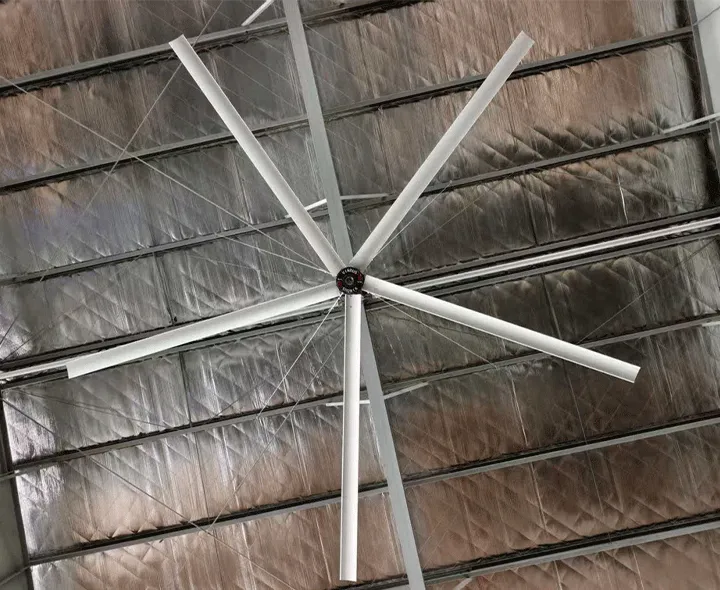
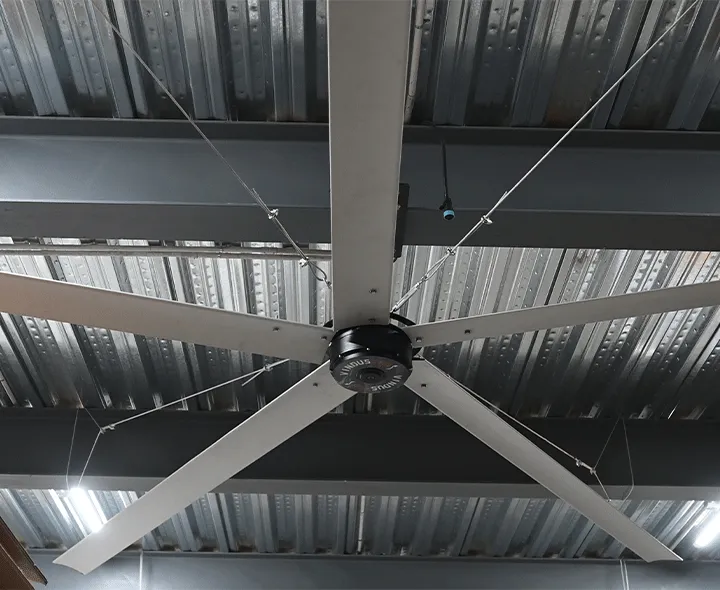
- PMSM direct-drive.The permanent magnet synchronous motor sits on the hub and turns the blades directly, with no reduction gearbox in the drivetrain. That removes the gear-mesh losses and the oil-service item that geared fans carry.
- Under 1,000 watts at max speed.For a fan spanning 20 or 24 feet, that is the number to hold onto when the conversation turns to running cost.
- Floor-level integrated HMI.The control interface lives at floor level, so speed changes do not require getting someone up to the ceiling.
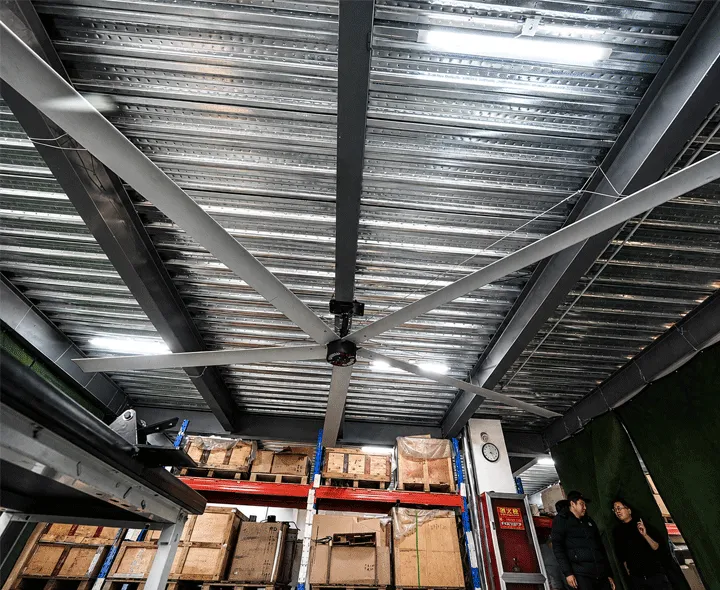
- Single ceiling-to-floor cable.One cable run keeps the installation simpler than multi-cable setups.
Those are the strengths worth comparing head to head, because each one is a concrete number or design fact rather than an adjective.
Vindus P780 vs. the fan you’re weighing
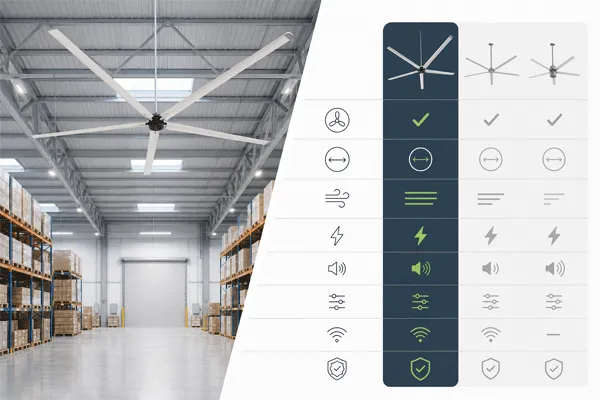
A fair comparison table needs verifiable data on both sides. Below is what Vindus publishes for the P780, paired with the exact question to ask about whatever premium Ventilador HVLS you are putting it against, so you fill the right-hand column with that manufacturer’s own current figures instead of guesswork.
| What to compare |
Vindus P780 (published) |
Confirm on the fan you’re weighing |
| Motor & drivetrain |
PMSM, gearless direct drive |
Is it direct-drive or geared? Ask directly. |
| Power at max speed |
Under 1,000 W |
Get the input watts at the fan’s rated airflow. |
| Diameter options |
20 ft and 24 ft |
Match the diameter to your floor area. |
| Ceiling height range |
20–33 ft |
Confirm it suits your mounting height. |
| Controlos |
Floor-level integrated HMI |
Where does the control panel live? |
| Wiring |
Single ceiling-to-floor cable |
How many cable runs does the install need? |
| Airflow test basis |
Follows AMCA 230-15 & ANSI/ASHRAE 216P |
Ask for airflow rated to the same standard. |
| Purchase price |
Request a quote (not published) |
Request a quote; compare like for like. |
The reason the right column is a set of questions rather than filled-in numbers is deliberate. Motor ratings, airflow figures, and pricing change by model and by year, and quoting a competitor’s spec from memory is how buyer’s guides end up wrong. Pull those figures from the manufacturer’s current documentation and drop them in yourself.
HVLS Fan Alternatives to Big Ass Fans: How Vindus Compares on Efficiency and Cost
Efficiency: what the sub-1,000-watt number is doing
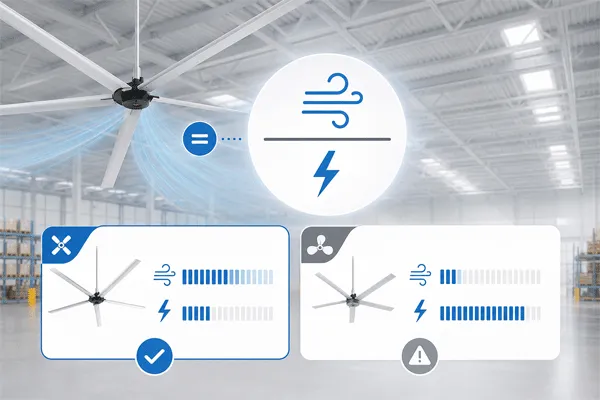
Under 1,000 watts on a 24-foot fan is a small draw for that much blade, and the reason traces back to the drivetrain. A geared fan spends energy at every gear mesh as friction and heat, continuously, for as long as it runs. A PMSM direct-drive fan has no gearbox to feed, and the permanent magnet motor avoids the rotor losses that induction motors carry. More of the input reaches the blades; less leaves as waste heat.
Here is the part buyers most often get backwards: input watts alone do not tell you which fan moves more air. Air movement comes mostly from blade diameter and blade design. A low wattage figure is only meaningful next to an airflow rating measured the same way on both fans. That is what AMCA 230-15, the Air Movement and Control Association’s airflow test method, and ANSI/ASHRAE 216P, the performance-rating method written specifically for HVLS fans, exist to make possible. Compare airflow-per-watt tested to those standards, not raw watts, and not motor horsepower.
The cost conversation, without hand-waving
“Cost” splits into two numbers, and only one of them is a sticker.
Purchase price is the sticker. Vindus does not publish prices; the P780 uses a request-a-quote model, so a figure for your ceiling and floor area comes from the company directly. This guide does not state a Big Ass Fans price either, because doing so responsibly means quoting their current published figure, not a remembered one. Get both quotes and compare them on the same room.
Operating cost is the number that runs for a decade. A fan drawing under 1,000 watts for two shifts a day costs less to run than a higher-draw fan doing the same job, and a gearless drivetrain has no gearbox oil to change on a schedule. Over the service life of the fan, that gap between energy plus maintenance on a direct-drive design and the equivalent on a geared one is often where the real money is, not in the day-one price. How fast it pays back depends entirely on runtime: a fan spinning year-round recovers a price difference far quicker than one used seasonally.
When the established brand may still be the right call
An honest alternative guide has to name the cases where you should not switch.
If you already run a fleet of one brand and have a dealer relationship, spare parts on the shelf, and technicians trained on that control system, adding a second brand introduces friction that a lower running cost may not offset for a single unit. If your specification was written around a particular model your engineering team has already validated, re-validating a substitute takes time you may not have. And if your stakeholders need to see a name they recognize on the invoice, that is a real procurement constraint, not a technical one.
None of those points is about airflow or watts. They are about switching cost and organizational risk, and they are legitimate reasons the incumbent sometimes wins. For a new building, a first HVLS purchase, or a facility watching its energy line closely, the calculus usually tips the other way.
HVLS Fan Alternatives to Big Ass Fans: How Vindus Compares on Efficiency and Cost
How to run a fair head-to-head
A comparison is only worth as much as its ground rules. To keep two HVLS fans honest against each other:
- Fix the room first: measure ceiling height and floor area, and note obstructions like racking or mezzanines before you look at any fan.
- Ask each manufacturer for airflow rated to the same standard (AMCA 230-15 / ANSI/ASHRAE 216P). Reject “coverage area” marketing numbers that skip the test method.
- Get input watts at that rated airflow, not at some unstated speed, so you can compute airflow per watt on equal terms.
- Ask whether the drivetrain is geared or direct-drive, and what the scheduled maintenance actually is, oil changes included.
- Compare the practical stuff: where the control panel sits, how many cable runs the install needs, warranty length, and lead time.
- Request a written quote from each on the same room, and compare purchase price alongside the ten-year running cost, not on its own.
Do those six things and the “which brand” question mostly answers itself, because you are finally comparing the same quantities instead of two marketing pages.
Perguntas frequentes
Q: Is Vindus a genuine alternative to Big Ass Fans?
A: For the large-space, tall-ceiling job an HVLS fan is built for, yes. The Vindus P780 covers 20 and 24 foot diameters for ceilings from 20 to 33 feet, on a PMSM direct-drive motor drawing under 1,000 watts at max speed. Whether it is the right alternative for you comes down to the head-to-head above.
Q: Are Vindus fans cheaper than Big Ass Fans?
A: This guide will not put a number on that, because Vindus prices by quote and stating a competitor’s price responsibly means citing their current figure, not a remembered one. The clearer cost story is operating cost: a sub-1,000-watt draw and no gearbox to service tend to lower the ten-year total. Get quotes from both to compare the sticker.
Q: Does Vindus use direct drive like the premium HVLS brands?
A: Yes. The P780 uses a gearless PMSM direct-drive, so the motor turns the hub with no reduction gearbox in between.
Q: Which Vindus fan competes with a large Big Ass Fan?
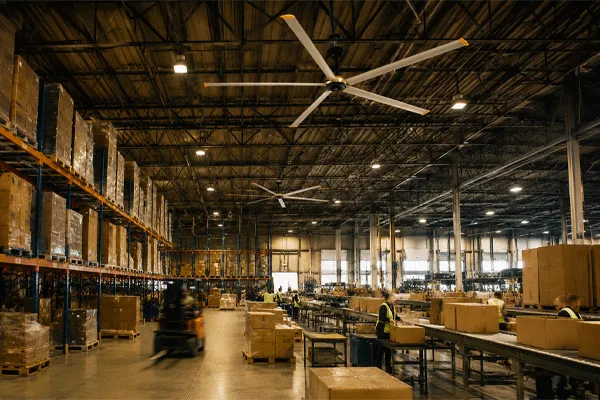
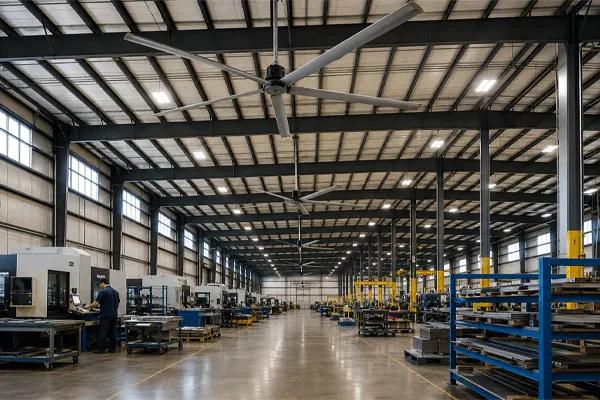
A: The P780, at 20 and 24 feet, is the model built for large, tall spaces such as warehouses, distribution centers, and manufacturing halls. Smaller footprints step down to the P730 (16–18 ft) or P680 (8–14 ft).
Q: Is Vindus supported in the United States?
A: Vindus runs manufacturing, assembly, and support from Palatka, Florida in addition to its Qingdao facilities, with a U.S. address and phone line, so a domestic buyer is not working across a single overseas time zone.
Before you request either quote, do the unglamorous part first: measure your ceiling height and floor area, and dig up the airflow rating and input watts of any fan you already run. Walk into both conversations with those three numbers and you can compare airflow per watt on the spot, which is the one comparison that actually separates these fans.