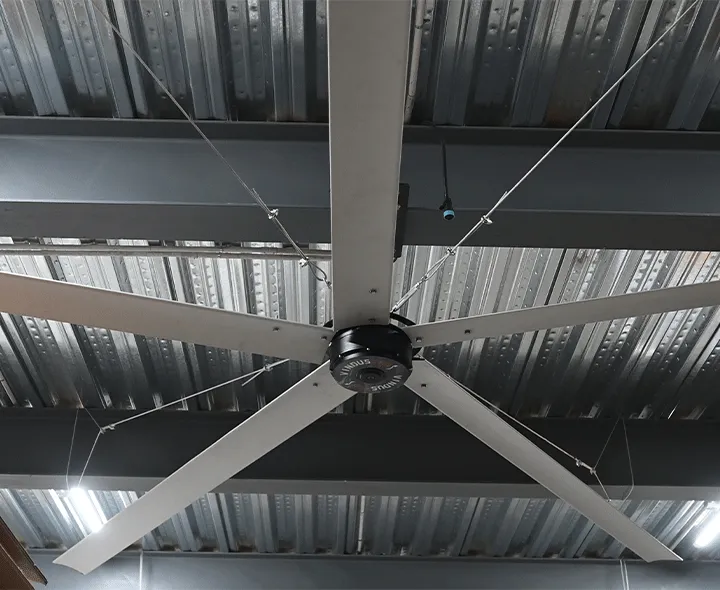
Michael Danielsson | CEO, Vindus Fans | Published August 11, 2026
HVLS fans cool large commercial and industrial spaces by moving high volumes of air at low rotational speed, creating a wide and slow airflow pattern at floor level. Because coverage scales with diameter rather than speed, one large fan replaces many small high-speed units, and the same fan pushes stratified heat downward in winter.
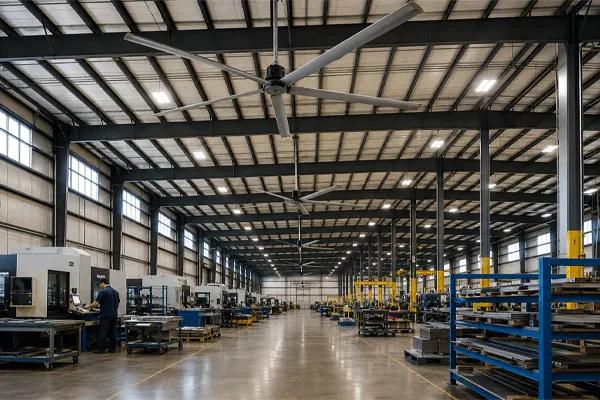
HVLS Fans for Cooling Large Commercial and Industrial Spaces
“Large” Is a Volume Problem, Not a Floor-Area Problem
Most sizing conversations start with square footage. That is the wrong first number.
A 30,000 sq ft space with a 14-foot ceiling and a 30,000 sq ft space with a 32-foot ceiling are different engineering problems. The first has roughly 420,000 cubic feet of air and very little vertical stratification to fight. The second holds over 950,000 cubic feet, and a substantial share of that volume sits above head height doing nothing except storing heat in summer and hoarding it in winter.
Three variables decide what equipment fits, and only one of them is area:
- Clear height to the lowest obstruction.This sets the maximum fan diameter that can throw air to the floor without producing an uncomfortable column directly beneath it. It also determines whether stratification is worth addressing at all — under roughly 15 feet, there is not much of a warm layer to recover.
- Obstruction density.Racking, mezzanines, crane rails, ductwork, lighting arrays and process equipment interrupt airflow before it spreads. Two buildings with identical dimensions can need different fan counts purely because one is empty and one is racked to 24 feet.
- Where people and product actually are.Airflow that lands on an unoccupied aisle is wasted. Airflow that lands on a packing station is doing work.
Floor area only tells you roughly how many units you will end up with once the other three are settled.
Why Diameter Beats Speed at Scale
The physics here is not complicated but it is frequently misread.
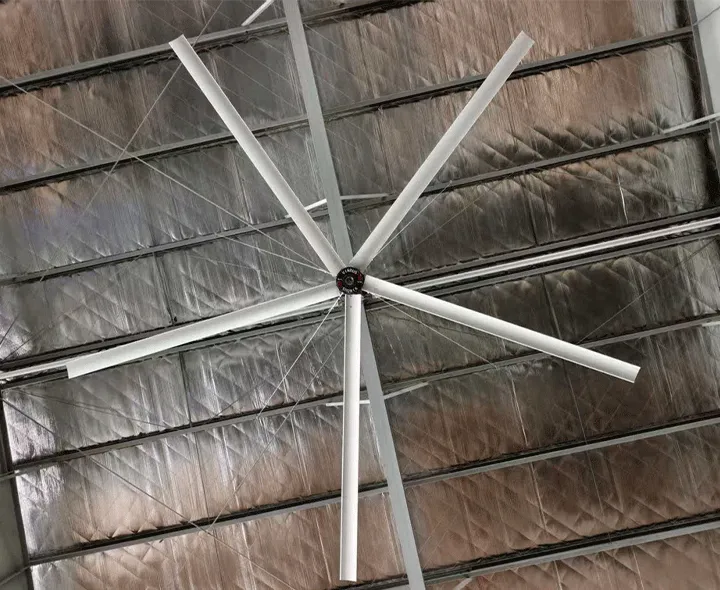
Airflow volume rises with the square of the diameter, while aerodynamic noise and energy loss rise steeply with tip speed. Doubling a fan’s diameter therefore buys roughly four times the swept area, and a large fan can move the same air volume as a small one while turning far more slowly. That is the entire premise of the category, and it is why a 24-foot fan drawing under 1,000 W can replace a bank of high-speed units that collectively draw several kilowatts.
The airflow pattern matters as much as the volume. A high-speed fan produces a narrow, fast jet that decays quickly and gives you a comfortable pocket in front of it and nothing thirty feet away. A large slow fan produces a broad descending column that spreads radially along the floor, so the air keeps moving outward through the occupied zone. Compared with the wall-mounted and pedestal high-speed fans still common in older facilities, the difference is coverage uniformity rather than peak air speed at any single point.
What Changes by Building Type
The same fan performs differently depending on what the building does.
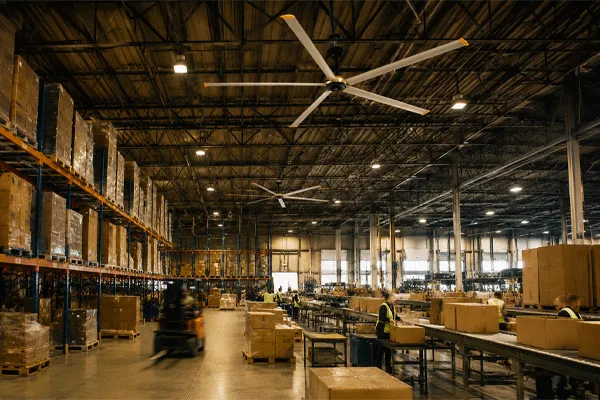
Warehouses and distribution centers. Racking geometry dominates. Fans go in cross-aisles and open staging areas, not over solid rack blocks that block the column. Ceiling heights frequently exceed 30 feet, which makes winter destratification the stronger part of the business case.
Manufacturing plants. Process heat is localized and often intense. HVLS fans handle general comfort across the floor; they do not replace spot cooling or local exhaust at a heat source, and running them near open-flame or fine-powder processes needs a hard look at whether air movement helps or spreads a problem.
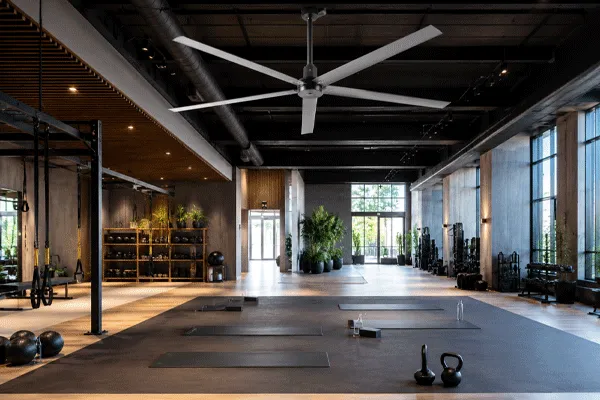
Retail, showrooms and big-box interiors. Sound and appearance carry real weight here. Speeds run lower than an industrial setting would use, and the fan is a visible design object in a way it is not in a warehouse.
Sports and assembly venues. High occupant heat load, low tolerance for noise, and moving obstructions like retractable seating and rigging.
Aircraft hangars, transit facilities and vehicle bays. Very high volumes, large door openings that dump conditioned air, and heavy vertical obstructions.
Agricultural buildings. Different problem entirely, and covered better in our livestock and agricultural facility material than here.
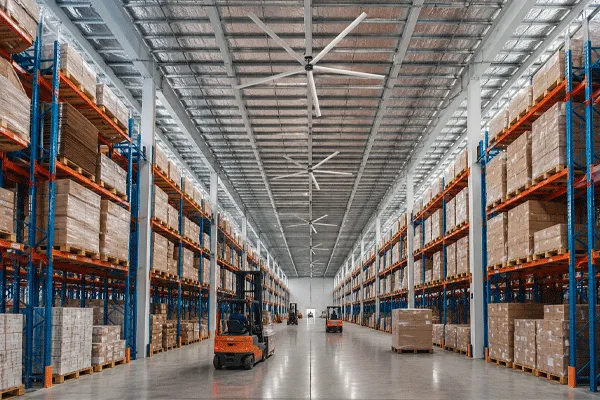
HVLS Fans for Cooling Large Commercial and Industrial Spaces
Direct Drive vs Gearbox-Driven Designs
Large-diameter fans put real torque through their drivetrain, and this is where the architectural difference shows up.
| Dimension |
Direct drive (PMSM) |
Gearbox-driven |
| Drivetrain |
Motor coupled directly to the hub |
Motor plus reduction gearbox |
| Mechanical loss points |
Bearings only |
Bearings, gear mesh, seals |
| Scheduled oil service |
None |
Periodic gear-oil inspection and change |
| Leak risk below the fan |
None |
Present; seals wear over time |
| Tonal noise source |
Aerodynamic only |
Aerodynamic plus gear mesh whine |
| Weight at the mounting point |
Lower |
Higher |
| Speed control |
Electronic via integrated drive |
Fixed gear ratio plus drive |
I led development of direct-drive HVLS models at MacroAir before this work at Vindus, and the row that changes decisions most often is the oil service line. In a food-handling facility, a clean room adjacent space, or anywhere over finished product, an oil-free drivetrain removes a contamination pathway rather than mitigating one. In a 24/7 operation, it also removes a maintenance window that has to be negotiated with production.
P780 Series Specifications
The P780 Series is the range we position for the largest spaces in the U.S. market.
| Specification |
P780 Series |
| Diameters |
20 ft and 24 ft |
| Suitable ceiling height |
20–33 ft |
| Motor |
PMSM, direct drive (gearless) |
| Power draw at maximum speed |
Under 1,000 W |
| Control |
Floor-level integrated HMI |
| Cabling |
Single ceiling-to-floor cable |
| Performance test basis |
AMCA 230-15 and ANSI/ASHRAE 216P |
| Safety compliance |
CE, CB, EN, IEC |
| Warranty |
3 years on defective components causing improper operation |
Two of those lines deserve unpacking.
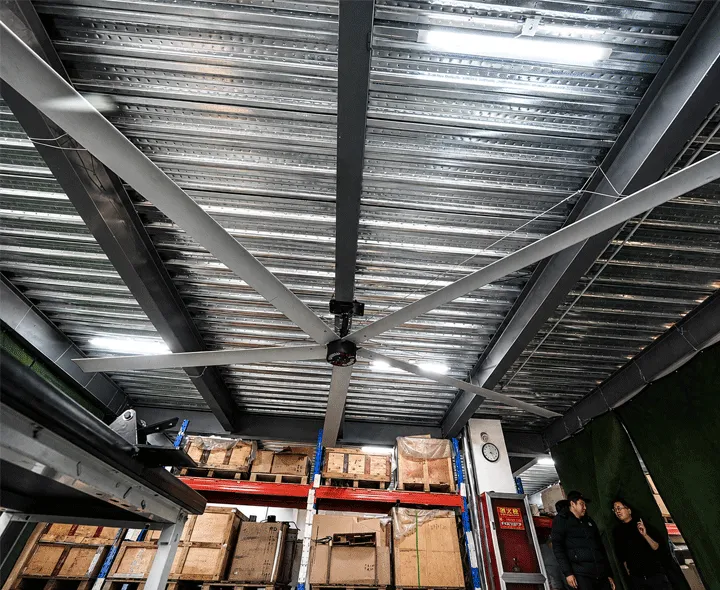
The single-cable design and floor-level HMI matter more in large buildings than in small ones because commissioning cost scales with distance. A fan at 30 feet in the middle of a 100,000 sq ft floor is expensive to reach. Controls that live at floor level mean speed adjustment and diagnostics do not require a lift.
The standards line is a purchasing tool, not decoration. AMCA 230-15 is the Air Movement and Control Association’s test method for air-circulating fan performance, and ANSI/ASHRAE 216P defines how HVLS fan performance is characterized. When you compare quotes, confirm that both vendors’ airflow numbers trace to the same method. An airflow figure with no stated test basis is not comparable to one that has it, and in this category the spread between optimistic marketing numbers and standardized test results can be wide.
Rated CFM per model is not published on our site, and neither are prices. Both follow from a layout review and a quote. For ceilings below 20 feet, the P680 Series (8–14 ft diameters, 10–25 ft ceilings) is the correct starting point; the P730 Series (16 ft and 18 ft diameters) fills the gap between them.
Six Steps From Building to Layout
- Establish clear height to the lowest obstruction across each bay.Not the roof peak. Sprinklers, lighting, ductwork, crane envelopes and rack tops all set the real number, and it often varies between bays in the same building.
- Map the obstruction plan at 10 feet and above.Anything at that level shapes where a column can descend.
- Overlay the occupied zones.Pick stations, aisles, work cells, seating. Fans get placed for these, not for geometric symmetry on a floor plan.
- Divide the building into control groups.A packing area and a bulk storage area should not be forced onto one speed setting. Independent control is usually cheaper than adding units.
- Check door openings and mechanical airflow paths.A fan next to a dock door with a strong prevailing draft will fight it rather than help.
- Confirm structural capacity, downrod length and lockout/tagout access with your engineer and electrician before ordering.A fan that cannot be safely reached for inspection will not be inspected.
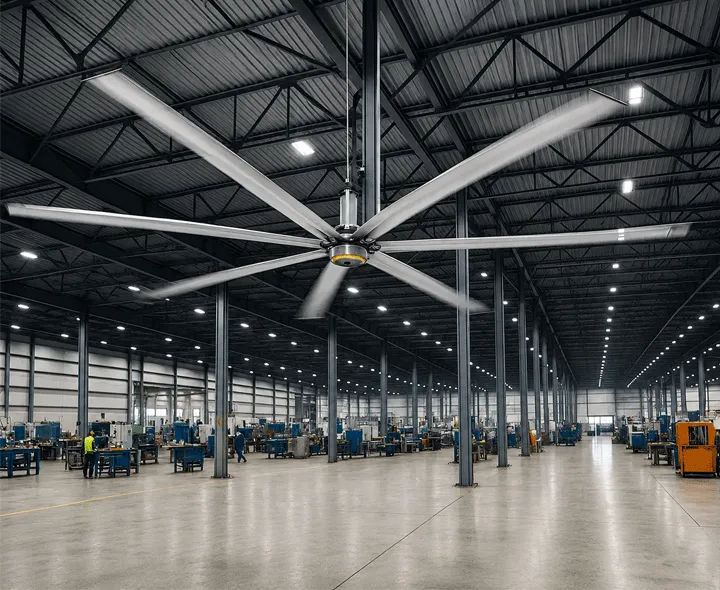
HVLS Fans for Cooling Large Commercial and Industrial Spaces
Edge Cases That Change the Answer
Very high ceilings above 33 feet. Beyond the specified range, the fan needs a longer downrod to bring the hub into a working height band, and downrod length has structural and vibration consequences. This is an engineering question, not a catalog question.
Mezzanines and partial second levels. These create two occupied zones at different heights within one volume. Treating the space as a single room produces a layout that serves neither level well.
Racked warehouses above roughly 24 feet. Solid rack blocks act as walls. Airflow travels in the aisle network, which means fan placement follows the aisle plan rather than a grid.
Buildings with large open doors during operating hours. Air exchange through a 20-foot dock opening can overwhelm interior circulation. Fan layout should account for the door-open condition, since that is often the operating norm.
Spaces with fixed noise limits. Vindus does not publish per-model sound pressure figures, and I would rather state that than quote a number without a test standard and measurement distance attached. If a contractual dB limit applies to your project, request measured data with those conditions specified.
Where HVLS Fans Do Not Solve the Problem
They do not dehumidify. In a humid climate they help evaporative cooling on skin, but the moisture load is a mechanical problem and stays one.
They do not ventilate. HVLS fans redistribute air already inside the building. They do not bring in outdoor air, remove CO₂, or exhaust fumes. Anything involving air quality compliance belongs to your ventilation system.
They do not cool product or equipment meaningfully. The perceived-temperature benefit applies to people, through evaporation. A stored pallet does not feel a breeze.
And they require permanent structural attachment. In a building with marginal roof structure or an unusual truss layout, the engineering and reinforcement cost can approach the equipment cost. That is worth discovering during design, not at installation.
FAQ
Q: How many HVLS fans does a 50,000 sq ft building need?
A: Square footage alone cannot answer this. The count depends on clear ceiling height, obstruction density, where occupants are, and how many independent control zones the operation needs. A racked 50,000 sq ft warehouse and an open 50,000 sq ft assembly hall can differ significantly in unit count. Layout review comes before quantity.
Q: What is the minimum ceiling height for a large HVLS fan?
A: The P780 Series is specified for 20–33 ft ceilings. Below 20 ft, a large diameter produces uncomfortable airflow directly underneath and dead zones between units. The P680 Series covers 10–25 ft ceilings; the P730 Series sits between the two.
Q: Can HVLS fans replace air conditioning in a large building?
A: In many industrial and semi-conditioned spaces they replace the need for full mechanical cooling by making higher air temperatures tolerable. In spaces with a fixed temperature requirement, or a heavy latent load, they reduce the cooling burden but do not remove it. The realistic framing is that they raise the acceptable setpoint, not that they substitute for a chiller.
Q: What do they cost?
A: Prices are not published. Cost depends on diameter, unit count, downrod length, control configuration and installation conditions, so a quote follows a layout review. When comparing quotes, ask each vendor for the airflow test standard behind their numbers.