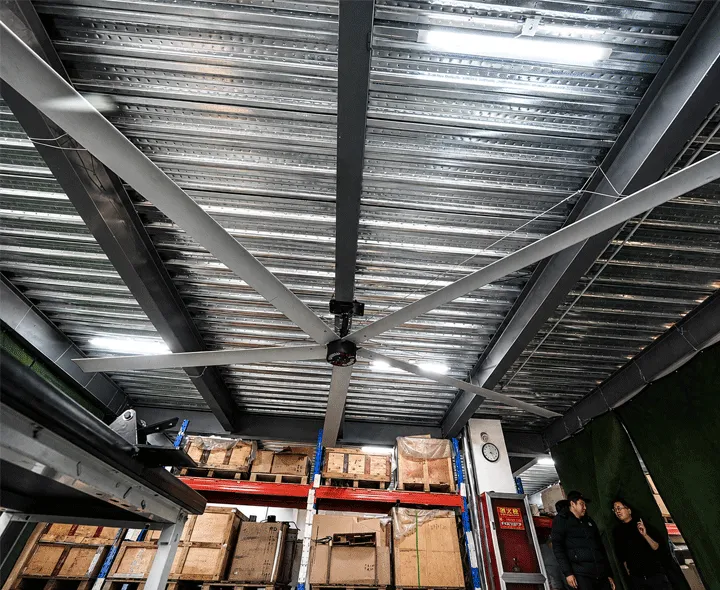
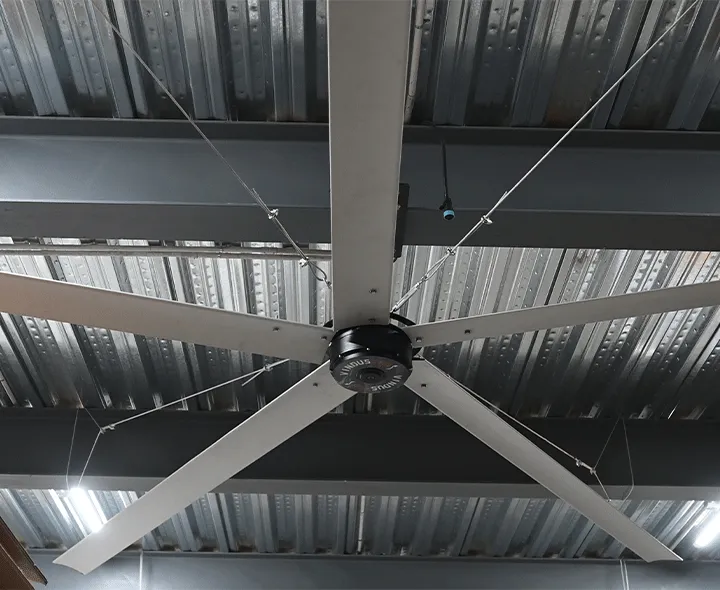
By Vindus Fans Engineering Team Published & last updated: July 15, 2026 Product details in this article reflect information Vindus published as of July 2026.
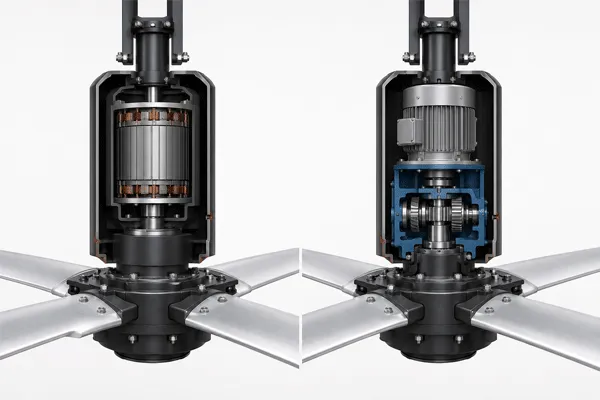
A PMSM HVLS fan is a high-volume, low-speed ceiling fan driven by a permanent magnet synchronous motor mounted directly on the hub, with no gearbox. Removing the gearbox cuts friction losses, drops the fan’s weight, and eliminates gear-mesh noise, which is why direct-drive PMSM designs run more efficiently and quietly than geared induction fans.
PMSM HVLS Fans: How Permanent Magnet Direct-Drive Motors Cut Energy Use and Noise
What “PMSM direct-drive” actually means?
Two acronyms do the heavy lifting here. Supporti HVLS for high-volume, low-speed: a fan with a large diameter, often 8 to 24 feet, that moves a big column of air while turning slowly. PMSM stands for permanent magnet synchronous motor, a motor whose rotor carries permanent magnets instead of relying on induced current to build its magnetic field.
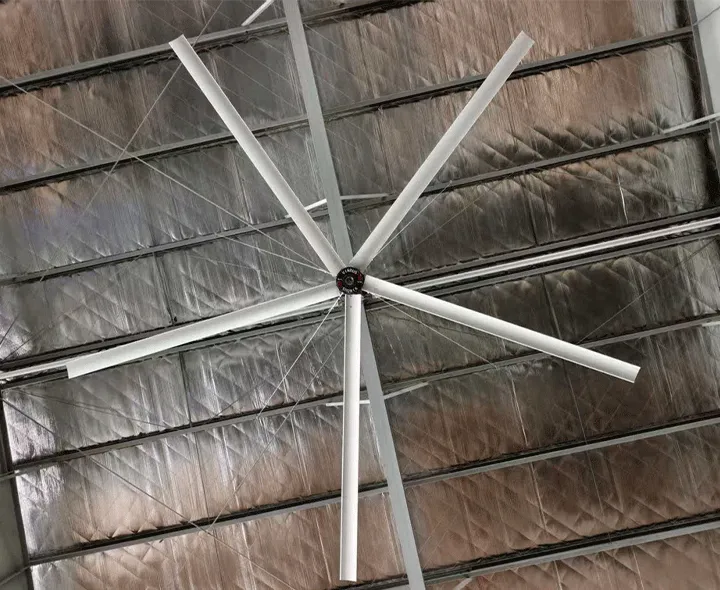
“Direct-drive” describes how the motor connects to the blades. In a direct-drive fan, the hub that the blades attach to sits on the motor shaft itself. Nothing sits in between. A conventional industrial fan often pairs a smaller, faster induction motor with a gear reduction to turn the large, slow blades. The PMSM approach skips that step: the motor is built to turn slowly and with high torque on its own.
That one design choice is the reason the rest of this article exists. Once the gearbox is gone, the efficiency, weight, noise, and maintenance profile of the fan all move together.
Where a geared fan loses energy, and a PMSM one doesn’t?
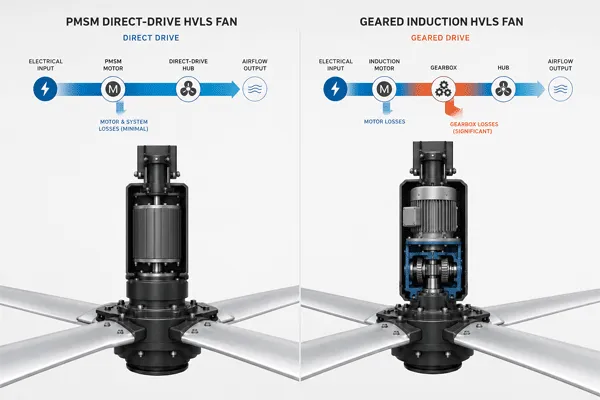
Every gear mesh in a drivetrain gives up a slice of energy to friction and heat. Put a reduction gearbox in front of a motor and you pay that toll continuously, every hour the fan runs. Take the gearbox out and the loss is gone.
The motor itself matters too. An induction motor generates its rotor field by inducing current in the rotor, and that induced current brings resistive losses plus a small speed lag called slip. A permanent magnet synchronous motor already carries its field in the magnets, so it runs in step with the supply frequency and skips the rotor losses that induction designs live with.
Airflow and input power for HVLS fans are measured against published standards rather than left to marketing language. AMCA 230-15, from the Air Movement and Control Association, defines how the airflow of a circulating fan is tested, and ANSI/ASHRAE 216P sets the performance-rating method specific to HVLS fans. Those two documents are the reference points for weighing any fan’s real output against its power draw, and Vindus states its products follow both.
The gearbox is also your loudest component
Gear teeth meshing under load produce a distinct whine, and that whine climbs as the fan speeds up. It is one of the most recognizable sounds in an older industrial fan. Remove the gearbox and that particular noise source is simply not there.
A PMSM direct-drive fan still makes sound. Air crossing the blades has its own acoustic signature, and the motor and controller add a little. But the loudest mechanical contributor in a geared design is missing, which is why direct-drive fans tend to sit lower on the noise scale at the same airflow. In a warehouse where crews call across the floor, or on a restaurant patio where people are trying to talk, that gap is easy to hear.
PMSM direct-drive vs. geared induction, side by side
Compared with the geared induction fans that still make up a large share of the market, a PMSM direct-drive design changes several things at once:
| Dimension |
PMSM direct-drive |
Geared induction |
| Drivetrain |
Motor shaft turns the hub directly |
Motor plus reduction gearbox |
| Gear friction losses |
None |
Continuo |
| Rotor losses |
Minimal; magnets supply the field |
Induced-current and slip losses |
| Gearbox oil service |
Not required |
Periodic oil changes |
| Primary mechanical noise |
Blade and airflow noise |
Gear-mesh whine plus airflow |
| Weight at the hub |
Lower, no gearcase |
Più alto |
| Speed control |
Electronic controller / VFD |
Often fixed or stepped |
| Moving parts that can fail |
Fewer |
More: gears, seals, oil path |
These rows describe mechanisms, not one lab test. Actual airflow and wattage depend on model and diameter, which is exactly why the standards named above exist.
PMSM HVLS Fans: How Permanent Magnet Direct-Drive Motors Cut Energy Use and Noise
Does a lower-wattage fan move less air?
This is where buyers often trip. A P780-class fan draws under 1,000 watts at full speed, which looks small next to older motors rated at several horsepower. The reflex is to read low wattage as weak airflow.
Air movement from an HVLS fan comes mostly from blade diameter and blade shape, not from raw motor power. A 24-foot fan turning slowly pushes a wide column of air on every rotation. Because PMSM direct-drive converts more of its input into blade rotation and wastes less as gearbox heat, a lower wattage figure reflects less waste, not less output. Judging two fans by input watts alone, without their airflow rating under AMCA 230-15, tells you almost nothing useful.
The trade-offs worth knowing before you buy
Direct-drive PMSM fans are not the right call in every situation, and the honest drawbacks deserve a place on the page.
The first is upfront cost. Permanent magnet motors use rare-earth magnet material and run alongside an electronic drive, and that hardware costs more to build than a plain geared induction package. You are trading a higher purchase price for lower running cost and lower maintenance across the fan’s life, so the payback depends on how many hours a year it actually spins. A fan running two shifts a day closes that gap far faster than one used a few weeks a season.
The second is dependence on power electronics. The variable-frequency controller that gives PMSM fans their smooth speed control is also a part that can fail, and it wants a stable power supply. This is well-understood technology, but it is a different service model from a bare induction motor, and a site with no electrical support on hand should plan for that.
Neither point cancels the efficiency and noise gains for most industrial and commercial buildings. A fan spinning only now and then in a small room, though, may not earn back the premium.

PMSM HVLS Fans: How Permanent Magnet Direct-Drive Motors Cut Energy Use and Noise
Vindus P-Series: PMSM direct-drive across three U.S. models
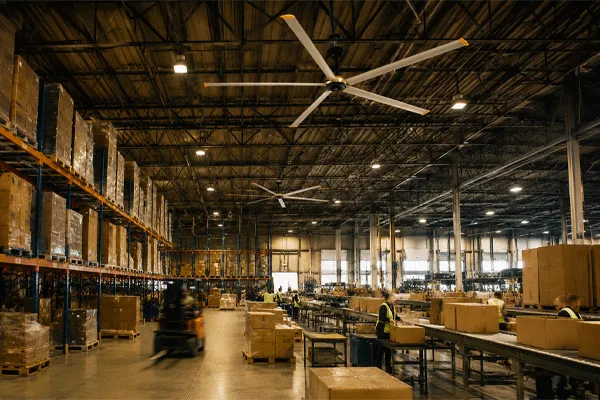
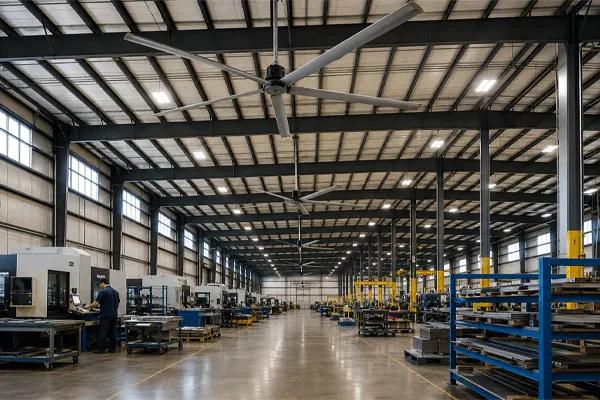
Vindus builds its U.S. lineup on the direct-drive PMSM approach above, and the P-Series ships to the U.S. market as part of a line the company exports to more than 20 countries. Three series cover different ceiling heights and floor areas.
| Series |
Diametro |
Suited ceiling height |
Motore |
Typical spaces |
| P780 |
20 ft & 24 ft |
20–33 ft |
PMSM, under 1,000 W at max speed |
Large warehouses, distribution centers, manufacturing halls |
| P730 |
16 ft & 18 ft |
20–33 ft |
PMSM, under 1,000 W at max speed |
Mid-to-large industrial and commercial floors |
| P680 |
8–14 ft |
10–25 ft |
PMSM direct-drive |
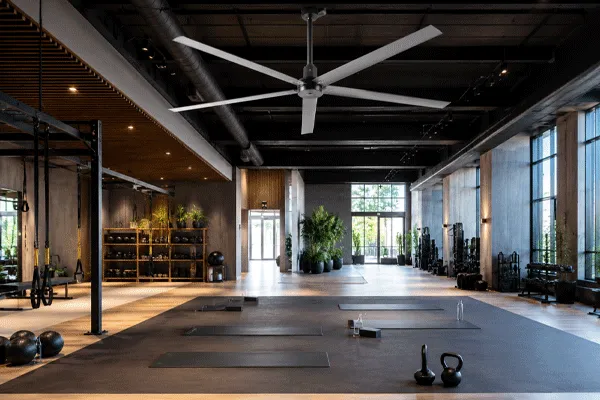
Workshops, logistics areas, retail, restaurants, outdoor patios |
The published sub-1,000-watt figure is stated for the P780 and P730; Vindus lists the P680 as a direct-drive design for medium-size spaces without a separate wattage number.
Two details carry across the P-Series. The human-machine interface sits at floor level, so an operator changes speed without climbing to the ceiling, and each fan runs on a single cable from ceiling to floor, which keeps an install cleaner than multi-cable wiring. For sites running several units, Vindus fans support centralized control through its FanBrain™ system, so a bank of fans can share one schedule.
Vindus does not publish per-model airflow or noise figures, and it does not post prices. Pricing follows a request-a-quote model, so a number matched to your ceiling and floor area comes from the company directly.
Sizing a PMSM HVLS fan for your space
Matching a fan to a room is mostly geometry. A workable process:
- Measure your ceiling height and compare it to the series ranges above. The P680 fits ceilings from 10 to 25 feet; the P730 and P780 want 20 to 33 feet. Hung too low, a fan forces uncomfortable air speed at head height; hung too high, the airflow spreads out before it reaches anyone.
- Estimate the floor area one fan needs to cover. Bigger diameters serve more square footage per unit, so a few large fans often beat a crowd of small ones.
- Note the obstructions. Racking, low-hung lighting, and mezzanines break up airflow, and tall warehouse racking in particular changes where air can actually travel.
- Decide whether units need to work as a group. Because the P-Series supports centralized control, a set of fans can run on one schedule instead of being switched one by one.
- Send those measurements to the manufacturer for an airflow proposal and quote rather than guessing from diameter alone.
Working through those five points before you request a quote gets you a far more useful answer than asking “which fan is best” from a cold start.
Domande frequenti
Q: Is a PMSM the same as a brushless DC or EC motor?
A: They are close relatives. Each uses permanent magnets on the rotor with electronic commutation. “PMSM” usually means a motor driven with smooth sinusoidal current for quiet, efficient running, which suits a large slow-turning fan. For a buyer, the shared point is that all of them avoid the rotor losses of an induction motor.
Q: Do direct-drive HVLS fans really need less maintenance?
A: Usually, because there is no gearbox to change oil in and fewer wearing parts. The main service attention shifts toward the electronic controller and routine blade and mounting checks.
Q: Will a PMSM fan lower my energy bill?
A: It uses less input power for a given airflow than a geared induction fan, so cost per running hour is lower. Whether that becomes a meaningful bill reduction depends on how many hours the fan runs and what it is replacing.
Q: Are Vindus P-Series fans certified?
A: Vindus states its products carry CE, CB, EN, and IEC safety compliance and follow AMCA 230-15 and ANSI/ASHRAE 216P for performance. Certificate numbers are not published publicly, so request documentation from the company if a project spec requires them.
Q: How much does a PMSM HVLS fan cost?
A: Vindus does not publish prices; the lineup uses a request-a-quote model. Cost depends on diameter, model, quantity, and installation, so a figure comes from a direct quote rather than a list.
What to do next depends on your building: if you already have ceiling height and floor area in hand, run them through the five sizing steps and send the result in with a quote request. If your ceilings are unusually tall or broken up by heavy racking, ask specifically about multi-unit layout and centralized control, since that is where a single-fan estimate tends to fall short.