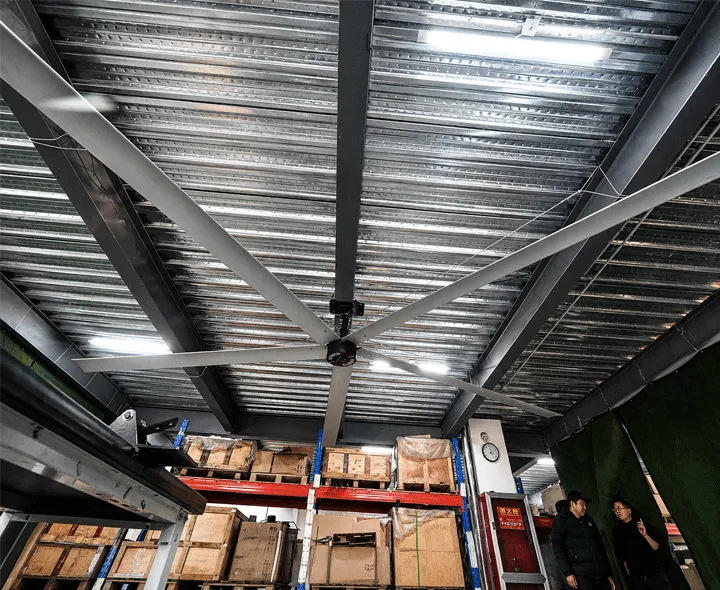
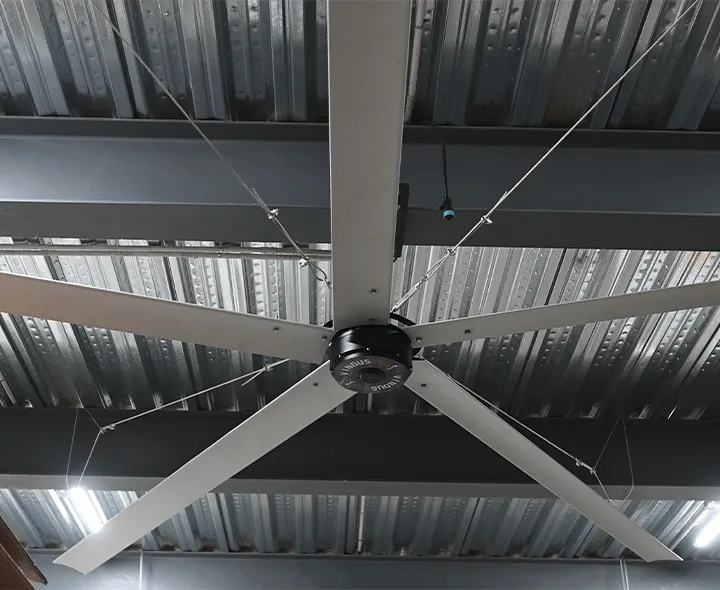
Industrial plants can become dangerously uncomfortable when heat builds up, air stops moving, and cooling costs rise. Poor circulation makes work areas feel hotter and affects daily operations. A properly selected large industrial ceiling fan helps solve these problems by creating steady, widespread air movement.
Ventilatori da soffitto industriali di grandi dimensioni help cool industrial plants by circulating large volumes of air at low speeds. These high volume low speed (HVLS) systems create a cooling breeze, reduce temperature differences between floor and ceiling levels, and support HVAC performance. They offer an efficient way to improve comfort in factories, warehouses, production facilities, and other large buildings.
Large Industrial Ceiling Fans for Cooling Industrial Plants: Benefits, Sizing & Buying Guide
Industrial building owners face a common challenge: keeping people comfortable without spending too much on cooling equipment. Choosing the right ceiling fan can make a meaningful difference.
In this guide, we explain how industrial ceiling fans work, where they perform best, what technical features matter, and how to select a suitable system for your facility.
1. Why Are Large Industrial Ceiling Fans Important for Industrial Plant Cooling?
Industrial plants often produce significant internal heat. Manufacturing equipment, machinery, lighting, and building roofs can all raise indoor temperatures. During summer, these conditions become especially difficult in facilities with high ceilings and limited natural ventilation.
Traditional small fans may cool individual workstations, but they struggle to provide consistent air movement across an entire production floor.
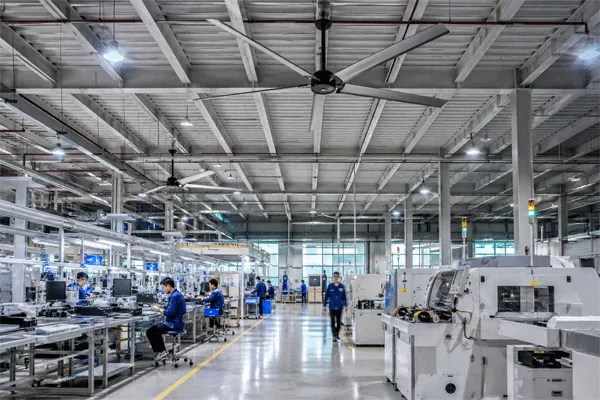
A large industrial ceiling fan addresses this challenge through its wide diameter and slow rotation. Instead of creating a strong breeze in one small area, it moves air throughout a much wider space.
Common cooling challenges in industrial plants
| Industrial Challenge |
Impact on Operations |
How Ceiling Fans Help |
| Heat accumulation |
Uncomfortable working conditions |
Create continuous air movement |
| Uneven temperature |
Hot and cold zones |
Improve temperature distribution |
| Poor circulation |
Stagnant indoor conditions |
Support whole-building air circulation |
| High HVAC demand |
Increased operating expenses |
Complement existing cooling systems |
| High ceilings |
Warm air accumulates overhead |
Support seasonal air mixing |
| Large production areas |
Uneven worker comfort |
Distribute air across occupied zones |
An industrial ceiling fan does not produce refrigerated air. Instead, it improves the way existing air moves around a building.
This distinction matters. When a ceiling fan creates sufficient air movement around people, it helps them feel cooler through increased convective and evaporative heat loss.
The result can be a more comfortable workplace without relying entirely on additional air conditioning.
2. How Does an HVLS Ceiling Fan Cool a Large Industrial Building?
An HVLS ceiling fan operates on a simple principle: high volume low speed.
Unlike small, fast-spinning fans, HVLS equipment uses a large diameter and carefully designed blades to move large volumes of air at relatively low rotational speeds.
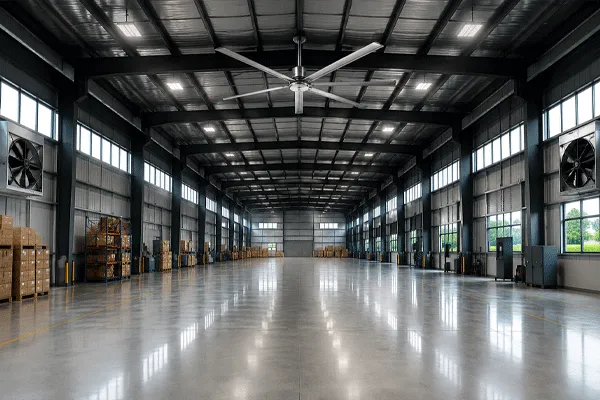
The rotating fan pushes air downward, allowing it to spread across the floor before circulating throughout the surrounding area.
This creates broad air movement rather than a narrow, concentrated stream.
Understanding the cooling process
An industrial HVLS system works through three main stages:
-
Downward air movement: The rotating blades direct air toward the occupied area.
-
Horizontal circulation: Air spreads across the floor and reaches surrounding work zones.
-
Continuous mixing: Air circulates throughout the building, helping reduce stagnant zones.
Large Industrial Ceiling Fans for Cooling Industrial Plants: Benefits, Sizing & Buying Guide
During summer, moving air increases the cooling sensation people experience. During colder months, carefully controlled low-speed operation can help redistribute warm air trapped near the roof.
For industrial facility owners, this means a well-designed ceiling fan system can support comfort in different seasons rather than serving only as a summer cooling product.
3. What Are the Main Benefits of Installing a Large Ceiling Fan?
The main value of an industrial ceiling fan extends beyond producing a breeze. A properly designed system can improve comfort, support energy efficiency, and make large buildings easier to manage.
Improved worker comfort
People working near machinery, packing stations, and assembly lines often experience uncomfortable heat.
A ceiling fan distributes air across these areas, reducing the feeling of stagnant heat.
Better thermal comfort can support a more pleasant working environment, although productivity improvements should be assessed against actual site conditions rather than assumed.
Reduced dependence on mechanical cooling
In air-conditioned facilities, increased air movement may allow operators to adjust temperature settings while maintaining acceptable comfort.
Actual savings depend on climate, operating hours, building insulation, HVAC equipment, and control settings.
Better year-round air circulation
A properly operated fan helps reduce vertical temperature differences during colder months.
This process, called destratification, can help heating systems serve occupied areas more effectively.
Wider coverage with fewer units
One large ceiling fan may serve a wider open area than several small circulation fans, depending on the building layout and required air speed.
For warehouse owners and industrial contractors, that can simplify equipment planning.
However, coverage should always be confirmed through manufacturer data and site-specific design rather than diameter alone.
4. Key Considerations When Choosing an Industrial Ceiling Fan
Selecting the right industrial ceiling fan requires more than comparing sizes or choosing the lowest purchase price.
Building geometry, mounting conditions, motor performance, controls, and operating environment all affect long-term results.
The following factors deserve particular attention.
| Selection Factor |
What to Evaluate |
Why It Matters |
| Diametro del ventilatore |
Available installation area |
Influences air distribution |
| Altezza del soffitto |
Mounting and occupied-zone clearances |
Affects safety and comfort |
| Tipo di motore |
Efficiency, control, and maintenance |
Influences operating expenses |
| Progettazione della lama |
Material and aerodynamic shape |
Affects performance |
| Noise level |
Sound characteristics at operating speed |
Important for occupied environments |
| Mounting structure |
Structural capacity and vibration |
Supports installation safety |
| Control system |
Speed adjustment and automation |
Improves operating flexibility |
| Environmental protection |
Humidity, dust, corrosion, and temperature |
Influences service life |
Motor technology
Modern HVLS systems may use a DC motor or other variable-speed drive configurations. Direct-drive equipment can reduce the number of mechanical transmission components.
Traditional ac motors may also provide reliable service when properly designed and maintained.
Rather than assuming one motor type is always superior, buyers should compare verified power consumption, operating speed, maintenance requirements, and control capabilities.
Blade construction
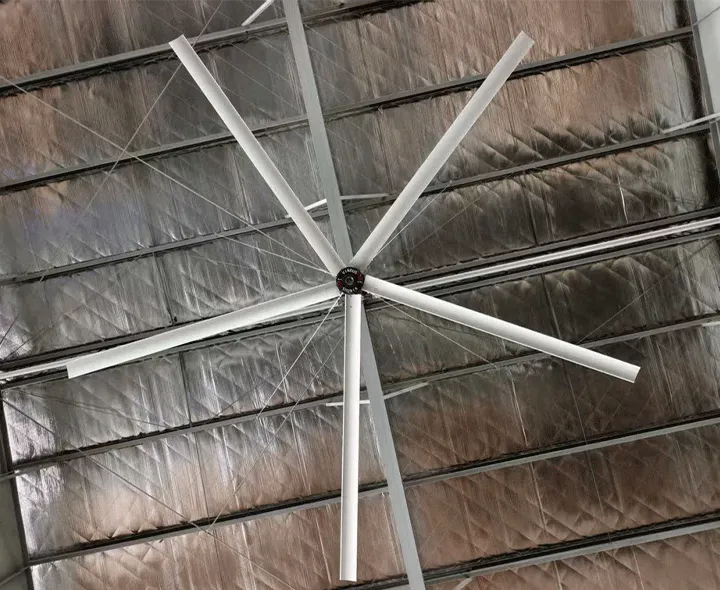
An aluminum blade can offer a useful balance between strength and weight. Its aerodynamic profile also influences how effectively the fan distributes air.
When comparing equipment, review the complete blade assembly, retention system, material specification, and available test data.
A well-matched motor and blade combination matters more than appearance alone.
5. What Size Large Industrial Ceiling Fan Does Your Factory Need?
Choosing the correct diameter is one of the most important steps when planning an industrial cooling project.
A larger diameter does not automatically guarantee better results. The fan must fit the building structure while maintaining suitable clearance around equipment, lights, sprinkler systems, and other ceiling-mounted components.
The following table provides a general starting point for discussing an installation with a produttore.
Industrial ceiling fan size comparison
| Diametro della ventola |
Typical Application |
Main Selection Consideration |
| 8–10 ft |
Smaller industrial work zones |
Limited mounting space |
| 12–14 ft |
Workshops and production areas |
Balanced coverage and clearance |
| 16–18 ft |
Medium-to-large industrial facilities |
Wider open-floor circulation |
| 20–22 ft |
Large production halls and logistics buildings |
Broad circulation requirements |
| 24 piedi |
Large, open industrial buildings |
Structural design and sprinkler coordination |
Note: These are illustrative application ranges, not universal product specifications or guaranteed coverage figures.
An extra large ceiling fan with a wide blade span may be useful in an open production hall, while a smaller unit may perform better in a building divided by machinery or storage racks.
For example, an hvls industrial ceiling fan 24ft installation requires adequate structural support and careful coordination with the fire protection system.
Facility owners should also consider:
-
Distance between adjacent fans.
-
Height of equipment and storage racks.
-
Locations of doors, vents, and exhaust systems.
-
-
Accessibility for maintenance.
-
Minimum required clearances.
For industrial ceiling fans warehouse projects, a layout drawing is often more valuable than a simple recommendation based on floor area.
Large Industrial Ceiling Fans for Cooling Industrial Plants: Benefits, Sizing & Buying Guide
6. Can Large Ceiling Fans Reduce Industrial HVAC Energy Costs?
Industrial cooling represents an important operating expense for many manufacturing and logistics facilities.
A ceiling fan offers a practical way to support existing HVAC systems by improving the distribution of conditioned air.
When moving air helps occupants feel comfortable at a higher cooling setpoint, the facility may reduce the amount of mechanical cooling required.
However, fan electricity consumption must also be included when calculating total energy savings.
Example: Estimating fan electricity consumption
Consider a hypothetical manufacturing facility evaluating four HVLS units.
Assume each unit has an average electrical input of 0.75 kW and operates for 10 hours per day, 300 days per year.
|
Calculation Item
|
Value
|
| Number of fans |
4 |
| Average input per fan |
0.75 kW |
| Daily operating time |
10 hours |
| Annual operating days |
300 |
| Electricity rate |
$0.12/kWh |
| Annual fan electricity use |
9,000 kWh |
| Estimated annual fan electricity cost |
$1,080 |
Calculation:
Annual consumption = Number of fans × Average power × Daily operating hours × Annual operating days.
4 × 0.75 × 10 × 300 = 9,000 kWh.
This is an illustrative calculation, not a measured product result. Actual consumption changes with equipment specifications and operating speeds.
Evaluating total operating cost
A complete financial assessment should include purchase price, installation, maintenance, electricity consumption, and any verified HVAC savings.
For a facility that operates cooling equipment throughout the year, even modest improvements in system coordination may have long-term value.
The objective is not simply to install the lowest-power electric ceiling fan. It is to achieve the required comfort level with an efficient, dependable combination of equipment.
7. Industrial Ceiling Fan vs. Traditional Fans: Which Is Better?
Traditional fans and HVLS systems perform different tasks.
Small directional fans are useful when operators need concentrated cooling near a workstation or a particular piece of equipment.
In contrast, large industrial ceiling fans serve broader occupied areas through relatively gentle, continuous circulation.
Comparing cooling technologies
|
Caratteristica
|
Ventilatore da soffitto HVLS |
Traditional Directional Fan |
Air Conditioning
|
| Main function |
Widespread air circulation |
Localized air movement |
Mechanical cooling |
| Suitable coverage |
Broad open areas |
Individual zones |
Designed conditioned zones |
| Reduces actual air temperature |
No |
No |
Sì |
| Creates cooling sensation |
Sì |
Sì |
Sì |
| Supports winter destratification |
Yes, when appropriately operated |
Limited, depending on placement |
Depends on system design |
| Fresh-air supply |
No |
No |
Depends on ventilation design |
| Installation requirements |
Structural mounting |
Varies by equipment |
HVAC infrastructure |
An industrial ceiling fan is generally the preferred circulation option for large, open production floors. Smaller fans can still be valuable near enclosed work areas or equipment that needs targeted circulation.
The most effective solution may combine several technologies.
For example, a manufacturing plant can use ceiling-mounted circulation equipment alongside mechanical exhaust and make-up air systems.
It is important to remember that a ventilation ceiling fan does not independently remove airborne contaminants or introduce fresh outdoor air.
Where industrial processes generate harmful fumes, combustible dust, or excess moisture, qualified engineers should design appropriate source extraction and mechanical ventilation systems.
8. Where Are Large Industrial Ceiling Fans Most Effective?
Industrial ceiling fans are used across a wide range of sectors because large buildings often share similar air circulation challenges.
The application determines the most suitable fan size, protection level, installation location, and control method.
Manufacturing plants and workshops
Factories frequently contain machines that produce significant amounts of heat.
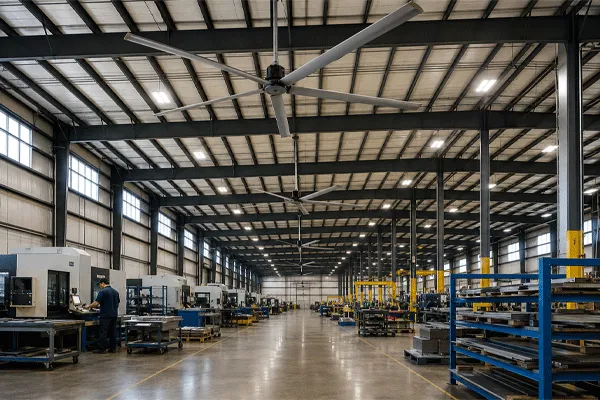
A large industrial ceiling fan can improve air movement across occupied work zones and support existing cooling equipment.
This makes it a practical addition to metal processing plants, equipment assembly workshops, packaging facilities, and general manufacturing buildings.
Warehouses and logistics centers
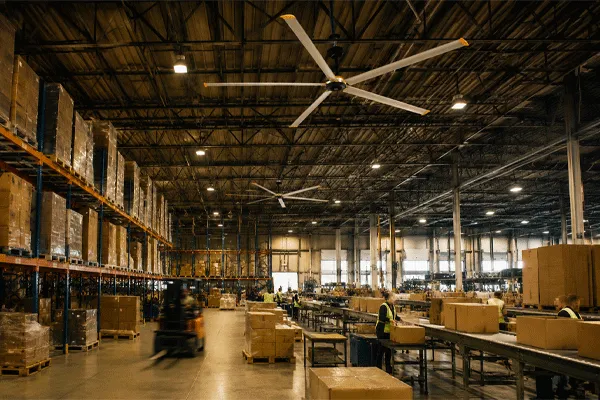
Warehouse ceiling fans help circulate air in open storage areas, goods-handling zones, and distribution facilities.
For buildings with tall storage racks, fan positioning should account for obstructions and fire protection requirements.
Agricultural and livestock buildings
Agricultural buildings may need continuous air movement to support temperature management and reduce stagnant conditions.
However, livestock and greenhouse applications require careful consideration of air speed, humidity, biological needs, and ventilation rates.
Commercial and public buildings
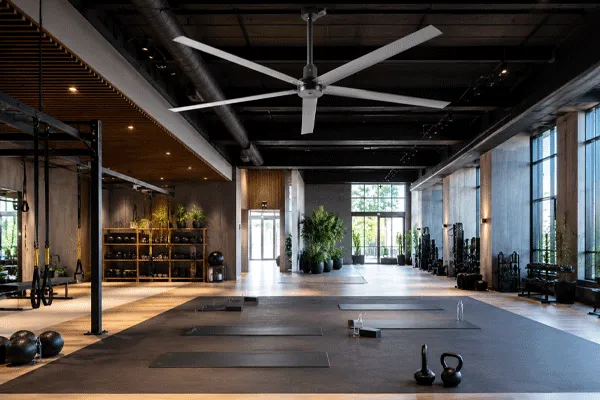
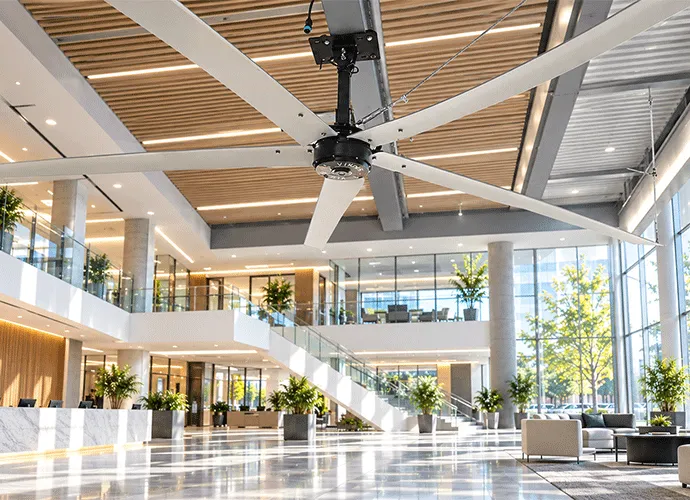
Large commercial facilities, exhibition centers, shopping malls, and sports venues can also benefit from broad air circulation.
A commercial ceiling fan should be selected with particular attention to occupant comfort, appearance, sound, and building integration.
|
Applicazione
|
Primary Requirement
|
| Manufacturing facility |
Worker comfort and process-compatible circulation |
| Logistics center |
Wide-area air movement |
| Agricultural building |
Climate management support |
| Centro sportivo |
Comfortable spectator and activity areas |
| Shopping mall |
Quiet operation and attractive design |
| Food processing facility |
Suitable hygienic design and process compliance |
The same fan configuration will not suit every application. A commercial industrial project, for example, may prioritize appearance and quiet performance, while a demanding manufacturing environment may place greater weight on durability and control integration.
9. What Safety Features Should Industrial Ceiling Fans Have?
Safety should be a primary consideration when installing heavy equipment above occupied industrial areas.
An industrial ceiling fan requires a mounting system compatible with the building’s structural design and the loads specified by the manufacturer.
Buyers should review how the fan attaches to the supporting structure, how the blades are secured, and what protective measures are available.
Important installation and safety requirements
-
Structural load assessment and appropriate mounting hardware.
-
Reliable blade retention and secondary safety provisions.
-
Suitable electrical protection and grounding.
-
Required clearance from machinery, lighting, and occupied areas.
-
Coordination with sprinkler systems.
-
Accessible emergency shutdown controls.
-
Qualified installation and periodic inspection.
HVLS equipment must not interfere with sprinkler effectiveness. The applicable design requirements should be reviewed by the fire protection engineer and local authority.
Why performance testing matters
Fan performance should also be supported by credible measurement methods.
When comparing products, buyers should request clear performance documentation rather than relying only on marketing descriptions such as giant industrial or heavy-duty.
Relevant information may include electrical input, measured performance, speed range, mounting instructions, and applicable safety documentation.
10. Top Picks: How to Choose the Best Large Industrial Ceiling Fans for Your Project
The best large industrial ceiling fans are not necessarily the largest or most expensive models.
They are the products that suit the actual building, operating schedule, budget, and long-term maintenance requirements.
For this reason, we recommend selecting equipment by application rather than relying on a generic ranking.
Recommended fan configurations by application
| Project Requirement |
Recommended Fan Category |
Main Advantage |
| Broad, open manufacturing floor |
Large-diameter HVLS system |
Wide-area circulation |
| Medium-sized production area |
Mid-size industrial model |
Flexible positioning |
| High-ceiling logistics building |
Large HVLS system |
Supports broad air distribution |
| Shopping center or exhibition hall |
Commercial-oriented model |
Comfort and appearance |
| Building with centralized controls |
Intelligent variable-speed system |
Flexible operating schedules |
| Agricultural facility |
Application-specific circulation fan |
Supports climate management |
These are category recommendations, not a ranking of verified individual products.
Are bigger fans always better?
Non necessariamente.
A big ceiling fan can be effective in a spacious, unobstructed building, but big ceiling fans are not automatically suitable for smaller workshops.
The relationship between diameter, mounting height, and operating speed matters considerably.
Likewise, equipment marketed as a silver ceiling fan, style ceiling fan, or blade ceiling fan may have visual appeal, but appearance is not a substitute for industrial performance testing.
Features such as a ceiling fan with light, industrial LED ceiling fan, or industrial ceiling fan with light can be useful in certain commercial environments. However, integrated lighting should be evaluated separately from the fan’s primary circulation performance.
For heavy industrial use, priority should remain on mechanical reliability, safe mounting, electrical protection, and controllable operation.
What should you ask an industrial ceiling fan supplier?
Before purchasing, request clear answers to these questions:
-
What diameter and mounting arrangement suit our building?
-
What motor configuration does the proposed model use?
-
Is the published performance based on a recognized testing method?
-
What installation and structural documentation is supplied?
-
Can the system integrate with our existing building controls?
-
What maintenance and after-sales support are available?
-
Is the equipment suitable for our environmental conditions?
A product described as a motor remote control ceiling fan may provide convenient local operation, but buyers should also confirm whether it supports broader intelligent control requirements.
The right industrial ceiling fan should fit both the physical building and its day-to-day operating needs.
11. Why Work With a Sino-US Joint Venture Industrial Ceiling Fan Manufacturer?
Selecting an industrial ceiling fan supplier is an important part of achieving a reliable cooling solution.
Product specifications matter, but so do application guidance, communication, and the ability to coordinate equipment selection with the requirements of an industrial project.
As a Sino-US joint venture manufacturer and solution provider, we specialize in HVLS fans, industrial ceiling fans, commercial ceiling fans, large industrial fans, and intelligent airflow control systems.
Our focus is to help B2B customers identify practical air circulation solutions for industrial, commercial, agricultural, logistics, sports, and large-building applications.
Our approach to industrial cooling projects
We believe selecting the right equipment starts with understanding the building.
A production workshop may require circulation that supports workers near machinery. A logistics center may prioritize wide-area coverage. A commercial development may place greater importance on quiet operation and control integration.
We work around these different project needs rather than treating every installation as identical.
Our solution approach considers:
-
Building dimensions and installation conditions.
-
Application-specific air circulation requirements.
-
Fan size and configuration selection.
-
-
Intelligent airflow control requirements.
-
Coordination with existing ventilation and HVAC systems.
For project developers, distributors, facility owners, and engineering contractors, this application-focused process supports more informed purchasing decisions.
Request an industrial ceiling fan solution for your facility
Planning a new cooling system or upgrading an existing industrial building?
Contact our team with your building dimensions, installation height, application, and operating requirements.
We can discuss suitable ceiling fan configurations and help you evaluate the equipment options for your project.
Whether you need a single large fan or an integrated air circulation solution, contact us to discuss your requirements and request a quotation.
Domande frequenti sui ventilatori industriali da soffitto
Do large industrial ceiling fans actually lower room temperature?
No. A ceiling fan does not actively refrigerate indoor air. It creates air movement that helps people feel cooler and improves circulation throughout the building. When combined with an appropriate HVAC strategy, it may also help reduce cooling demand.
How many industrial ceiling fans do I need for my warehouse?
The required number depends on floor area, ceiling height, building layout, equipment obstructions, and desired air movement. A professional layout assessment is the most reliable way to determine suitable fan quantities and installation positions.
What is CFM in industrial ceiling fan specifications?
CFM stands for cubic feet per minute. It describes the volume of air moved by a fan under specified testing conditions. Buyers should compare CFM figures obtained through consistent, recognized methods rather than assuming that the highest advertised number guarantees the best performance.
Are industrial ceiling fans suitable for outdoor use?
Only when the specific equipment is rated for outdoor use and the installation complies with its environmental and mounting requirements. A standard indoor ceiling fan should not automatically be considered suitable for exposed locations. For indoor and outdoor applications, confirm protection against moisture, corrosion, and other relevant conditions with the manufacturer.
Can an HVLS fan operate during winter?
Yes. Low-speed operation can help redistribute warm air that collects near high ceilings. This process supports temperature balance in heated buildings. The appropriate fan setting depends on the heating system, building design, and occupant comfort requirements.
What is the difference between an industrial ceiling fan and a commercial ceiling fan?
Industrial equipment typically emphasizes wide-area circulation, structural durability, and demanding operating environments. Commercial models may place greater emphasis on appearance, acoustics, and integration with occupied public spaces. However, actual capabilities depend on each product’s specifications.
Conclusion: Choosing the Right Large Industrial Ceiling Fan
Large industrial ceiling fans provide a practical way to improve comfort and air circulation in manufacturing plants, warehouses, logistics centers, and other large buildings.
Their value comes from moving air effectively, supporting existing HVAC systems, and helping building operators manage indoor conditions.
Whether you are upgrading an existing facility or planning a new industrial project, careful equipment selection is essential.
Punti chiave
-
Large industrial ceiling fans improve comfort through widespread air circulation.
-
HVLS technology moves substantial quantities of air at relatively low rotational speeds.
-
A ceiling fan can complement mechanical cooling but does not replace fresh-air ventilation or process extraction.
-
Correct sizing depends on building dimensions, mounting height, obstructions, and application needs.
-
Motor efficiency, blade construction, controls, and maintenance requirements influence long-term ownership costs.
-
Structural mounting and sprinkler coordination should be reviewed before installation.
-
Intelligent airflow controls can help align fan operation with changing building requirements.
-
Working with an experienced manufacturer can help buyers identify suitable equipment for their projects.
Looking for an industrial ceiling fan solution? Contact our team to discuss your facility’s cooling challenges, request product information, and explore an industrial airflow solution tailored to your building.