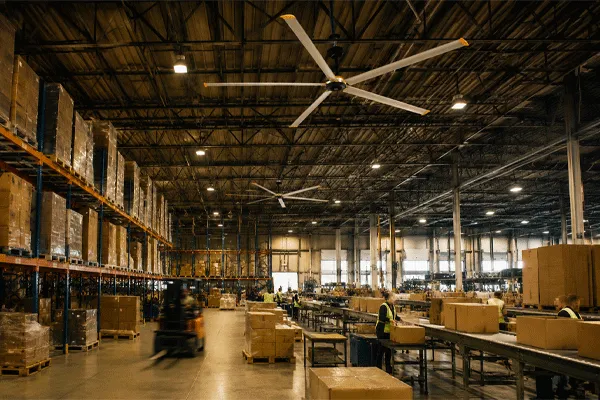
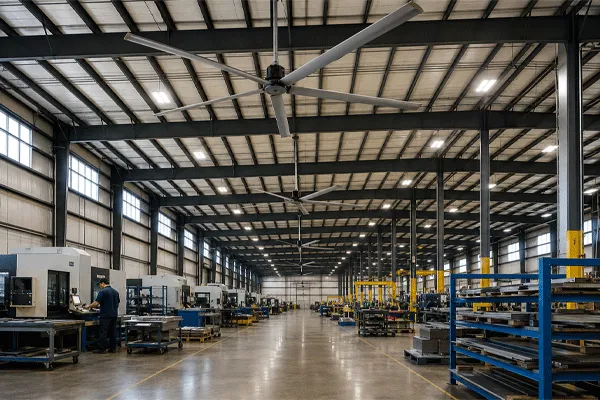
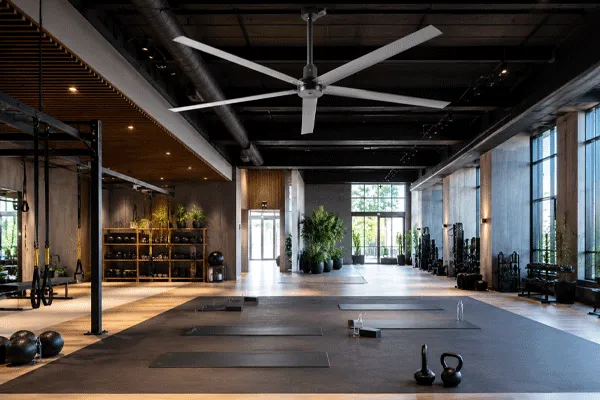
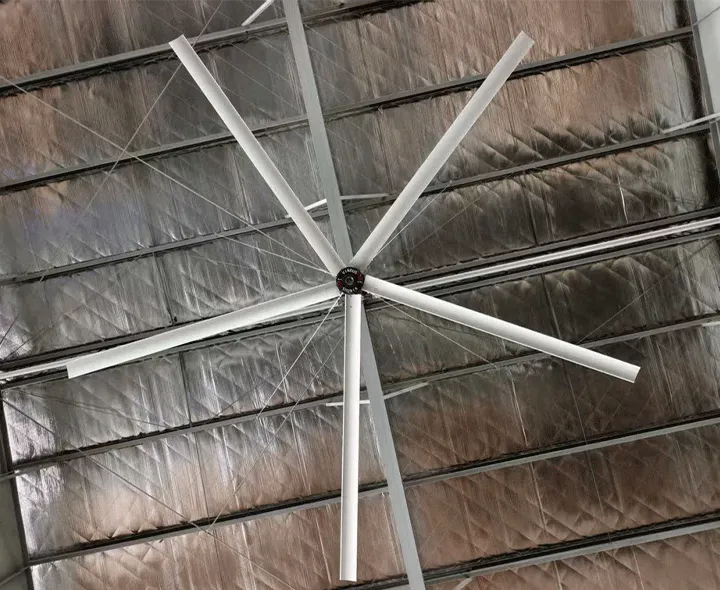
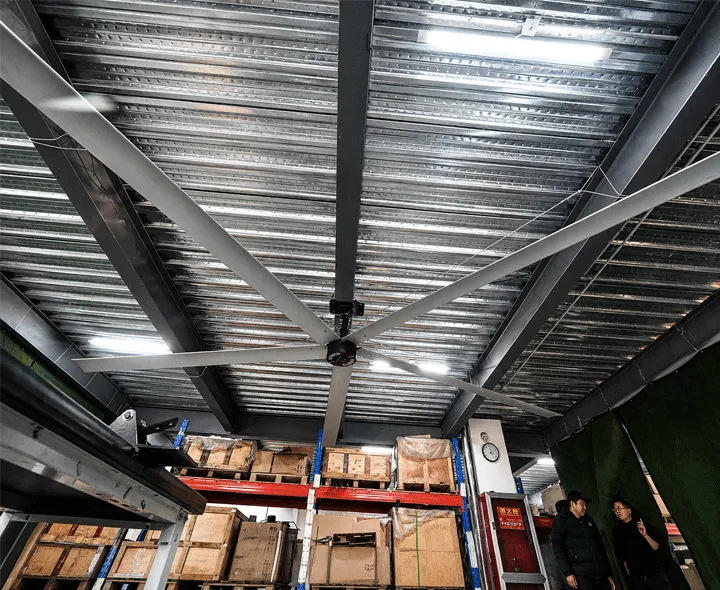
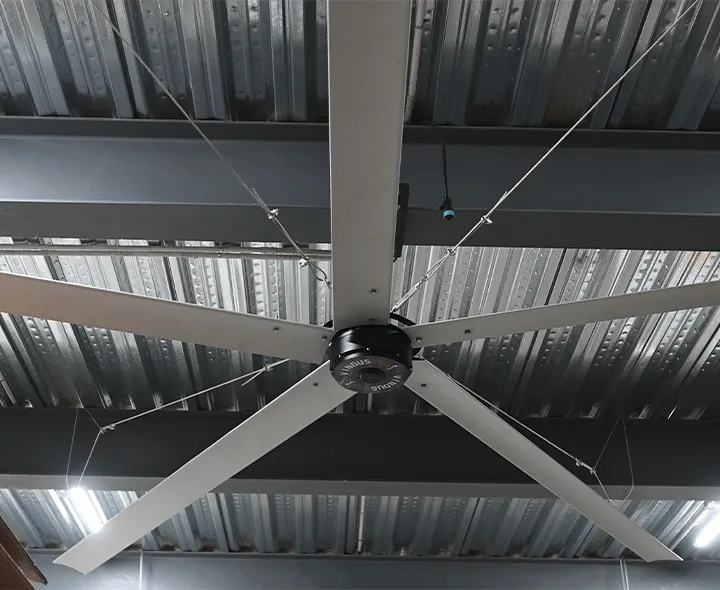
Una palestra affollata può diventare rapidamente calda, soffocante e scomoda. I soffitti alti trattengono l’aria calda, mentre le aree di allenamento affollate aggiungono calore e umidità. L’aggiunta di molti piccoli ventilatori può creare rumore senza risolvere il problema dell’intero ambiente. Un ventilatore HVLS scelto correttamente può fornire un flusso d’aria di raffrescamento ampio e costante.
I grandi ventilatori industriali a soffitto rinfrescano le palestre muovendo lentamente grandi volumi d'aria su ampie superfici. Un Ventilatore da soffitto HVLS aumenta la velocità dell’aria intorno agli occupanti, migliora la circolazione dell’aria, riduce le zone stagnanti e può integrare i sistemi HVAC. Il ventilatore migliore dipende dalle dimensioni della palestra, dall’altezza del soffitto, dal diametro, dal numero di occupanti, dagli ostacoli, dagli obiettivi relativi alla rumorosità e dal flusso d’aria richiesto, non soltanto dalle dimensioni del ventilatore.
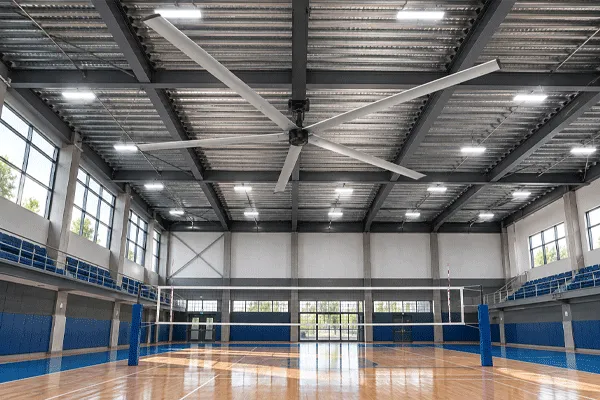
Grandi ventilatori industriali a soffitto per raffrescare le palestre: guida alla scelta dei ventilatori HVLS
Per i proprietari di palestre, gli sviluppatori di centri sportivi, gli installatori di impianti HVAC e i gestori di edifici commerciali, la vera domanda non è semplicemente: «Quanto deve essere grande il ventilatore?». Occorre sapere dove si allenano le persone, quanto è alto il soffitto, come entra nella sala l’aria climatizzata e dove si accumula il calore.
In qualità di produttore di una joint venture sino-americana e fornitore di soluzioni per la circolazione dell'aria, siamo specializzati in ventilatori HVLS, ventilatori industriali da soffitto, ventilatori commerciali da soffitto, grandi ventilatori industriali e sistemi intelligenti di controllo della circolazione dell'aria. Progettiamo soluzioni per centri sportivi, magazzini, stabilimenti industriali, strutture logistiche, centri commerciali, agricoltura e altri grandi ambienti in cui comfort e consumo energetico sono importanti.
Perché i grandi ventilatori industriali a soffitto sono utili in una palestra?
Una palestra di grandi dimensioni presenta una complessa sfida di raffrescamento. Durante l'attività fisica, le persone producono calore corporeo. Le attrezzature cardio, l'illuminazione, le finestre e le condizioni esterne ne aggiungono altro. Se il soffitto è alto, l'aria calda può accumularsi anche molto al di sopra della zona occupata.
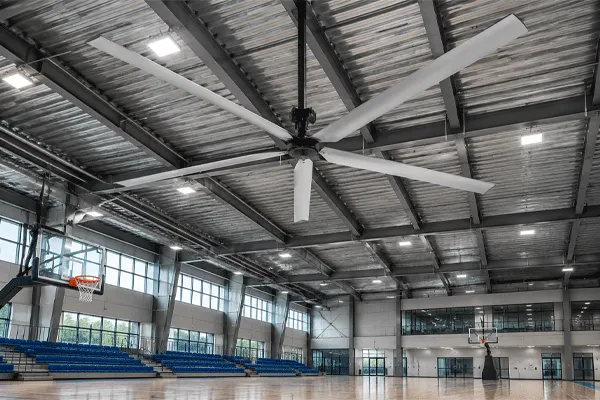
Un ventilatore HVLS risolve il problema creando un ampio e delicato movimento dell’aria. Invece di concentrare un getto potente su un singolo tapis roulant o su una panca per i pesi, distribuisce l’aria su un’area molto più vasta.
Le linee guida ASHRAE spiegano che una maggiore velocità dell'aria può migliorare il comfort termico in condizioni di caldo, poiché l'aria in movimento aumenta la dispersione di calore dalla pelle. Questo è uno dei motivi per cui un grande ventilatore a soffitto può far percepire agli occupanti una temperatura più fresca, anche se la temperatura effettiva a bulbo secco dell'ambiente varia di poco.
Per i grandi edifici sportivi, questa distinzione è importante:
Un ventilatore non crea aria refrigerata. Aiuta le persone a scambiare calore con l’aria circostante in modo più efficace.
Questo rende un ventilatore HVLS a soffitto particolarmente utile quando le ampie aree occupate necessitano di una circolazione uniforme anziché di un intenso raffrescamento localizzato.
Che cos’è un ventilatore HVLS e come raffresca un ambiente di grandi dimensioni?
HVLS significa alto volume e bassa velocità.
Un sistema HVLS utilizza un diametro elevato e un numero di giri relativamente basso per muovere notevoli quantità d’aria attraverso un’ampia area. L’aria si muove verso il basso sotto il ventilatore, raggiunge la zona occupata e si diffonde sul pavimento.
AMCA definisce un ventilatore da soffitto di grande diametro come un ventilatore con un diametro alla punta delle pale di almeno 84,5 pollici nel suo attuale standard di prova. La normativa statunitense utilizza generalmente un diametro superiore a 7 piedi per i ventilatori da soffitto di grande diametro. I prodotti HVLS rientrano in questa più ampia categoria di grandi ventilatori, ma presentano caratteristiche prestazionali specifiche.
L'ampia area di spazzamento consente a un solo ventilatore di influenzare una zona molto più estesa rispetto a numerosi piccoli ventilatori elettrici convenzionali.
Ecco perché i sistemi HVLS sono comuni anche in:
- centri sportivi;
- edifici adibiti a magazzino;
- centri di distribuzione;
- stabilimenti produttivi;
- spazi di aeroporti o hangar per la manutenzione;
- officine automobilistiche;
- saloni commerciali;
- grandi edifici agricoli, come un fienile.
L’idea di base rimane la stessa: muovere più aria in uno spazio più ampio senza dipendere da un flusso d’aria stretto ad alta velocità.
In che modo un ventilatore a soffitto fa sentire più freschi gli utenti della palestra?
Immagina di uscire all'aperto in una giornata calda.
In assenza di vento, si percepisce più caldo. Quando inizia a soffiare una brezza, la temperatura può rimanere esattamente la stessa, ma spesso ci si sente più a proprio agio.
Un ventilatore da soffitto per palestra funziona secondo lo stesso principio di base.
L'aria in movimento aumenta il trasferimento di calore convettivo ed evaporativo dal corpo. Per chi cammina lentamente, solleva pesi o usa un tapis roulant, questo flusso d'aria aggiuntivo può migliorare il comfort.
Le indicazioni ASHRAE sul comfort termico consentono specificamente velocità dell’aria più elevate per ampliare l’intervallo di condizioni che gli occupanti possono percepire come confortevoli. Il beneficio effettivo dipende dalla temperatura, dalle condizioni radianti, dall’abbigliamento, dal livello di attività, dall’umidità e dalla velocità dell’aria.
Questo è importante perché l’intensità dell’esercizio varia notevolmente.
Un'area yoga può richiedere un flusso d'aria delicato.
Un’area dedicata ai pesi liberi potrebbe aver bisogno di qualcosa in più.
Una zona di allenamento ad alta intensità può richiedere una strategia di flusso d'aria completamente diversa.
Pertanto, un buon sistema di ventilatori HVLS non dovrebbe investire ogni persona con la stessa brezza intensa. Dovrebbe creare una circolazione ampia e offrire all’operatore utili opzioni di controllo.
Ventilatore HVLS a confronto con il ventilatore industriale tradizionale: quale è migliore per una palestra?
Nessuna delle due tecnologie è la scelta migliore in ogni applicazione.
Un ventilatore industriale tradizionale è spesso utile quando serve un flusso d'aria concentrato in un'area circoscritta. I modelli a parete, quelli a piantana e i ventilatori assiali possono dirigere l'aria verso una zona specifica.
Un sistema HVLS è più adatto a una copertura ampia.
| Caratteristica |
Ventilatore HVLS |
Ventilatore industriale ad alta velocità |
| Schema principale del flusso d'aria |
Ampia e distribuita |
Mirato |
| Modalità di funzionamento tipica |
Alto volume, bassa velocità |
Flusso d’aria locale a velocità più elevata |
| Impiego ideale |
Circolazione dell'aria nell'intero ambiente |
Raffrescamento localizzato |
| Potenziale rumorosità |
Spesso più basso alle normali velocità operative |
Può aumentare con la velocità |
| Copertura |
Ampi spazi a pavimento |
Zone più piccole e mirate |
| Installazione |
Sopra la testa |
Parete, pavimento, colonna, soffitto |
| Disordine visivo |
Potrebbero essere necessarie meno unità |
Potrebbe essere necessario installare più unità |
In una grande sala di allenamento aperta, un grande ventilatore industriale a soffitto può occuparsi della circolazione generale dell’aria, mentre unità più piccole servono le aree specifiche.
È simile a ciò che vediamo nei progetti industriali. Il nostro ventilatori HVLS per stabilimenti industriali utilizzano un'ampia circolazione dell'aria per l'intero edificio, mentre i ventilatori locali gestiscono le singole postazioni di lavoro quando necessario.
La stessa logica può funzionare all’interno di un centro sportivo.
Qual è il diametro migliore per un ventilatore in una palestra?
Non esiste una risposta universale.
I ventilatori HVLS sono disponibili in un’ampia gamma di dimensioni. A seconda della serie di prodotti e dei requisiti del progetto, gli acquirenti possono prendere in considerazione modelli commerciali relativamente compatti fino a ventilatori molto grandi, da 8 a 24 piedi.
Si possono incontrare ricerche come:
- HVLS da 8 piedi;
- ventilatore HVLS da 14 piedi;
- Ventilatore HVLS da 20 piedi;
- grande ventilatore da palestra;
- ventilatore HVLS da piedi;
- Ventilatore da soffitto HVLS di grandi dimensioni.
Ma il solo diametro non dovrebbe mai determinare la scelta.
Considerate due centri sportivi con la stessa superficie.
Il primo ha un tetto libero da ostacoli alto 30 piedi, con pochissime ostruzioni.
La seconda ha un soffitto più basso, canestri da basket, tabelloni segnapunti, strutture di illuminazione, condotte dell'aria, altoparlanti e travi strutturali.
Un ventilatore da 20 piedi può funzionare bene in uno ed essere inadatto nell'altro.
Tra i fattori importanti figurano:
| Fattore di scelta |
Perché è importante |
| Diametro del ventilatore |
Influisce sull'area di spazzamento e sulla copertura |
| Altezza del soffitto |
Influisce sul montaggio e sulla distribuzione dell'aria |
| Disposizione dei campi e delle attrezzature |
Determina le zone in cui il flusso d'aria può circolare |
| Condotte dell'aria |
Possono ostacolare le pale e il flusso d'aria |
| Illuminazione |
Richiede una distanza di sicurezza |
| Irrigatori |
Deve essere considerato durante la progettazione |
| Posti a sedere |
Modifica le esigenze di capienza e comfort |
| Posizioni delle bocchette dell’impianto HVAC |
Influenza i modelli di circolazione |
La scelta corretta di un ventilatore da soffitto parte dalla planimetria dell'edificio, non da una tabella dei diametri.
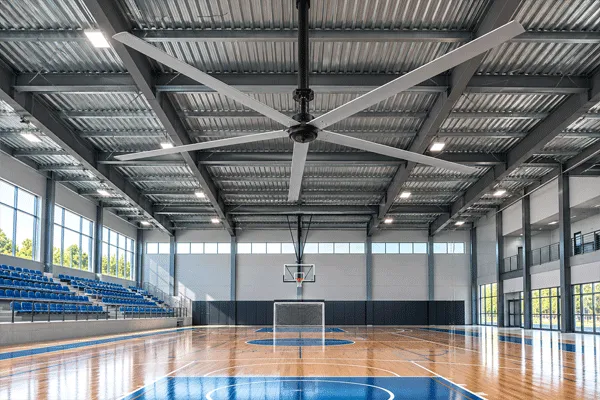
Grandi ventilatori industriali a soffitto per raffrescare le palestre: guida alla scelta dei ventilatori HVLS
In che modo l’altezza del soffitto influisce su un ventilatore a soffitto HVLS?
L’altezza del soffitto è una delle prime misure che i nostri ingegneri richiedono.
Un soffitto alto offre a un ventilatore di grandi dimensioni lo spazio per sviluppare un'ampia circolazione dell'aria, ma anche la posizione e l'altezza di montaggio del ventilatore sono importanti. Installare l'unità troppo in alto, troppo in basso o vicino a ostacoli importanti può ridurre la distribuzione utile dell'aria.
La relazione non è semplicemente questa:
Soffitto più alto = ventilatore più grande.
Un soffitto alto 24 piedi sopra una sala di allenamento aperta può consentire una certa configurazione. La stessa altezza sopra posti a sedere disposti su più livelli, attrezzature per arrampicata o capriate strutturali può richiedere una soluzione diversa.
Quando valutiamo un progetto, consideriamo:
- altezza del soffitto finito;
- elemento strutturale più basso;
- luci e altoparlanti;
- condotte dell'impianto HVAC;
- canestri da basket;
- reti;
- tabelloni segnapunti;
- impianti sprinkler;
- attrezzature sportive mobili;
- accesso per la manutenzione.
Per questo motivo, la scelta di un ventilatore industriale da soffitto HVLS deve tenere conto del diametro del ventilatore, della posizione di montaggio, degli spazi liberi e del flusso d'aria previsto nella zona occupata.
L'obiettivo non è riempire il tetto con il ventilatore più grande possibile.
L’obiettivo è portare aria utile dove le persone si allenano effettivamente.
Una palestra dovrebbe usare 5 pale o un'altra configurazione?
Gli acquirenti si concentrano spesso sul numero di pale.
They may search for 5 blades, six-blade designs, or other configurations and assume that more blades always mean more airflow.
That is too simple.
The blade profile, pitch, diameter, hub design, motor, rotational speed, and control system work together. A fan with fewer highly engineered airfoils may perform very differently from a fan with more blades.
You should therefore compare actual performance data rather than appearance.
A useful B2B evaluation should ask:
- What tested airflow performance is available?
- What is the fan’s efficiency?
- At what rpm was the rating measured?
- How does performance change with speed?
- How is each blade attached?
- What safety retention system is provided?
- Is the performance independently verified?
AMCA maintains certified performance programs for large-diameter ceiling fans, and its current HVLS guidance emphasizes standardized testing and verified performance data.
This matters more than simply choosing an attractive big size fan.
PMSM Motor vs. Traditional Drive: What Should Gym Owners Consider?
Motor design affects efficiency, noise, maintenance, weight, and control.
A PMSM motor, or permanent magnet synchronous motor, is commonly used in modern direct-drive fan designs because it can provide efficient variable-speed operation without some of the mechanical components found in traditional geared drive systems.
For gym applications, buyers often care about:
- smooth speed control;
- low operating sound;
- reduced maintenance;
- compact drive design;
- energy efficiency;
- reliable low-speed operation.
A PMSM design can be a strong option, but you should still evaluate the entire fan rather than selecting it from the motor label alone.
Precision engineering across the motor, controller, blades, hub, mounting system, and software determines the final performance.
As manufacturers, we also consider how the fan will operate with other equipment. An intelligent controller may allow speed changes by schedule, temperature, or building zone instead of running every fan at maximum output.
That is where energy saving becomes a system-level discussion rather than a motor-marketing claim.
Can Industrial Ceiling Fans Reduce Gym HVAC Costs?
Potentially, yes—but there is no single savings percentage that applies to every building.
A large ceiling fan can support an HVAC system in two main ways.
First, during warm conditions, increased air speed may allow occupants to remain comfortable at conditions that would otherwise feel too warm. ASHRAE recognizes elevated air speed as an important thermal-comfort variable.
Second, in cooler seasons, slow fan operation can mix warm air that collects near a high ceiling with cooler air below. This process is called destratification.
AMCA notes that large-diameter ceiling fans are used for cooling effects, air mixing, and destratification in commercial, industrial, agricultural, and other buildings.
A simple building-energy relationship is:
Fan Energy Use = Input Power × Operating Hours
But total savings require a wider calculation:
Total Building Impact = Fan Energy + HVAC Energy Change + Operating Schedule + Climate + Occupancy
That is why we do not promise a fixed HVAC saving without project data.
Un efficiente ventilatori da soffitto industriali layout should complement the HVAC design instead of fighting against it.
How Can HVLS Fans Improve Air Circulation in a Large Gym?
A large sports building can develop stagnant air even when mechanical ventilation is installed.
Air may move well around supply diffusers but poorly in the center of a court. Equipment zones may block circulation. Upper-level warm air may remain separated from lower zones.
An HVLS fan creates a much larger circulation pattern.
The fan moves air downward. When it approaches the occupied zone, that air spreads outward. The process supports air circulation across wide areas and encourages greater mixing within the room.
This is particularly useful in:
- basketball courts;
- indoor training halls;
- badminton centers;
- tennis buildings;
- fitness clubs;
- indoor sports arenas;
- large school gyms;
- commercial recreation centers.
For buildings that need more than simple circulation, a complete ventilatori commerciali strategy can combine HVLS equipment with exhaust systems, air conditioning, sensors, and other ventilation equipment.
Remember the difference:
Circulation moves indoor air. Ventilation replaces indoor air. HVAC conditions indoor air.
A good gym may need all three.
Grandi ventilatori industriali a soffitto per raffrescare le palestre: guida alla scelta dei ventilatori HVLS
What Is the Difference Between a Commercial Ceiling Fan and Industrial HVLS Fan?
A commercial ceiling fan may be designed for restaurants, retail stores, studios, offices, hospitality spaces, or moderate-size fitness facilities.
An industrial HVLS system usually targets much larger floor areas, higher mounting positions, and more demanding duty cycles.
That does not mean every gym needs industrial equipment.
A boutique studio with a moderate ceiling may need a different product from a 5,000 m² sports complex.
| Applicazione |
Typical Direction |
| Small fitness studio |
Commercial ceiling system |
| Boutique gym |
Commercial/HVLS depending on layout |
| Large training hall |
Alto livello di voltura |
| Indoor basketball center |
Grandi HVLS |
| Multi-court sports hall |
Multiple HVLS zones |
| Warehouse-style gym |
Industrial HVLS |
| Arena auxiliary space |
Application-specific |
A commercial ceiling fan is therefore not automatically better or worse than a larger industrial unit.
It serves a different range of applications.
The right choice depends on air circulation needs, room dimensions, ceiling structure, noise limits, and occupancy.
How Important Is Noise in a Gym Ceiling Fan?
Noise can easily be overlooked during fan purchasing.
In a factory, moderate equipment noise may blend into the background. In a yoga studio, coaching space, premium fitness club, or indoor sports venue, the same sound can become distracting.
A buyer may encounter generic internet claims such as 70 to 85 decibels, but such numbers should not be assumed for every product or installation.
Ask for actual fan-specific acoustic information when noise matters.
Sources of fan sound may include:
- motor operation;
- gearbox operation;
- aerodynamic blade noise;
- structural vibration;
- electrical switching;
- poor mounting;
- excessive operating speed.
A high-quality HVLS fan should be selected around the required performance at practical operating speeds.
This is another reason not to compare products only by maximum airflow.
If the fan only reaches the required performance at an undesirable noise level, it may not be the correct solution for the gym.
How Should HVLS Fans Work With Ventilation and HVAC?
The fan should be part of the building system.
Suppose an air-conditioned fitness center already has supply diffusers around the perimeter. If large circulation fans are positioned correctly, they can help distribute conditioned air more evenly.
But poor positioning can interfere with other air patterns.
That is why cooling and ventilation should be reviewed together.
Our normal engineering questions include:
- Where are HVAC supply diffusers?
- Where are return-air grilles?
- Is outdoor-air ventilation mechanical or natural?
- Where do people gather?
- Which zones run hottest?
- Does the building have large exterior doors?
- What hours is the facility occupied?
- Are different zones conditioned separately?
The answers help determine whether the fan should run continuously or change speed throughout the day.
A smart system may use temperature sensors and schedules so a ceiling fan does not operate harder than necessary.
Why Are HVLS Fans Different From Warehouse Fans?
The equipment may be similar, but the design priorities can be different.
In a warehouse, the main concerns may include employee comfort, rack obstructions, loading doors, stored goods, and aisle airflow.
In a gym, human comfort becomes even more important because occupants are exercising.
A ceiling fan for warehouse applications may prioritize broad worker-area coverage, while a sports facility may require more careful control over drafts near seating, courts, or low-activity zones.
Our warehouse fans use the same core airflow-engineering principles but apply them to logistics layouts.
This distinction is important for buyers comparing hunter fans, hunter industrial products, general ventilatori da magazzino, a Titan HVLS ceiling fan, or other fan manufacturers.
Brand searches can help you build a shortlist.
Engineering data should make the final decision.
What Should You Look for in a Large Industrial HVLS Ceiling Fan?
Price matters, but price alone is a poor specification.
Searching for a cheap industrial fan may lead to a low initial purchase price but does not tell you anything about airflow performance, motor efficiency, safety, control capability, durability, or support.
For a serious commercial project, compare:
- tested airflow;
- fan diameter;
- motor efficiency;
- drive type;
- safety retention systems;
- blade design;
- controller functions;
- installation requirements;
- maintenance;
- warranty;
- replacement-part availability;
- technical support.
AMCA’s current program for HVLS products relies on standardized test methods and verification so performance ratings can be evaluated on a consistent basis.
This is particularly useful for global B2B buyers.
A large fan may run thousands of hours over its service life. Purchase price represents only one part of the total cost.
The better question is:
What airflow performance, reliability, control, efficiency, and support am I buying for the project?
What Does the Installation Process Involve?
The installation process begins well before a technician lifts the fan toward the ceiling.
Large fans require structural and clearance review.
A professional project should examine:
- mounting structure;
- fan weight;
- ceiling geometry;
- blade clearance;
- sprinklers;
- lighting;
- tabelloni segnapunti;
- reti;
- canestri da basket;
- HVAC ducts;
- electrical supply;
- emergency equipment;
- access for future maintenance.
The exact requirements depend on the fan model and local building and fire rules.
This means easy installation should never mean skipping engineering review.
When we prepare a project, we use building dimensions and layout information to recommend the fan position before installation begins. This reduces interference with other systems and makes the final airflow more predictable.
For complex facilities, intelligent HVLS industrial systems can also coordinate several fan zones from one control platform.
A Practical Gym Cooling Example
Consider a large warehouse-style fitness center.
It has a high metal roof, several exercise zones, cardio equipment along one wall, free weights in the center, and an HVAC system that struggles during busy summer afternoons.
The operator is considering several high-speed fans.
Before adding equipment, we would first map the problem.
Step 1: Measure the space
Record floor dimensions, ceiling height, structural beams, HVAC ducts, and exercise zones.
Step 2: Identify heat zones
Look at sunny walls, cardio areas, crowded training zones, and upper-level heat accumulation.
Step 3: Review existing ventilation
Confirm outdoor-air supply, exhaust, and HVAC return locations.
Step 4: Determine useful fan diameter
Compare one very large ceiling fan with several medium-size HVLS units.
Step 5: Check obstacles
Sports equipment, lighting, speakers, and ductwork may alter the design.
Step 6: Create operating zones
A low-activity stretching area should not necessarily receive the same air velocity as a crowded functional-training zone.
Step 7: Add intelligent controls
Schedule speeds according to occupancy and thermal conditions.
This approach produces a solution rather than simply filling the roof with big industrial fans.
That is how we approach both sports facilities and commercial ceiling applications: understand the people, the building, and the required airflow first.
Frequently Asked Questions About Big Industrial Ceiling Fans for Gyms
What size HVLS fan is best for a gym?
There is no universal size. Fan diameter depends on floor dimensions, ceiling height, obstructions, activity zones, desired air velocity, and the number of fans. A building drawing is more useful than a generic size chart.
Can an HVLS ceiling fan replace air conditioning?
No. An HVLS ceiling fan for cooling mainly increases air velocity and circulation. It can improve perceived comfort and complement air conditioning, but it does not provide refrigeration like an HVAC system.
Is a 20-foot HVLS fan too large for a gym?
Not necessarily. A 20 foot HVLS fan may work in a large open sports facility with sufficient mounting height and clearance. In a smaller or more obstructed room, several smaller units may create better coverage.
Are HVLS fans energy efficient?
HVLS technology can move broad volumes of air at relatively low rotational speeds. However, high efficiency depends on the actual motor, controller, fan design, operating speed, and system layout. Compare verified performance data rather than diameter alone.
How many ceiling fans does a gym need?
The number depends on the building shape, fan diameter, mounting height, required coverage, obstructions, and airflow targets. One fan may suit one open room, while a multi-court building may need several independently controlled zones.
Can HVLS fans run with air conditioning?
Yes. Properly designed HVLS systems can operate alongside HVAC equipment. The key is to position and control the fans so their airflow complements supply and return patterns rather than disturbing them.
Choose a Gym Fan Based on Airflow, Not Just Big Size
A big industrial ceiling fan can dramatically change how a large gym feels, but size alone does not guarantee comfort.
A successful project connects five things:
building dimensions + ceiling height + fan performance + HVAC design + occupant needs
That combination matters more than a brand name, blade count, or maximum diameter.
As a Sino-US joint venture manufacturer and solution provider, we develop HVLS fans, industrial and commercial ceiling fans, large industrial airflow equipment, and intelligent control systems for sports buildings, warehouses, manufacturing plants, logistics centers, agricultural facilities, malls, and other large spaces.
For a gym project, we recommend starting with a floor plan.
Show us the room dimensions, ceiling height, HVAC arrangement, exercise zones, obstacles, and the problem you want to solve. From there, we can determine fan diameter, quantity, position, speed strategy, and control requirements.
That approach gives you something much more useful than simply buying the biggest fan available.
Aspetti fondamentali da ricordare
- HVLS fans use high-volume, low-speed airflow to serve large occupied areas.
- A gym ceiling fan improves perceived cooling mainly through increased air speed.
- A fan supports HVAC; it does not replace refrigeration or required outdoor-air ventilation.
- Ceiling height and fan diameter must be considered together.
- More blades do not automatically mean more airflow.
- PMSM systems can offer efficient variable-speed operation, but total fan design matters more than motor type alone.
- Large fans can help reduce stagnant zones and improve circulation.
- Different workout zones may need different air speeds.
- Noise matters in premium gyms, studios, coaching spaces, and sports centers.
- Installation must consider structure, sprinklers, lighting, HVAC ducts, and sports equipment.
- Winter low-speed operation can support destratification in suitable high-ceiling spaces.
- Compare tested performance, efficiency, safety, controls, service, and total operating cost—not purchase price alone.
- The best large industrial HVLS ceiling fan is the one designed around your actual building and comfort target.