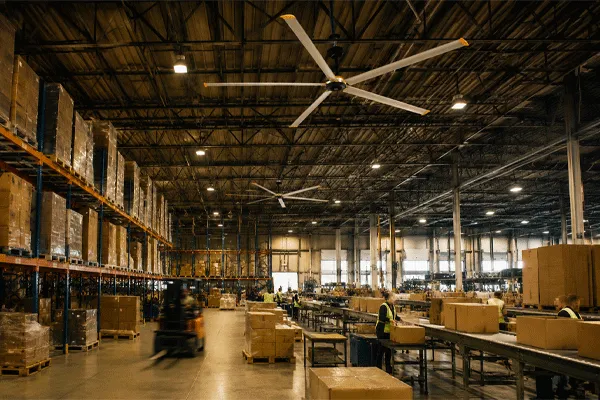
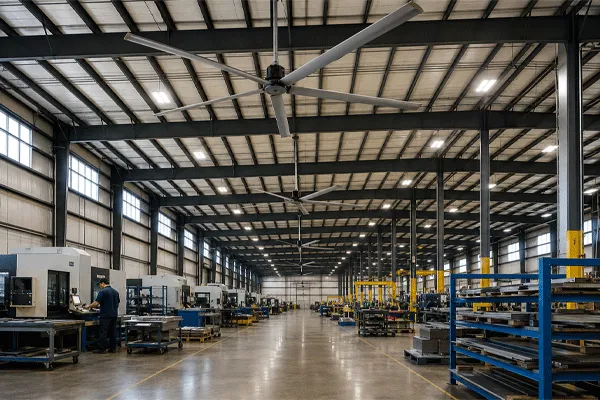
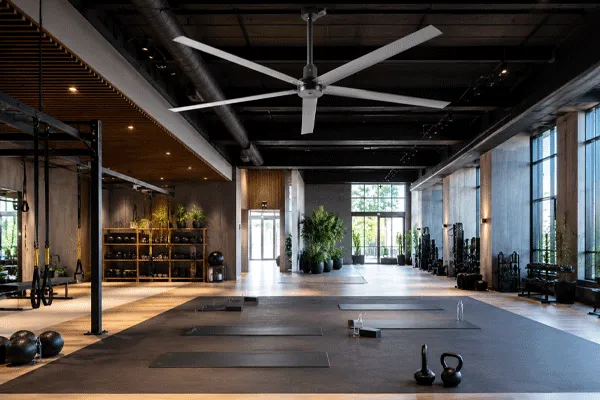
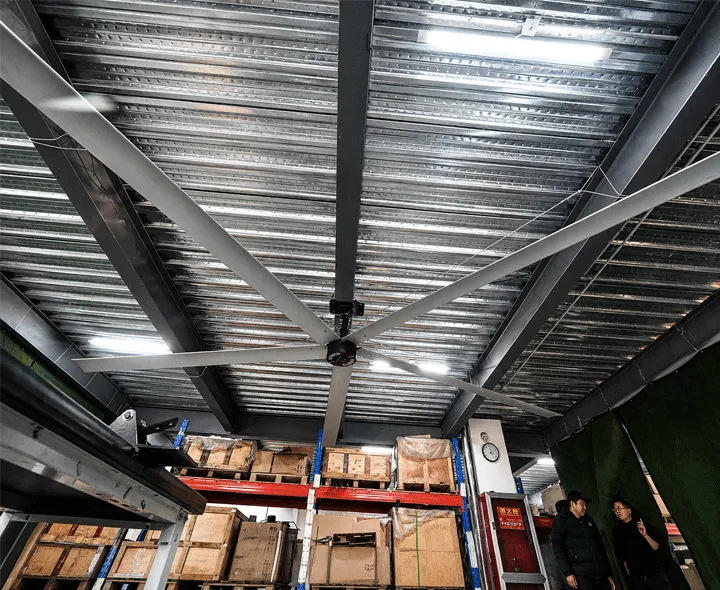
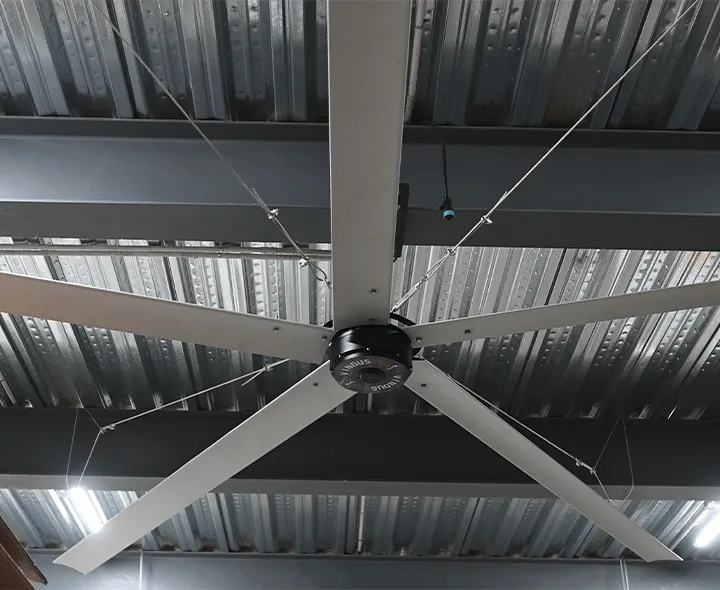
Big retail locations often have high ceilings, wide aisles, glass entrances, lighting heat, and uneven HVAC coverage. Customers may feel warm in one zone and cold in another, while the cooling system keeps working harder. A properly selected large industrial ceiling fan can help solve that airflow problem.
For large retail spaces, an HVLS ceiling fan improves comfort by moving a high volume of air at a relatively low rotational speed. It does not refrigerate the air. Instead, it improves air movement around shoppers and staff, mixes hot and cold layers, and helps conditioned air reach more of the occupied space.
Large Industrial Ceiling Fans for Cooling Big Retail Locations: How to Choose the Right HVLS Industrial Ceiling Fan
For facility owners, developers, HVAC contractors, and global B2B buyers, the real question is not simply, “Which ceiling fan is biggest?” It is: Which fan diameter, mounting height, airflow pattern, control strategy, and layout will work with the building you already have?
As a Sino-US joint venture manufacturer and airflow solution provider, we work with HVLS fans, industrial ceiling fans, commercial ceiling fans, directional industrial fans, and intelligent control systems. In our experience, retail projects perform best when the ceiling fan becomes part of the building system—not an isolated fixture.
1. Why Are Big Retail Locations Difficult to Cool With a Normal Ceiling Fan?
A large retail store behaves very differently from a small office or home. A spacious showroom, supermarket, furniture store, home-improvement center, outlet, or shopping mall may have thousands of square feet of open floor area and a high industrial ceiling.
Heat also enters from several directions:
- Roof and exterior walls
- Large glass storefronts
- Open entrance doors
- Lighting fixtures
- Refrigeration or display equipment
- Customers and employees
- Solar heat near windows
- Warm air trapped near the ceiling
Traditional residential ceiling fans can work well in a bedroom or small room, but their blade span and coverage are not designed for airflow in large commercial areas. Installing multiple fans with small diameters may also create a patchwork of strong and weak zones.
Portable fans create another problem. They produce concentrated airflow, occupy valuable floor space, add cables or stands to the environment, and may interfere with merchandise displays.
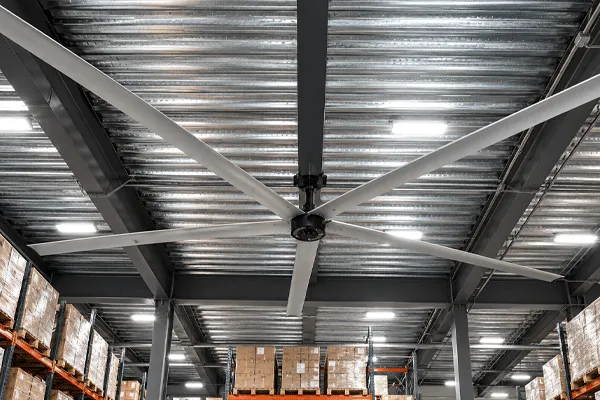
A large ceiling fan takes another approach. Instead of creating one narrow jet, the fan pushes a broad column of air downward. That air then spreads across the occupied zone.
This is why HVLS technology has become useful across warehouses, production facilities, sports buildings, and retail spaces. AMCA notes that large-diameter ceiling fans are used for air mixing, destratification, and cooling effects in commercial, industrial, agricultural, and other buildings.
2. How Does an HVLS Ceiling Fan Create Cooling Airflow?
HVLS means high-volume, low-speed.
That description is important. An HVLS fan is not designed to spin as fast as a small directional industrial fan. Instead, its long blades move large amounts of air over a broad area.
The result is gentle but widespread air circulation.
When an HVLS ceiling fan operates in a retail store, air is pushed downward from the fan, spreads along the floor, and then moves outward through the space. This helps circulate air across checkout zones, product aisles, customer waiting areas, displays, and staff workspaces.
The fan does not directly lower dry-bulb room temperature. Rather, moving air increases heat transfer from people, helping them feel cooler.
ASHRAE Standard 55 treats air speed as one of the key variables that affects thermal comfort, together with temperature, thermal radiation, humidity, clothing, and activity level.
This distinction matters.
A ceiling fan changes how people experience the environment before it changes how the thermostat reads the environment.
That is one reason a properly designed HVLS industrial ceiling fan can complement a building’s cooling system without pretending to replace refrigeration or mechanical ventilation.
3. Industrial Ceiling Fan vs Smaller Fans: Which Is Better for Large Spaces?
There is no single fan type that wins every application.
A small industrial fan can deliver strong air movement to a checkout station, loading zone, stockroom doorway, or specific workspace. An HVLS ceiling fan is stronger when the goal is broad coverage.
Consider the differences:
| Factor |
HVLS Industrial Ceiling Fan |
Smaller Directional Fans |
Residential Ceiling Fans |
| Coverage |
Broad |
Localized |
Small room |
| Fan speed |
Low |
High |
Moderate |
| Typical use |
Large open retail area |
Specific workstation |
Residential room |
| Floor space |
None |
May require wall/floor space |
None |
| Noise potential |
Low with proper design |
Often higher near occupants |
Usually low |
| Air pattern |
Wide circulation |
Narrow directional jet |
Limited coverage |
| Large-space suitability |
High |
Supplemental |
Low |
| Units required |
Often fewer |
Often multiple fans |
Many |
A large fan can therefore reduce the need to scatter smaller units around a building. That does not mean small fans disappear completely.
Many strong designs combine both.
For example, an HVLS ceiling fan may handle the main sales floor while a directional fan supports a busy customer pickup counter or loading area.
The goal is not to buy the best large fan on a generic list. It is to match airflow to the actual building.
4. How Much Airflow and CFM Does a Commercial Ceiling Fan Need?
Buyers often ask for one number:
“What is the CFM?”
CFM means cubic feet per minute, and it describes airflow volume. It is useful, but it should not be the only selection factor.
Two ceiling fans can show different airflow figures yet produce very different conditions on the floor because performance also depends on:
- Fan diameter
- Mounting height
- Blade geometry
- RPM
- Obstructions
- Distance between fans
- Store layout
- Racking or displays
- Ceiling structure
- Fan control setting
AMCA Standard 230 establishes uniform laboratory methods for measuring air-circulating fan performance, including airflow rate. That makes standardized testing much more useful than comparing marketing claims produced under unknown conditions.
When evaluating airflow in expansive retail facilities, ask the supplier for more than peak CFM.
Ask:
- Under what standard was the fan tested?
- At what speed was the measurement taken?
- What air speed should we expect at customer level?
- How does airflow change at lower fan speed?
- What spacing is recommended?
- How will displays and fixtures affect circulation?
That gives you a far more realistic view of effective air circulation.
A strong supplier should be engineered to deliver a layout, not just a catalogue number.
5. What Blade Span, Ceiling Height, and Number of Blades Should You Choose?
This is where choosing a large ceiling fan becomes a building-design task.
Start with clear height.
Measure from the floor to the actual proposed mounting point. Do not use only the architectural roof height. Signs, lighting rails, sprinklers, HVAC ducts, roof trusses, decorative features, and suspended ceilings can all reduce usable space.
Then look at blade span.
A wider ceiling fan generally covers a broader area, but bigger is not always better. A fan that is too large for the clearances around it may perform poorly or create an installation conflict.
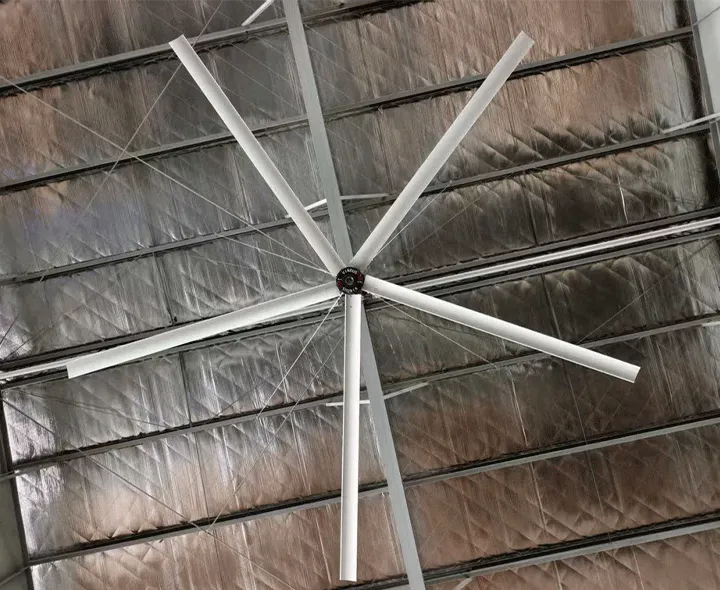
For example, the current Vindus P680 range uses five blades and includes 8 ft, 10 ft, 12 ft, and 14 ft models for recommended blade heights of 10–25 ft. Published maximum speeds range from 118 RPM for the 8 ft model to 82 RPM for the 14 ft model.
For larger high-ceiling areas, the P730 range includes 16 ft and 18 ft models, also using five anodized aluminum blades, for recommended blade heights of 20–33 ft.
Large Industrial Ceiling Fans for Cooling Big Retail Locations: How to Choose the Right HVLS Industrial Ceiling Fan
A simple first-stage selection chart
| Retail Condition |
Initial Fan Direction |
| 10–15 ft ceiling |
Compact HVLS / medium-diameter fan |
| 15–25 ft ceiling |
10–14 ft HVLS often worth evaluating |
| 20–33 ft ceiling |
16–18 ft HVLS may suit larger zones |
| Dense hanging displays |
Smaller zones may work better |
| Large open showroom |
Larger diameter may improve coverage |
| Mixed ceiling heights |
Use zoning or mixed fan sizes |
These are planning starting points, not final engineering rules.
The number of blades also should not be judged in isolation. More blades do not automatically mean more useful airflow. Motor design, blade profile, blade size, pitch, control strategy, and total system geometry matter together.
For medium-height retail environments, the P680 Series HVLS fan range is designed specifically for spaces including retail, restaurants, logistics areas, and workshops.
6. Where Should a Large Industrial Ceiling Fan Be Installed in a Retail Store?
Good placement often matters more than buying a larger motor.
A ceiling fan needs open space around it to move air effectively. That means the layout should be reviewed before installation—not after the electrical contractor arrives.
Common obstacles include:
- Pendant lighting
- Sprinkler systems
- Security cameras
- Hanging advertising banners
- HVAC diffusers
- Store signs
- Decorative ceiling structures
- Mezzanines
- Tall merchandise racks
- Escalators
- Display towers
An HVLS fan should be positioned so that its airflow reaches the occupied area and can spread outward.
For a large open furniture showroom, one broad fan pattern may work well.
For a supermarket filled with tall aisle shelving, airflow paths are more complicated. You may need additional fans, different positions, or a smaller diameter in certain zones.
Typical retail layout priorities
Checkout area: Occupants remain in one place, so excessive air speed can become uncomfortable.
Main aisles: Broad circulation works well because shoppers move continuously.
Entrance zone: Door opening can disturb indoor conditions.
Display area: Avoid excessive movement around light merchandise or hanging materials.
Customer service desk: Comfort matters because staff remain there for long periods.
Stockroom: May require a different fan strategy from the customer-facing sales floor.
This is why a commercial project should be designed by zone rather than simply dividing square footage by fan coverage.
Vindus provides dedicated guidance for commercial building HVLS fan applications.
7. Can an Industrial Ceiling Fan Reduce Heating and Cooling Costs?
Potentially, yes—but the reason needs to be understood correctly.
An HVLS ceiling fan does not create refrigerated air. Instead, it can improve how effectively conditioned air is used.
During warm periods, greater air movement can improve perceived comfort. This may allow an HVAC engineer or facility operator to use a different temperature strategy while maintaining comfort, depending on building conditions and applicable design requirements.
During heating season, another effect becomes important: destratification.
Warm air naturally rises. In a high industrial ceiling environment, that heat can collect far above shoppers. The HVAC system may keep heating the occupied level while valuable warm air remains near the roof.
A low-speed HVLS fan can help distribute air vertically and reduce hot and cold layers.
A simple concept looks like this:
Without destratification
Roof       ██████████  Warmest
Upper      ████████
Occupied   █████
Floor      ████

With HVLS mixing
Roof       ██████
Upper      ██████
Occupied   ██████
Floor      ██████
The more even temperature profile can support energy efficiency and reduce unnecessary load on the heating and cooling system.
However, every building is different. HVAC equipment, climate, doors, roof insulation, occupancy, lighting load, and operating schedule all affect savings.
Avoid any supplier that promises a fixed percentage reduction in heating and cooling costs without studying the building first.
8. Why Do Noise, Fixtures, and Store Appearance Matter in a Commercial Setting?
A retail customer does not experience the store as an engineering diagram.
They experience sound, comfort, lighting, visual space, product displays, and movement.
That makes a retail ceiling fan different from a fan installed in a noisy factory.
Noise matters
A motor may be technically acceptable but still become irritating above a quiet furniture display, premium retail area, restaurant, or customer lounge.
The current Vindus P680 and P730 specifications list sound below 50 dBA at maximum speed.
In normal operation, ceiling fans operate quietly when the motor, drive system, blade balance, mounting, and control are designed correctly.
Fixtures matter
Treat every sprinkler, light, duct, sign, cable tray, and architectural feature as a potential fixture conflict.
The fan must not simply “fit between the lights.” It needs enough operating clearance to perform safely and effectively.
Appearance matters
A shopping environment may require:
- Clean blade geometry
- Minimal visible wiring
- Coordinated finishes
- Low-profile controls
- Orderly mounting
- No floor equipment
That makes ceiling-mounted HVLS systems a practical choice for various commercial interiors where appearance matters as much as airflow.
Large Industrial Ceiling Fans for Cooling Big Retail Locations: How to Choose the Right HVLS Industrial Ceiling Fan
9. Which Industrial Ceiling Fan Is Best for Different Retail Spaces?
There is no universal choice for any commercial building, because a 30,000-square-foot furniture showroom is not the same as a supermarket.
A useful decision table is:
| Commercial Space |
Main Challenge |
Fan Strategy |
| Supermarket |
Mixed thermal zones, busy aisles |
Zoned HVLS |
| Home-improvement store |
High ceiling, open aisles |
Large HVLS |
| Furniture showroom |
Large open floor |
Broad gentle airflow |
| Shopping mall common area |
Customer comfort + appearance |
Quiet commercial HVLS |
| Outlet store |
Wide sales floor |
Medium/large HVLS |
| Auto showroom |
Glass solar load |
HVLS + HVAC |
| Garden center |
Open/semi-open environment |
Site-specific HVLS |
| Distribution retail store |
Sales + warehouse zones |
Mixed fan system |
Vindus’ current U.S. range illustrates this sizing logic.
The P680 uses 8–14 ft diameters and is aimed at medium-size commercial and industrial spaces with 10–25 ft recommended blade height. The P730 uses 16 and 18 ft diameters and targets larger areas with 20–33 ft blade heights. Both currently use five-blade layouts.
Buyers comparing fans for large retail buildings can also explore the P730 Series for larger commercial spaces.
Search phrases such as “DDI HVLS fan,” “deals on industrial ceiling fans,” or “best commercial fan” can produce many listings. Do not make the final decision from a marketplace title.
Compare the actual engineering data.
10. How Can Intelligent Controls Improve Multiple Ceiling Fans?
The best airflow strategy changes during the day.
A retail store may have:
- Low morning occupancy
- Peak afternoon traffic
- Evening cooling demand
- Weekend peaks
- Seasonal heating mode
- Different temperatures across zones
Running every ceiling fan at the same speed all day can waste energy and reduce comfort.
Instead, intelligent fan control can coordinate:
- Fan speed
- Operating schedule
- Groups or zones
- Forward/reverse operation where supported
- Building management integration
- Seasonal settings
- Runtime
- Temperature-based strategies
This becomes especially important when operating multiple fans.
Vindus’ FanBrain system is designed for HVLS fan automation, control, and energy management. Buyers planning multi-zone retail facilities can review the.
A good system might run slower near a customer lounge, faster through a wide merchandise area, and differently in a stock-handling zone.
That is better than treating every ceiling fan as a simple on/off fixture.
11. What Should You Check Before Buying a Large Industrial Ceiling Fan?
Before requesting a quotation, collect the building information first.
A good supplier can do much more with ten accurate measurements than with a message saying:
“I need a big ceiling fan for 50,000 sq ft.”
Prepare:
- Building length and width
- Clear ceiling height
- Mounting height
- Roof or structural drawings if available
- Sprinkler layout
- HVAC duct locations
- Lighting positions
- Tall display locations
- Customer and employee zones
- Electrical supply
- Local climate
- Operating hours
- Desired control method
Then ask the supplier for:
- Recommended fan diameter
- Quantity
- Fan spacing
- Mounting location
- Expected operating speed
- Standardized airflow data
- Sound performance
- Electrical requirements
- Structural load information
- Warranty terms
- Control options
- Installation requirements
Do not assume that a “limited lifetime warranty” headline is automatically better than a clear three-year warranty with defined coverage. Warranty scope, exclusions, parts availability, technical support, and service process matter.
Frequently Asked Questions About Large Industrial Ceiling Fans
Do large industrial ceiling fans actually cool a retail store?
They improve cooling comfort mainly by increasing air speed around people and distributing conditioned air more evenly. A ceiling fan does not work like an air conditioner and normally does not directly reduce room dry-bulb temperature.
What size ceiling fan works best for a large commercial space?
It depends on mounting height, clearances, floor layout, displays, HVAC ducts, and desired coverage. Medium-size spaces may use 8–14 ft HVLS fans, while higher or more open spaces may suit 16–18 ft or larger designs.
Is a five-blade industrial ceiling fan better?
Not automatically. The number of blades is only one design variable. Blade profile, motor, diameter, RPM, controls, mounting height, and total airflow performance must be considered together.
Should I compare HVLS fans by CFM?
Yes, but not by CFM alone. Ask for standardized test conditions and expected air velocity in the occupied zone. Cubic feet per minute tells you airflow quantity, but not whether that air reaches the places where customers and workers need it.
Can commercial ceiling fans replace air conditioning?
Usually not. Commercial ceiling fans move and mix air; they do not mechanically remove heat or humidity. They work best as part of a complete HVAC, cooling, and ventilation strategy.
Is an HVLS fan suitable for a supermarket or shopping mall?
Often, yes. An HVLS fan is designed to move broad volumes of air efficiently, making it potentially ideal for large stores, malls, showrooms, and other high-ceiling commercial areas. Final placement must account for sprinklers, displays, lights, signs, and customer comfort.
Large Industrial Ceiling Fans: What to Remember
- A large industrial ceiling fan is most effective when the goal is broad, gentle air movement across a large commercial area.
- HVLS technology uses a large blade span and relatively low rotational speed to move significant amounts of air without the concentrated draft of smaller fans.
- A ceiling fan improves perceived comfort but does not replace refrigeration, dehumidification, exhaust, or fresh-air ventilation.
- Blade size, mounting height, store layout, obstructions, RPM, airflow, and fan speed all affect performance.
- Five blades can be an effective design, but number of blades alone does not determine performance.
- Large fans can support HVAC operation by eliminating hot and cold spots and efficiently circulating air throughout the occupied zone.
- Choose standardized airflow performance rather than relying on advertising CFM alone.
- Match the fan to the actual retail environment instead of selecting only by square footage.
- Smart control makes a multi-fan installation more flexible and energy-efficient.
- A properly specified system can create a more comfortable and productive environment for shoppers and staff while supporting lower building operating costs.
A retail airflow project should begin with the building, not the catalogue. Send us your floor dimensions, clear mounting height, lighting and sprinkler layout, HVAC arrangement, operating schedule, and the zones where comfort is most important. We can then help determine whether a medium-diameter HVLS fan, a larger commercial fan, directional support fans, or a zoned combination is the right solution.