Michael Danielsson | CEO, Vindus Fans | Published August 11, 2026
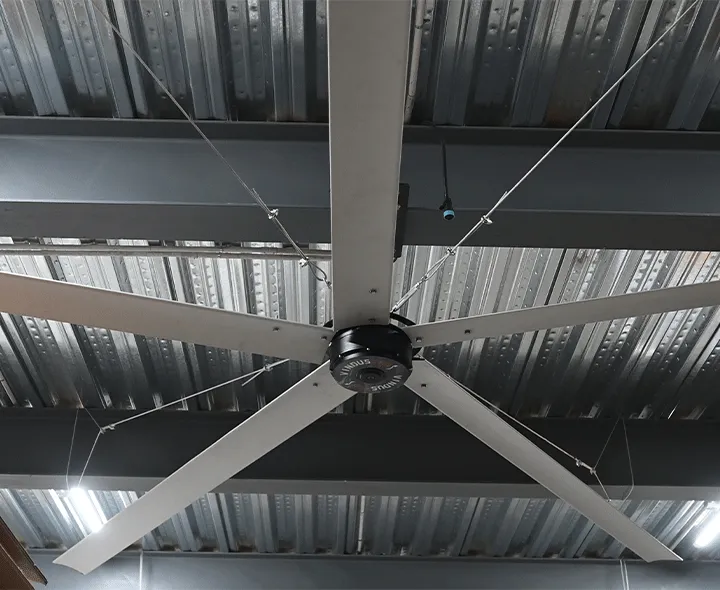
Gyms and sports venues use HVLS fans to move large air volumes at low rotational speed, spreading gentle, even airflow across courts and training floors. One 16-to-18-foot fan covers area that would take several high-speed units, cooling occupants by evaporation while keeping sound levels low enough for coaching and classes.
HVLS Fans for Gyms, Fitness Centers and Sports Venues
What Air Movement Actually Does in a Gym
A fan does not lower air temperature. What it changes is the rate at which a body sheds heat, and in a room full of people producing four to eight times their resting metabolic output, that distinction matters more than in almost any other commercial space.
Moving air strips away the saturated boundary layer that forms against damp skin, so evaporation continues instead of stalling. This is why a gym at 78 °F with steady air movement feels workable while the same room at 78 °F with still air feels oppressive by the second set. Air movement also breaks up the humidity pockets that collect over rubber flooring and cardio banks, where a dozen machines each dump moisture into a small footprint.
The second job runs in reverse. Gymnasiums with 25-plus foot ceilings stratify badly in winter, stacking heated air at the roof deck where nobody benefits. Running an HVLS fan slowly in the cold months pushes that warm layer back down along the walls. Heating setpoints can often come down a degree or two as a result, and the floor stops feeling cold to anyone doing mat work.
Four Mistakes That Show Up Repeatedly in Fitness Spaces
- Treating one fan as the whole answer for a multi-zone facility.A weight floor, a spin studio and a two-court gymnasium have different ceiling heights, occupant densities and noise tolerances. One fan sized for the largest zone leaves the others either untouched or over-ventilated.
- Mounting over the equipment instead of over the people.Airflow from an HVLS fan lands as a column and spreads outward along the floor. Centering a fan on a rack row rather than the open circulation space wastes half the coverage against steel and mirrors.
- Ignoring the sound floor of the room.A studio with a 65 dB music baseline hides fan noise easily. A yoga room or a physical therapy bay does not, and neither does a gymnasium during a coach’s instruction.
- Assuming ventilation and air movement are interchangeable.HVLS fans redistribute air within a room. They do not bring in outdoor air or remove CO₂. Fans supplement mechanical ventilation; they do not substitute for it.
Matching Airflow to Activity, Zone by Zone
- Free-weight and functional training floors— highest sustained heat and moisture output per square foot, and the most tolerant of noticeable airflow. Run these zones at higher speeds.
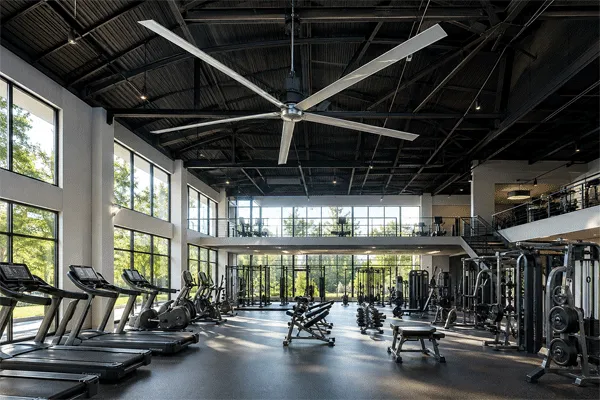
- Cardio banks— users are stationary and directional airflow is welcome, but machine consoles and screens sit at head height, so keep the fan column off the equipment line.
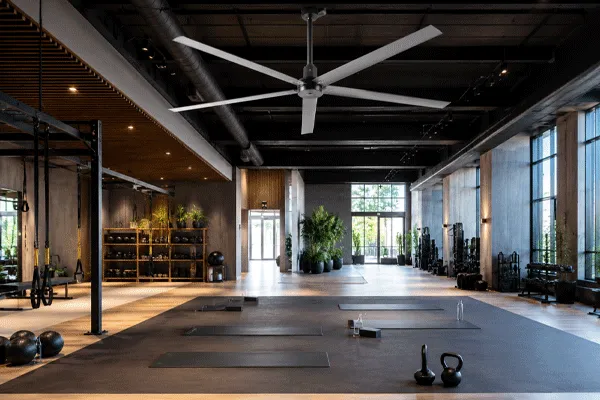
- Group fitness and cycling studios— often lower ceilings and enclosed. Smaller-diameter fans, or a P680 Series unit rated for 10-to-25-foot ceilings, generally fit better than a full-size gymnasium fan.
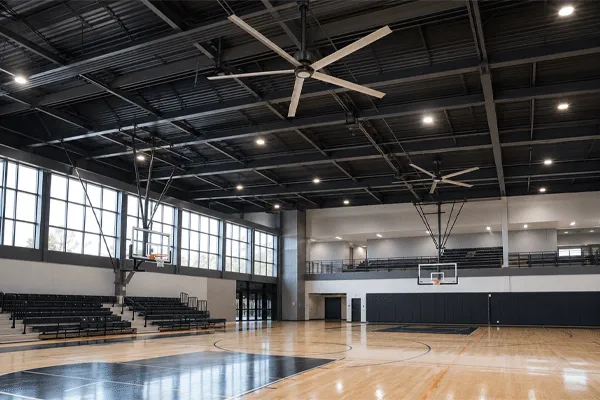
- Courts and multi-purpose gymnasiums— the main HVLS use case. Wide diameters at reduced RPM cover full court widths without disturbing shuttlecock or table-tennis play at low speeds, though badminton and similar sports usually require fans off during competition.
- Spectator seating and lobbies— comfort rather than performance. These zones can share a fan with the court if the throw reaches them.
- Locker rooms and wet corridors— do not put an HVLS fan here. Ceiling heights are too low and the humidity problem is an exhaust problem.
HVLS Fans for Gyms, Fitness Centers and Sports Venues
Noise Is Usually the Deciding Factor
Fitness operators rarely lose a fan argument on airflow. They lose it on sound, because members complain about noise long before they complain about heat.
Two things drive acoustic performance. The first is tip speed: a large fan turning slowly moves the same air volume as a small fan turning fast, with far less aerodynamic noise from the blade tips. The second is the drivetrain. Compared with the gearbox-driven HVLS designs still common in the category, and with the wall-mounted high-speed drum fans found in older facilities, a direct-drive permanent magnet motor removes the meshing gear teeth that produce a tonal whine at fixed frequencies — the kind of sound the human ear locks onto in an otherwise quiet room.
Vindus does not publish rated sound-pressure figures per model, and I would rather say that plainly than quote a number without a measurement standard and distance attached to it. If sound is a contractual requirement for your project, request site-specific data with the test conditions stated.
Direct Drive vs Gearbox-Driven Designs
| Dimension |
Direct drive (PMSM) |
Gearbox-driven |
| Drivetrain |
Motor coupled directly to hub |
Motor plus reduction gearbox |
| Mechanical loss points |
Bearings only |
Bearings, gear mesh, seals |
| Oil service |
Nenhum |
Periodic gear-oil checks and changes |
| Leak risk over a court or mat floor |
Nenhum |
Present; gearbox seals wear |
| Tonal noise source |
Aerodynamic only |
Aerodynamic plus gear mesh |
| Assembly weight at mount point |
Mais baixo |
Mais alto |
| Speed control |
Electronic, via integrated drive |
Mechanical ratio plus drive |
I led the development of direct-drive HVLS models at MacroAir before founding this work at Vindus, and the maintenance column above is the one that changes facility decisions most often. A gym cannot easily close a court for oil service during league season.
P730 Series Specifications
O P730 Series is the model range we position for gymnasiums, field houses and larger fitness floors in the U.S. market.
| Specification |
P730 Series |
| Diâmetros |
16 ft and 18 ft |
| Suitable ceiling height |
20–33 ft |
| Motor |
PMSM, direct drive (gearless) |
| Power draw at maximum speed |
Under 1,000 W |
| Controlar |
Floor-level integrated HMI |
| Cabling |
Single ceiling-to-floor cable |
| Performance test basis |
AMCA 230-15 and ANSI/ASHRAE 216P |
| Safety compliance |
CE, CB, EN, IEC |
| Garantia |
3 years on defective components causing improper operation |
A note on the standards line, because it is worth understanding rather than skimming. AMCA 230-15 is the Air Movement and Control Association’s test method for measuring air-circulating fan performance, and ANSI/ASHRAE 216P defines how HVLS fan performance is characterized. Any airflow figure quoted to you without reference to a test standard is not a comparable figure. When you evaluate two fans, confirm both sets of numbers trace back to the same method.
Rated CFM per model is not published on our site, and neither are prices. Sizing and airflow output for a specific room require a quote and a layout review.
For ceilings outside the 20–33 ft band, the range splits: the P680 Series (8–14 ft diameters, 10–25 ft ceilings) suits studios, mezzanine training areas and smaller boutique facilities, while the P780 Series (20 ft and 24 ft diameters) covers arena-scale volumes.
HVLS Fans for Gyms, Fitness Centers and Sports Venues
Five Steps to a Workable Layout
- Measure the clear height to the lowest obstruction, not to the roof deck. Trusses, lighting arrays, basketball hoop backstops in the raised position, banner rigging and sprinkler heads all set the real ceiling.
- Map the occupied zonesand mark where people actually stand, sit and lie down. Airflow targets bodies, not floor area.
- Divide the space by activity and noise tolerance, then decide how many independently controlled fans that implies. Independent speed control per zone is usually worth more than one extra fan.
- Check the retracted position of any moving equipment. Divider curtains, retractable seating, folding backstops and climbing walls all swing through space a fan might occupy.
- Confirm downrod length, mounting structure capacity and lockout/tagout accesswith your structural engineer and electrician before ordering. A fan you cannot safely reach for inspection is a fan that will not be inspected.
Edge Cases Worth Raising Before You Order
Ceilings under 20 feet.
A large-diameter fan in a low room produces uncomfortably strong airflow directly beneath it and dead zones between fans. Go smaller in diameter and add units rather than forcing a gymnasium-sized fan into a converted retail space.
Glass-walled studios and mirrored rooms.
Hard reflective surfaces raise reverberation, which makes any fan sound more present than the same fan in an absorptive gymnasium. Plan for lower operating speeds during quiet class formats.
Courts hosting shuttlecock or lightweight-ball sports.
Badminton and table tennis require still air for competition play. Specify fans as trainable-hours comfort equipment in these facilities and build the off-state into the operating protocol.
Retractable bleachers.
Extended seating changes both the occupied zone and the obstruction map. Size the layout for the extended condition, since that is when the room is full.
The Honest Limitations
HVLS fans do not dehumidify. In a coastal facility running 70% relative humidity in August, air movement helps evaporation but there is a ceiling on what it achieves, and the real fix is on the mechanical side. They do not filter or introduce outdoor air. They require permanent structural attachment, so retrofits into buildings with marginal roof structure carry engineering cost beyond the fan itself. And installed cost is front-loaded compared with the portable floor fans a facility might otherwise buy in twos and threes, even though a unit drawing under 1,000 W at full speed changes the operating-cost math over a season.
There is also a cultural point. Members notice new equipment and form opinions in the first week. Commissioning matters: set speeds by zone, walk the floor at peak hours, and adjust before the complaint emails arrive rather than after.
Perguntas frequentes
Q: Will members hear the fan during a quiet class?
A: At low speeds, a direct-drive HVLS fan produces aerodynamic noise only, without the tonal gear whine of gearbox-driven designs. Vindus does not publish per-model dB ratings, so if a specific sound limit applies to your space, request measured data with the test standard and distance stated.
Q: What ceiling height does a gymnasium need?
A: The P730 Series is specified for 20–33 ft ceilings. Below 20 ft, look at the P680 Series (10–25 ft ceilings). Above that range, the P780 Series covers larger volumes.
Q: Can HVLS fans run in winter, or do they only help in summer?
A: They run year-round. In heating season, slow operation pushes stratified warm air down from the roof deck into the occupied zone, which is often where the clearer energy case sits for a high-ceilinged gymnasium.
Q: What does a fan cost for a two-court gym?
A: Prices are not published. Cost depends on diameter, quantity, downrod length, control configuration and installation conditions, so a quote follows a layout review. Ask for the airflow basis in writing alongside the price.