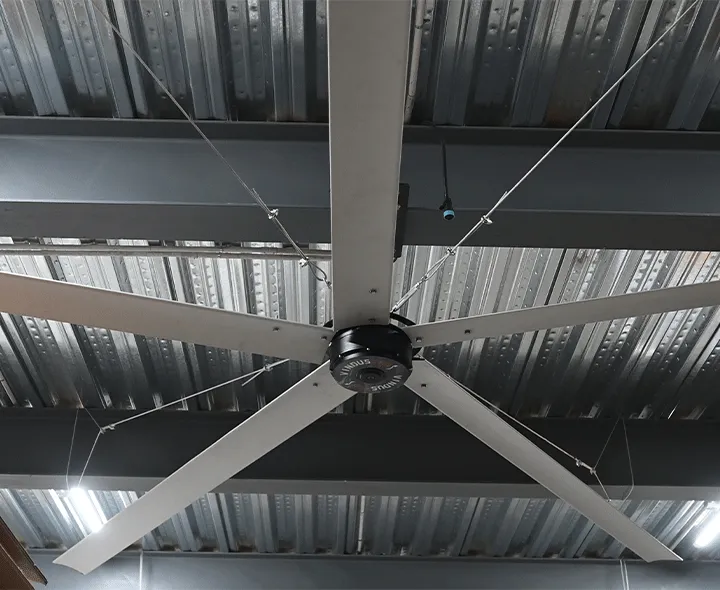
Installing an HVLS fan too low can create safety risks, poor airflow, and conflicts with racks, lights, sprinklers, or equipment. Install it too high without proper sizing, and performance may suffer. The solution is to match the fan diameter, ceiling height, mounting drop, and clearance to the building.
For many industrial HVLS ceiling fans, the lowest point of the fan blade should be at least about 10 feet (3.05 m) above the floor or any occupied working surface. However, there is no universal minimum height for every HVLS fan. Some compact commercial models allow lower installation heights, while large industrial fans often perform better at 20 feet or more. Always follow the specific manufacturer’s installation requirements.
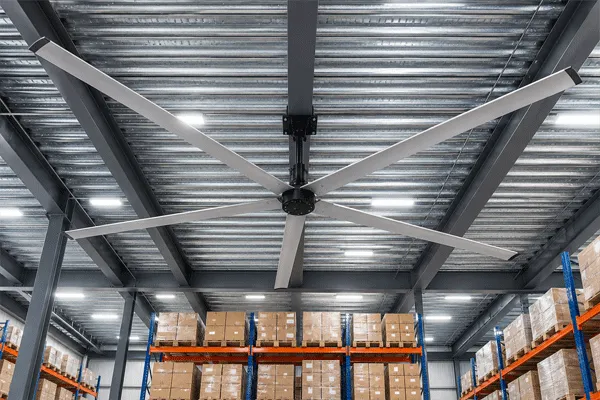
What Is the Minimum Height for an HVLS Fan? Ceiling Height, Fan Size & Clearance Guide
Schema dell'articolo
- What is the minimum height for an HVLS fan?
- Why does ceiling height matter for HVLS fan performance?
- How does fan diameter affect the required ceiling height?
- How much clearance does an HVLS ceiling fan need?
- What clearance is required around fire sprinklers?
- How do you determine how many HVLS fans are needed?
- Is an HVLS fan suitable for 7-foot, 10-foot, or 20-foot ceilings?
- How do HVLS fans work with HVAC systems?
- What fan size works for warehouses and commercial buildings?
- How do you choose the right HVLS fan for your space?
- Frequently asked questions about HVLS fan height and sizing
What Is the Minimum Height for an HVLS Fan?
For a typical large industrial HVLS fan, a good starting point is to keep the lowest part of the rotating blade at least 10 feet above the floor. Several industrial fan installation manuals use this minimum, especially where people, forklifts, shelving, mezzanines, or raised working platforms are present. MacroAir’s AirVolution documentation, for example, specifies a minimum blade height of 10 feet above the floor.
That does not mean every building needs a 13-, 15-, or 20-foot ceiling. The required ceiling height depends on the mounting system. A fan with a short direct mount may fit into a lower space, while another design may use a 2- or 3-foot drop tube.
There are also compact commercial models designed for lower ceilings. Current MacroAir documentation for its Lincoln Street model, for example, gives an 8-foot minimum blade-to-floor height and lists mounting arrangements for ceilings beginning around 9 feet. This shows why one universal number cannot describe all commercial ceiling fans or industrial models.
Simple planning rule
| Installation condition |
Practical planning guidance |
| Compact commercial HVLS fan |
Check model-specific requirements; some allow blades around 8 ft above floor |
| Typical industrial HVLS fan |
Plan for at least about 10 ft blade-to-floor clearance |
| Fan with standard 3 ft drop |
Often needs approximately 13 ft or more total ceiling height |
| Large 16–24 ft fan |
Usually better suited to higher industrial ceilings |
| Mezzanine or raised work area |
Measure from the occupied surface, not only the ground floor |
| Sprinklered building |
Add sprinkler clearance and fire-control requirements |
The important word is planning. Final installation dimensions must come from the selected fan’s manual, structural drawings, local code requirements, and site conditions.
For buyers comparing different models, our industrial HVLS fans are designed for factories, warehouses, logistics facilities, workshops, and other large spaces where mounting height and airflow coverage must be evaluated together.
Why Does Ceiling Height Matter for HVLS Fan Performance?
An HVLS ceiling fan works differently from a small residential ceiling fan. Instead of spinning very fast and producing a narrow stream of air, it uses a large diameter and relatively low speed to move a broad column of air downward.
When that air reaches the floor, it spreads outward across the building. The result is large-area air movement rather than a harsh high-speed blast.
That is why fan height matters.
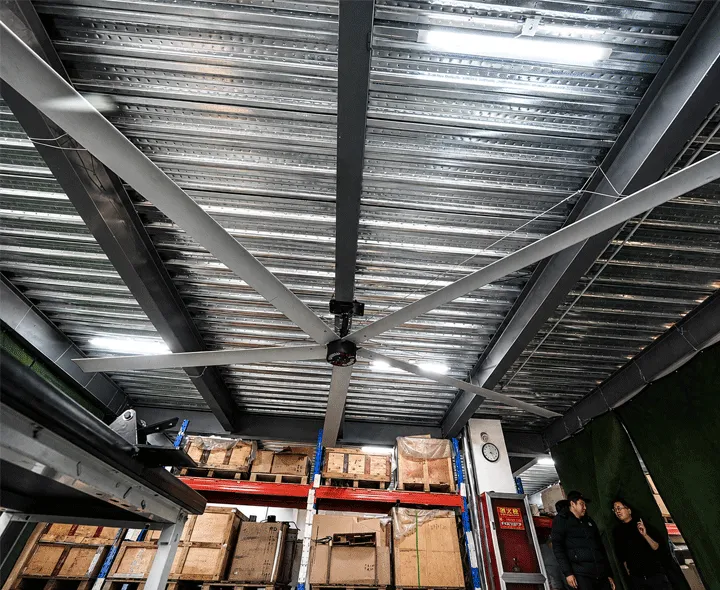
If the fan is too close to the ceiling, the fan may not receive enough unobstructed incoming air above its blades. If it hangs too low, it may interfere with people, equipment, racks, cranes, lighting, ducts, or production lines.
If it is installed much higher than needed, the airflow pattern may also need to be adjusted through a different fan size, speed, or drop length.
The airflow path
            CEILING / ROOF
                 ↓
          Intake air space
                 ↓
        ─────────────────
          HVLS FAN BLADE
        ─────────────────
                 ↓
                 ↓
        Large column of air
                 ↓
                 ↓
              FLOOR
          ↙      ↓      ↘
      Air spreads across
         the occupied zone
For most projects, the goal is not to mount the fan as low as possible. It is to position it where it can generate optimal airflow while maintaining safe clearances.
A professional HVLS layout therefore considers ceiling height, fan diameter, mounting structure, equipment height, rack locations, wall distance, and the occupied zone together.
How Does Fan Diameter Affect the Required Ceiling Height?
A 6-foot fan and a 24-foot industrial ceiling fan should not be treated as the same product.
Larger fans move air over a wider area, but they also need more room around their blade sweep. The diameter of the fan affects roof clearance, wall clearance, spacing between fans, and the location of nearby structures.
Typical HVLS products may range from approximately 6 feet to 24 feet in diameter, although product definitions and available sizes vary by manufacturer.
ASHRAE notes that large-diameter ceiling fans, commonly called HVLS fans, are generally larger than about 7 feet in diameter and can reach approximately 24 feet.
A larger fan is usually a better match for a large open warehouse than installing many small fans, but bigger is not always better.
Example planning ranges
| Altezza del soffitto |
Possible fan strategy |
Typical application |
| 9–12 ft |
Compact HVLS / commercial fan |
Retail, gym, workshop, low commercial space |
| 12–16 ft |
Small-to-medium HVLS |
Production areas, small warehouses |
| 16–20 ft |
Medium-to-large HVLS |
Factories, logistics buildings |
| 20–30 ft |
Grandi HVLS |
Warehouses, industrial plants, sports buildings |
| 30+ ft |
Engineered large HVLS layout |
Hangars, distribution centers, high-bay facilities |
These are not code limits. They are useful planning ranges before detailed engineering.
Our HVLS ceiling fan size guide explains how square footage, fan diameter, mounting height, obstacles, and building layout should be considered together when selecting an HVLS ceiling fan size.
How Much Clearance Does an HVLS Ceiling Fan Need?
Blade-to-floor distance is only one part of fan installation.
You must also ensure adequate clearance:
- Above the fan blade
- Around the blade tips
- From walls
- From lights
- From ducts
- From roof trusses
- From cranes
- From racks
- From mezzanines
- From sprinkler heads
- From open doors or strong cross-air sources
Different manufacturers specify different values.
For example, older MacroAir installation guidance states that its large fans should have enough space below the ceiling for proper air circulation and gives manufacturer-specific clearance relationships based on fan diameter. Its current product documentation also provides model-specific roof slope and extension tables.
This is why the statement “my ceiling is 20 feet high” is not enough to choose the right fan.
We also need to know what occupies those 20 feet.
Esempio
Imagine a warehouse with:
- Ceiling: 20 feet
- Pallet racks: 16 feet
- Lighting: 17 feet
- Sprinkler pipes: 18 feet
- Structural beams: 19 feet
The usable installation zone is much more restricted than the headline 20 feet suggests.
Likewise, in a manufacturing plant, a crane rail may pass through the desired fan blade arc.
A professional layout must therefore examine the full three-dimensional space.
What Clearance Is Required Between an HVLS Fan and Fire Sprinklers?
This is one of the most important design issues in sprinklered warehouses and factories.
Guidance associated with NFPA 13 requires HVLS installations in sprinkler-protected buildings to consider fan diameter, sprinkler position, vertical clearance, and automatic fan shutdown.
A widely cited NFPA-based requirement is a minimum 3-foot (0.9 m) vertical clearance between the HVLS fan and the sprinkler deflector. The fan should also be positioned approximately between adjacent sprinklers, and the fan system must shut down when the required waterflow alarm condition occurs.
This requirement can completely change the mounting position.
Suppose you have a 22-foot ceiling. A sprinkler deflector sits close to the roof. The fan cannot simply be mounted anywhere below it. The drop length, blade plane, sprinkler location, and structural mount must work together.
For this reason, placing HVLS fans should involve coordination among:
- HVLS fan supplier
- HVAC contractor
- Fire protection contractor
- Electrical contractor
- Structural engineer
- Building owner
A fan supplier should never treat sprinkler coordination as an afterthought.
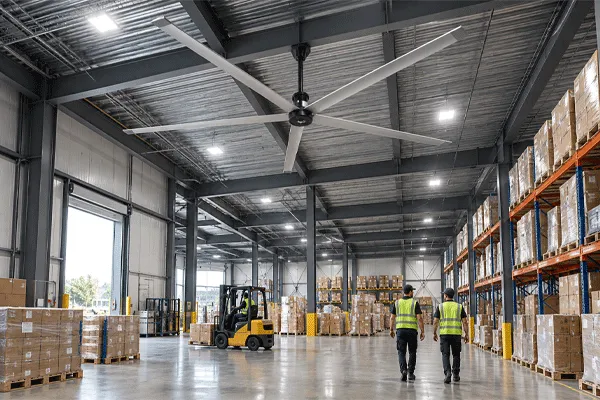
What Is the Minimum Height for an HVLS Fan? Ceiling Height, Fan Size & Clearance Guide
How Do You Determine How Many HVLS Fans Are Needed?
Buyers often ask:
“My warehouse is 50,000 square feet. How many fans do I need?”
Square footage alone cannot answer that question.
To determine how many fans are needed, we normally evaluate:
- Superficie totale
- Altezza del soffitto
- Building length and width
- Diametro del ventilatore
- Rack configuration
- Production equipment
- Walls and partitions
- Required occupied-zone air speed
- Existing HVAC
- Heat sources
- Doors and loading bays
- Required cooling or destratification objective
Two buildings with the same square feet can need very different layouts.
A wide open distribution warehouse might achieve good coverage with several large fans. A factory of the same square footage may require multiple fans because machinery, walls, cranes, process heat, and enclosed work cells divide the airflow.
Simplified layout concept
OPEN WAREHOUSE

      Fan A                 Fan B
        ○                     ○
   ← airflow →           ← airflow →


PARTITIONED FACTORY

 Fan A       WALL       Fan B       WALL       Fan C
   ○          │           ○          │           ○
You also need to find the distance between fans based on actual airflow performance, diameter, and the building layout rather than applying one universal spacing formula.
For large projects, intelligent controls can coordinate multiple fans instead of operating every fan at full speed all day. Our intelligent airflow control systems can support centralized fan operation, scheduling, zoning, and airflow management for larger facilities.
Can You Install an HVLS Fan on a 7-Foot, 10-Foot, or 20-Foot Ceiling?
This question helps show why minimum height and ideal installation height are different concepts.
7 piedi
A traditional large industrial HVLS fan is generally not suitable for a 7-foot ceiling because there is not enough safe vertical space between the rotating blade and occupants.
A normal residential ceiling fan belongs to a different product category and follows different sizing and mounting rules.
10 piedi
A 10 feet ceiling is a borderline case.
Some compact commercial products may work, depending on mounting structure and required blade height. However, many traditional industrial HVLS models cannot fit because the mounting assembly would push the blade plane below the manufacturer’s minimum safe height.
For example, MacroAir publishes products with different requirements. Some industrial MacroAir fans specify a 10-foot blade-to-floor minimum, while its smaller Lincoln Street product currently specifies an 8-foot minimum. Its support information tells users to contact MacroAir for model-specific placement and extension selection.
20 feet
A 20 feet ceiling gives the designer much more flexibility.
This height can support many medium and large industrial fan configurations, provided sprinkler, structural, rack, crane, lighting, and wall clearances are satisfied.
Large industrial and commercial spaces often benefit from higher mounting positions because the fan can develop broad airflow across the occupied zone.
The correct choice still depends on the building. A large ceiling fan mounted at 20 feet in an empty gym has a very different airflow environment from the same fan above warehouse racks.
How Do HVLS Fans Work With HVAC Systems?
HVLS fans do not normally replace every part of an HVAC system. They help the building use conditioned air more effectively.
During warm weather, airflow across the skin can improve perceived comfort. The room itself may not become dramatically colder, but occupants can feel more comfortable because moving air supports evaporative cooling.
During heating season, warm air naturally tends to collect near high ceilings. An HVLS fan running slowly can bring that warmer air back toward the occupied zone. This process is called destratification.
An ASHRAE-published hangar study offers a useful example. Researchers evaluated a 20-foot HVLS fan with a blade height of about 27 feet. With the fan operating, the measured floor-to-ceiling temperature difference dropped from about 6.0°F to about 0.7°F, and normalized gas use fell by 29% during the study conditions. Results will vary by building, climate, operating schedule, and heating system.
That is why HVLS fans help more than worker comfort alone.
They can support:
- Summer comfort
- Winter destratification
- Better air circulation
- Reduced stagnant zones
- More uniform indoor conditions
- HVAC load management
- Moisture management in suitable applications
Our energy-saving ventilation solutions combine fan selection, airflow planning, and control strategies for facilities seeking lower energy costs and improved indoor comfort.
Does CFM Tell You Which HVLS Fan Has Better Performance?
Not by itself.
Cubic feet per minute describes a volume of air, and CFM is useful. But a very large published CFM number should not be the only reason you buy a fan.
HVLS performance also depends on:
- Diametro del ventilatore
- Air velocity profile
- Input power
- NUMERO DI GIRI
- Progettazione della lama
- Motor efficiency
- Copertura
- Installation height
- Controlli
- Tested efficiency
In the United States, large-diameter ceiling fan testing is tied to recognized procedures, including AMCA-based testing and the federal Ceiling Fan Energy Index, or CFEI. U.S. DOE rules use standardized testing to support meaningful efficiency comparisons.
AMCA has also warned that some published airflow figures can be unrealistic when airflow and power do not agree with fan-law relationships. This is why serious B2B buyers should ask how fan performance was tested instead of simply choosing the product with the largest claimed CFM.
A better purchasing question is:
How much useful airflow does the fan deliver across my occupied area for the electrical power it consumes?
That is much more valuable than one marketing number.
What Fan Size Works Best for Warehouses, Factories, and Commercial Spaces?
The best fan for your space depends on the application.
Warehouses and logistics centers
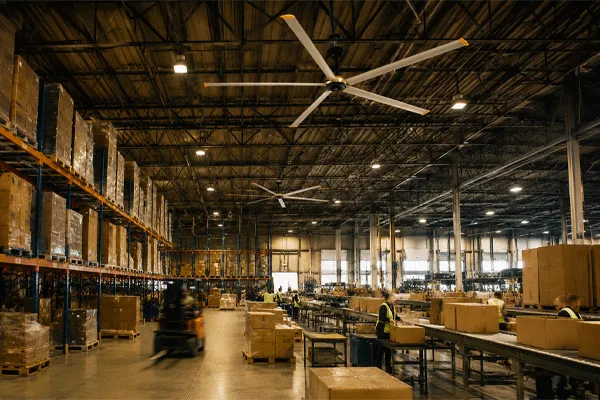
Large warehouse fans are often used where there are long aisles, loading areas, high ceilings, workers, and forklift traffic.
The design goal may include summer cooling, destratification, or both.
Manufacturing facilities
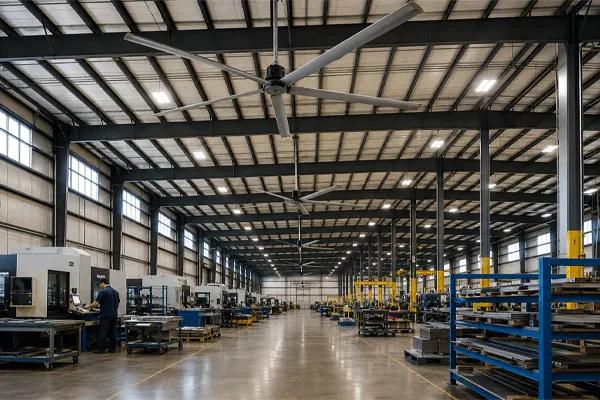
Factories may have furnaces, machinery, cranes, ducts, exhaust systems, and process heat. A large fan might provide strong overall air circulation, but several smaller units may give better coverage around obstructions.
Shopping malls and commercial buildings
Large commercial ceiling fans often need quiet operation, appearance, smooth speed control, and coordination with air conditioning.
Nostro ventilatori da soffitto commerciali are intended for commercial and public spaces where comfort, appearance, noise, and controllability matter alongside airflow.
Sports centers
Gymnasiums and sports halls often provide wide open volumes that work well with large-diameter fans. Mounting height must still account for lighting, scoreboards, basketball equipment, and suspended structures.
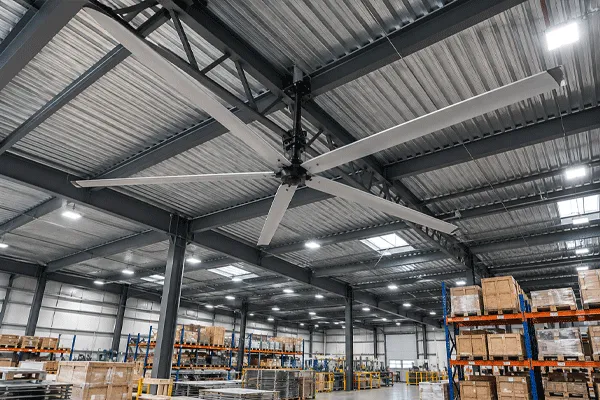
What Is the Minimum Height for an HVLS Fan? Ceiling Height, Fan Size & Clearance Guide
Agriculture and livestock
Barns, agricultural buildings, and some greenhouse facilities may use HVLS systems to circulate air across a broad area.
Research comparing HVLS and high-speed fans in dairy-barn conditions found that HVLS fans could cover a larger area with more uniform airflow, reinforcing why fan choice should consider distribution rather than only peak local air speed.
How Do You Choose the Right HVLS Fan for Your Space?
Choosing the right HVLS fan begins with site data.
Before requesting a quotation, prepare:
| Project information |
Why we need it |
| Building length × width |
Determines coverage area |
| Altezza del soffitto |
Determines mounting possibilities |
| Lowest structural beam |
Defines mounting point |
| Rack/equipment height |
Identifies airflow obstacles |
| Sprinkler location |
Required for fire-system coordination |
| Building use |
Changes comfort and airflow goals |
| Desired fan quantity |
Helps compare layouts |
| Power supply |
Determines electrical configuration |
| Existing HVAC |
Helps plan combined operation |
| Photos/drawings |
Helps locate obstructions |
As a Sino-US joint venture manufacturer and airflow solution provider, we do not believe the best fan is simply the largest fan that fits beneath the roof.
Our work covers HVLS fans, industrial ceiling fans, commercial ceiling fans, large industrial fans, and intelligent airflow control systems. For warehouse owners, factories, HVAC engineering contractors, farms, sports buildings, developers, distributors, and global B2B buyers, we focus on the whole airflow system.
That includes the fan, motor, blade design, mounting height, controls, layout, and operating strategy.
For complex projects, our custom HVLS fan solutions can help you choose the right solution based on drawings, operating conditions, ventilation objectives, and building limitations.
A practical project example
Consider a large commercial facility measuring 200 × 250 feet:
- Floor area: 50,000 square feet
- Ceiling: 28 feet
- Rack height: 16 feet
- Sprinklered building
- Existing HVAC
- Several loading doors
- Objective: worker comfort + winter destratification
A poor design approach would be:
“50,000 square feet = X fans.”
A better approach is to map airflow zones, identify the loading doors and racks, locate sprinkler heads, check blade clearances, assess the existing HVAC pattern, and then compare alternative fan diameters.
This may result in fewer large fans or more medium-size fans.
The goal is not to sell one fan more than necessary.
The goal is to create the required air movement with a safe, efficient layout.
Frequently Asked Questions About HVLS Fan Minimum Height
What is the minimum height requirement for an HVLS fan?
Many industrial HVLS fan manufacturers specify that the lowest part of the fan blade must remain at least 10 feet above the floor or occupied working surface. Some smaller commercial models permit lower mounting heights. Always follow the specific manufacturer’s installation manual because the minimum height requirement varies by model.
Does an HVLS fan need a ceiling that is at least 13 feet high?
Not always.
A 13-foot recommendation often comes from combining a 10-foot minimum blade height with about a 3-foot mounting drop. However, many models can be shortened with alternative mounting arrangements, and compact models may use much shorter drops.
The mounting system determines the real total ceiling requirement.
How far should HVLS fan blades be from sprinklers?
For installations subject to the relevant NFPA 13 provisions, the vertical clearance between the HVLS fan and sprinkler deflector should be at least 3 feet (0.9 m), with additional requirements involving placement and automatic shutdown. Always coordinate the final design with the project’s fire protection professional and applicable local rules.
Can I use a 24-foot HVLS fan with a 20-foot ceiling?
Possibly, but the fan diameter alone does not answer the question.
You must check floor clearance, roof clearance, sprinkler layout, wall distance, structures, racks, cranes, lighting, and manufacturer requirements. A 24-foot industrial ceiling fan can be appropriate for many large facilities, but every site needs layout verification.
Does a larger fan always move more useful air?
A larger diameter can help move air across a wider area, but useful performance also depends on blade design, speed, motor power, mounting height, airflow distribution, and efficiency. Compare tested performance rather than diameter alone.
How do I determine the number of fans required?
To calculate the number of fans required, provide building dimensions, ceiling height, fan diameter options, rack and equipment layout, target air speed, HVAC information, and obstacles. A professional airflow layout can then determine whether a facility needs one large fan or several smaller units.
Final Answer: What Height Should You Plan for an HVLS Fan?
If you are in the early planning stage, use 10 feet of blade-to-floor clearance as a common industrial starting point, not as a universal rule.
Then work upward.
Add the fan motor, mounting system, drop tube, roof clearance, structural beam, sprinkler clearance, and any other restrictions. For some projects, that may mean a total ceiling height around 13 feet. For larger industrial fans, 20-foot, 25-foot, or higher spaces may deliver much better installation flexibility and airflow coverage.
Most importantly, choose the fan after checking the building—not before.
Key Things to Remember
- Many industrial HVLS fan models require blades to remain at least about 10 feet above the floor.
- Some compact commercial HVLS models can operate at lower heights, so there is no single universal minimum.
- Ceiling height and blade-to-floor height are not the same measurement.
- A standard drop tube increases the total ceiling height required.
- Larger ceiling fans need more space around their blade sweep.
- Fan diameter must match the building size, layout, and mounting conditions.
- Sprinklered buildings may require at least 3 feet of vertical clearance between the HVLS fan and sprinkler deflector under applicable NFPA provisions.
- A mezzanine or raised working platform changes the safe clearance calculation.
- Square footage alone cannot tell you how many fans are needed.
- Compare tested airflow and energy-efficiency data instead of relying only on claimed cubic feet per minute.
- HVLS fans can support HVAC by improving summer comfort and winter destratification.
- Higher ceilings often give large industrial ceiling fans more space to build broad, stable airflow.
- Warehouse racks, cranes, lights, ducts, doors, and structural beams must be included in the layout.
- The right fan for your space is the one that delivers the required airflow safely and efficiently—not simply the biggest fan available.
- For industrial and commercial projects, provide your building drawings, ceiling dimensions, obstacles, power supply, and airflow goals so an engineering team can help you pick the right HVLS solution.