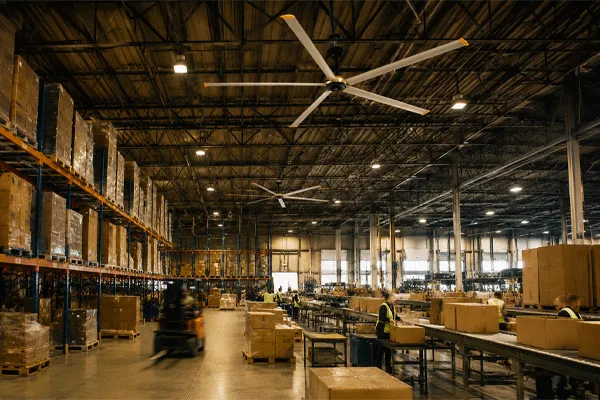
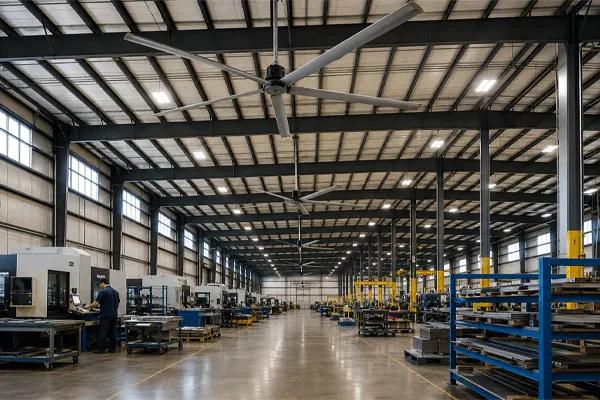
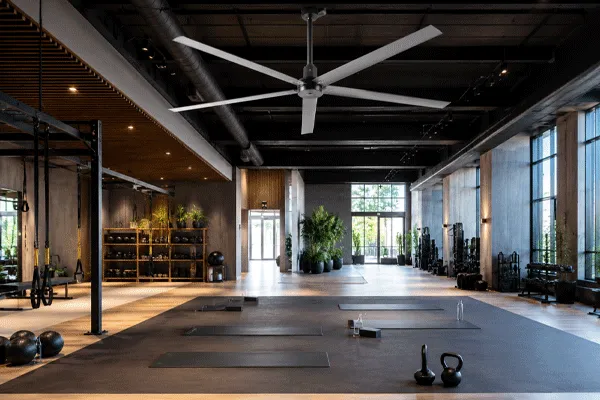
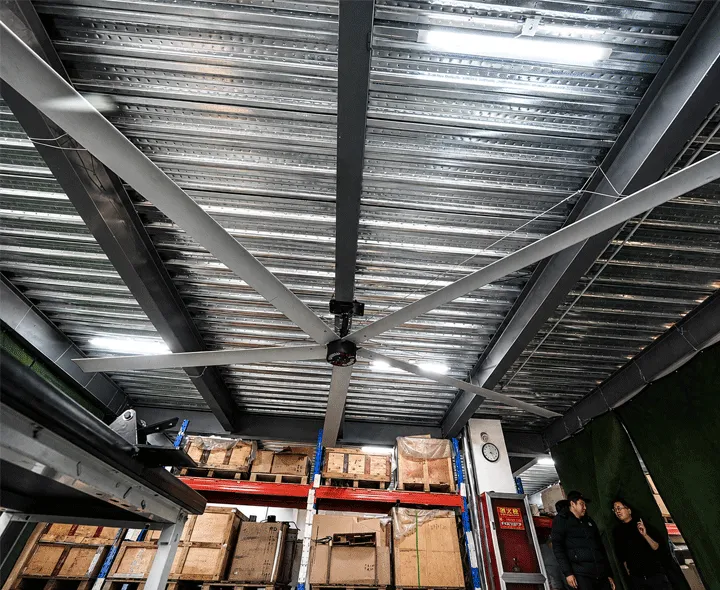
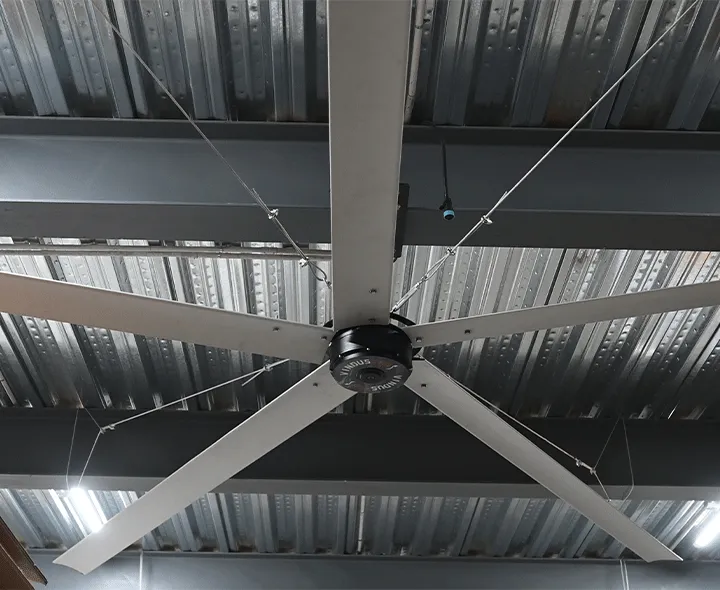
Large sports facilities require more than simple cooling. High ceilings, large crowds, intense physical activity, and changing humidity levels create complex airflow challenges. This guide explains how HVLS fans help stadiums, sports halls, and indoor sports facilities achieve better ventilation, energy efficiency, and a more comfortable environment.
Poor air movement in large sports facilities can cause hot spots, stagnant air, uncomfortable humidity, and rising HVAC energy costs. As crowds grow and indoor activities become more intense, traditional cooling methods often struggle to maintain comfort.
Ventilatori HVLS are designed for large sports facilities by moving large volumes of air at low speed, improving air circulation, reducing heat and humidity problems, and creating a more comfortable indoor environment for athletes and spectators.
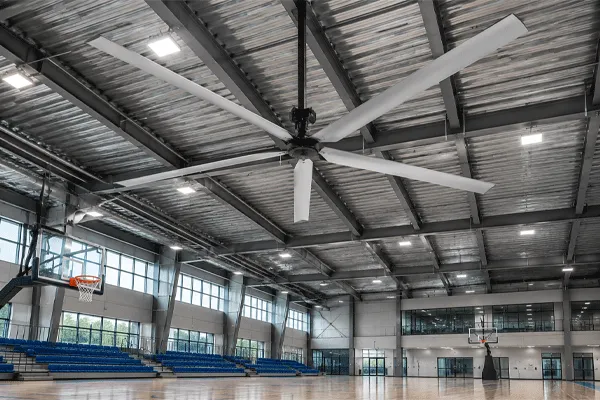
HVLS Fans for Large Sports Facilities: Improving Indoor Air Circulation, Ventilation and Comfort in Sports Facilities
Schema dell'articolo
- What Is an HVLS Fan and Why Are Sports Facilities Choosing It?
- Why Do Large Sports Facilities Need HVLS Fans for Better Ventilation?
- How Do HVLS Fans Improve Air Circulation in Indoor Sports Facilities?
- What Are the Benefits of HVLS Fans Compared with Traditional Industrial Fans?
- How Do HVLS Industrial Fans Reduce Energy Costs in Sports Buildings?
- How Do HVLS Ceiling Fans Control Heat and Humidity in Large Sports Spaces?
- How Should Engineers Select the Right Industrial Ceiling Fan for a Sports Facility?
- Why Are HVLS Fans Becoming Popular in Stadiums and Sports Arenas?
- Installation and Maintenance Considerations for HVLS Fans in Sports Facilities
- Frequently Asked Questions About HVLS Fans for Sports Facilities
What Is an HVLS Fan and Why Are Sports Facilities Choosing It?
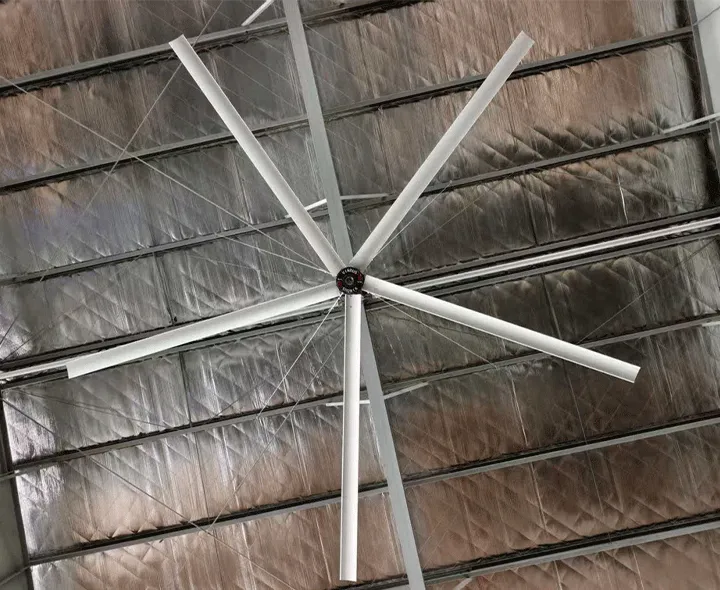
An HVLS fan means “High Volume Low Speed” fan. Unlike small traditional fans that create narrow airflow streams, an HVLS fan uses large blades rotating at a low speed to move a high volume of air across a wide area. This design makes it especially suitable for large spaces such as stadiums, sports halls, training centers, and indoor recreation facilities.
Modern sports facilities often have high ceilings and large open spaces. Because of their size, maintaining consistent airflow can be difficult. Warm air naturally rises and collects near the ceiling, while areas closer to the floor may experience uneven temperatures. HVLS technology solves this problem by pushing warm air downward and creating continuous air movement.
As a Sino-US joint venture manufacturer and solution provider, we specialize in developing Ventilatori industriali HVLS, industrial ceiling fans, commercial ceiling fans, and intelligent airflow control solutions for global markets. Our engineering approach focuses on helping customers reduce HVAC energy consumption while improving indoor comfort.
| Caratteristica |
Ventilatore tradizionale |
Ventilatore HVLS |
| Air movement range |
Limited area |
Covers large spaces |
| Operating speed |
Ad alta velocità |
Bassa velocità |
| Applicazione |
Piccole stanze |
Sports halls, warehouses, stadiums |
| Efficienza energetica |
Moderare |
Alto |
| Airflow pattern |
Local cooling |
Wide air circulation |
For sports facilities, the goal is not simply creating stronger wind. The goal is creating balanced airflow that supports athletes, spectators, and building systems.
A properly designed industrial fan solution can work together with HVAC equipment to reduce temperature differences, improve air quality, and maintain comfortable conditions during long events.
Why Do Large Sports Facilities Need HVLS Fans for Better Ventilation?
Large sports facilities often face unique ventilation challenges. A small gym or fitness room may rely on conventional ventilation methods, but large sports buildings require a different approach because of their size, ceiling height, and occupant density.
During competitions and training sessions, heat generated by athletes and spectators increases quickly. Thousands of people inside a stadium can significantly affect indoor temperature, carbon dioxide levels, and humidity. Without effective ventilation, some areas may feel hot and uncomfortable while other areas remain cooler.
Sports facilities often use HVAC systems, but HVAC alone may not provide enough air movement in very large areas. Air conditioning can control temperature, but it does not always distribute air evenly across a large building volume.
This is where HVLS fans provide additional value.
They help:
- Move large amounts of air throughout the facility
- Reduce stagnant air zones
- Support HVAC performance
- Improve air circulation
- Create better comfort for athletes and spectators
A large sports facility usually includes:
| Tipo di struttura |
Common Airflow Challenge |
| Indoor stadium |
Large crowds and heat buildup |
| Sports hall |
High ceiling and uneven temperatures |
| Swimming center |
High humidity and condensation |
| Basketball court |
Heat generated by athletes |
| Indoor football field |
Large open spaces |
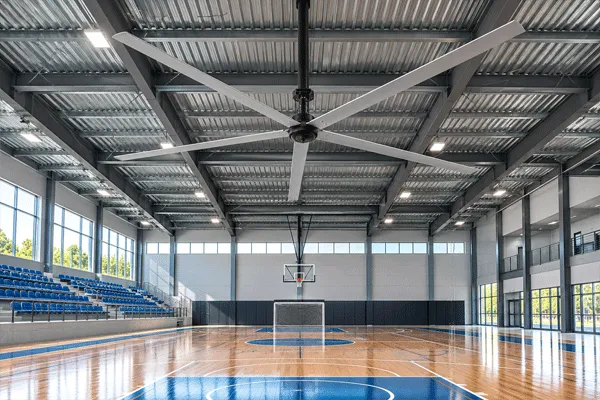
For example, in a basketball arena, players generate significant heat during intense activity. Spectators also increase the thermal load. A suitable HVLS ceiling fan helps circulate air from the upper areas downward, creating improved air distribution without producing uncomfortable strong winds.
Our engineering team evaluates factors such as building dimensions, ceiling height, and expected occupancy before recommending a suitable airflow solution.
The right fan arrangement ensures consistent airflow instead of simply increasing air speed in one location.
How Do HVLS Fans Improve Air Circulation in Indoor Sports Facilities?
The main advantage of an HVLS fan is its ability to improve air circulation through wide-area airflow. The large blades create a gentle but powerful airflow pattern that moves across the entire space.
In indoor sports facilities, air movement is critical because heat and moisture can quickly accumulate. Athletes generate body heat, spectators create additional warmth, and activities such as swimming or indoor training increase humidity.
Without proper air movement, facilities may experience:
- Uneven temperatures
- Excess humidity
- Poor air quality
- Condensation problems
- Uncomfortable conditions for users
An HVLS fan creates a downward airflow column below the fan and spreads air horizontally when it reaches the floor. This natural circulation pattern helps distribute temperature more evenly.
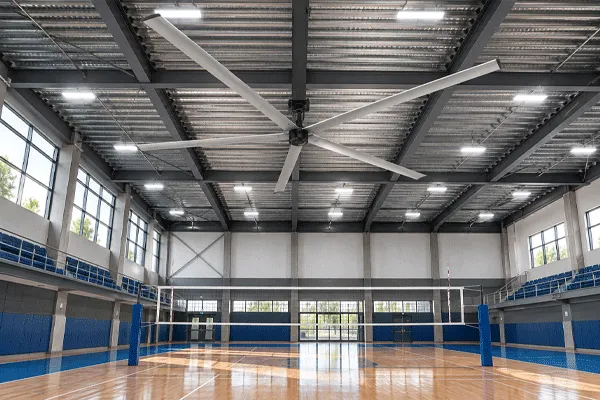
HVLS Fans for Large Sports Facilities: Improving Indoor Air Circulation, Ventilation and Comfort in Sports Facilities
How HVLS Fans Move Air in Large Spaces
This airflow method is different from conventional high-speed fans. Instead of creating a strong local breeze, HVLS technology creates a stable airflow environment.
For indoor sports facilities, this provides several advantages:
- Better air movement across courts and fields
- Improved comfort during physical activities
- Reduced humidity accumulation
- More balanced indoor temperature
A professional industrial ceiling fan system can also complement by improving air distribution. When air is properly circulated, does not need to work as hard to maintain desired conditions.
This combination can help facility operators achieve better energy efficiency while maintaining a comfortable environment.
What Are the Benefits of HVLS Fans Compared with Traditional Industrial Fans?
Choosing the right ventilation equipment is critical for large sports facilities. Traditional industrial fans usually focus on producing high-speed airflow in a limited area, while HVLS fans are designed to move a much larger volume of air with lower operating speed.
For sports buildings, strong airflow is not always the best solution. Athletes and spectators need a comfortable airflow environment rather than a powerful wind stream that may affect performance, comfort, or indoor activities.
The main difference between an HVLS fan and a traditional industrial fan is the airflow method.
| Confronto |
Ventilatore industriale tradizionale |
Ventilatore HVLS |
| Airflow coverage |
Localized airflow |
Wide-area airflow |
| Velocità |
Ad alta velocità |
Bassa velocità |
| Blade size |
Small or medium |
Grande diametro |
| Noise level |
Higher in many applications |
Lower operating noise |
| Suitable applications |
Workshops, small areas |
Sports facilities, stadiums, warehouses |
| Consumo energetico |
Higher for large spaces |
Minore consumo energetico |
An HVLS fan creates a slow-moving air column that travels across the building floor and improves the overall indoor environment. This makes it suitable for basketball courts, indoor football fields, training centers, and multi-purpose sports halls.
Unlike small fans that only cool people directly below them, HVLS fans circulate air throughout the entire building. This helps reduce temperature differences between ceiling areas and occupied zones.
For example, a large sports hall with a ceiling height of more than 10 meters may collect warm air near the roof. Installing hvls ceiling fans helps redistribute this warm air and improve overall comfort.
As a professional HVLS industrial fan manufacturer, we design solutions based on:
- Building size
- Altezza del soffitto
- Occupancy level
- Sports activity type
- Required airflow performance
The goal is not simply installing a fan. The goal is creating an efficient airflow system that improves indoor conditions.
How Do HVLS Industrial Fans Reduce Energy Costs in Sports Buildings?
Energy consumption is one of the biggest concerns for modern sports facility operators. Large stadiums, sports centers, and indoor arenas often operate for many hours every day, leading to significant operating expenses.
HVLS industrial fans help reduce demand by improving air distribution and allowing cooling systems to operate more effectively.
When air becomes trapped near the ceiling, systems may continue running because temperature sensors detect uneven conditions. By moving warm air downward and distributing conditioned air more evenly, HVLS fans support performance.
This process can provide several energy advantages:
- Reduce unnecessary operation
- Improve temperature balance
- Support air conditioning efficiency
- Lower overall energy consumption
- Reduce long-term maintenance costs
According to the U.S. Department of Energy, fans and air movement systems can improve comfort by enhancing air circulation and allowing temperature settings to be adjusted while maintaining occupant comfort.
Reference:
For many large facilities, even a small improvement in efficiency can create meaningful savings.
| Applicazione |
How HVLS Fans Help |
| Sports arena |
Supports airflow distribution during events |
| Indoor training center |
Maintains comfortable exercise conditions |
| Stadium concourse |
Reduces heat accumulation |
| Swimming facility |
Helps manage humidity |
| Multi-purpose hall |
Provides flexible ventilation support |
A well-designed airflow system combines mechanical ventilation,and large industrial fans to achieve better results.
Our engineering team often works with contractors and facility owners to analyze airflow requirements before installation. This ensures the fan layout provides maximum coverage while minimizing unnecessary energy use.
For customers managing large commercial buildings, sports centers, and public facilities, energy savings are not only about reducing electricity bills. They also improve equipment lifespan and create more sustainable operations.
How Do HVLS Ceiling Fans Control Heat and Humidity in Large Sports Spaces?
Heat and humidity are common challenges in indoor sports environments. Activities such as basketball, volleyball, badminton, swimming, and fitness training create additional heat loads because athletes generate significant body heat during exercise.
At the same time, many sports buildings contain large numbers of spectators. The combined effect of athletes, lighting systems, equipment, and crowds can quickly increase indoor temperature.
Without proper airflow management, facilities may experience:
- High humidity levels
- Condensation on surfaces
- Uncomfortable indoor conditions
- Reduced air quality
HVLS fans help solve these issues by creating continuous air movement.
The large blades of an HVLS fan move air from the upper building areas downward. This process helps prevent warm air from remaining near the ceiling and improves the exchange of indoor and outdoor air when combined with ventilation systems.
For sports facilities, maintaining proper humidity is especially important.
Examples include:
| Facility |
Humidity Concern |
| Swimming pools |
Moisture accumulation and condensation |
| Ice rinks |
Temperature balance |
| Fitness centers |
Heat from exercise activities |
| Indoor courts |
Athlete comfort |
| Stadiums |
Large crowd heat load |
By improving airflow, HVLS fans help create a more stable indoor climate.
A sports hall with poor air movement may feel warmer even.This happens because conditioned air is not evenly distributed. Adding an HVLS solution helps circulate air and improve comfort without creating excessive wind speed.
For example, in indoor sports facilities, maintaining a comfortable environment requires balancing temperature, humidity, and airflow. A properly selected commercial ceiling fan can support these goals by improving overall air movement.
Our HVLS solutions are engineered for:
- Large industrial buildings
- Sports arenas
- Distribution centers
- Exhibition halls
- Spazi commerciali
The result is a better indoor experience for athletes and spectators while helping facility operators manage operating costs.
HVLS Fans for Large Sports Facilities: Improving Indoor Air Circulation, Ventilation and Comfort in Sports Facilities
How Should Engineers Select the Right Industrial Ceiling Fan for a Sports Facility?
Selecting the correct fan size and quantity requires professional planning. Installing too few fans may create uneven airflow, while installing too many may increase unnecessary investment.
Engineers normally evaluate several important factors before designing an HVLS airflow solution:
| Selection Factor |
Why It Matters |
| Building area |
Determines airflow coverage |
| Altezza del soffitto |
Influences fan diameter selection |
| Indoor layout |
Affects airflow direction |
| Occupancy |
Determines cooling demand |
| Sistema HVAC |
Helps integrate airflow control |
| Sports activity |
Defines comfort requirements |
For large sports facilities, ceiling height is one of the most important considerations. Buildings with high ceilings require fans capable of moving air from upper levels down to occupied areas.
A suitable industrial ceiling airflow design should consider:
- Diametro del ventilatore
- Installation height
- Rotation speed
- Progettazione della lama
- Control system
- Safety requirements
Modern HVLS systems often include intelligent controls that allow operators to adjust fan speed according to seasons, occupancy, and temperature conditions.
For example:
- Summer: Higher airflow improves comfort
- Winter: Reverse rotation helps distribute warm air
- Low occupancy: Reduced speed saves energy
This flexibility makes HVLS fans a practical choice for facilities operating throughout the year.
A professional supplier should provide not only equipment but also engineering support, including airflow simulation, installation guidance, and after-sales service.
As a Sino-US joint venture manufacturer, we provide complete airflow solutions for global B2B customers, helping contractors, developers, and facility owners select reliable fans for sports facilities based on real application requirements.
Why Are HVLS Fans Becoming Popular in Stadiums and Sports Arenas?
Modern stadiums and sports arenas are becoming larger, smarter, and more focused on visitor experience. Facility owners are no longer only considering seating capacity and lighting systems. They are also paying closer attention to indoor air quality, temperature control, ventilation efficiency, and operating costs.
For this reason, HVLS fans are increasingly used in large sports buildings around the world.
A stadium or sports arena usually contains:
- Large open areas
- High ceilings
- Thousands of spectators
- Long operating hours
Traditional cooling methods may struggle to provide uniform comfort across such a large area. Some zones may become warmer, especially near crowded seating areas, while other areas may receive insufficient airflow.
HVLS technology addresses this challenge by creating consistent airflow throughout the building.
Unlike small fans that only affect a limited area, HVLS fans circulate air across large spaces. A single HVLS fan can move a large volume of air, helping improve airflow distribution in areas such as:
- Basketball arenas
- Indoor football fields
- Exhibition halls
- Sports training centers
- Stadium entrances
- Multi-purpose sports complexes
For example, during a major sporting event, thousands of spectators generate additional heat. The heat generated by athletes and large crowds can quickly change the indoor environment. HVLS fans help maintain balanced air movement and create a better experience for everyone inside.
The benefits of HVLS fans in sports arenas include:
| Benefici |
Impact on Facility |
| Improved air circulation |
More balanced indoor temperature |
| Reduced stagnant air |
Better comfort for athletes and spectators |
| Lower HVAC pressure |
Potential energy savings |
| Better ventilation support |
Improved air quality |
| Flexible operation |
Suitable for different seasons |
Many sports facilities also use HVLS fans together with smart building management systems. These systems allow operators to adjust airflow according to occupancy levels, weather conditions, and indoor temperature.
For large sports projects, selecting an experienced supplier is important. A professional HVLS industrial fan manufacturer can provide engineering support from initial design to installation and operation.
Our company provides customized airflow solutions for global customers, including sports facilities, industrial buildings, commercial projects, and large public spaces. We focus on creating reliable, energy-efficient airflow systems rather than simply supplying equipment.
How Do HVLS Fans Support Ventilation and Air Quality in Indoor Sports Facilities?
Good ventilation is essential for any indoor sports environment. During exercise, athletes consume more oxygen and release more heat and moisture. At the same time, spectators increase the demand for fresh air and comfortable conditions.
Without proper ventilation, indoor sports facilities may experience:
- Poor air quality
- Excess humidity
- Uncomfortable temperatures
- Accumulated odors
- Uneven airflow
HVLS fans support ventilation by improving air movement throughout the building. Although they do not replace fresh air systems, they help existing HVAC systems distribute conditioned air more effectively.
The combination of HVAC systems and HVLS airflow creates a more balanced environment.
A typical airflow process includes:
- HVAC equipment supplies conditioned air.
- HVLS fans distribute air across the facility.
- Warm air is moved away from occupied areas.
- Temperature differences are reduced.
- Occupants experience improved comfort.
This approach is especially useful for indoor sports facilities with high ceilings.
A sports hall, for example, may have a ceiling height of 15 meters or more. Warm air naturally rises and collects near the upper structure. Without effective air movement, the lower occupied area may feel uncomfortable even when heating or cooling equipment is running.
HVLS fans circulate this trapped air and improve indoor conditions.
They are commonly installed in:
- Sports halls
- Indoor courts
- Fitness centers
- Swimming facilities
- Indoor stadiums
By creating continuous airflow, HVLS systems help improve air circulation and support better indoor air management.
For facility managers, the goal is not creating strong wind. The goal is maintaining a stable, comfortable environment where athletes can perform and spectators can enjoy events.
How Should HVLS Fans Be Installed and Maintained in Sports Facilities?
Proper installation directly affects the performance and service life of HVLS fans. Even high-quality equipment requires professional planning to achieve the best airflow results.
Before installation, engineers usually analyze:
- Building structure
- Altezza del soffitto
- Fan location
- Airflow direction
- Lighting systems
- Safety requirements
A well-designed installation ensures that airflow moves effectively across the entire facility.
Key Installation Considerations
1. Correct Installation Height
The installation height must match the building structure. Fans installed too high may not provide enough airflow at occupant level, while fans installed too low may affect safety and comfort.
2. Proper Fan Placement
Large sports buildings often require multiple fans. Engineers position fans based on:
- Floor layout
- Seating arrangement
- Playing area
- Airflow coverage
3. Structural Safety
Because HVLS fans have large blades and strong airflow capability, installation must consider building structure and load capacity.
4. Intelligent Control Systems
Modern systems can include:
- Controllo a velocità variabile
- Temperature sensors
- Remote monitoring
- Smart scheduling
These features help facilities optimize energy efficiency.
Maintenance Recommendations
Ventilatori HVLS generally require less maintenance than many mechanical cooling systems, but regular inspection is still important.
Recommended maintenance includes:
| Maintenance Item |
Recommended Action |
| Blade inspection |
Check for damage or imbalance |
| Motor inspection |
Verify operating condition |
| Connection check |
Ensure secure installation |
| Control system check |
Confirm normal operation |
| Cleaning |
Remove dust buildup |
For large facilities, preventive maintenance helps avoid unexpected downtime and ensures consistent airflow.
A reliable supplier should provide technical documentation, installation guidance, and long-term support.
Case Study: HVLS Fan Solution for a Large Indoor Sports Facility
A large indoor sports facility faced several airflow challenges:
- High ceiling structure
- Uneven temperature distribution
- Increased heat during events
- High HVAC operating costs
The facility originally depended mainly on traditional HVAC equipment. However, during crowded events, some areas still experienced uncomfortable conditions.
After evaluating the building layout, our engineering team designed an HVLS airflow solution based on:
- Building dimensions
- Occupancy patterns
- Existing HVAC system
- Required airflow coverage
The installed HVLS system created wider air movement across the sports area and helped distribute conditioned air more evenly.
The results included:
- Improved indoor comfort
- Better airflow distribution
- Reduced stagnant air areas
- Improved experience for athletes and spectators
- More efficient HVAC operation
This type of application demonstrates why more facility owners are choosing HVLS technology for modern sports buildings.
Frequently Asked Questions About HVLS Fans for Sports Facilities
What makes HVLS fans suitable for large sports facilities?
HVLS fans are designed to move large amounts of air at low speed. Their wide airflow coverage makes them suitable for stadiums, sports halls, and other large spaces where traditional fans cannot provide enough air movement.
Can HVLS fans replace HVAC systems in sports buildings?
No. HVLS fans work together with HVAC systems rather than replacing them. They improve air distribution, help circulate air, and support more efficient temperature control.
How much energy can HVLS fans save in sports facilities?
Energy savings depend on building size, HVAC design, climate conditions, and operating schedules. However, HVLS fans can reduce HVAC workload by improving airflow distribution and reducing temperature imbalance.
Are HVLS ceiling fans noisy during sports events?
Modern HVLS ceiling fans are designed for quiet operation. Their low-speed rotation creates smooth airflow without producing the strong noise associated with smaller high-speed fans.
How many HVLS fans does a sports hall need?
The number depends on several factors, including building size, ceiling height, airflow requirements, and layout. Professional engineers usually calculate coverage before recommending the quantity and installation positions.
Can HVLS fans help control humidity in swimming facilities?
Yes. HVLS fans improve air movement and help reduce areas where moisture can accumulate. They support ventilation systems by promoting more balanced humidity distribution.