A hot, stuffy building can leave workers tired and customers uneasy. Buying a bigger fan without checking its performance may add cost while leaving the same dead spots. The answer is to match verified output, coverage, and running costs to your space.
Choose a ceiling fan with verified CFM data, a suitable diameter, and proven coverage at your mounting height. Compare power use and noise at the speed you will actually use. The fan with the highest output is not always the best fit: blade design, clearance, and obstacles affect how evenly its breeze reaches people. For large buildings, request an HVLS layout and floor-level speed estimates before buying.
How Do I Choose a Ceiling Fan That Moves the Most Air? CFM and Airflow Explained
As a Sino-US joint venture manufacturer and solution provider, we specialize in Ventilatori HVLS, industrial and commercial models, and intelligent controls. This ceiling fan buying guide explains what to check, what to question, and how to plan a system around your building.
Article outline
- Understand CFM and useful coverage.
- Define good performance for your space.
- Compare blade design and pitch.
- Match diameter to building layout.
- Check mounting height and clearance.
- Compare efficiency and operating costs.
- Coordinate fans with heating and cooling.
- Plan coverage with a worked example.
- Request a complete supplier proposal.
- Answer common buying questions.
1. What Does CFM Tell You About a Ceiling Fan?
CFM means cubic feet per minute. It measures how much air a unit delivers per minute under stated test conditions. A rotating unit delivers a volume of air through its operating area, but that number does not describe every breeze felt across a room. A higher CFM means greater total delivery when the measurements are comparable. It does not prove better comfort at every desk, packing station, or aisle.
When comparing a CFM rating, ask for the test method, operating speed, input power, and exact model. The higher the CFM, the more output is reported under those conditions. Yet the phrase “more CFM means more air movement” needs context: walls and storage racks change where that output goes. AMCA explains large-diameter fan testing and performance metrics, including why different product classes require care when comparing results.
For us, choosing a ceiling fan starts with one practical question: where do people need relief? The air a fan can move matters only if enough reaches the occupied zone. Ask for a coverage map with stated speed levels, mounting conditions, and room assumptions. Treat a bare “covers this many square feet” claim as incomplete.
2. What Is Good Airflow for a Ceiling Fan in Your Space?
There is no single CFM target for every building. Good airflow for a ceiling depends on the activity below it, room geometry, temperature, and obstacles. A quiet showroom needs a different breeze from a busy loading area. Air velocity means local air speed—the breeze people actually feel. Strong airflow and local comfort should both guide your choice.
When you are looking for a fan, define the task before comparing catalogs. A powerful ceiling fan might suit an open workshop but disturb loose packaging at a nearby bench. For optimal airflow, agree on the target conditions with your designer and verify them after installation. Use the following table to set priorities rather than treating all large spaces alike.
| Applicazione |
Main goal |
What to check |
| Warehouse or logistics hub |
Comfort along working routes |
Racks, loading doors, and occupied aisles |
| Factory or food facility |
Worker comfort with process control |
Heat sources, dust, hygiene, and cleaning |
| Mall or sports center |
Broad coverage with acceptable noise |
Seating, activity levels, and acoustics |
| Greenhouse or livestock building |
Suitable conditions around crops or animals |
Moisture control and fresh-air requirements |
3. How Do Blade Pitch and Blade Shape Impact Airflow?
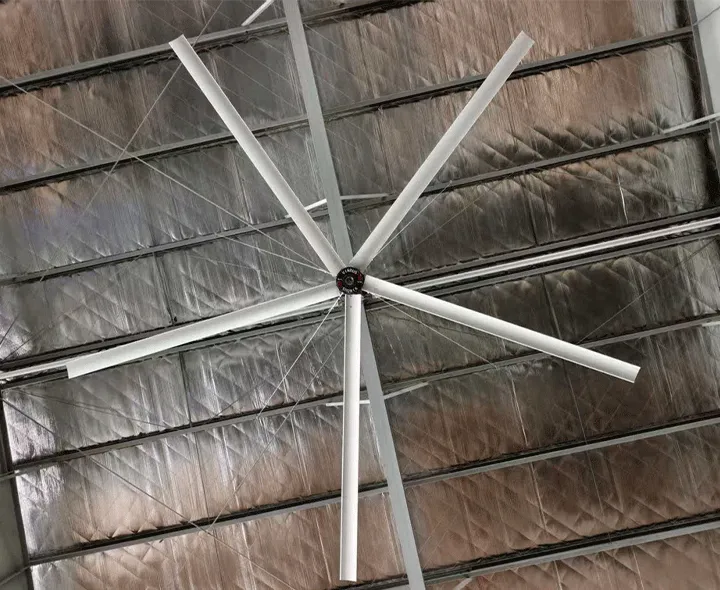
Every fan blade works as part of a matched system. Its length, width, profile, angle, and speed affect output and noise. Blade pitch describes its angle, but a steeper angle is not automatically better. The motor must handle the load, and the shape must perform well at its intended speed. More blades alone do not prove that a ceiling fan will move more air.
A well-designed ceiling fan blade balances useful output, strength, and smooth operation. Two models with the same blade count may perform very differently. Ask how the blade assembly is balanced and how its finish suits your environment. A warehouse may need easy dust removal; agricultural premises may need greater resistance to moisture and corrosion. Always verify the specific model’s suitability.
Avoid choosing by appearance or blade pitch alone. Compare tested output, sound data, and power at the same operating point. Our industrial fan options for manufacturing facilities provide a starting point for discussing these needs. The aim is to deliver strong airflow with stable operation, rather than chase one dramatic specification.
4. Which Blade Span Helps a Ceiling Fan Cover Large Areas?
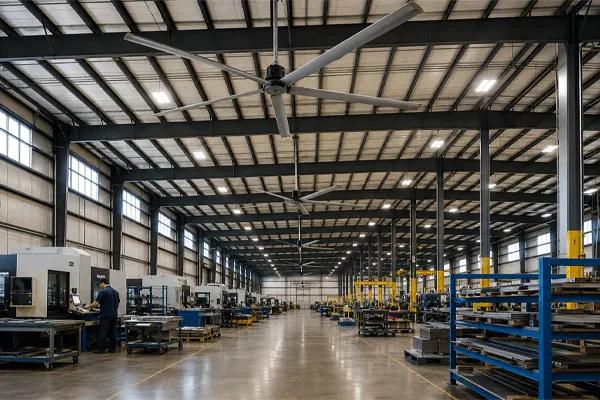
Blade span is the diameter swept by the rotating assembly. Increasing that diameter can help a fan move air across a broader area at lower rotational speed. This is the basic appeal of high-volume, low-speed, or HVLS, equipment: it can move a lot of air across open spaces. However, the size of the fan must fit the building and its clearances.
A large ceiling fan can be useful over an open production area, while several smaller fans may suit divided rooms or narrow work zones. Do not assume one central unit will circulate air effectively behind tall racks. Ask for a layout showing obstacles, occupied areas, and the route of the returning air. Compare fan size alongside installation limits and measured output.
Review our HVLS systems for large open buildings when planning spacious workshops, sports halls, or logistics facilities. We recommend discussing coverage before choosing a diameter. A suitable ceiling fan should provide usable reach without creating awkward mounting conflicts or leaving important work areas outside its effective zone.
5. How Do Ceiling Height and Mounting Affect Airflow?
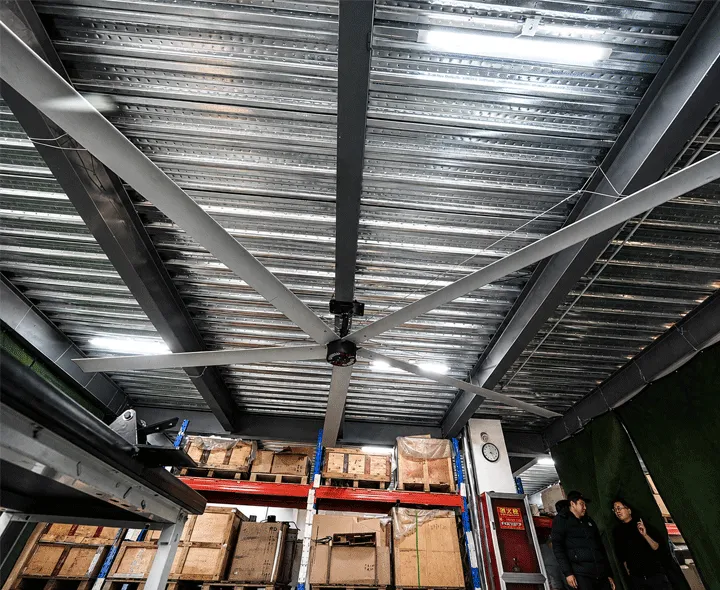
A ceiling fan needs space around its blade assembly to work as intended. Mounting it too close to the ceiling can restrict its inlet, depending on the design. The air the fan draws in needs a clear path. A tall roof may require an approved extension so the breeze reaches the working zone. When placing a ceiling fan, consider the structure, nearby services, and maintenance access together.
An 8-foot ceiling requires a different approach from a high-bay warehouse. Do not apply domestic installation guidance to large industrial equipment. Confirm the required blade clearance in feet above the floor, plus distances from walls, lights, sprinklers, cranes, and racks. Use the manufacturer’s instructions and have the project’s qualified installer confirm site requirements.
Before you position the fan, share a measured drawing and photos taken from several angles. Include lifting equipment and moving machinery in the survey. A suitable mount helps the unit effectively circulate air and limits avoidable vibration. A ceiling fan chosen from floor area alone may have no practical place to operate.
How Do I Choose a Ceiling Fan That Moves the Most Air? CFM and Airflow Explained
6. How Can You Compare CFM and Energy Efficiency?
An efficient ceiling fan combines useful delivery with modest electrical input. CFM per watt expresses output relative to power at a stated condition. For example, 6,200 CFM divided by 40 watts equals 155 CFM per watt. That is an illustrative calculation, not a performance claim for our products. Compare figures measured at matching speeds and on the same basis.
For eligible residential products, ENERGY STAR explains its weighted efficiency metric. Large industrial models need a different review: AMCA explains the Ceiling Fan Energy Index, or CFEI, and the limits of using simple output-per-watt comparisons across designs. A DC motor fan may offer useful speed control, but the motor label alone cannot prove superior whole-system performance.
Check energy efficiency at your likely daily setting, not just maximum speed. Airflow efficiency, usable coverage, and noise belong in the same comparison. A high CFM model that runs slowly for much of the day may suit your needs, but ask for measured part-speed data. Our intelligent controls for multi-fan installations are relevant when different areas need separate schedules or settings.
7. Can Ceiling Fan Air Circulation Reduce HVAC Costs?
A ceiling fan supports comfort by increasing heat loss from the body; it does not produce refrigerated cool air. When used with air conditioning, it may let occupants stay comfortable at a higher thermostat setting. A U.S. Department of Energy cooling tip gives about 4°F as a possible adjustment. That is household guidance, not a guaranteed result for a factory or mall.
In heating season, gentle mixing can bring warm air trapped near the roof back toward occupied areas. This process is called destratification. The best direction and speed depend on the equipment and building. Follow the supplier’s settings and compare temperatures at several heights. Our destratification solutions for high-bay buildings address this uneven temperature problem.
Fans do not replace fresh-air ventilation, moisture removal, or air conditioners where those functions are needed. Improved air circulation can support drying, but it does not remove water vapor from a sealed building. Greenhouses, livestock farms, and food plants need coordinated moisture and ventilation plans. Set separate goals for comfort, indoor conditions, and process needs.
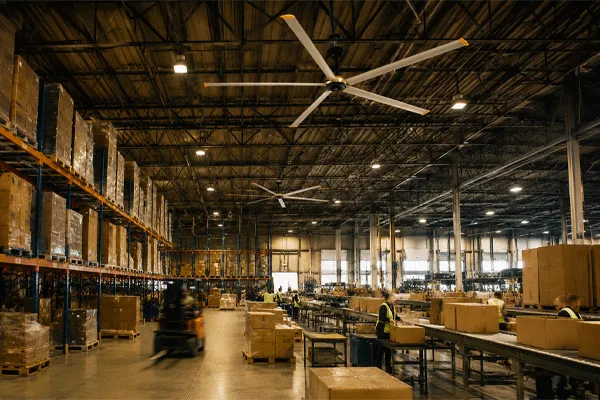
8. How Should You Plan Air Distribution Across a Warehouse?
Consider this illustrative planning example, not a customer case study. A warehouse has tall racks, a packing zone, and loading doors. Rather than select one ceiling fan by headline output, first mark where people spend time. Request speed estimates along those routes, then compare proposed layouts for consistent air circulation throughout the occupied areas.
Suppose two proposed systems can meet the same agreed comfort target. The table shows how electrical demand alone affects annual fan costs. These assumed values exclude installation, maintenance, demand charges, and changes to HVAC consumption. Neither row establishes actual product performance or proves that either layout will suit your building.
| Illustrative input |
Layout A |
Layout B |
| Combined operating power |
1.2 kW |
1.8 kW |
| Annual running time |
3,000 hours |
3,000 hours |
| Annual electricity use |
3,600 kWh |
5,400 kWh |
| Assumed electricity rate |
$0.12/kWh |
$0.12/kWh |
| Annual fan electricity cost |
$432 |
$648 |
The difference is $216 per year, provided both arrangements deliver the required result. Use your tariff and measured operating power for a real estimate. Our warehouse ventilation and cooling solutions can frame that discussion. After installation, check comfort and speed at agreed points before accepting the layout as complete.
How Do I Choose a Ceiling Fan That Moves the Most Air? CFM and Airflow Explained
9. How Do You Choose the Right Ceiling Fan Supplier?
Choosing the right fan means checking the proposal as carefully as the product. Ask for documentation tied to the exact model, including test results, electrical supply, sound measurements, environmental suitability, and maintenance needs. The fan price is only part of ownership cost. Access equipment, mounting work, spare parts, and service response can all affect your decision.
We provide energy-saving ventilation, cooling, destratification, and circulation solutions for industrial, commercial, agricultural, and public spaces. Our approach is to connect the equipment choice with the building’s purpose. Whether you manage one factory or source equipment for several projects, send enough detail to compare solutions on a shared basis.
Request a project-specific proposal through our HVLS system consultation service. Include the details below so we can discuss a suitable fan for your space. Ask each supplier to separate verified specifications from estimates and to state what installation and after-sales support its quotation includes.
- Building dimensions, roof structure, and working height.
- Floor plan, rack positions, and heat sources.
- Occupancy, shifts, and existing HVAC equipment.
- Local power supply and environmental conditions.
- Comfort targets, noise limits, and budget.
- Required drawings, documentation, warranty, and spare parts.
10. Ceiling Fan FAQs: Output, Blade Design, and Buying Choices
Which ceiling fan moves the most air?
There is no universal winner across all sizes and uses. Compare verified results within a suitable product class. Then check whether the reported capacity reaches your occupied areas at an acceptable speed, noise level, and power draw.
Does a higher CFM guarantee powerful airflow everywhere?
No. A fan moves air through the room, but racks may block its path. In cooling mode, many designs push air downward below the assembly. Ask for a coverage map showing local speeds and assumptions. The fan that moves the greatest total quantity may still leave dead spots in a divided building.
Does a five-blade design outperform a three-blade design?
Not necessarily. Blade count works together with diameter, profile, pitch, and motor output. Compare the tested assembly. A well-matched three-blade design may move as much air as a model with more blades; another may favor quiet operation.
Can I install a ceiling fan in a bathroom?
Only use a suitably rated product in an approved location. It cannot replace the exhaust system that removes humid air outdoors. Check environmental suitability, electrical installation requirements, and the manufacturer’s instructions before selecting equipment for wet areas.
Should I compare a Hunter fan with an industrial HVLS model?
Only if their intended use and test data make the comparison meaningful. A household unit and an industrial system solve different problems. For a commercial room needing both airflow and lighting, evaluate the light output separately from the fan’s cooling effect.
How can I enjoy maximum airflow without running at full speed?
You may not need peak output to feel comfortable. Choose a suitable diameter and layout, maintain clearances, and keep each blade clean. Commission the controls at the lowest setting that meets your target, then adjust as occupancy and conditions change.
Key points to remember
- Compare verified CFM figures using compatible test methods.
- Check the breeze at occupied height, not just total output.
- Match diameter, blade design, and mounting to the building.
- Review operating power, noise, and the appropriate efficiency metric.
- Coordinate circulation with heating, cooling, and ventilation.
- Request a documented layout and a clear service proposal before ordering.