PMSM vs Induction Motor: Which Is Better for Large Industrial Fans?
2026-09-15
Updated September 15, 2026 | Michael Danielsson, CEO, Vindus Fans
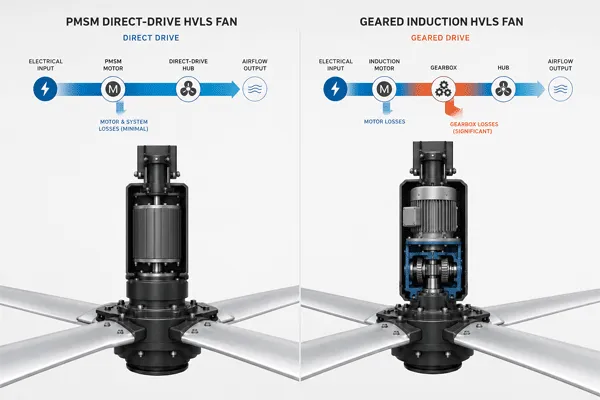
PMSM and induction motors can both power industrial fans, but they create different system architectures. A permanent-magnet synchronous motor is well suited to compact direct drive and precise variable-speed control. An induction motor remains practical for conventional belt- or gearbox-driven equipment where service familiarity, availability, and upfront cost matter.
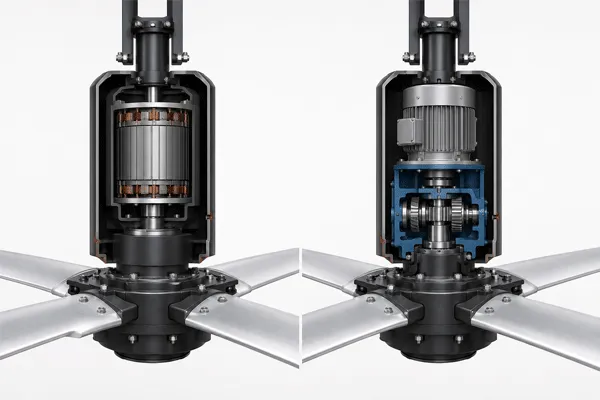
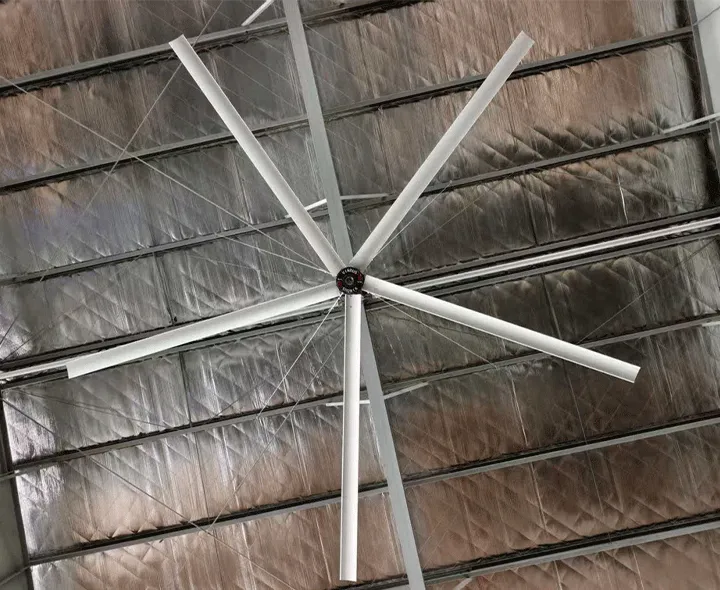
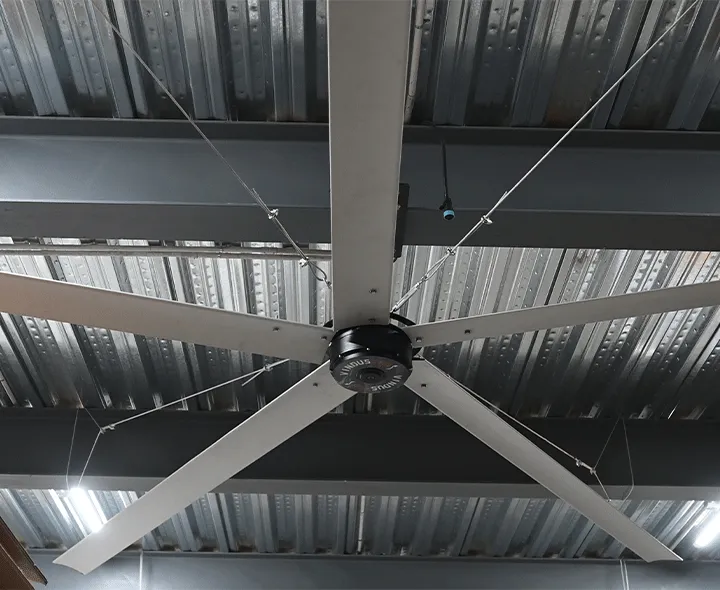
A direct-drive PMSM removes the gearbox stage used in many conventional induction-motor HVLS systems.
PMSM vs induction motor: the operating difference
A permanent-magnet synchronous motor uses permanent magnets in the rotor. The rotor turns in step with the rotating magnetic field produced by the stator, so rotor speed is synchronized with electrical frequency after the drive accounts for the motor’s pole count. Electronic control is integral to practical variable-speed operation.
An induction motor creates rotor current through electromagnetic induction. The rotor must turn slightly slower than the stator’s rotating field to produce torque; this difference is called slip. Industrial induction motors are widely available and familiar to maintenance teams, but the complete fan may also need belts, pulleys, or a gearbox to reach the required fan speed and torque.
Decision factor
PMSM
Induction motor
Rotor principle
Permanent magnets; synchronous rotation
Induced rotor current; operates with slip
Typical HVLS architecture
Compact direct drive is practical
Often paired with a gearbox or belt reduction
Speed control
Requires a matched electronic drive
Variable frequency drive commonly used for variable speed
Rotor losses
No induction-related rotor copper loss
Rotor losses are inherent to torque production
Mechanical service points
Direct drive can remove belts and gear oil
Depends on whether the fan uses belts, pulleys, or a gearbox
Supply familiarity
Controller and motor must be treated as a matched system
Broad market availability and established service knowledge
Initial equipment cost
Magnets and drive electronics can increase component cost
Standard motors may offer a lower initial component cost
Efficiency depends on the complete drive train
Motor efficiency is only one part of fan input power. The controller, motor, gearbox or belt transmission, bearings, fan aerodynamics, operating speed, and control schedule all affect the measured result. Comparing a premium induction motor with a PMSM while ignoring transmission losses can give the wrong answer for the installed fan.
The U.S. Department of Energy’s Motor Systems resources likewise treat the motor as part of a broader driven-equipment system. For an HVLS project, procurement comparisons should use measured or certified whole-fan input at equivalent operating points rather than transferring a motor-only percentage directly to the building.
A PMSM avoids the rotor losses associated with induction and can maintain useful efficiency across a variable-speed operating range. In a direct-drive fan, it can also remove the losses and maintenance points of a separate gearbox or belt reduction. The actual saving is project-specific; it must be calculated from verified input power at the required duty point and annual operating hours.
An induction motor may still be efficient when correctly sized and paired with a suitable variable frequency drive. Oversizing either motor type and running it far from the intended duty point can undermine the expected result. Fan speed matters greatly because aerodynamic power changes rapidly as speed rises.
Control and low-speed torque
Large-diameter HVLS fans operate at low rotational speed and need controlled acceleration, stable torque, and smooth speed adjustment. A PMSM controller uses rotor-position information or estimation to regulate torque and speed. The motor, drive firmware, protection settings, and user interface therefore form one engineered package.
An induction motor with a VFD also supports soft starting and variable speed. Its behavior depends on the motor data, VFD control method, minimum-speed cooling, cable length, switching settings, and load. For either design, simply connecting a generic drive without validated motor parameters can cause poor starting, nuisance trips, overheating, or unstable operation.
Maintenance is an architecture question
Permanent magnets do not make a fan maintenance-free. Bearings, fasteners, safety devices, blades, electrical connections, controller cooling, and structural attachments still require inspection. The practical PMSM advantage appears when direct drive eliminates a gearbox, belts, pulleys, lubrication, and alignment work.
An induction motor itself is familiar and serviceable. If it drives the fan through a gearbox or belt system, maintenance must also cover oil condition, seals, gear wear, belt tension, alignment, guards, and replacement intervals. In some markets, a standard induction motor may be easier to source quickly than a proprietary matched PMSM assembly.
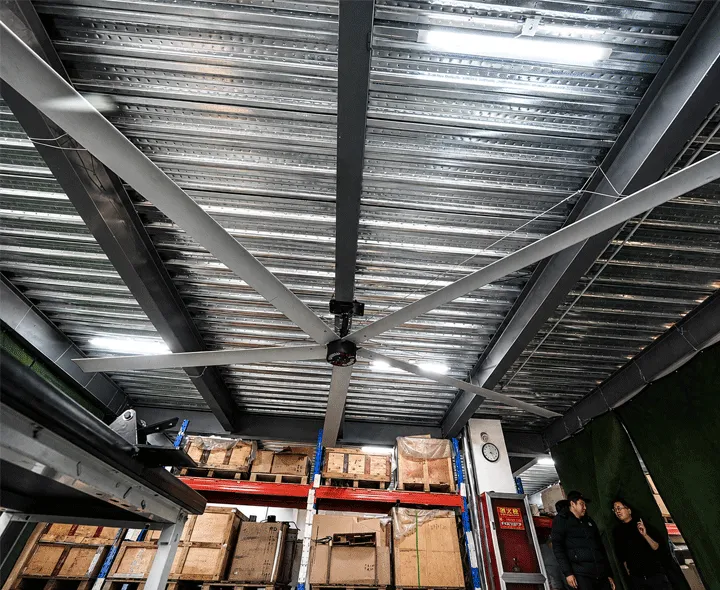
The motor, hub, bearings, controller, blades, and safety structure should be evaluated as one fan system.
Weight, structure, and installation
Removing a separate gearbox can reduce the mass and depth of a drive assembly. That may simplify handling and reduce the suspended load, but it never removes the need for a structural review. Fan diameter, motor torque, dynamic loading, mounting hardware, building steel, seismic requirements, safety cables, clearances, and installation access must all be checked.
Compared with a conventional geared induction system, a direct-drive PMSM layout may contain fewer mechanical interfaces. The tradeoff is greater dependence on the matched electronics and the manufacturer’s diagnostic and replacement support. Buyers should ask how faults are identified, which components are field-replaceable, and how long critical spares remain available.
P780 Series planning reference
The Vindus P780 Series uses a direct-drive PMSM for large U.S.-market applications. Published configurations include 20 ft and 24 ft diameters for approximate blade heights of 20–33 ft. The series lists maximum-speed input below 1,000 W and provides a floor-level integrated HMI through a single ceiling-to-floor cable.
Published P780 item
Buyer verification
Direct-drive PMSM
Confirm controller match, protection settings, diagnostics, warranty, and spare-part route
20 ft or 24 ft diameter
Check target zone, fan spacing, obstructions, sprinklers, lights, cranes, racks, and doors
Approximate blade height of 20–33 ft
Verify roof structure, mounting geometry, safety clearances, and service access
Maximum-speed input below 1,000 W
Compare verified input power at the intended speed and annual operating schedule
Floor-level integrated HMI
Define operator access, normal setpoints, seasonal modes, shutdown, and fault response
These are product-level planning references, not a guarantee of savings in every building. Vindus does not publish a fixed P780 price. A quotation depends on model, quantity, controls, electrical scope, delivery, installation, and project support.
When an induction motor remains the better fit
An induction motor may be preferable when the facility standardizes on readily available motor frames, the maintenance team already supports the installed drive system, and rapid local replacement is more important than minimizing drive-train components. Existing equipment constraints may also make a like-for-like induction replacement the lowest-risk decision.
A PMSM direct-drive system is compelling when the application values variable-speed operation, compact drive architecture, fewer mechanical transmission components, and verified low input power. The choice should still be based on the complete fan, controller, structural package, warranty, documentation, and supplier support.
Six checks before selecting the motor system
Define the fan duty. Record diameter, airflow objective, operating speed range, hours, seasonal modes, starts, stops, and reversals.
Compare complete-system input. Include controller, motor, gearbox or belts, and the fan at the same useful operating point.
Review maintenance work. List bearings, lubrication, belts, alignment, seals, electronics, inspection intervals, and access requirements.
Test the support path. Confirm diagnostics, spare parts, field replacement, documentation, warranty, and technical response.
Commission the installed fan. Verify rotation, speed, vibration, power, controls, safety devices, airflow pattern, and abnormal-stop behavior.
Common comparison mistakes
Comparing nameplate motor efficiency while ignoring gearbox or belt losses.
Assuming direct drive means no maintenance or structural inspection.
Comparing power readings at different fan speeds or different airflow duties.
Ignoring controller compatibility, firmware, diagnostics, and replacement availability.
Using a maximum-power figure as if the fan always operates at that input.
Selecting from motor type alone without checking fan aerodynamics and building layout.
FAQ
Is a PMSM always more efficient than an induction motor?
Not under every operating condition. PMSMs avoid induction-related rotor losses and suit direct drive, but installed efficiency depends on the controller, transmission, fan, speed, and duty point. Compare verified whole-system input for the same useful output.
Does an induction motor need a gearbox in an HVLS fan?
Not by definition, but many conventional HVLS designs use a gearbox or other reduction stage to obtain the required low fan speed and torque. Evaluate the actual product architecture rather than the motor label alone.
Can a PMSM run directly from mains power?
A practical variable-speed PMSM fan requires a compatible electronic controller. The motor data, drive, firmware, protection, cabling, and interface should be supplied and validated as a matched system.
Which motor has lower maintenance?
The answer depends on the drive train. A direct-drive PMSM can remove belts and a gearbox, reducing mechanical service points. Both designs still require bearing, electrical, blade, fastener, safety, and structural inspections.
What data should be requested before buying?
Request fan curves or performance data, complete-system input power, speed range, controller details, assembly mass, mounting loads, protection features, maintenance requirements, warranty terms, certifications, and spare-part support.
Compare the whole fan, not one component
Prepare the building dimensions, clear height, obstructions, required coverage, electrical supply, duty schedule, control needs, and maintenance constraints. Review the Vindus HVLS fan range and contact Vindus for a model and layout discussion based on the complete application.
About the author
Michael Danielsson is CEO of Vindus Fans. His background includes fan product development, production, operations, and customer service for large-space airflow applications.
Updated September 15, 2026 | Michael Danielsson, CEO, Vindus Fans
PMSM and induction motors can both power industrial fans, but they create different system architectures. A permanent-magnet synchronous motor is well suited to compact direct drive and precise variable-speed control. An induction motor remains practical for conventional belt- or gearbox-driven equipment where service familiarity, availability, and upfront cost matter.
A direct-drive PMSM removes the gearbox stage used in many conventional induction-motor HVLS systems.
PMSM vs induction motor: the operating difference
A permanent-magnet synchronous motor uses permanent magnets in the rotor. The rotor turns in step with the rotating magnetic field produced by the stator, so rotor speed is synchronized with electrical frequency after the drive accounts for the motor's pole count. Electronic control is integral to practical variable-speed operation.
An induction motor creates rotor current through electromagnetic induction. The rotor must turn slightly slower than the stator's rotating field to produce torque; this difference is called slip. Industrial induction motors are widely available and familiar to maintenance teams, but the complete fan may also need belts, pulleys, or a gearbox to reach the required fan speed and torque.
Decision factor
PMSM
Induction motor
Rotor principle
Permanent magnets; synchronous rotation
Induced rotor current; operates with slip
Typical HVLS architecture
Compact direct drive is practical
Often paired with a gearbox or belt reduction
Speed control
Requires a matched electronic drive
Variable frequency drive commonly used for variable speed
Rotor losses
No induction-related rotor copper loss
Rotor losses are inherent to torque production
Mechanical service points
Direct drive can remove belts and gear oil
Depends on whether the fan uses belts, pulleys, or a gearbox
Supply familiarity
Controller and motor must be treated as a matched system
Broad market availability and established service knowledge
Initial equipment cost
Magnets and drive electronics can increase component cost
Standard motors may offer a lower initial component cost
Efficiency depends on the complete drive train
Motor efficiency is only one part of fan input power. The controller, motor, gearbox or belt transmission, bearings, fan aerodynamics, operating speed, and control schedule all affect the measured result. Comparing a premium induction motor with a PMSM while ignoring transmission losses can give the wrong answer for the installed fan.
The U.S. Department of Energy's Motor Systems resources likewise treat the motor as part of a broader driven-equipment system. For an HVLS project, procurement comparisons should use measured or certified whole-fan input at equivalent operating points rather than transferring a motor-only percentage directly to the building.
A PMSM avoids the rotor losses associated with induction and can maintain useful efficiency across a variable-speed operating range. In a direct-drive fan, it can also remove the losses and maintenance points of a separate gearbox or belt reduction. The actual saving is project-specific; it must be calculated from verified input power at the required duty point and annual operating hours.
An induction motor may still be efficient when correctly sized and paired with a suitable variable frequency drive. Oversizing either motor type and running it far from the intended duty point can undermine the expected result. Fan speed matters greatly because aerodynamic power changes rapidly as speed rises.
Control and low-speed torque
Large-diameter HVLS fans operate at low rotational speed and need controlled acceleration, stable torque, and smooth speed adjustment. A PMSM controller uses rotor-position information or estimation to regulate torque and speed. The motor, drive firmware, protection settings, and user interface therefore form one engineered package.
An induction motor with a VFD also supports soft starting and variable speed. Its behavior depends on the motor data, VFD control method, minimum-speed cooling, cable length, switching settings, and load. For either design, simply connecting a generic drive without validated motor parameters can cause poor starting, nuisance trips, overheating, or unstable operation.
Maintenance is an architecture question
Permanent magnets do not make a fan maintenance-free. Bearings, fasteners, safety devices, blades, electrical connections, controller cooling, and structural attachments still require inspection. The practical PMSM advantage appears when direct drive eliminates a gearbox, belts, pulleys, lubrication, and alignment work.
An induction motor itself is familiar and serviceable. If it drives the fan through a gearbox or belt system, maintenance must also cover oil condition, seals, gear wear, belt tension, alignment, guards, and replacement intervals. In some markets, a standard induction motor may be easier to source quickly than a proprietary matched PMSM assembly.
The motor, hub, bearings, controller, blades, and safety structure should be evaluated as one fan system.
Weight, structure, and installation
Removing a separate gearbox can reduce the mass and depth of a drive assembly. That may simplify handling and reduce the suspended load, but it never removes the need for a structural review. Fan diameter, motor torque, dynamic loading, mounting hardware, building steel, seismic requirements, safety cables, clearances, and installation access must all be checked.
Compared with a conventional geared induction system, a direct-drive PMSM layout may contain fewer mechanical interfaces. The tradeoff is greater dependence on the matched electronics and the manufacturer's diagnostic and replacement support. Buyers should ask how faults are identified, which components are field-replaceable, and how long critical spares remain available.
P780 Series planning reference
The Vindus P780 Series uses a direct-drive PMSM for large U.S.-market applications. Published configurations include 20 ft and 24 ft diameters for approximate blade heights of 20–33 ft. The series lists maximum-speed input below 1,000 W and provides a floor-level integrated HMI through a single ceiling-to-floor cable.
Published P780 item
Buyer verification
Direct-drive PMSM
Confirm controller match, protection settings, diagnostics, warranty, and spare-part route
20 ft or 24 ft diameter
Check target zone, fan spacing, obstructions, sprinklers, lights, cranes, racks, and doors
Approximate blade height of 20–33 ft
Verify roof structure, mounting geometry, safety clearances, and service access
Maximum-speed input below 1,000 W
Compare verified input power at the intended speed and annual operating schedule
Floor-level integrated HMI
Define operator access, normal setpoints, seasonal modes, shutdown, and fault response
These are product-level planning references, not a guarantee of savings in every building. Vindus does not publish a fixed P780 price. A quotation depends on model, quantity, controls, electrical scope, delivery, installation, and project support.
When an induction motor remains the better fit
An induction motor may be preferable when the facility standardizes on readily available motor frames, the maintenance team already supports the installed drive system, and rapid local replacement is more important than minimizing drive-train components. Existing equipment constraints may also make a like-for-like induction replacement the lowest-risk decision.
A PMSM direct-drive system is compelling when the application values variable-speed operation, compact drive architecture, fewer mechanical transmission components, and verified low input power. The choice should still be based on the complete fan, controller, structural package, warranty, documentation, and supplier support.
Six checks before selecting the motor system
Define the fan duty. Record diameter, airflow objective, operating speed range, hours, seasonal modes, starts, stops, and reversals.
Compare complete-system input. Include controller, motor, gearbox or belts, and the fan at the same useful operating point.
Review maintenance work. List bearings, lubrication, belts, alignment, seals, electronics, inspection intervals, and access requirements.
Test the support path. Confirm diagnostics, spare parts, field replacement, documentation, warranty, and technical response.
Commission the installed fan. Verify rotation, speed, vibration, power, controls, safety devices, airflow pattern, and abnormal-stop behavior.
Common comparison mistakes
Comparing nameplate motor efficiency while ignoring gearbox or belt losses.
Assuming direct drive means no maintenance or structural inspection.
Comparing power readings at different fan speeds or different airflow duties.
Ignoring controller compatibility, firmware, diagnostics, and replacement availability.
Using a maximum-power figure as if the fan always operates at that input.
Selecting from motor type alone without checking fan aerodynamics and building layout.
FAQ
Is a PMSM always more efficient than an induction motor?
Not under every operating condition. PMSMs avoid induction-related rotor losses and suit direct drive, but installed efficiency depends on the controller, transmission, fan, speed, and duty point. Compare verified whole-system input for the same useful output.
Does an induction motor need a gearbox in an HVLS fan?
Not by definition, but many conventional HVLS designs use a gearbox or other reduction stage to obtain the required low fan speed and torque. Evaluate the actual product architecture rather than the motor label alone.
Can a PMSM run directly from mains power?
A practical variable-speed PMSM fan requires a compatible electronic controller. The motor data, drive, firmware, protection, cabling, and interface should be supplied and validated as a matched system.
Which motor has lower maintenance?
The answer depends on the drive train. A direct-drive PMSM can remove belts and a gearbox, reducing mechanical service points. Both designs still require bearing, electrical, blade, fastener, safety, and structural inspections.
What data should be requested before buying?
Request fan curves or performance data, complete-system input power, speed range, controller details, assembly mass, mounting loads, protection features, maintenance requirements, warranty terms, certifications, and spare-part support.
Compare the whole fan, not one component
Prepare the building dimensions, clear height, obstructions, required coverage, electrical supply, duty schedule, control needs, and maintenance constraints. Review the Vindus HVLS fan range and contact Vindus for a model and layout discussion based on the complete application.
About the author
Michael Danielsson is CEO of Vindus Fans. His background includes fan product development, production, operations, and customer service for large-space airflow applications.
Hi, I’m Michael Danielsson, CEO of Vindus Fans, with over 15 years of experience in the engineering and design industry. I’m here to share what I’ve learned. If you have any questions, feel free to contact me at any time. Let’s grow together!