Industrial Ceiling Fans: A Buyer’s Guide to Sizing, Motors, Controls, and Energy Use
2026-09-21
Updated September 17, 2026 | Michael Danielsson, CEO, Vindus Fans
Industrial ceiling fans should be specified as part of the building’s airflow system, not selected from diameter alone. The right choice depends on ceiling height, usable floor zones, racks and equipment, motor and drive architecture, controls, structural loads, safety clearances, operating schedule, and the result the facility needs to measure.
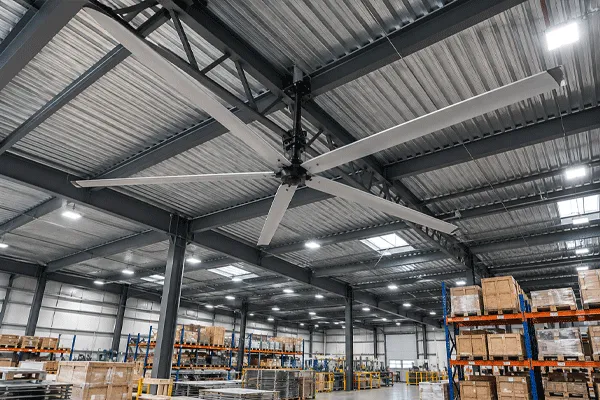
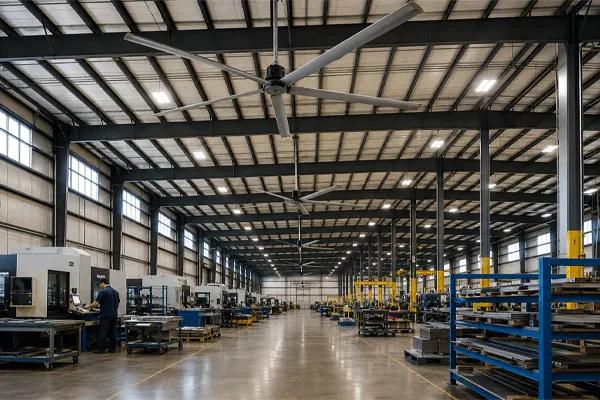
Fan diameter and placement must be coordinated with roof structure, racks, lighting, sprinklers, doors, and work zones.
Define the job before comparing fan sizes
A buyer may want better summer comfort, less vertical temperature difference in winter, wider distribution of conditioned air, or fewer stagnant zones. These are related goals, but they require different baselines and operating modes. Record temperatures and air speed in occupied areas, note door positions and HVAC schedules, and map where the problem occurs by shift.
Industrial ceiling fans recirculate indoor air. They do not create outdoor-air exchange, refrigerate the building, or replace local exhaust for dust, fumes, or combustion products. Where contaminant control is required, the ventilation and industrial-hygiene design takes priority over comfort circulation.
The Air Movement and Control Association provides technical material about fan performance, testing, and system effects through AMCA Education. Ask suppliers for applicable test references and compare products at equivalent operating points rather than relying on unverified coverage claims.
Sizing starts with building geometry
Floor area is only the first input. Measure clear height, roof slope, beam spacing, rack tops, mezzanines, partitions, cranes, ducts, lights, sprinklers, large equipment, dock doors, and occupied locations. These elements can restrict fan inlet air, interrupt floor-level spread, or divide one building into several practical airflow zones.
A large fan can serve an open floor efficiently, while several smaller fans may suit divided spaces or long rack aisles. More diameter is not automatically better. A fan that is too large for available clearances, mounted too near the roof, or poorly aligned with the work zone may underperform despite an impressive nominal size.
Survey item
Effect on selection
Evidence to provide
Clear ceiling and blade height
Limits diameter, mounting geometry, and useful floor-level air movement
Sections, roof drawings, measured clearances
Racks and partitions
Create sheltered zones and interrupt horizontal spread
Rack plan, heights, aisle widths, partitions
Lights, sprinklers, cranes, and ducts
Control safe fan position and service access
Reflected ceiling plan and equipment paths
Dock and process doors
Change pressure and redirect airflow when open
Door dimensions and operating schedule
Occupied zones
Determine comfort targets and acceptable air speed
Workstation map, shifts, seasonal complaints
Supply and exhaust points
May complement or conflict with circulation
HVAC drawings, operating modes, measured airflow
Match the fan family to diameter and height
For U.S. projects, the Vindus P-series covers several building scales. The P680 Series includes published diameters from 8 ft to 14 ft for approximate blade heights of 10–25 ft. The P730 Series includes 16 ft and 18 ft choices for approximate blade heights of 20–33 ft. The P780 Series includes 20 ft and 24 ft choices for approximate blade heights of 20–33 ft.
These ranges support initial screening, not final layout approval. The correct family still depends on obstructions, target zones, structural conditions, neighboring fans, and tested product performance. A supplier should explain why a proposed diameter and quantity suit the actual plan.
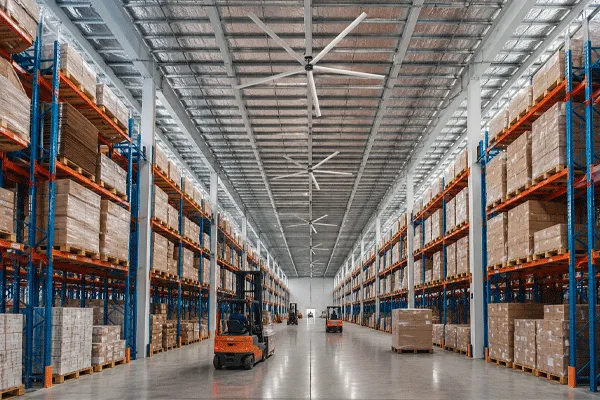
Multiple industrial ceiling fans need coordinated spacing so their air patterns support, rather than disrupt, the intended zones.
Direct drive versus geared or belt-driven systems
Direct-drive PMSM architecture places the motor at the fan hub without a separate gearbox. This can remove gear oil, seals, belts, pulleys, and alignment tasks from the drive train. Permanent-magnet synchronous motors also suit variable-speed control and avoid the rotor losses associated with induction.
A geared or belt-driven induction system remains familiar to many industrial maintenance teams. Standard motor sourcing and established service knowledge may be useful. The complete maintenance plan must also cover its transmission components, including lubrication, seals, belt tension, alignment, guards, and replacement intervals where applicable.
Compare complete-fan input power at the same useful duty. A motor-efficiency label does not include gearbox, belt, controller, or aerodynamic losses. See the Vindus guide to PMSM versus induction motors for a component-by-component comparison.
Controls determine how the fan is actually used
The controller should make approved operating modes repeatable. Define start and stop, normal speed range, direction where applicable, seasonal settings, emergency shutdown, fault handling, and operator permissions. A multi-fan site may also need centralized control, scheduling, or building-automation integration.
Maximum speed should not become the default without commissioning. People near the fan may experience drafts before distant zones receive useful movement. Open doors, supply diffusers, exhaust points, and neighboring fans can alter the pattern. Test several settings and document the chosen summer and winter modes.
P780 specification reference
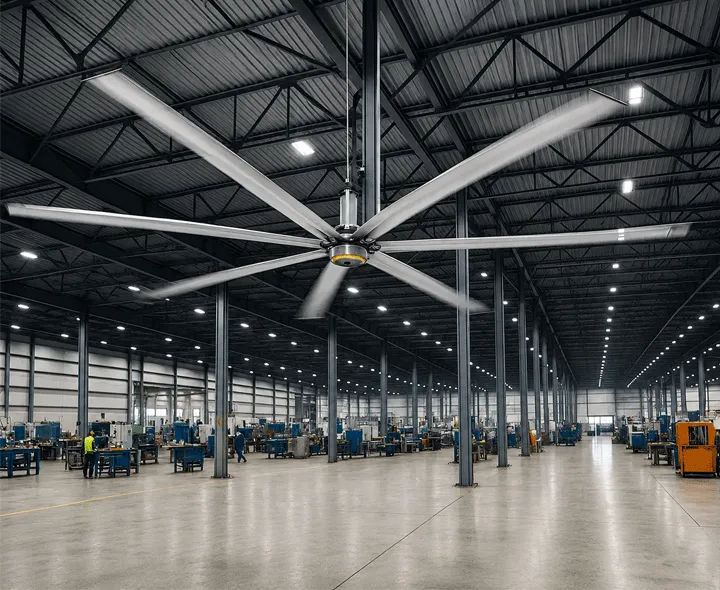
The Vindus P780 Series is intended for large U.S.-market industrial and commercial spaces. It uses a direct-drive PMSM, offers published 20 ft and 24 ft diameters, and is presented for approximate blade heights of 20–33 ft. Published maximum-speed input is below 1,000 W. A floor-level integrated HMI connects through a single ceiling-to-floor cable.
A model recommendation should connect published specifications to the real ceiling, floor zones, operating schedule, and control plan.
Published P780 item
What the buyer should verify
20 ft or 24 ft diameter
Target area, fan spacing, rack aisles, doors, walls, and neighboring fans
Approximate blade height of 20–33 ft
Structure, inlet clearance, sprinklers, lights, cranes, ducts, and maintenance access
Direct-drive PMSM
Controller match, diagnostics, protection, warranty, replacement, and spare support
Maximum-speed input below 1,000 W
Measured complete-fan input at the intended speed and annual schedule
Floor-level integrated HMI
Operator access, setpoints, seasonal modes, shutdown, and fault response
Vindus does not publish a fixed P780 price. A quotation depends on diameter, quantity, controls, electrical scope, mounting, installation, delivery, and technical support. Ask for the full project scope before comparing totals.
Estimate energy from duty, not maximum power alone
Annual fan energy is the measured input power at each operating condition multiplied by the hours at that condition. A maximum-power value is not an annual-consumption figure. A fan that runs at reduced speed for much of the year can have a different energy profile from one that operates at full speed throughout every shift.
Compare proposed systems using the same occupied zones, operating schedule, seasonal modes, and acceptance targets. Include existing spot fans or HVAC changes that the project expects to avoid. Do not claim a saving until baseline and post-installation power and operating hours can be compared.
Safety and structure are part of the product decision
The mounting structure must be checked for static and dynamic loads. Coordinate brackets, fasteners, safety restraints, blade clearance, electrical isolation, service access, seismic or wind requirements where applicable, and the planned inspection process.
Fans must also be coordinated with sprinklers, smoke detection, lights, cranes, doors, racks, and process exhaust. Qualified project professionals and the authority having jurisdiction determine the final requirements. A low equipment price does not compensate for an installation that cannot be approved or maintained safely.
An eight-step buying checklist
State the measurable goal. Identify comfort, destratification, air distribution, stagnant-zone, or energy objectives.
Survey the building. Provide drawings, dimensions, heights, structure, obstacles, doors, racks, equipment, and occupied zones.
Map existing airflow. Record HVAC supply, return and exhaust locations, door conditions, and current fan operation.
Compare layouts. Review fan family, diameter, quantity, placement, spacing, clearances, and expected interaction.
Review the complete fan. Compare tested performance, motor and drive, controller, blades, hub, safety devices, sound, and power.
Price the installed lifecycle. Include equipment, freight, structure, electrical work, installation, commissioning, inspection, service, and downtime.
Commission against the goal. Verify rotation, vibration, input power, controls, safety, air movement, temperature distribution, and approved setpoints.
Common specification mistakes
Choosing from square footage without ceiling height or a reflected ceiling plan.
Using a generic coverage circle as a guarantee for a racked or divided facility.
Comparing motor labels while ignoring drive-train and fan-system losses.
Assuming industrial ceiling fans provide outdoor air or contaminant removal.
Ignoring structural loads, sprinklers, cranes, service access, and controls.
Comparing equipment price without installation, commissioning, maintenance, and spare parts.
FAQ
What size industrial ceiling fan is needed?
Size depends on ceiling height, target zones, obstructions, fan performance, acceptable air speed, neighboring fans, and operating objectives. Floor area alone cannot determine diameter or quantity.
Are larger industrial fans always better?
No. A larger fan can cover an open area, but available clearance, structure, divided zones, racks, doors, and desired air speed may favor a different diameter or multiple fans.
Can industrial ceiling fans replace HVAC?
No. They recirculate air and can improve comfort or distribute conditioned air, but they do not provide refrigeration, outdoor air, or contaminant extraction.
What is the difference between direct drive and geared drive?
Direct drive connects the motor to the hub without a separate gearbox. A geared system uses mechanical reduction between motor and fan. Compare whole-system efficiency, maintenance, control, service support, and application fit.
How should energy use be compared?
Use verified complete-fan input at equivalent duty points, then multiply each operating condition by annual hours. Do not compare maximum watts alone or transfer an unverified percentage from another building.
Michael Danielsson is CEO of Vindus Fans. His background includes fan product development, production, operations, and customer service for large-space airflow applications.
Updated September 17, 2026 | Michael Danielsson, CEO, Vindus Fans
Industrial ceiling fans should be specified as part of the building’s airflow system, not selected from diameter alone. The right choice depends on ceiling height, usable floor zones, racks and equipment, motor and drive architecture, controls, structural loads, safety clearances, operating schedule, and the result the facility needs to measure.
Fan diameter and placement must be coordinated with roof structure, racks, lighting, sprinklers, doors, and work zones.
Define the job before comparing fan sizes
A buyer may want better summer comfort, less vertical temperature difference in winter, wider distribution of conditioned air, or fewer stagnant zones. These are related goals, but they require different baselines and operating modes. Record temperatures and air speed in occupied areas, note door positions and HVAC schedules, and map where the problem occurs by shift.
Industrial ceiling fans recirculate indoor air. They do not create outdoor-air exchange, refrigerate the building, or replace local exhaust for dust, fumes, or combustion products. Where contaminant control is required, the ventilation and industrial-hygiene design takes priority over comfort circulation.
The Air Movement and Control Association provides technical material about fan performance, testing, and system effects through AMCA Education. Ask suppliers for applicable test references and compare products at equivalent operating points rather than relying on unverified coverage claims.
Sizing starts with building geometry
Floor area is only the first input. Measure clear height, roof slope, beam spacing, rack tops, mezzanines, partitions, cranes, ducts, lights, sprinklers, large equipment, dock doors, and occupied locations. These elements can restrict fan inlet air, interrupt floor-level spread, or divide one building into several practical airflow zones.
A large fan can serve an open floor efficiently, while several smaller fans may suit divided spaces or long rack aisles. More diameter is not automatically better. A fan that is too large for available clearances, mounted too near the roof, or poorly aligned with the work zone may underperform despite an impressive nominal size.
Survey item
Effect on selection
Evidence to provide
Clear ceiling and blade height
Limits diameter, mounting geometry, and useful floor-level air movement
Sections, roof drawings, measured clearances
Racks and partitions
Create sheltered zones and interrupt horizontal spread
Rack plan, heights, aisle widths, partitions
Lights, sprinklers, cranes, and ducts
Control safe fan position and service access
Reflected ceiling plan and equipment paths
Dock and process doors
Change pressure and redirect airflow when open
Door dimensions and operating schedule
Occupied zones
Determine comfort targets and acceptable air speed
Workstation map, shifts, seasonal complaints
Supply and exhaust points
May complement or conflict with circulation
HVAC drawings, operating modes, measured airflow
Match the fan family to diameter and height
For U.S. projects, the Vindus P-series covers several building scales. The P680 Series includes published diameters from 8 ft to 14 ft for approximate blade heights of 10–25 ft. The P730 Series includes 16 ft and 18 ft choices for approximate blade heights of 20–33 ft. The P780 Series includes 20 ft and 24 ft choices for approximate blade heights of 20–33 ft.
These ranges support initial screening, not final layout approval. The correct family still depends on obstructions, target zones, structural conditions, neighboring fans, and tested product performance. A supplier should explain why a proposed diameter and quantity suit the actual plan.
Multiple industrial ceiling fans need coordinated spacing so their air patterns support, rather than disrupt, the intended zones.
Direct drive versus geared or belt-driven systems
Direct-drive PMSM architecture places the motor at the fan hub without a separate gearbox. This can remove gear oil, seals, belts, pulleys, and alignment tasks from the drive train. Permanent-magnet synchronous motors also suit variable-speed control and avoid the rotor losses associated with induction.
A geared or belt-driven induction system remains familiar to many industrial maintenance teams. Standard motor sourcing and established service knowledge may be useful. The complete maintenance plan must also cover its transmission components, including lubrication, seals, belt tension, alignment, guards, and replacement intervals where applicable.
Compare complete-fan input power at the same useful duty. A motor-efficiency label does not include gearbox, belt, controller, or aerodynamic losses. See the Vindus guide to PMSM versus induction motors for a component-by-component comparison.
Controls determine how the fan is actually used
The controller should make approved operating modes repeatable. Define start and stop, normal speed range, direction where applicable, seasonal settings, emergency shutdown, fault handling, and operator permissions. A multi-fan site may also need centralized control, scheduling, or building-automation integration.
Maximum speed should not become the default without commissioning. People near the fan may experience drafts before distant zones receive useful movement. Open doors, supply diffusers, exhaust points, and neighboring fans can alter the pattern. Test several settings and document the chosen summer and winter modes.
P780 specification reference
The Vindus P780 Series is intended for large U.S.-market industrial and commercial spaces. It uses a direct-drive PMSM, offers published 20 ft and 24 ft diameters, and is presented for approximate blade heights of 20–33 ft. Published maximum-speed input is below 1,000 W. A floor-level integrated HMI connects through a single ceiling-to-floor cable.
A model recommendation should connect published specifications to the real ceiling, floor zones, operating schedule, and control plan.
Published P780 item
What the buyer should verify
20 ft or 24 ft diameter
Target area, fan spacing, rack aisles, doors, walls, and neighboring fans
Approximate blade height of 20–33 ft
Structure, inlet clearance, sprinklers, lights, cranes, ducts, and maintenance access
Direct-drive PMSM
Controller match, diagnostics, protection, warranty, replacement, and spare support
Maximum-speed input below 1,000 W
Measured complete-fan input at the intended speed and annual schedule
Floor-level integrated HMI
Operator access, setpoints, seasonal modes, shutdown, and fault response
Vindus does not publish a fixed P780 price. A quotation depends on diameter, quantity, controls, electrical scope, mounting, installation, delivery, and technical support. Ask for the full project scope before comparing totals.
Estimate energy from duty, not maximum power alone
Annual fan energy is the measured input power at each operating condition multiplied by the hours at that condition. A maximum-power value is not an annual-consumption figure. A fan that runs at reduced speed for much of the year can have a different energy profile from one that operates at full speed throughout every shift.
Compare proposed systems using the same occupied zones, operating schedule, seasonal modes, and acceptance targets. Include existing spot fans or HVAC changes that the project expects to avoid. Do not claim a saving until baseline and post-installation power and operating hours can be compared.
Safety and structure are part of the product decision
The mounting structure must be checked for static and dynamic loads. Coordinate brackets, fasteners, safety restraints, blade clearance, electrical isolation, service access, seismic or wind requirements where applicable, and the planned inspection process.
Fans must also be coordinated with sprinklers, smoke detection, lights, cranes, doors, racks, and process exhaust. Qualified project professionals and the authority having jurisdiction determine the final requirements. A low equipment price does not compensate for an installation that cannot be approved or maintained safely.
An eight-step buying checklist
State the measurable goal. Identify comfort, destratification, air distribution, stagnant-zone, or energy objectives.
Survey the building. Provide drawings, dimensions, heights, structure, obstacles, doors, racks, equipment, and occupied zones.
Map existing airflow. Record HVAC supply, return and exhaust locations, door conditions, and current fan operation.
Compare layouts. Review fan family, diameter, quantity, placement, spacing, clearances, and expected interaction.
Review the complete fan. Compare tested performance, motor and drive, controller, blades, hub, safety devices, sound, and power.
Price the installed lifecycle. Include equipment, freight, structure, electrical work, installation, commissioning, inspection, service, and downtime.
Commission against the goal. Verify rotation, vibration, input power, controls, safety, air movement, temperature distribution, and approved setpoints.
Common specification mistakes
Choosing from square footage without ceiling height or a reflected ceiling plan.
Using a generic coverage circle as a guarantee for a racked or divided facility.
Comparing motor labels while ignoring drive-train and fan-system losses.
Assuming industrial ceiling fans provide outdoor air or contaminant removal.
Ignoring structural loads, sprinklers, cranes, service access, and controls.
Comparing equipment price without installation, commissioning, maintenance, and spare parts.
FAQ
What size industrial ceiling fan is needed?
Size depends on ceiling height, target zones, obstructions, fan performance, acceptable air speed, neighboring fans, and operating objectives. Floor area alone cannot determine diameter or quantity.
Are larger industrial fans always better?
No. A larger fan can cover an open area, but available clearance, structure, divided zones, racks, doors, and desired air speed may favor a different diameter or multiple fans.
Can industrial ceiling fans replace HVAC?
No. They recirculate air and can improve comfort or distribute conditioned air, but they do not provide refrigeration, outdoor air, or contaminant extraction.
What is the difference between direct drive and geared drive?
Direct drive connects the motor to the hub without a separate gearbox. A geared system uses mechanical reduction between motor and fan. Compare whole-system efficiency, maintenance, control, service support, and application fit.
How should energy use be compared?
Use verified complete-fan input at equivalent duty points, then multiply each operating condition by annual hours. Do not compare maximum watts alone or transfer an unverified percentage from another building.
Michael Danielsson is CEO of Vindus Fans. His background includes fan product development, production, operations, and customer service for large-space airflow applications.
Hi, I’m Michael Danielsson, CEO of Vindus Fans, with over 15 years of experience in the engineering and design industry. I’m here to share what I’ve learned. If you have any questions, feel free to contact me at any time. Let’s grow together!