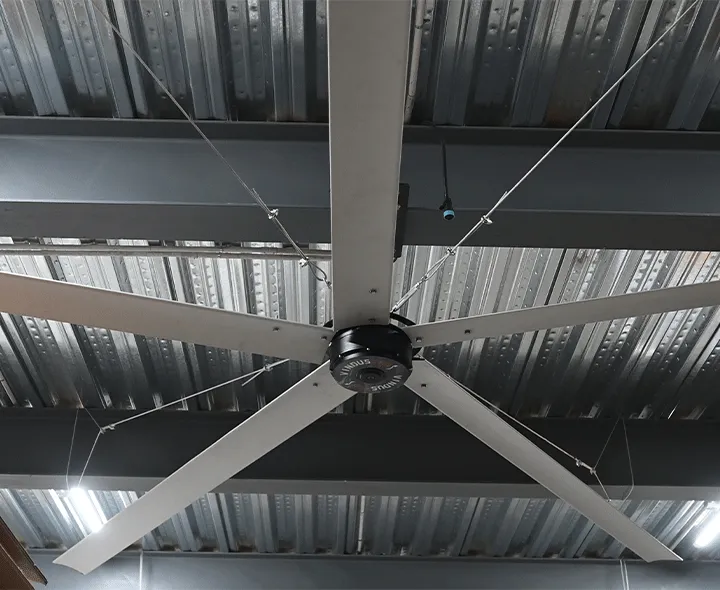
A ceiling fan mounted too close to the ceiling may struggle to pull enough air, while a fan that hangs too low can create safety and clearance problems. The right solution is to match the flush mount, blade clearance, ceiling height, and fan size to the space.
A flush mount ceiling fan normally places the blades about 8–10 inches below the ceiling, depending on the model. As a practical rule, allow at least about 8 inches between the fan blades and the ceiling for airflow. If ceiling height allows, 10–12 inches of clearance can improve air movement. The lowest point of the fan should generally remain at least 7 feet above the floor.
How Far Should a Flush Mount Ceiling Fan Be from the Ceiling? Ceiling Fan Height & Mounting Guide
Article Outline
- What is the ideal distance between a flush mount ceiling fan and the ceiling?
- Why does the space between the ceiling and fan blades matter?
- What is the difference between a flush mount fan and a downrod fan?
- What ceiling fan height works for an 8-foot or low ceiling?
- How do you determine the right downrod length for a high ceiling?
- Does fan size or room size change the mounting height?
- Can you install a flush mount ceiling fan on a sloped ceiling?
- How does ceiling fan placement affect airflow and HVAC performance?
- Are flush mount ceiling fans suitable for industrial and commercial spaces?
- How do you choose the right ceiling fan for a large-space project?
- Frequently asked questions about ceiling fan height and flush mounting
What Is the Ideal Distance Between a Flush Mount Ceiling Fan and the Ceiling?
A flush mount ceiling fan is designed to sit much closer to the ceiling than a traditional fan with a downrod. The mounting bracket connects directly to the ceiling structure, so there is no long vertical rod between the ceiling and motor housing.
For practical airflow, Hunter recommends at least 8 inches of clearance between the fan blades and the ceiling. U.S. Department of Energy guidance has also noted that ceiling fans generally perform well when the blades are about 10 to 12 inches below the ceiling.
That gives us a simple planning range:
| Ceiling fan arrangement |
Typical blade-to-ceiling distance |
| Very low-profile / hugger design |
Around 6–10 inches, model dependent |
| Good practical minimum |
About 8 inches |
| Strong general airflow target |
About 10–12 inches |
| Standard downrod fan |
Often more than 10–12 inches |
The exact distance must still come from the selected product specifications.
In fact, recent U.S. DOE terminology treats many “hugger” fans as models where the lowest point of the blades sits 10 inches or less from the ceiling, which shows just how close this type of fan may operate.
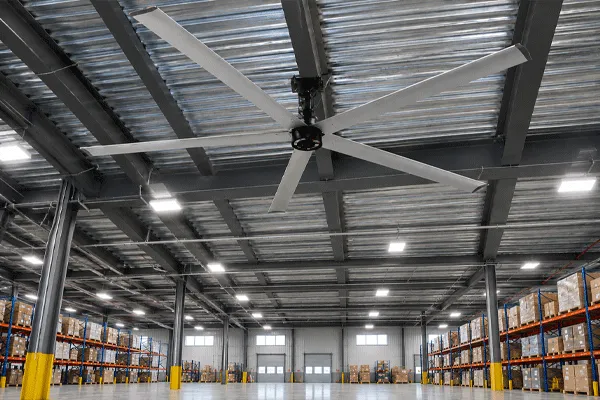
For large facilities, however, this rule should not automatically be applied to industrial HVLS equipment. A large-diameter industrial fan may need much more free space above and around the blades.
Why Does the Space Between the Ceiling and Fan Blades Matter?
A ceiling fan does not only push air downward. It also needs to pull air into the top of the rotating blade area.
If the fan blades and the ceiling are too close together, the ceiling can restrict the air entering the fan. That reduces the amount of air the fan can move.
Think of the airflow like this:
             CEILING
─────────────────────────

        Intake airflow
      ↘      ↓      ↙

      ─────────────
        FAN BLADES
      ─────────────
             ↓
             ↓
         Air movement
             ↓
          Occupants
When there is enough space between the ceiling and blades, air can enter more freely from above.
Hunter specifically recommends at least eight inches of blade clearance for adequate air circulation.
What happens when the fan is too close?
A fan mounted extremely close to the ceiling may experience:
- Reduced airflow
- Lower cooling effect
- Increased turbulence
- More noise in some designs
- Less efficient air circulation
This is one reason a flush mount fan may not always move as much air as the same fan geometry mounted lower with a downrod.
For a room with enough ceiling height, a downrod design can often position the blades farther away from the ceiling and closer to the occupied area.
That said, a flush mount model solves an important problem: head clearance.
In a room with a low ceiling, keeping the fan closer to the ceiling may be more important than maximizing every last unit of airflow.
What Is the Difference Between a Flush Mount Fan and a Downrod Fan?
The main difference is how the motor and blades connect to the ceiling.
Flush mount ceiling fan
A flush mount or low-profile fan connects almost directly to the ceiling bracket.
It is often called:
- Hugger fan
- Low-profile ceiling fan
- Flush mount fan
- Low ceiling fan
Hunter states that low-profile, hugger, and flush-mount fans describe essentially the same installation concept. They are designed for ceilings under about 8 feet where a normal downrod may cause the fan to hang too low.
Downrod fan
A downrod fan uses a vertical rod between the ceiling mount and the motor.
The downrod moves the fan farther from the ceiling and can improve airflow in rooms where enough vertical space is available.
| Feature |
Flush Mount |
Downrod Mount |
| Best for |
Low ceiling |
Standard/high ceiling |
| Downrod |
No or very short |
Yes |
| Blade location |
Closer to ceiling |
Lower from ceiling |
| Headroom |
Maximum |
Reduced |
| Air intake above fan |
More limited |
Usually better |
| Sloped ceiling use |
Often limited |
Better |
| Tall ceilings |
Usually not ideal |
Recommended |
For many standard rooms, Hunter recommends flush mounting around an 8-foot ceiling, while a standard mounting system is more suitable around a 9-foot ceiling.
What Ceiling Fan Height Works for an 8-Foot or Low Ceiling?
A low ceiling creates a simple problem: you must maintain safe space below the blades.
For many ceiling fan applications, the bottom of the fan blades should remain at least 7 feet above the floor. Hunter uses this as a safety guideline, and DOE materials also discuss standard ceiling fans around this occupied-zone height.
So, with an 8-foot ceiling:
8 ft ceiling
= 96 inches

Minimum blade height
= 84 inches / 7 ft

Available vertical space
= about 12 inches
That is exactly why low-profile ceiling fans exist.
A conventional fan with a 12-inch downrod plus motor body could easily put the lowest point of the fan below the desired height.
A compact flush-mount design keeps the blade plane much closer to the ceiling.
For example, Hunter publishes low-profile fans with blade positions around 8 inches from the ceiling, allowing them to work in rooms with low ceiling heights.
Practical guidance
For rooms with:
7-foot ceiling:
A conventional ceiling fan is usually unsuitable because maintaining 7 feet above the floor becomes impossible.
8-foot ceiling:
A flush mount or low-profile model is usually the best choice.
9-foot ceiling:
Either a flush mount or short-downrod fan may work.
10-foot ceiling:
A standard fan with a short downrod usually provides better air circulation.
Higher ceiling:
Use a longer downrod to bring the blades closer to the occupied zone.
How Far Should a Flush Mount Ceiling Fan Be from the Ceiling? Ceiling Fan Height & Mounting Guide
How Do You Determine the Right Downrod Length for a High Ceiling?
Once the ceiling height increases, installing the fan directly against the ceiling is usually not the best strategy.
A high ceiling may place the blades far above occupants, weakening the air speed people actually feel.
The goal is to bring the blades down to the right height while maintaining safety clearance.
A useful planning equation is:
Downrod length ≈
Ceiling height
– desired blade height
– motor/mount height
For example:
| Ceiling height |
Possible mounting approach |
| 8 ft |
Flush mount |
| 9 ft |
Flush or short downrod |
| 10 ft |
Short downrod |
| 12 ft |
Medium downrod |
| 14 ft |
Longer downrod |
| 16+ ft |
Engineered downrod / commercial solution |
These are planning examples, not universal installation specifications.
Manufacturer requirements always come first.
Tall ceiling heights require more than a longer rod
With a tall ceiling, you also need to consider:
- Fan diameter
- Downrod stability
- Ceiling structure
- Fan speed
- Vibration
- Blade clearance
- Nearby beams
- Lighting
- HVAC ducts
The downrod length must match both structural and airflow requirements.
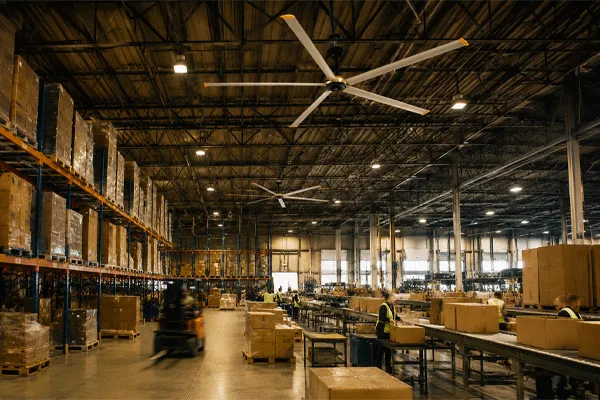
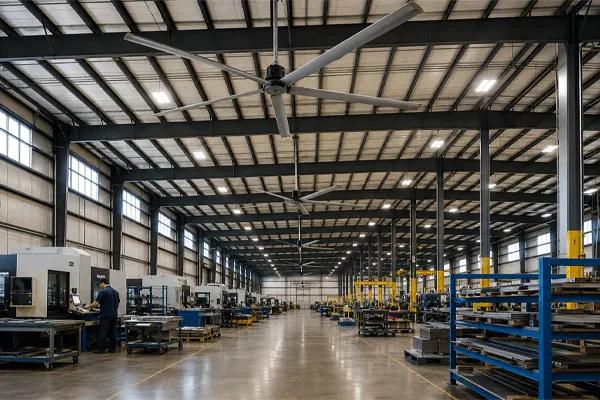
For large warehouses, sports centers, factories, and logistics centers, the project often moves beyond a normal ceiling fan into large industrial or HVLS equipment.
Does Fan Size or Room Size Change the Mounting Height?
Yes, but not in a simple one-to-one formula.
A bigger fan size means longer blades. Longer blades need more open space around their tips.
The correct ceiling fan placement therefore depends on three dimensions:
- Height
- Width
- Distance from obstacles
A 42-inch fan in a small room has very different clearance needs from a 20-foot industrial fan in a warehouse.
Room size affects diameter
In general:
- Small rooms use smaller blade spans.
- Medium rooms use medium fans.
- Large rooms use larger fans.
- Very large industrial spaces may use HVLS fans.
But increasing diameter does not mean you can ignore the mounting height.
The ceiling fan blade must still be far enough from the ceiling to draw air, far enough above occupants for safety, and far enough from walls or objects to avoid interference.
Hunter recommends roughly 30 inches between blade tips and nearby walls or obstacles for many conventional fan installations.
For large industrial fans, clearances can be much larger and should come from manufacturer engineering data.
Can You Install a Flush Mount Ceiling Fan on a Sloped Ceiling?
Usually, a true flush mount ceiling fan is best suited to a flat ceiling.
A sloped ceiling creates a geometric problem. If you install the fan body directly against an angled surface, the blades may not remain level.
That is why many sloped-ceiling installations use:
- A downrod
- Ball-and-socket mounting system
- Angled ceiling adapter
- Sloped ceiling adapter
Hunter recommends using suitable angled mounting hardware for steep or vaulted ceiling applications.
The downrod allows gravity to keep the fan horizontal while the ceiling bracket follows the roof angle.
Do not force a flush mount onto the wrong ceiling
A flush mount may look attractive because it keeps the fan closer to the roof.
But if the manufacturer does not approve that mounting method for the ceiling slope, do not improvise.
Improper installation can cause:
- Uneven blade clearance
- Wobble
- Structural stress
- Poor fan performance
- Safety problems
For commercial projects, a ceiling adapter or engineered mounting bracket is often the better solution.

How Far Should a Flush Mount Ceiling Fan Be from the Ceiling? Ceiling Fan Height & Mounting Guide
How Does Ceiling Fan Placement Affect Airflow and HVAC Performance?
A fan works best when air can reach it freely.
That means fan placement should avoid large obstacles near the intake or blade tips.
A fan installed beside:
- A wall
- Large beam
- HVAC supply duct
- Return-air grille
- Tall shelf
- Hanging light fixture
may not perform the same way as a fan in an open area.
Big Ass Fans, for example, warns that locating a fan too close to large surfaces or HVAC intakes and outlets can affect airflow and fan behavior.
Ceiling fans and HVAC
A ceiling fan does not create refrigerated air.
Instead, it creates air movement.
In occupied spaces, that airflow can help people feel cooler. This may allow some buildings to operate air conditioning more efficiently.
DOE guidance notes that ceiling fans can improve perceived comfort and may allow users to raise thermostat settings while maintaining comfort under suitable conditions.
In large buildings, industrial fans can also support destratification.
Warm air naturally rises toward a tall ceiling. A properly designed ceiling fan system can mix that air back into the occupied zone.
For large commercial or industrial projects, the fan should therefore work with the HVAC system, not fight against it.
Are Flush Mount Ceiling Fans Suitable for Industrial and Commercial Spaces?
Sometimes.
A flush mount ceiling fan can work well in:
- Shops
- Offices
- Restaurants
- Small fitness areas
- Low-ceiling retail spaces
- Covered commercial spaces
- Small workshops
But it is not automatically the best solution for a warehouse, factory, logistics center, livestock building, or sports hall.
Large spaces usually need much more air circulation.
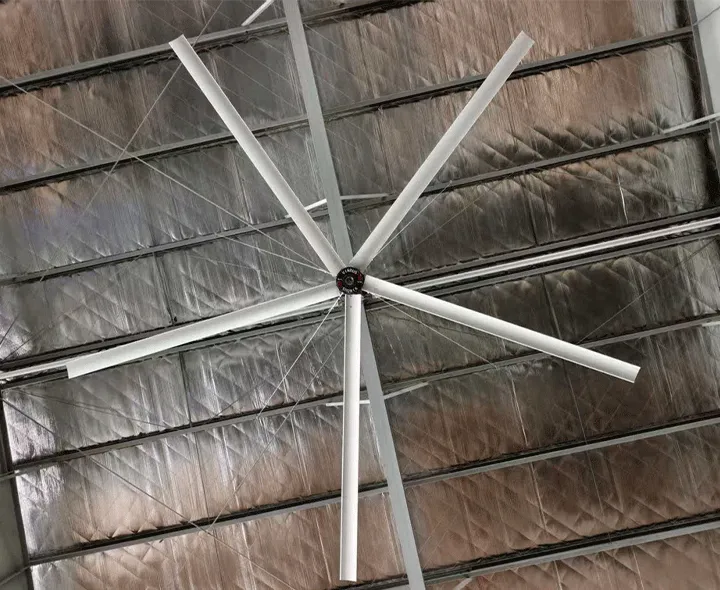
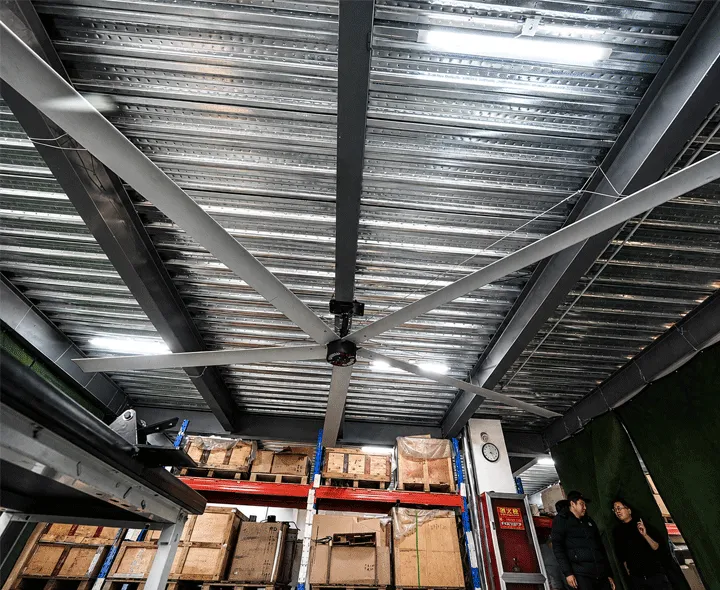
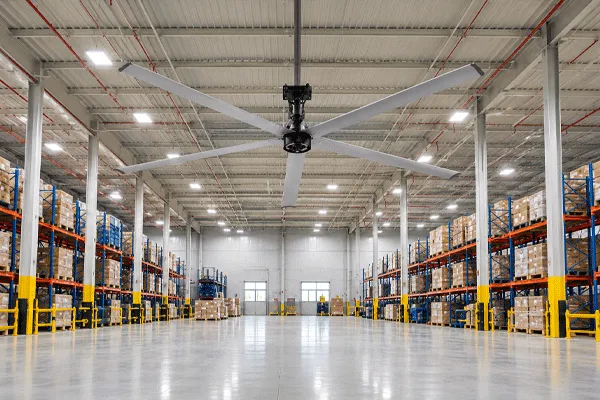
This is where commercial ceiling fans, industrial ceiling fans, or HVLS fans become important.
As a Sino-US joint venture manufacturer and airflow solution provider, we work with building owners and engineering contractors to distinguish between small low-profile fans and large industrial air-movement systems.
Flush mount vs HVLS fan
| Factor |
Flush Mount Fan |
Large HVLS Fan |
| Typical scale |
Small/medium |
Large |
| Ceiling requirement |
Often low |
Usually higher |
| Blade diameter |
Small |
Large |
| Main goal |
Local comfort |
Large-area circulation |
| Downrod |
None/short |
Engineered mount |
| Air coverage |
Limited area |
Large zone |
| Common location |
Office, retail |
Warehouse, factory |
| Control system |
Basic |
Can be intelligent/networked |
This difference matters.
Trying to cool a 50,000-square-foot warehouse with many small flush mount fans may produce poor coverage and unnecessary installation complexity.
A smaller number of properly selected large industrial fans may provide more uniform circulation.
How Do You Choose the Right Ceiling Fan for a Large-Space Project?
The perfect ceiling fan is not simply the one with the largest diameter or highest fan speed.
You need to match the fan to the building.
Before choosing a model, collect the following data:
| Project information |
Why it matters |
| Building length and width |
Defines coverage |
| Ceiling height |
Determines mounting options |
| Lowest beam height |
Controls blade elevation |
| Room size |
Helps select fan diameter |
| Racks and equipment |
Affect airflow paths |
| HVAC layout |
Helps coordinate systems |
| Ceiling slope |
Determines mounting hardware |
| Power supply |
Determines motor/controller configuration |
| Occupancy |
Influences comfort goals |
| Heat and humidity |
Defines airflow objective |
For a small room, the goal may simply be finding the perfect ceiling fan height.
For a warehouse, the question becomes more complex:
How can we deliver useful air movement across the occupied zone with the fewest properly sized fans?
That is a system-design problem.
Our product and engineering scope includes HVLS fans, large industrial fans, commercial fans, and intelligent airflow controls for logistics centers, factories, agricultural buildings, sports centers, food facilities, and other large-space projects.
For complex buildings, we recommend selecting the fan after reviewing drawings, ceiling structure, HVAC configuration, obstacles, and target air speed.
A Practical Ceiling Fan Installation Example
Consider a commercial hall with:
- Ceiling height: 8 feet
- Room size: 350 square feet
- Flat ceiling
- No exposed beams
- Standard HVAC
- Primary goal: occupant comfort
A long downrod fan would not be the right choice because the fan may hang too low.
A flush mount model could keep the blade plane about 8–10 inches from the ceiling, while maintaining close to or more than 7 feet above the floor, depending on the exact fan dimensions.
Now compare that with a warehouse:
- Ceiling: 25 feet
- Area: 60,000 square feet
- Racking: 15 feet
- Multiple loading doors
- HVAC
- Workers and forklifts
A low-profile fan mounted flush against the ceiling would keep the blades too far from the occupied zone and provide limited coverage.
A large industrial fan on an engineered mount would usually make more sense.
Same basic concept—moving air.
Very different fan.
Frequently Asked Questions About Flush Mount Ceiling Fan Height
How many inches should a flush mount ceiling fan be from the ceiling?
For many designs, the blades end up about 8 to 10 inches from the ceiling. Hunter recommends at least about eight inches for air circulation, while DOE guidance has identified roughly 10–12 inches below the ceiling as a useful performance range for standard ceiling fans.
Always check the exact model dimensions.
Can a fan be mounted directly against the ceiling?
The mounting canopy or ceiling bracket of a flush mount design attaches directly or nearly directly to the ceiling.
However, the blades are not directly against the ceiling. The motor housing and fan structure create the required space between the ceiling and the fan blades.
What is the minimum ceiling height for a ceiling fan?
For standard residential-style fans, the blades should generally remain at least 7 feet above the floor. Rooms with an 8-foot ceiling commonly use low-profile or flush-mounted designs.
Is 7 feet enough for a ceiling fan?
The usual guideline refers to the blade height being 7 feet above the floor, not the ceiling itself being 7 feet high.
If the actual ceiling is only 7 feet high, there generally is not enough room for a normal ceiling fan beneath it.
Does a flush mount fan move less air?
It can.
Putting blades closer to the ceiling can restrict incoming airflow compared with a fan that hangs lower. The exact difference depends on fan design, blade geometry, motor performance, and available ceiling clearance.
A well-engineered low-profile ceiling fan is designed to work within those limits.
Should I use a flush mount or a fan with a downrod?
Use a flush mount fan when headroom is limited, especially around an 8-foot ceiling.
Use a ceiling fan with a downrod when you have a standard, high, vaulted, or tall ceiling and need to move the fan closer to the occupied zone.
Final Answer: How Far Should a Flush Mount Ceiling Fan Be from the Ceiling?
For most low-profile installations, start with at least about 8 inches between the ceiling and the blade plane.
A true flush mount design may place the blades within approximately 8–10 inches of the ceiling, while conventional fans often benefit from around 10–12 inches of clearance where ceiling height permits.
But blade-to-ceiling clearance is only half the equation.
You must also ensure the lowest point of the fan remains high enough above the floor.
For most conventional ceiling fan installations, that means at least 7 feet above the floor.
For industrial and commercial buildings, do not automatically apply residential flush-mount rules to large industrial fans. Fan diameter, ceiling height, structural mounting, HVAC, racks, sprinklers, equipment, and target airflow all need to be reviewed as a system.
Key Things to Remember
- A flush mount ceiling fan sits much closer to the ceiling than a downrod fan.
- About 8 inches of blade-to-ceiling clearance is a useful practical minimum for many conventional fans.
- Around 10–12 inches below the ceiling can support stronger airflow when enough ceiling height is available.
- Many hugger fans place the lowest blade point within roughly 10 inches of the ceiling.
- The fan blades should generally remain at least 7 feet above the floor.
- An 8-foot ceiling is a common use case for a flush mount or low-profile fan.
- A high ceiling generally benefits from a downrod.
- The correct downrod length depends on ceiling height, motor dimensions, and target blade height.
- A sloped ceiling usually needs an angled mounting system rather than a standard flush mount.
- Larger fan size requires greater attention to walls, beams, lighting, and other obstructions.
- Good ceiling fan placement improves airflow and helps the fan work with the HVAC system.
- Flush mount ceiling fans are useful for low-ceiling commercial spaces, but large warehouses and factories often need industrial or HVLS fans instead.
- The right ceiling fan is selected from the building dimensions and airflow goal—not from ceiling height alone.
- For large industrial and commercial projects, building drawings, ceiling dimensions, equipment layout, HVAC information, and airflow goals should be reviewed before selecting the final fan.