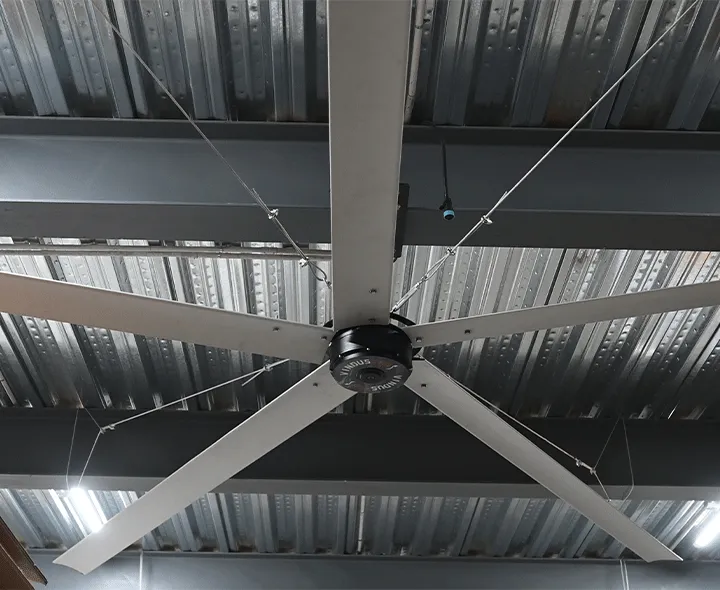
A fan may look large and powerful yet still leave hot zones across a building. Choosing by blade count alone can make the problem worse. To get real comfort, compare airflow, fan size, blade design, motor performance, and the space the fan must serve.
The fan that moves the most air is the one with the highest verified CFM for its application—not simply the fan with the most blades. For large warehouses, factories, gyms, and high-ceiling spaces, a large-diameter HVLS ceiling fan can move far more total air than a conventional ceiling fan. Blade span, blade pitch, aerodynamic design, motor performance, RPM, and installation height all affect airflow.
Which Type of Ceiling Fan Moves the Most Air? Airflow, Blade Design, and 5-Blade Ceiling Fans Explained
When buyers ask us, “Which type of fan gives more air?” we rarely answer with a blade number.
As a Sino-US joint venture manufacturer specializing in HVLS fans, industrial ceiling fans, commercial fans, and intelligent airflow systems, we first ask about the building. A 52-inch ceiling fan for a living room and a five-blade 24-foot industrial HVLS fan solve completely different airflow problems.
For warehouse owners, factory managers, HVAC contractors, logistics companies, sports-center operators, agricultural facilities, and distributors, understanding that difference can save a lot of time and money.
What Does “More Air” Mean for a Ceiling Fan?
Before comparing fans, we need to define airflow.
Fan airflow is commonly expressed in CFM, or cubic feet per minute. CFM tells you how much air a fan can move during one minute.
A ceiling fan producing a higher verified CFM moves a greater volume of air under the specified test conditions.
The U.S. Department of Energy uses measured airflow in CFM when evaluating ceiling fan performance and defines ceiling fan efficiency in relation to airflow and electrical power. DOE testing therefore provides a much more useful basis for comparison than simply counting blades.
Pense nisso desta forma:
| Measurement |
What It Tells You |
| Blade count |
Número de lâminas |
| Extensão da lâmina |
Overall diameter of the fan |
| RPM |
How fast the fan rotates |
| CFM |
How much air the fan moves |
| CFM/W |
Airflow relative to power |
| Air speed |
How fast air reaches an area |
| Cobertura |
How large an area receives useful air movement |
If your goal is maximum airflow, CFM deserves much more attention than whether the fan has three, four, five, or six blades.
That is why our industrial ceiling fan solutions for large industrial spaces are selected around building dimensions and airflow requirements rather than blade count alone.
Which Type of Fan Moves the Most Air?
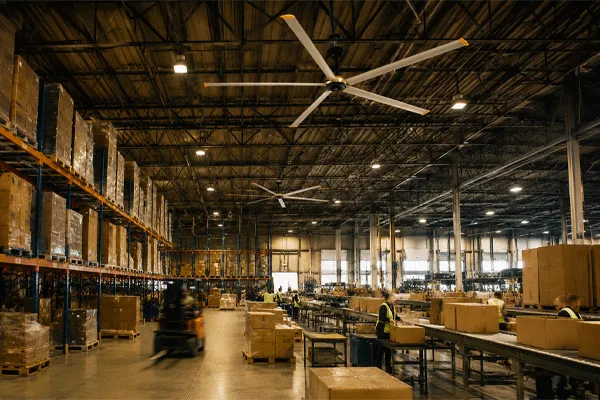
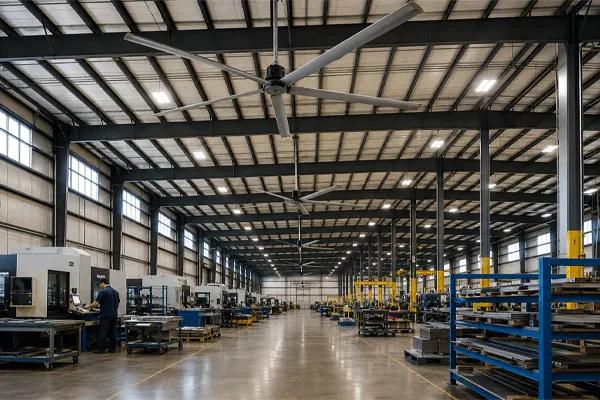
For very large indoor spaces, a large-diameter HVLS ceiling fan can move an enormous total amount of air.
HVLS means High Volume Low Speed.
Instead of spinning a small blade very fast, the fan uses a very large blade span and rotates at relatively low speed. Each rotation acts on a much larger area of air.
This allows one fan to create a broad downward column of air that reaches the floor and spreads outward.
In simple terms
Small fan:
Small blade + higher speed → concentrated airflow
Large HVLS fan:
Very large blades + low speed → high-volume, wide airflow
The second pattern is much more useful in a large room such as a:
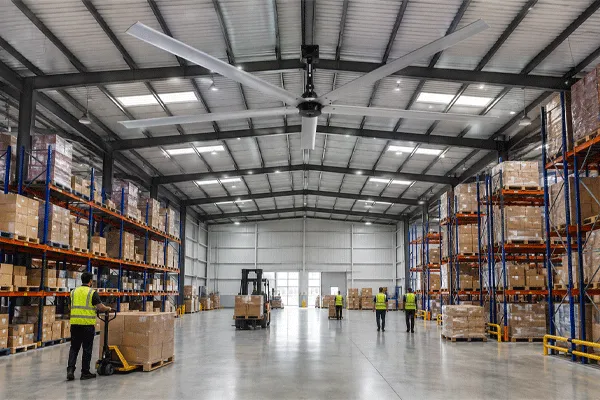
- Armazém
- Distribution center
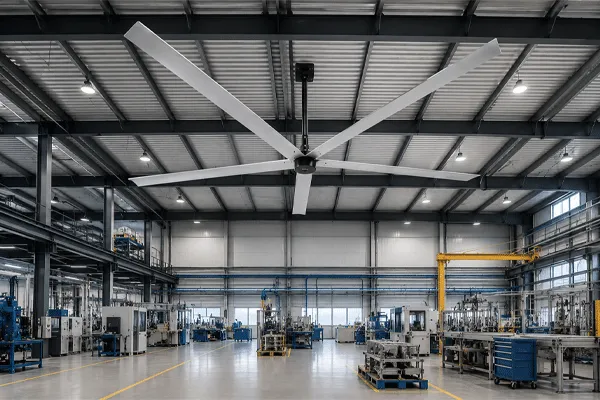
- Manufacturing plant
- Aircraft hangar
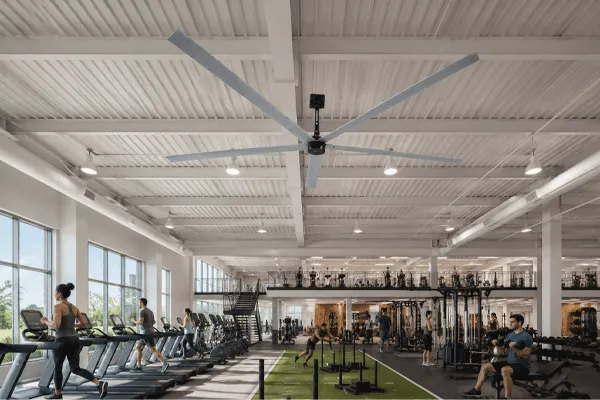
- Sports hall
- Ginásio
- Shopping center
- Agricultural building
AMCA provides performance guidance for large-diameter ceiling fans and gives an example involving a 24-foot fan where airflow is measured in the hundreds of thousands of CFM. AMCA also warns buyers to examine whether published airflow figures are physically realistic.
That scale explains why a large HVLS ceiling fan and a residential ceiling fan should not be compared simply by saying, “Both have five blades.”
They are very different machines.
Buyers evaluating several diameters can compare our HVLS and industrial ceiling fan product range for different large-space requirements.
Which Type of Ceiling Fan Moves the Most Air? Airflow, Blade Design, and 5-Blade Ceiling Fans Explained
Do 5-Blade Ceiling Fans Move More Air Than 3-Blade Fans?
Not automatically.
This is one of the most common misunderstandings about 5 blade ceiling fans.
It sounds logical:
Five blades must push more air than three blades.
But fan engineering is more complicated.
Adding another blade changes the aerodynamic load on the fan motor. It also changes how air interacts with neighboring blades. If the motor, RPM, blade spacing, pitch, and aerodynamic profile are not designed correctly, simply adding blades may not produce better airflow.
A well-engineered 3-blade fan can outperform a poorly designed five-blade model.
Likewise, a well-designed 5-blade ceiling fan can move much more air than another fan of similar size.
3-blade and 5-blade ceiling fans
| Fator |
3-Blade Fan |
5-Blade Fan |
| Blade count |
3 |
5 |
| Aerodynamic drag |
Depends on design |
Depends on design |
| Barulho |
Depends on RPM/design |
Depends on RPM/design |
| Fluxo de ar |
Depends on CFM |
Depends on CFM |
| Appearance |
Often minimal |
Often fuller |
| Eficiência |
Model-specific |
Model-specific |
| Best choice |
Based on performance |
Based on performance |
So which fan moves the most air?
Look at tested airflow data.
Do not choose based on blade count alone.
For industrial applications, our own five-blade HVLS designs use the blade number as part of a complete engineered system. The motor, hub, blade shape, blade length, speed control, and installation geometry all work together.
How Does Blade Pitch Affect Ceiling Fan Airflow?
Blade pitch is the angle at which a fan blade meets the air.
Imagine holding your hand flat outside a moving car.
If your hand stays almost flat, it cuts through the air easily.
Tilt it more, and you feel much greater force.
A ceiling fan blade behaves in a similar way.
A greater ceiling fan blade pitch can allow the blade to interact more strongly with the surrounding air. But there is a limit. More pitch also creates more resistance, so the motor must provide enough torque.
That is why blade pitch and motor selection must work together.
A fan with aggressive blade pitch but a weak motor may slow down. The result may be worse, not better.
Blade pitch influences:
- Amount of air moved per rotation
- Motor load
- Required torque
- Air speed
- Barulho
- Eficiência
This also explains why comparing two fans by RPM alone is misleading.
A smaller fan spinning quickly may still move less total air than a much larger fan rotating slowly.
The question is not:
How fast can the fan spin?
It is:
How much useful air can the complete fan system move?
Why Does Blade Design Matter So Much?
Industrial fan blades are not just flat pieces of metal.
Good blade design uses aerodynamic principles to control how the blade interacts with air.
Design variables can include:
- Blade width
- Blade length
- Blade twist
- Airfoil profile
- Stiffness
- Surface shape
- Tip design
- Blade angle
- Distance between blades
These factors affect fan performance throughout the full blade span.
Poor blade geometry can waste motor power by creating drag and turbulence.
Good geometry helps the fan move air more efficiently.
AMCA notes that improvements in blade efficiency, drive systems, gearboxes, direct-drive motors, and motor efficiency can increase output airflow for a given power input.
This is especially important with an HVLS fan.
A very long blade travels through a huge circle. Small improvements in aerodynamic design can therefore influence a very large volume of air.
For B2B buyers, this is another reason to avoid judging industrial fans from photographs alone.
Two fans may look nearly identical.
Their real airflow can be very different.
Does a Larger Ceiling Fan Always Move More Air?
Usually, increasing diameter gives a fan the potential to interact with more air.
But bigger is not automatically better for every room.
The fan size must match the space.
ENERGY STAR’s residential guidance shows this clearly. It recommends different blade spans for different room sizes and notes that mounting height also affects optimal airflow.
A small fan in a large room may struggle to circulate air effectively.
But a fan that is too large can also create problems if:
- Clearances are insufficient
- The room is too small
- Air speed becomes uncomfortable
- Lighting interferes with the fan
- Structural supports are unsuitable
- Sprinkler clearances are compromised
For residential living rooms, selecting a ceiling fan may mean choosing among common blade spans around the size of the room.
For an industrial building, the scale changes completely.
Vindus’ public product line, for example, includes HVLS models from approximately 8 feet up to 24 feet in diameter, reflecting the much larger coverage requirements of warehouses and factories.
That is why ceiling fan size should always match:
floor area + ceiling height + obstacles + desired air speed + application
Not just the customer’s preference for a larger fan.
How Does Ceiling Height Affect Airflow?
The distance between the fan and the occupied area matters.
For standard residential fans, ENERGY STAR recommends suitable mounting positions and notes that appropriate distance from the floor helps produce effective airflow.
Industrial buildings require a different approach.
A warehouse may have a ceiling height of several meters or much more.
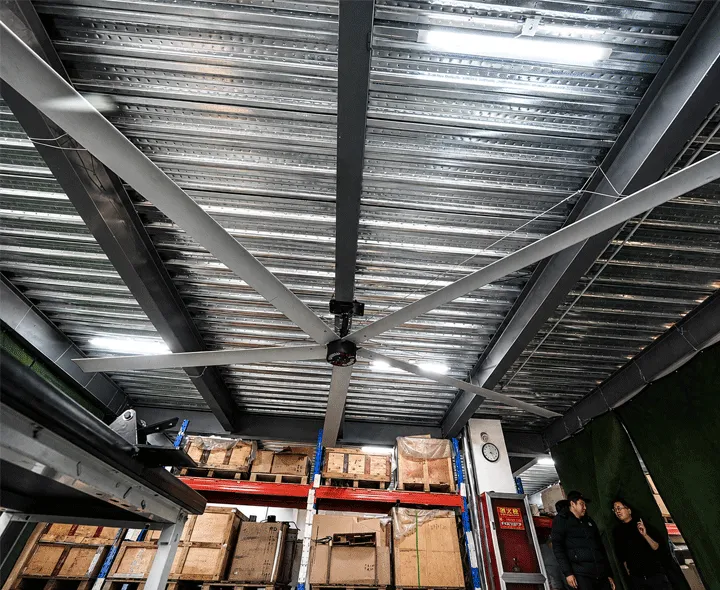
An HVLS ceiling fan needs enough open space around and below its blades to develop its broad airflow pattern.
If the fan is installed too:
- Close to the ceiling
- Close to a wall
- Close to racks
- Close to structural beams
- Close to HVAC ducts
airflow can be disrupted.
A fan installed in an open high-bay warehouse behaves differently from the same fan placed above tightly packed pallet racks.
This is why professional fan selection begins with a plan view and building section.
We normally look at:
- Floor dimensions
- Clear height
- Roof structure
- Racking
- Machinery
- Crane locations
- HVAC ducts
- Lighting
- Sprinklers
- Worker locations
Then we decide where to install the fan.
For warehouse-specific planning, see our HVLS fans for warehouse airflow and cooling.
Which Type of Ceiling Fan Moves the Most Air? Airflow, Blade Design, and 5-Blade Ceiling Fans Explained
Why Can a Low-Speed HVLS Fan Move So Much Air?
The answer is diameter.
A ceiling fan moves air over the circular area swept by its blades.
As diameter grows, that swept area grows rapidly.
The area of a circle is:
Area = π × radius²
That squared radius matters.
Consider a simplified example.
| Diâmetro do ventilador |
Approximate Swept Area |
| 4 ft |
12.6 ft² |
| 8 ft |
50.3 ft² |
| 16 pés |
201.1 ft² |
| 24 pés |
452.4 ft² |
A 24-foot fan does not sweep six times the area of a 4-foot fan.
It sweeps roughly 36 times the area.
That does not mean airflow automatically increases by exactly the same amount. Blade design, RPM, motor power, pitch, and aerodynamic losses still matter.
But it shows why large-diameter fans can move a lot of air while operating at low rotational speed.
An HVLS fan can push a broad column of air downward. When that air reaches the floor, it spreads outward and helps distribute air more evenly over a much larger area.
This is the core reason HVLS technology works so well in warehouses.
Does a Faster Fan Always Give Better Airflow?
Não.
Fast airflow and high total airflow are different ideas.
A small high-speed fan may produce a strong jet.
Stand directly in front of it, and you feel plenty of air.
Move far to the side, and the effect may disappear.
A large HVLS fan produces a different pattern. The local air speed may be gentler, but the fan can move a much greater amount of air through a large area.
Think about two tools:
High-speed directional fan
→→→→→
Strong narrow stream.
Ventilador de teto HVLS
↓↓↓↓↓↓↓↓↓↓
↙ ← ← ↓ → → ↘
Broad circulation zone.
Neither design is always better.
They serve different purposes.
A dock worker may benefit from a high-speed directional fan.
A 50,000-square-foot warehouse may benefit from broad HVLS air circulation throughout the occupied zone.
Nosso HVLS airflow applications for commercial and industrial buildings cover warehouses, factories, logistics centers, agriculture, sports facilities, and other large spaces where broad circulation matters more than a narrow air jet.
How Important Is the Fan Motor for Maximum Airflow?
Very important.
The motor must overcome the aerodynamic resistance of the blades.
That becomes more demanding as:
- Blade size increases
- Blade pitch changes
- Blade count increases
- Required airflow increases
The fan motor must also maintain stable operation across the required speed range.
For industrial HVLS systems, designers may use different drive technologies, including geared systems and direct-drive permanent-magnet motors.
But motor type alone does not tell you which fan is better.
Good fan engineering combines:
Motor + blades + hub + controller + mounting + airflow design
If any one part is poorly matched, the system loses performance.
Imagine putting a racing-car engine in a truck with badly designed tires.
The engine may be excellent.
The complete vehicle is not.
Fans work in the same way.
This is why we recommend that B2B buyers compare complete system specifications rather than asking only for motor wattage.
What Is CFM/W and Why Does Energy Efficiency Matter?
Moving more air is useful.
Moving more air without wasting power is better.
This is where energy efficiency matters.
DOE defines ceiling fan efficiency using the relationship between airflow and power consumption, expressed using CFM per watt in relevant test procedures.
A simple example:
Fan A
Airflow efficiency:
50 CFM/W
Fan B
Airflow efficiency:
83.3 CFM/W
Both move the same nominal volume.
Fan B uses less power.
For a residential ceiling fan that runs several hours each evening, the difference may be modest.
For multiple large industrial fans operating long shifts throughout the year, efficiency becomes much more important.
Warehouse owners should therefore consider:
- CFM
- Electrical input
- Hours per day
- Number of fans
- Fan coverage
- Control strategy
Do not compare only purchase price.
Compare the airflow solution over its working life.
How Do You Choose the Right Ceiling Fan for a Room or Building?
The first step in choosing the right fan is identifying your real problem.
Small bedroom or office
A conventional ceiling fan is normally appropriate.
Living rooms
Select a fan size that matches the room and provides suitable tested airflow.
Large restaurant
One or several commercial fans may work depending on ceiling height and layout.
Armazém
A large HVLS fan often becomes more practical because broad coverage is required.
Factory
HVLS, directional industrial fans, or a hybrid design may work best.
Gym or sports hall
A large commercial HVLS fan can provide gentle, broad air circulation without creating a harsh local blast.
Loading dock
A directional industrial fan may be more useful.
Livestock building
Fan selection should focus on animal-level air speed, heat load, ventilation, humidity, and building geometry.
So to choose the right ceiling fan, start with the space rather than the catalog.
Our complete HVLS and industrial fan selection range helps buyers compare large ceiling fans with directional airflow products for different operating zones.
What About Ceiling Fans With Lights?
A ceiling fan with light can be practical in homes, hotels, restaurants, and smaller commercial rooms.
But lighting is not the main factor affecting airflow.
The airflow performance still depends on:
- Diâmetro do ventilador
- Blade geometry
- Passo da lâmina
- Motor
- RPM
- Instalação
- Air resistance
For residential buyers, combining a fan and light can save ceiling space.
For industrial buyers, lighting and HVLS fans are normally treated as separate ceiling systems.
That means coordination is critical.
A large industrial ceiling may contain:
- Fãs HVLS
- LED fixtures
- Sprinklers
- HVAC ducts
- Structural beams
- Cranes
- Cable trays
If these systems are planned independently, they may interfere with one another.
A professional fan installation layout should therefore be completed before equipment locations become fixed.
Can a 5-Blade HVLS Fan Deliver Better Airflow?
Yes, when the five-blade configuration is properly engineered.
But the key phrase is properly engineered.
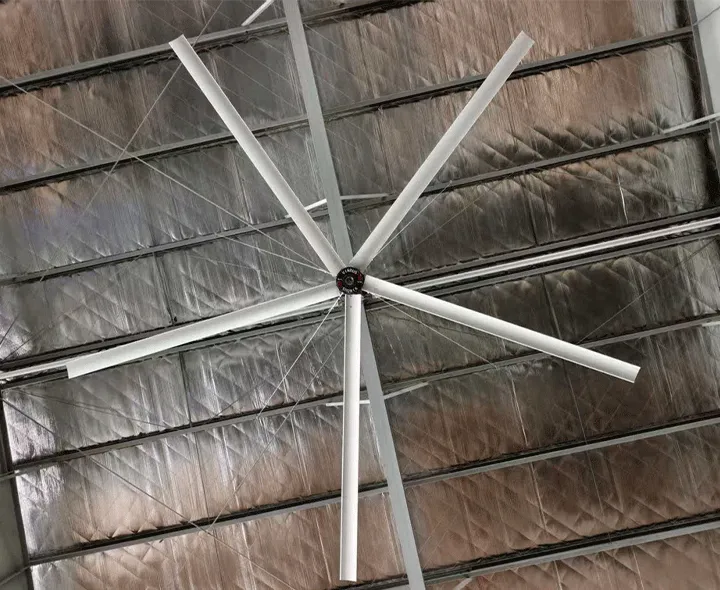
Our five-blade HVLS fan design does not rely on “five blades” as a marketing shortcut.
We look at how the complete system works:
- Grande diâmetro
- Five aerodynamic blades
- Suitable blade pitch
- Low-speed operation
- Matched motor
- Strong central hub
- Stable mounting
- Variable-speed control
- Building-specific layout
The purpose is to produce broad, controlled airflow suitable for large industrial and commercial environments.
For distributors and project contractors, customization may also involve:
- Diâmetro do ventilador
- Control system
- Mounting configuration
- Color
- Tensão
- Group controls
- Project layout
- OEM branding
Buyers requiring private-label products can review our OEM and customized HVLS fan manufacturing services.
The key is still the same:
five blades are part of the design—not the entire reason the fan performs well.
How Can You Compare Ceiling Fan Airflow Claims Correctly?
This is especially important for industrial buyers.
A supplier may advertise a very large CFM number.
Another supplier may publish a lower number.
Does that automatically mean the first fan is better?
Não.
Ask how the figure was measured.
AMCA has specifically cautioned that published performance data for large-diameter ceiling fans should be evaluated for physical realism and recommends using standardized engineering methods to assess fan performance.
Before comparing products, request:
- Tested CFM
- Diâmetro do ventilador
- RPM
- Input power
- Measurement standard
- Test conditions
- CFM/W or other efficiency data
- Sound data where relevant
One seller may report peak air velocity directly below the fan.
Another may report total CFM.
Those are not the same measurement.
Better buying question
Do not ask:
“Which fan has the biggest number?”
Ask:
“Which fan that delivers the required airflow has credible performance data for my actual building?”
That is a much safer B2B purchasing method.
An Illustrative Warehouse Example
Consider a high-ceiling warehouse with long aisles, employees working at packing stations, and heat collecting around the roof.
The manager could install many smaller fans.
Each one might create strong local airflow.
But the facility could still have:
- Dead zones
- Uneven air distribution
- Multiple power connections
- Many maintenance points
- Heat stratification
Another approach is to use fewer large HVLS fans designed around the warehouse layout.
The airflow objective changes from:
“Blow air at this worker.”
to:
“Create broad circulation through this zone.”
That distinction is important.
Vindus’ warehouse engineering guidance describes HVLS fans as devices that create a broad, slow-moving air column in large high-ceiling spaces and can also be used for destratification during colder periods.
For projects like this, proper layout planning is more important than simply ordering the biggest fan available.
FAQs About Which Ceiling Fan Gives More Air
Which ceiling fan moves the most air?
The ceiling fan with the highest credible CFM moves the most total air under the stated test conditions. For very large spaces, large-diameter HVLS fans can produce much greater total airflow than conventional residential ceiling fans.
Do five blades move more air than three blades?
Not necessarily. 3-blade and 5-blade ceiling fans can both perform well. Airflow depends on blade shape, pitch, diameter, RPM, motor performance, and complete fan design.
Is a larger blade span always better?
A larger blade span provides the potential to act on a larger area of air, but the right ceiling fan must match the room or building. Bigger is not automatically better for every space.
Does higher RPM mean more airflow?
Not always. A smaller fan may spin very fast but still move less total air than a large low-speed fan. Compare CFM rather than RPM alone.
What blade pitch gives maximum airflow?
There is no single perfect blade pitch for every fan. Blade pitch must be matched with blade profile, motor torque, fan diameter, RPM, and the desired airflow characteristics.
How can I maximize airflow from a ceiling fan?
To maximize airflow, select the correct fan diameter and verified CFM, install it at the proper height and location, keep suitable clearance around the blades, and avoid major obstructions that disturb the airflow pattern.