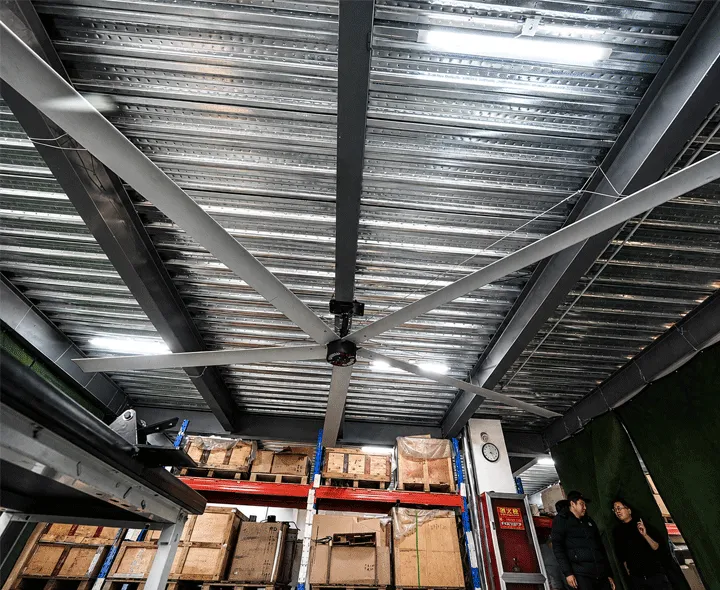
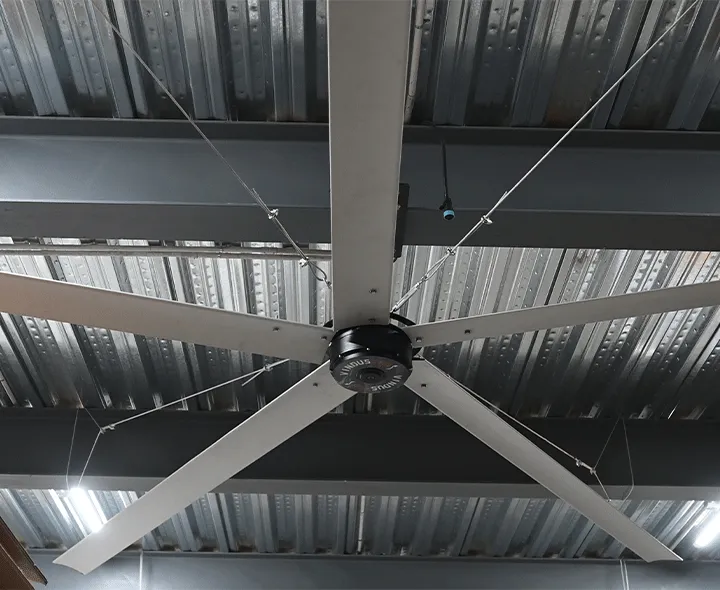
A hot building can slow work and leave people uncomfortable. Choosing equipment by price alone may add noise, service needs, and wasted power. Understanding the drive technology helps you select a system that fits your space, supports comfort, and keeps long-term costs in view.
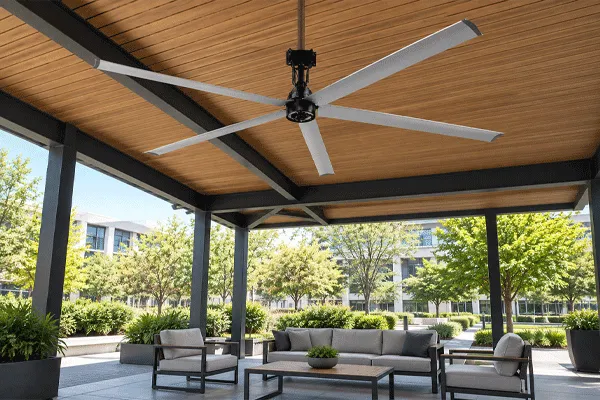
Which HVLS Fan Motor Should You Choose? Direct Drive vs. Geared Ceiling Fan Motors
An HVLS fan commonly uses either an AC induction unit with a reduction gearbox or a permanent-magnet drive connected directly to the hub. Many newer gearless designs use PMSM technology. Both arrangements can deliver broad coverage at low speed. Compare tested performance, electrical input, sound, controls, and service access before deciding which suits your building.
We are a Sino-US joint venture manufacturer and solution provider specializing in Fãs HVLS, ventiladores industriais, commercial ceiling fans, and intelligent controls. This guide explains the main designs and the questions worth asking before you buy.
Article outline
- Common drive types
- How geared induction designs work
- How permanent-magnet designs work
- Why slow rotation matters
- Benefits and practical trade-offs
- Efficiency and running costs
- Controls and building conditions
- Installation and long-term service
- Selecting a supplier
- Frequently asked questions
1. What Are the Main Types of HVLS Fan Motors?
The two main arrangements are geared induction and gearless permanent-magnet designs. The first uses a gearbox to reduce shaft speed. The second connects the drive directly to the hub. As AMCA’s technical comparison explains, either arrangement can produce similar results when the blade assembly and rotational speed are comparable. The technology label alone does not determine coverage.
Separate electrical design from mechanical layout. “Induction” and “permanent magnet” describe how torque is produced; “geared” and “direct drive” describe how it reaches the rotating assembly. This distinction helps you read a quotation correctly. Ask suppliers to identify both parts, rather than accept a vague description such as “advanced drive.”
| Recurso |
Geared induction |
Gearless permanent magnet |
| Transmission |
Reduction gearbox |
Direct connection to hub |
| Output speed |
Reduced mechanically |
Controlled at the required hub speed |
| Sound sources |
Gears, bearings, and blade assembly |
Bearings, electronics, and blade assembly |
| Service review |
Gearbox, lubrication requirements, and drive |
Bearings, controller, and drive |
| Buying priority |
Proven performance and support |
Proven performance and support |
2. How Does a Geared HVLS Fan Motor Work?
A geared arrangement starts with a relatively fast-turning induction unit. The gearbox reduces speed and increases output torque, minus transmission losses. Torque means turning force. The large rotating assembly needs enough of it to start smoothly and keep turning against air resistance. A compatible variable-frequency drive can regulate operation.
This design remains a practical option for a warehouse or manufacturing plants where documented performance and service support meet the project’s needs. Some gearboxes require lubricant checks or changes; others use sealed designs with different service instructions. Never assume every geared product needs frequent oil replacement. Check the exact maintenance schedule and what its warranty requires.
For buyers comparing industrial ventilation equipment, useful questions include: Can the gearbox be replaced separately? Is lifting equipment needed? Are parts available locally? A modest purchase price can lose its appeal if routine work disrupts production. Equally, an accessible, well-supported assembly may serve a site well for years.
3. What Is a Permanent-Magnet Direct Drive Motor?
A permanent magnet synchronous motor, or PMSM, uses magnets in its rotating part and an electronically controlled magnetic field to create rotation. “Synchronous” means that the rotor follows that field at the same rotational rate. Manufacturers offer this technology in commercial products; Apogee’s DM-series description provides one example. Specifications still vary by model.
In a direct drive HVLS fan, the hub turns at the same speed as the drive output. There is no reduction gearbox between them. The assembly must therefore provide high torque at the required slow rotation. A matched electronic controller manages starting and running. PMSM, brushless DC, and EC labels can overlap in marketing, so request the actual electrical design and controller requirements.
A gearless layout removes gearbox-related wear and lubrication tasks, but bearings and electronics still need attention. For gearless HVLS equipment options, compare the complete package: drive, controls, mounting, protection, and parts support. A direct-drive product should be selected on evidence, not the assumption that fewer mechanical components eliminate all possible faults.
4. Why Do High Volume Low Speed Fans Need Strong Turning Force?
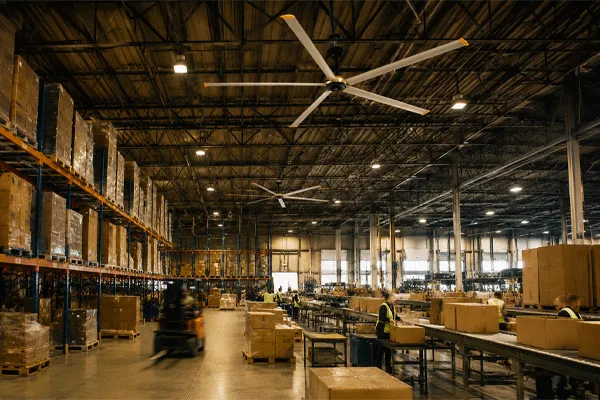
An HVLS ceiling fan moves a broad volume of air using a large rotating assembly at low rotational speeds. During downward operation, it forms a wide column of air that spreads outward when it reaches the floor. The goal is useful air movement across occupied areas, rather than a narrow blast at one workstation.
Commercial ranges often include diameters of 8 to 24 feet, although smaller and larger products exist. Greenheck’s published ranges illustrate this variation. Larger size does not mean every corner receives the same breeze. Racks, partitions, and machinery can change the path. Request coverage estimates that reflect your building.
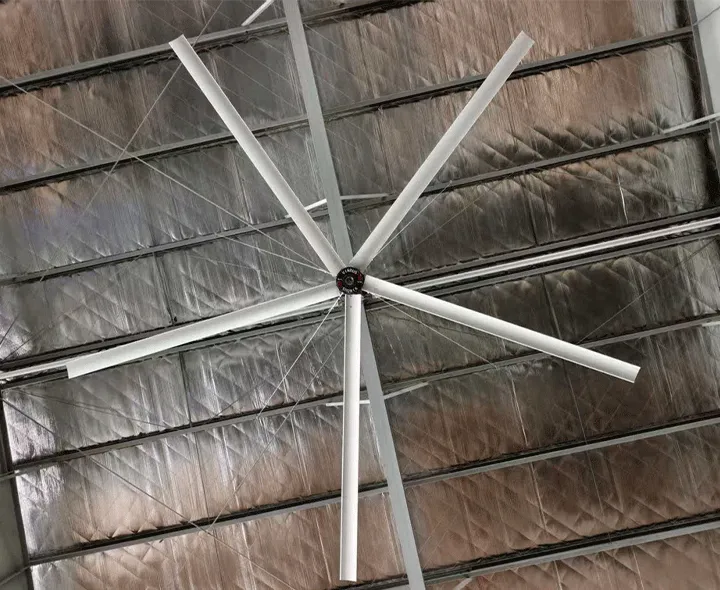
Unlike conventional high-speed fans, these units use a broad sweep to support gentle mixing in a large space. Claims about “massive volumes of air” still need test data. Ask for measured output and expected local air speeds. The shape of the HVLS fan blades and their operating point matter alongside the drive choice.
5. What Are the Benefits of HVLS Fan Motors—and the Trade-Offs?
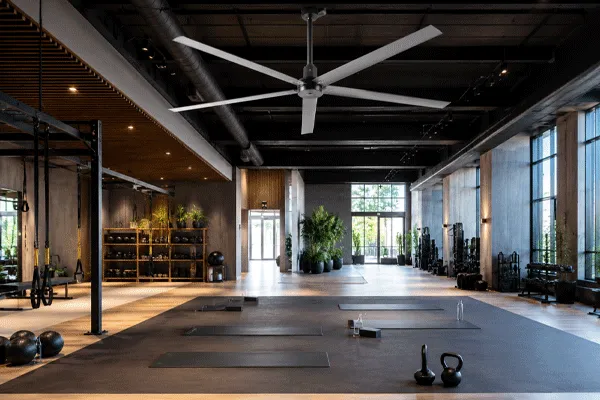
The main benefits to seek are steady performance, sensible electrical demand, and manageable upkeep. A gearless design can support quiet operation by removing gear noise. However, blade sound, mounting vibration, and room acoustics remain. Compare sound measurements at stated distances and operating speeds, especially for shops, sports centers, and public halls.
Low maintenance does not mean maintenance-free. Both arrangements need inspections and cleaning according to their manuals. Big Ass Fans’ drive comparison also highlights serviceability: the work needed for repair depends on the actual assembly. Ask whether a technician can replace a component in place or must lower the entire unit.
We encourage buyers to evaluate reliability at system level. Good bearings, suitable cooling, protected electronics, proper installation, and accessible spare parts all matter. For commercial air circulation solutions, consider how repairs would affect customers and opening hours. The best choice balances comfort today with practical support throughout ownership.
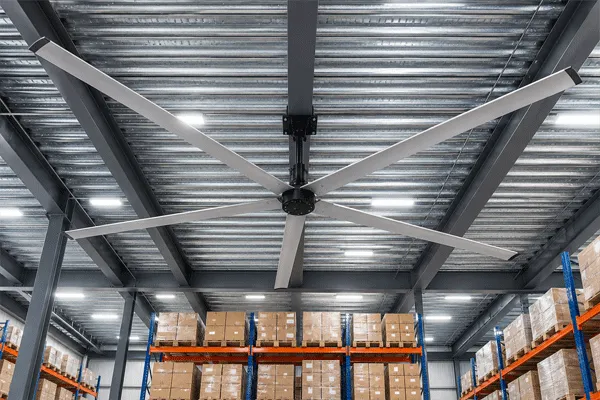
Which HVLS Fan Motor Should You Choose? Direct Drive vs. Geared Ceiling Fan Motors
6. How Do You Compare Energy Efficiency and Energy Savings?
Compare complete units at an equivalent duty: similar diameter, useful output, and coverage. Do not compare one model at full output with another barely turning. For large-diameter ceiling fans, CFEI, the Ceiling Fan Energy Index, is a relevant performance metric.
Ask for measured electrical input at the settings you expect to use. Claims about energy-efficient HVLS fan motors should lead to documented whole-unit results. Your annual energy consumption depends on input power and running hours. Calculate both before assuming that a higher purchase price will pay back quickly.
Illustrative cost example—not product data: Suppose two proposals meet the same agreed comfort target. One draws 0.75 kW and the other 1.00 kW at the planned setting. At 3,000 hours per year and $0.12/kWh, their annual energy costs differ as follows.
| Calculation |
Proposal A |
Proposal B |
| Assumed operating input |
0.75 kW |
1.00 kW |
| Annual electricity use |
2,250 kWh |
3,000 kWh |
| Annual electricity cost |
$270 |
$360 |
The difference is $90 per unit annually. This estimate excludes maintenance, demand charges, and HVAC effects. If the installed-price premium is $450, electricity savings alone imply a five-year simple payback under these assumptions.
7. How Do Controls Improve an HVLS Fan System?
Variable speed control lets you match operation to occupancy, weather, and activity. A busy packing area may need a stronger breeze than a quiet storage zone. Timers, sensors, and building-management connections can improve coordination when correctly specified. Our intelligent airflow control solutions are relevant when a project needs several independently managed areas.
Check the incoming voltage, phase, and frequency before ordering. The building’s electrical supply and the drive’s internal output are not necessarily the same. Confirm compatibility, cable limits, restart behavior, and available fault signals. Require the supplier to state which control functions are included and which need extra hardware.
In winter, gentle mixing can redistribute warm air collected near the roof and may reduce heating costs where temperature layers are significant. Fans do not provide refrigeration or remove moisture from a sealed room. Improved air circulation also cannot replace fresh-air ventilation or filtration needed for air quality.
8. How Do Fan Diameter, Ceiling Height, and Placement Affect Results?
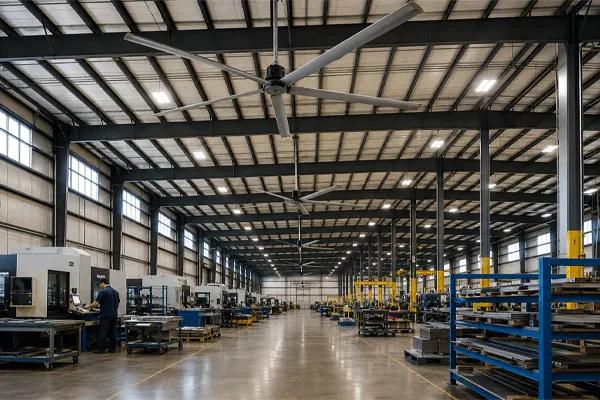
A suitable drive cannot overcome a poor layout. Fan placement must account for roof structure, racks, cranes, lights, sprinklers, and supply or return vents. A large industrial ceiling fan also needs enough clear space to operate within its approved limits. Use the product manual and a qualified installer to resolve mounting requirements. Greenheck’s application guide discusses the importance of clearances and structural support.
In industrial spaces, confirm dust exposure, heat, and cleaning methods. In agricultural buildings, review moisture and corrosion risks. Food-processing facilities may have additional hygiene requirements. An enclosure rating does not automatically prove that a product suits washdown chemicals or every cleaning process. Get written confirmation for the actual environment.
Para warehouse cooling and ventilation planning, provide a measured drawing, photos, and occupied work zones. After installation, check performance at agreed points. Record settings, noise concerns, and dead spots. This practical handover shows whether the proposed layout meets the comfort target and gives staff a useful starting point for daily operation.
Which HVLS Fan Motor Should You Choose? Direct Drive vs. Geared Ceiling Fan Motors
9. What Key Features Should You Request From a Supplier?
A reliable HVLS fan needs a clear specification and a service plan. Ask for test reports tied to the exact model, installation drawings, environmental limits, electrical details, and warranty terms. For distributors and contractors, also confirm documentation language, spare-parts availability, and who handles technical support in the destination market.
Our work covers industrial and commercial buildings, logistics sites, agriculture, sports facilities, and other large venues. We approach selection as a building solution: define the comfort need, review the layout, and compare suitable equipment. Different fan designs may fit different projects; the most expensive option is not automatically the most useful.
Request an HVLS project assessment and quotation with the information below. We can use it to discuss an appropriate configuration and proposal scope. A clear brief helps every bidder respond on the same basis and makes your final comparison easier.
- Building length, width, and mounting height.
- Floor plan, obstacles, and occupied areas.
- Working hours and existing HVAC equipment.
- Available electrical supply and control precisa.
- Temperature, dust, moisture, and cleaning conditions.
- Budget, installation scope, warranty, and support expectations.
Our selection principle: choose the complete solution around the building’s needs, then compare the technology inside it.
10. Frequently Asked Questions About HVLS Fan Technology
Are all modern HVLS fans permanent-magnet designs?
No. Both geared induction and gearless permanent-magnet arrangements remain available. Check the exact specification. A product’s appearance, age, or price does not reliably identify its drive technology.
Is a low speed fan the same as an ordinary fan on its lowest setting?
No. Purpose-built large units combine suitable geometry, turning force, and controls. Reducing the setting on a small circulator does not give it the same coverage or performance.
Does a gearbox-free design always produce more airflow?
No. Output depends strongly on the rotating assembly and its speed. Gearless construction changes the transmission arrangement; it does not by itself guarantee better coverage. Compare measured results and site-specific estimates.
Can this equipment help distribution centers and manufacturing plants?
Yes, when layout and operating conditions suit the application. Broad circulation can support worker comfort, but tall racks and process areas need careful review. Cooling, ventilation, and humidity control may require several coordinated systems.
How should buyers assess lifetime operating cost?
Include installation, electricity, scheduled service, lift access, spare parts, and downtime. Request a repair procedure and parts quotation. Calculate costs using your planned hours and settings rather than the nameplate rating alone.
Can a standard wall dimmer control these units?
Do not assume compatibility. Use the specified controller and approved accessories. Incorrect controls can cause poor operation or damage. Have a qualified installer check the electrical design and follow the manufacturer’s instructions.
Principais conclusões
- Geared induction and gearless permanent-magnet arrangements are both common.
- Compare verified whole-unit performance, not technology labels alone.
- Review sound, servicing, controls, and environmental suitability.
- Calculate costs using realistic settings and operating hours.
- Match the layout to occupied areas and building obstacles.
- Request a documented proposal with clear installation and support responsibilities.