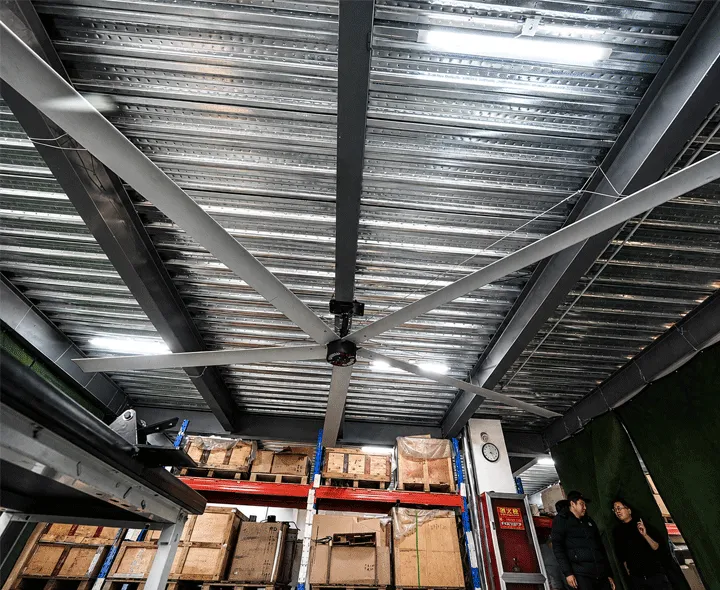
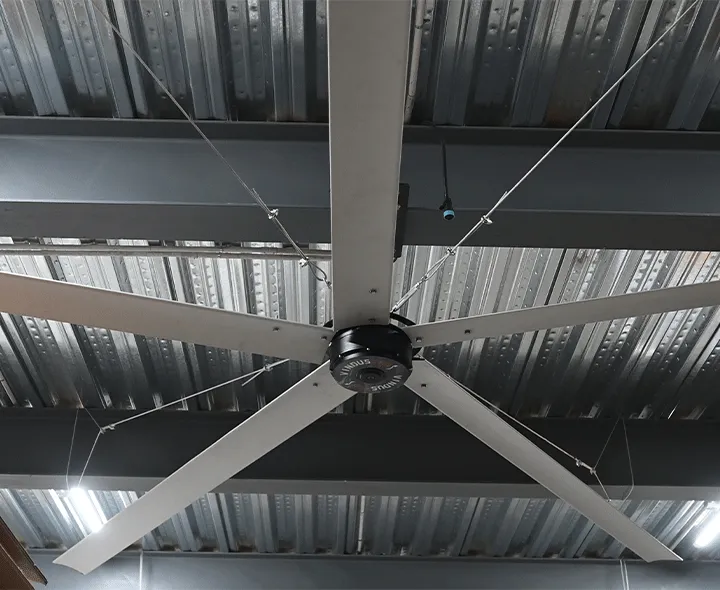
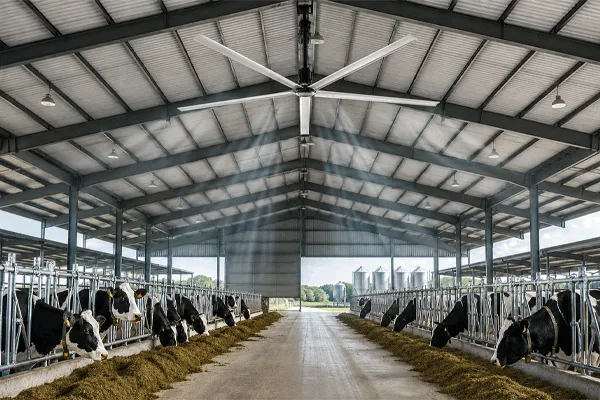
Hot roofs, still corners, trapped moisture, and uneven temperatures can make an agricultural storage shed hard to manage. Add more small fans and the problem may remain. A properly sized HVLS fan can create broad, steady airflow across the building and support a more effective ventilation strategy.
HVLS fans help cool agricultural storage buildings and sheds by moving large volumes of air at low speed across a wide floor area. The right HVLS ceiling fan depends on ceiling height, fan diameter, building layout, stored materials, obstructions, and existing ventilation. Large industrielle Deckenventilatoren can also support destratification, moisture management, worker comfort, and more even temperatures.
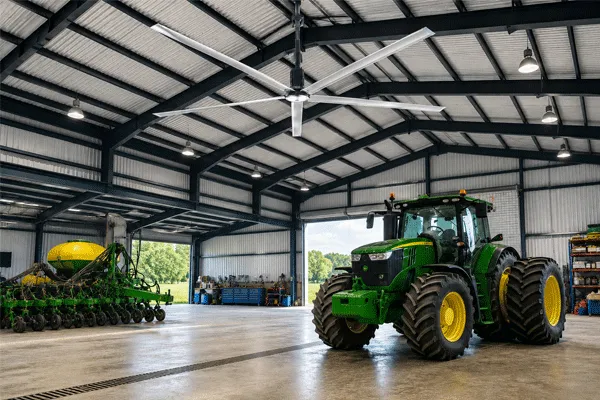
HVLS Fan & Industrial Ceiling Fan Guide for Agricultural Storage and Shed Ventilation
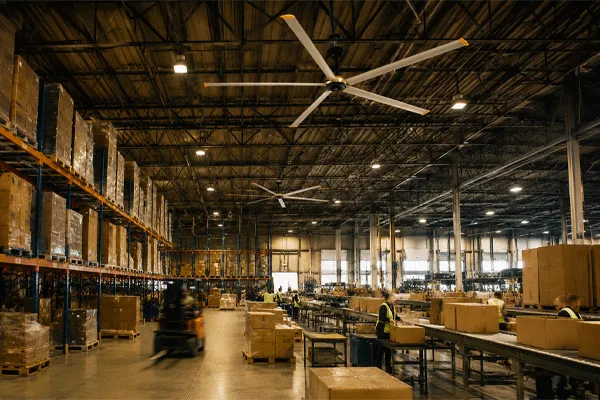
Agricultural storage buildings are rarely simple empty boxes. They may contain machinery, pallets, feed, packaged crops, work areas, loading doors, racks, or seasonal stock. Each object changes the way air travels.
That is why we do not select a ceiling fan from building size alone.
As a Sino-US joint venture manufacturer and airflow solution provider, we design HVLS fans, industrial ceiling fans, commercial ceiling fans, large industrial fans, and intelligent airflow control systems for agricultural, industrial, logistics, commercial, sports, and other large-space applications. Our job is to understand the building first, then determine how the fans should work inside it.
Why Do Agricultural Storage Buildings Need Better Ventilation?
An agricultural shed can become hot very quickly. Sunlight warms the roof. Equipment produces heat. Large doors introduce warm outdoor air. Moist products or outdoor humidity can make conditions worse.
Without enough ventilation, this heat can stay trapped near the roof while stagnant air develops around stored materials and working zones. The result may be uncomfortable staff, uneven temperatures, moisture problems, and difficult working conditions.
Penn State Extension notes in its guidance for agricultural buildings that poor ventilation can allow warm, humid air to condense on colder building surfaces. This is especially important around roofs, siding, and structural members.
An HVLS fan addresses a different part of this problem than an exhaust system. Exhaust fans replace indoor air. Large circulating fans create air movement within the building.
In many agricultural buildings, you need both.
A well-planned system can:
- keep air moving across a large floor area;
- reduce isolated warm zones;
- support moisture management;
- improve worker comfort;
- distribute incoming fresh air;
- reduce temperature differences between ceiling and floor;
- support seasonal cooling and destratification.
This is why ventilation planning should start with the whole building rather than a single piece of equipment.
How Does an HVLS Fan Move Air Through a Large Shed?
HVLS stands for high volume, low speed.
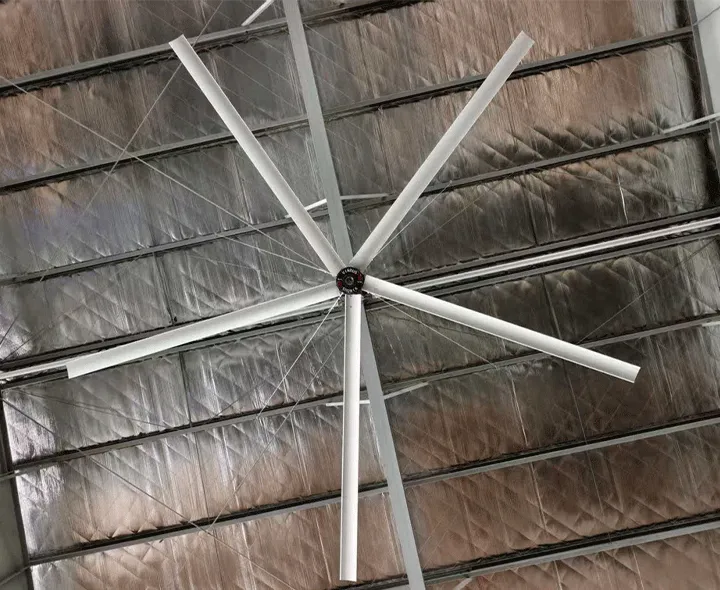
Instead of producing a narrow jet of air, a large HVLS fan uses long blades and relatively slow rotation to produce broad airflow beneath the fan. The moving air reaches the occupied area and spreads outward across the floor.
Think of it as moving a wide column of air rather than firing a narrow stream.
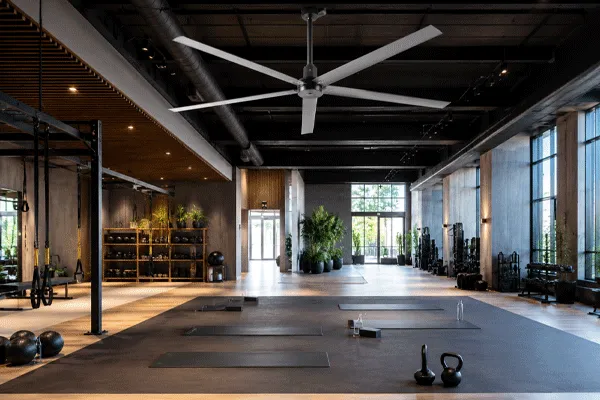
This makes HVLS technology useful in commercial and industrial buildings where one larger fan may influence a much broader area than several small circulation fans.
Fan performance still depends on several factors:
| Faktor |
Warum es wichtig ist |
| Lüfterdurchmesser |
Influences the area affected by the fan |
| Deckenhöhe |
Changes how airflow reaches the occupied zone |
| Entwurf der Klinge |
Affects how effectively the fan moves air |
| Lüftergeschwindigkeit |
Influences air velocity and perceived cooling |
| Hindernisse |
Racks, machinery, walls, and stock can block airflow |
| Lüfterplatzierung |
Determines overlap and dead zones |
| Building openings |
Crosswinds can change the air pattern |
A manufacturer’s design guide based on testing in large spaces also shows that fan location, building height, obstructions, and crosswinds can materially affect HVLS performance.
This is why square foot coverage should never be treated as one fixed number for every installation.
How Does Ceiling Height Affect HVLS Fan Size?
Ceiling height is one of the first measurements we request when designing an HVLS project.
A fan installed too close to the floor may produce uncomfortable local air velocity or create clearance problems. A fan installed high above the occupied zone must move air far enough to create useful circulation below.
The answer is not simply, “Higher roof equals bigger fan.”
You also need to evaluate:
- usable mounting height;
- structural beams;
- lighting;
- sprinkler systems;
- doors;
- cranes or suspended equipment;
- stored material height;
- floor layout.
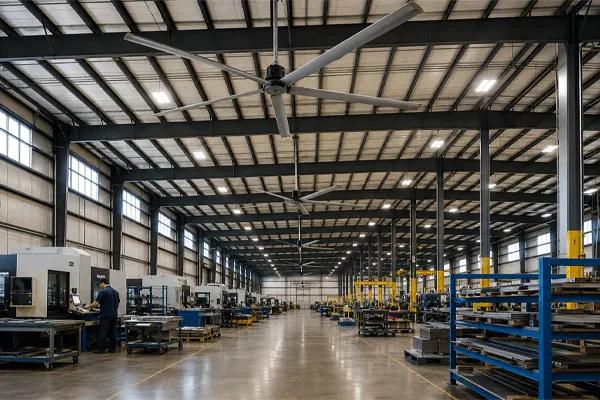
For example, an open machine shed with an 8 m ceiling height may allow a large fan to spread air widely. A storage building of the same height filled with tall pallet racks may need a different layout because the racks interrupt horizontal airflow.
This is why we treat fan size, ceiling height, and obstruction layout as one design problem.
For buildings that need broad overhead circulation, our industrial ceiling fans can be selected around the usable mounting height and floor layout.
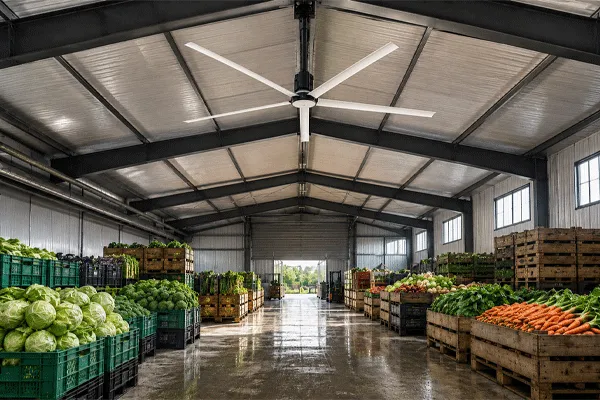
HVLS Fan & Industrial Ceiling Fan Guide for Agricultural Storage and Shed Ventilation
8-Foot to 12-Foot Fans or 14-Foot to 16-Foot Fans: Which Size Is Better?
There is no single ideal fan diameter for every agricultural shed.
8-foot to 12-foot fans can work well in smaller buildings, lower roof areas, divided work zones, or applications where structural conditions limit the size of the fan.
14-foot to 16-foot fans may suit wider open areas where the objective is to create broader coverage with fewer units.
A larger diameter, however, does not automatically mean a better system.
| General Situation |
Possible Design Direction |
| Lower ceiling |
Smaller-diameter fan may be appropriate |
| Wide open floor |
Larger fan may provide broader coverage |
| Many structural obstructions |
Multiple smaller zones may work better |
| Tall clear building |
Larger HVLS fan may be suitable |
| Strong crosswinds |
Fan selection and mounting require extra care |
| Local work area only |
Targeted fan may be more practical |
Some projects may even use a foot HVLS ceiling fan configuration at one end of the size range and much larger equipment in another zone.
The correct fan size depends on the airflow target, not only the number printed in a catalog.
When buyers ask us, “How many fans do I need?” our first response is usually to request the building drawing. That tells us far more than total square footage alone.
How Much Square Foot Coverage Can One HVLS Ceiling Fan Provide?
This is one of the most common questions from warehouse owners and agricultural project contractors.
It is also one of the easiest numbers to misuse.
A manufacturer may publish an estimated coverage area, but real-world coverage changes with:
- ceiling height;
- fan diameter;
- blade design;
- fan speed;
- nearby walls;
- racks;
- stored products;
- open doors;
- roof shape;
- crosswinds.
Imagine two 2,000-square-meter buildings.
The first is an open equipment shed with a clear floor and few obstructions. The second is a warehouse filled with 5-meter-high racks.
The same HVLS fan will not create the same usable airflow in both spaces.
The rack system can divide the second building into airflow channels and shadows. In that case, fan placement becomes more important than simple theoretical coverage.
Large-space HVLS research and design guidance similarly stresses that major obstructions such as warehouse racks or pallets should be considered because they can block airflow to large portions of a space.
For that reason, our engineers normally evaluate coverage by zone rather than promising a fixed number of square feet for every project.
Can an Industrial Fan Actually Cool a Warehouse or Storage Shed?
Yes—but it helps to understand what “cooling” means.
A circulating industrial fan does not operate like an air conditioner. It normally does not remove heat from the building. Instead, increased air velocity over the skin can create a cooling effect for people.
In other words, moving air can make a warm environment feel more comfortable even when the measured air temperature remains similar.
That makes a warehouse ceiling fan useful in large agricultural storage spaces where people load, sort, inspect, pack, maintain, or move products and equipment.
Where mechanical cooling or evaporative cooling already exists, circulation can also help distribute conditioned air more evenly.
This distinction matters.
Fans provide circulation. HVAC removes or adds heat. Ventilation exchanges air.
A good design determines which of those jobs the building actually needs.
Can HVLS Fans Reduce Stagnant Air and Improve Air Circulation?
Yes. This is one of the strongest applications for HVLS technology.
A large open building often develops areas where very little air moves. These may appear behind stored equipment, around corners, beneath mezzanines, or between poorly arranged fan zones.
HVLS fans can help reduce stagnant zones by creating broad circulation patterns across the occupied space.
The downward airflow from the fan spreads across the floor, while other air moves back toward the fan. This supports continuous Luftzirkulation instead of relying only on short streams from local fans.
For projects where circulation is the main objective, our air circulation systems can combine large fans, sensors, variable-speed controls, and zone-based operation.
However, we always separate circulation from fresh-air requirements.
If a storage building contains fumes, dust, high moisture loads, or contaminants, simply moving the same air around is not enough. A proper exhaust and fresh-air system may also be required.
HVLS Fan & Industrial Ceiling Fan Guide for Agricultural Storage and Shed Ventilation
HVLS Fan vs. High-Speed Fans: What Is the Difference?
Both technologies can be useful.
They simply solve different airflow problems.
A traditional industrial fan, pedestal unit, wall-mounted fans, or axial fans may create higher localized air velocity. This can be useful at a workstation, doorway, loading zone, or narrow passage.
An HVLS unit focuses on broad distribution.
| Besonderheit |
HVLS-Lüfter |
Hochgeschwindigkeitslüfter |
| Air pattern |
Breit |
Focused |
| Typical speed |
Niedrig |
Höher |
| Abdeckung |
Large area |
Local area |
| Typical installation |
Ceiling |
Wall, floor, structure |
| Number required |
Often fewer |
Often more |
| Best use |
Whole-space circulation |
Spot airflow |
Many facilities use both.
For example, a large warehouse may use overhead HVLS units for general circulation and smaller fans around a packing station or maintenance area.
This hybrid strategy can work especially well in commercial and industrial spaces with mixed activities.
Our experience with hvls fans for manufacturing facilities follows the same principle: use broad airflow for the overall building, then solve special local zones separately.
Can HVLS Fans Lower Heating and Cooling Costs?
They can support lower heating and cooling costs, but savings depend on the building and HVAC system.
In summer, fans can help occupants feel more comfortable through increased air velocity. This may allow some facilities to operate mechanical cooling more efficiently, depending on the process and temperature requirements.
Winter presents a different problem.
Warm air naturally rises. In a high building, this can create a large temperature difference between the floor and the roof. The process is called thermal stratification.
Slow fan operation can mix these layers.
The U.S. Department of Energy notes that ceiling fans in high-ceiling spaces can help destratify warm air that collects near the ceiling and redistribute it toward lower areas.
A separate large-space field study used temperature measurements at different heights in a 15,000-square-foot hangar with a 40-foot peak ceiling and a 20-foot HVLS fan to examine destratification and heating-energy impacts.
The important point is not to promise one universal saving percentage.
Actual results depend on:
- local climate;
- building insulation;
- HVAC equipment;
- warehouse ceiling height;
- fan operating schedule;
- thermostat strategy;
- door activity;
- building envelope;
- fan efficiency.
An HVLS fan may reduce waste in the right system, but the design should be evaluated as a complete energy strategy.
What Role Does Blade Design Play in HVLS Airflow?
A fan is not defined by diameter alone.
The blade shape, blade pitch, number of blades, motor performance, control logic, and hub design all influence the final airflow pattern.
Two fans with the same diameter may perform differently.
That is why serious B2B buyers should compare more than:
“How big is the fan?”
Better questions include:
- What airflow data is available?
- How was performance tested?
- What motor and drive system does the fan use?
- What safety systems are included?
- How does the blade connect to the hub?
- Is variable-speed control available?
- What maintenance does the product require?
HVLS fans are designed to create broad air movement, but the quality of that air movement depends on engineering.
A well-designed blade should move useful air while keeping rotational speed and noise appropriate for the application.
For large agricultural storage and industrial spaces, reliability also matters because a failed fan can interrupt normal operations or leave a major building zone without circulation.
Where Should HVLS Fans Be Installed in Agricultural Buildings?
Good fan placement starts with the work zone.
Do not automatically place one fan in the geometric center of the building.
Instead, ask where people work, where products are stored, where heat enters, and where air currently becomes stagnant.
Important layout factors include:
- roof and structural beam positions;
- ceiling height;
- large doors;
- rack layout;
- machinery;
- stored-product height;
- lighting;
- sprinkler systems;
- existing exhaust fans;
- natural airflow direction.
Open-sided sheds need extra attention.
Crosswinds can interact with a large rotating fan, so mounting, diameter, controls, and structural conditions must be reviewed carefully. HVLS design guidance specifically treats buildings with open walls or large operational doors—including barns and hangars—as environments where crosswinds affect installation considerations.
For smaller service areas next to a large shed, garage and workshop fans may be more suitable than extending one very large fan beyond its useful zone.
Are HVLS Fans Suitable for Crop and Equipment Storage?
Often, yes—but the storage process comes first.
If the building stores machinery, packaging materials, empty containers, dry goods, or general farm supplies, an HVLS fan can support broad circulation and worker comfort.
Stored crops require more careful analysis.
Grain, fruit, vegetables, seed, and other biological products may have specific temperature and moisture requirements. In these applications, room circulation must not be confused with crop aeration.
For example, University of Minnesota Extension explains that stored grain requires controlled aeration to manage temperature and moisture migration. It also warns that condensation around storage structures can contribute to spoilage.
Penn State guidance for fresh produce likewise stresses controlled cooling airflow and uniform air distribution through storage spaces.
Therefore, fans may be used in the building, but an overhead fan should never replace a crop-specific aeration or refrigeration system.
This distinction is essential for warehouses and storage applications.
How Should Intelligent Controls Manage Agricultural HVLS Fans?
A fan does not always need to run at full speed.
Morning conditions may be cool. Afternoon roof temperatures may climb rapidly. One loading door may remain open while another building zone is closed.
Variable-speed control allows the system to respond.
A simple control strategy might look like this:
| Condition |
Fan Response |
| Mild temperature |
Niedrige Geschwindigkeit |
| Hot working period |
Increased speed |
| Winter heating |
Slow destratification mode |
| Unoccupied zone |
Reduced operation |
| High crosswind at open shed |
Adjust according to control strategy |
| Different building zones |
Independent fan speeds |
Sensors can add another layer of control.
Temperature, humidity, schedules, and building zones can all inform operation. For some agricultural storage processes, humidity monitoring is particularly important.
University of Minnesota Extension notes that temperature- and humidity-based fan control can be useful in crop conditioning applications, although these systems must be matched carefully to the crop process.
As a manufacturer of industrial HVLS fans and intelligent airflow systems, we use controls to make the fan system respond to the building rather than forcing the building to accept one operating speed.
How Do We Select an HVLS Fan for a Real Project?
We start with data.
When a warehouse owner, agricultural contractor, equipment distributor, or HVAC engineer contacts us, the most useful information includes:
- building length;
- building width;
- minimum and maximum ceiling height;
- structural drawings;
- existing ventilation;
- product storage layout;
- rack or machinery positions;
- local climate;
- large-door locations;
- working areas;
- desired result.
Then we ask one important question:
What problem are you trying to solve?
One customer may need worker cooling. Another wants better airflow around machinery. A third needs winter destratification. Another is struggling with heat and moisture in an open-sided agricultural shed.
These projects should not receive the same layout.
Unser agricultural and utility buildings solutions are therefore developed around the operating environment, structural conditions, and airflow objective rather than a one-size-fits-all fan count.
That approach also helps prevent oversizing.
The biggest fan is not always the best fan. The best system delivers useful air where you need it.
A Simple HVLS Fan Selection Example
Consider a 3,000 m² agricultural equipment and packaged-feed storage building.
The roof is high, the main floor is open, and workers spend much of the day moving products between storage and loading areas. The building has large doors at both ends, but natural wind becomes weak during hot summer afternoons.
Several small fans already operate around the building.
Workers still complain about warm, still zones.
A practical design process might be:
Step 1: Map the building
Identify structural columns, doors, stored materials, work zones, and obstacles.
Step 2: Review existing ventilation
Confirm where fresh air enters and leaves.
Step 3: Set the airflow goal
Determine whether the priority is worker comfort, general circulation, destratification, moisture management, or several goals at once.
Step 4: Compare fan diameters
Evaluate whether several medium units or fewer large fans provide better coverage.
Step 5: Model or review fan placement
Avoid major obstructions and excessive overlap.
Step 6: Add controls
Use variable-speed operation to match changing conditions.
Step 7: Verify performance
Measure actual air velocity at working level after installation.
This final step is often overlooked.
A fan spinning above the floor does not prove that the building has good airflow. What matters is the air people and processes actually experience.
Frequently Asked Questions About HVLS Fans for Agricultural Storage
What ceiling height is best for an HVLS fan?
There is no single ideal ceiling height. The correct mounting height depends on fan diameter, building structure, clearances, floor use, and desired airflow. Very low buildings may be better suited to smaller fans, while taller open buildings can often use larger HVLS equipment.
Is a larger fan always better?
No. A larger fan can cover more open space, but walls, racks, products, machinery, and crosswinds may limit its useful airflow. Several smaller units can sometimes provide more even coverage.
Can an HVLS fan replace ventilation fans?
Usually not. A circulating ceiling fan moves indoor air. Exhaust and supply systems exchange indoor air with outdoor air. If the building needs contaminant, moisture, or heat removal, ventilation must be designed separately.
Can HVLS fans be installed in open-sided agricultural sheds?
Yes, in suitable applications, but wind exposure matters. Open walls and large doors can create crosswinds, so fans should be installed only after structural, clearance, and environmental conditions are reviewed.
Are HVLS fans useful in winter?
Yes. Slow operation can help mix warm air trapped near a high roof with cooler air below. This process, called destratification, can create more even vertical temperatures and support heating efficiency in appropriate buildings.
How many HVLS fans does my warehouse need?
You cannot reliably calculate fan quantity from square footage alone. Fan diameter, ceiling height, obstructions, working zones, floor area, desired air velocity, and fan placement all influence the result.
Choose the Fan Around the Building, Not the Catalog
An HVLS fan can be a powerful tool for agricultural storage, sheds, workshops, and warehouse environments. But good results come from more than installing a very large ceiling fan overhead.
You need the right diameter.
You need the right mounting height.
You need the right position.
And most importantly, you need to understand how air should move through the building.
As a Sino-US joint venture manufacturer and solution provider, we design and supply HVLS fans, large industrial fans, commercial fans, and intelligent airflow controls for agriculture, logistics, manufacturing, commercial buildings, sports facilities, warehouses, and other large spaces.
Our approach is application-driven. We review the building, the process, and the operating conditions before recommending equipment.
If you are planning a new agricultural shed or improving an existing storage facility, prepare your floor area, ceiling height, building drawings, storage layout, and ventilation conditions first. With those details, an airflow engineer can provide a far more useful recommendation than a simple fan-size chart.
Key Things to Remember
- HVLS fans move large volumes of air at relatively low speed across wide spaces.
- Agricultural sheds often need both circulation and fresh-air ventilation.
- Ceiling height strongly affects fan selection and airflow behavior.
- Fan diameter alone does not determine real-world coverage.
- Racks, machinery, stock, walls, and doors can block airflow.
- 8-foot to 12-foot fans and 14-foot to 16-foot fans serve different building layouts.
- An HVLS fan can create a cooling effect for people without acting like an air conditioner.
- Slow winter operation can support destratification in tall heated buildings.
- Crop storage may require dedicated aeration or refrigeration in addition to room circulation.
- Variable-speed controls can adapt airflow to changing conditions.
- Good fan placement matters as much as fan size.
- The most reliable solution begins with the building drawing and a clearly defined airflow goal.