Vindus Fans Engineering Team | Product Engineering & Technical Support | Published July 25, 2026
Airflow optimization for an HVLS-Ventilator comes down to three variables working together: blade diameter matched to ceiling height, mounting clearance above the blade tips, and spacing between units sized to each fan’s coverage radius. Miss one of the three and the rest of the setup underperforms regardless of motor power.
Most airflow complaints about large-diameter fans trace back to the site plan, not the equipment. A single unit dropped into the center of a warehouse with no regard for column spacing, mezzanine overhangs, or rack height will move air, but it won’t move it where people and product actually are. The steps below walk through the sizing and placement logic in the order a facility manager or installer would actually work through it.
HVLS Fan Airflow Optimization: Sizing, Placement and Coverage for Large Spaces
Step 1: Map Your Space Before You Pick a Fan
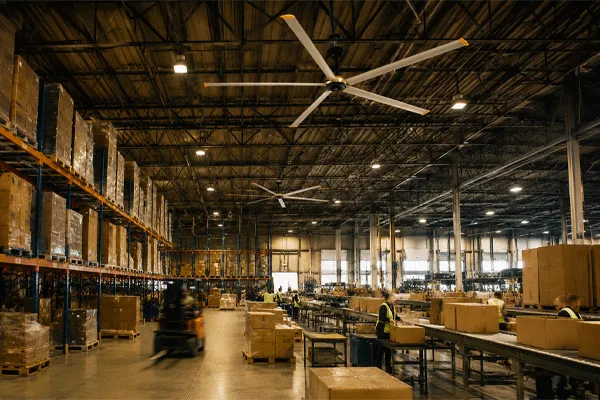
Start with a floor plan, not a spec sheet. Note the ceiling height at its lowest point (not the peak, if the roof is pitched or trussed), any fixed obstructions below 20 ft such as conveyor lines or racking, and the square footage you actually need conditioned versus the total building footprint. A 60,000 sq ft warehouse with 15,000 sq ft of active pick-and-pack floor doesn’t need uniform coverage across the whole building — it needs coverage where the work happens.
Completion check: you should be able to draw a rectangle on the floor plan representing the zone that needs airflow, with a ceiling height noted for that specific zone.
Step 2: Match Diameter to Ceiling Height
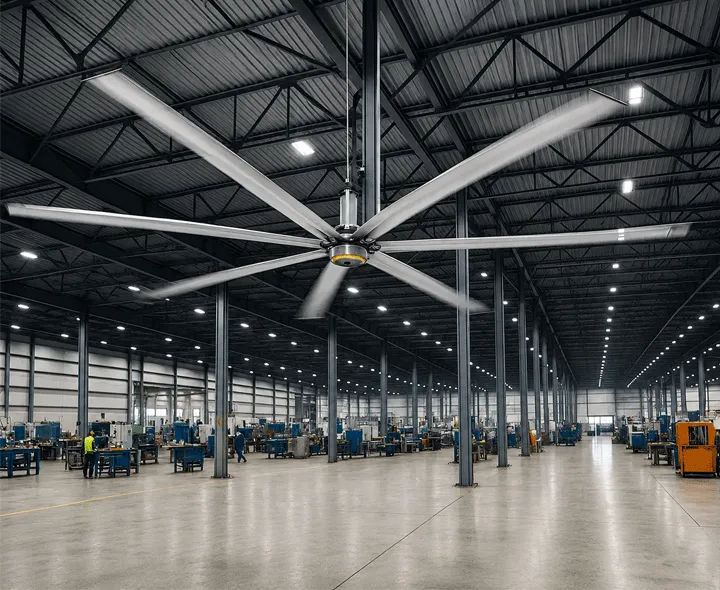
Diameter and mounting height are linked. A wider fan needs more vertical clearance to develop its full downward air column before it reaches occupant level, and a fan mounted too low relative to its blade span throws turbulent, uneven air instead of a broad, even column.
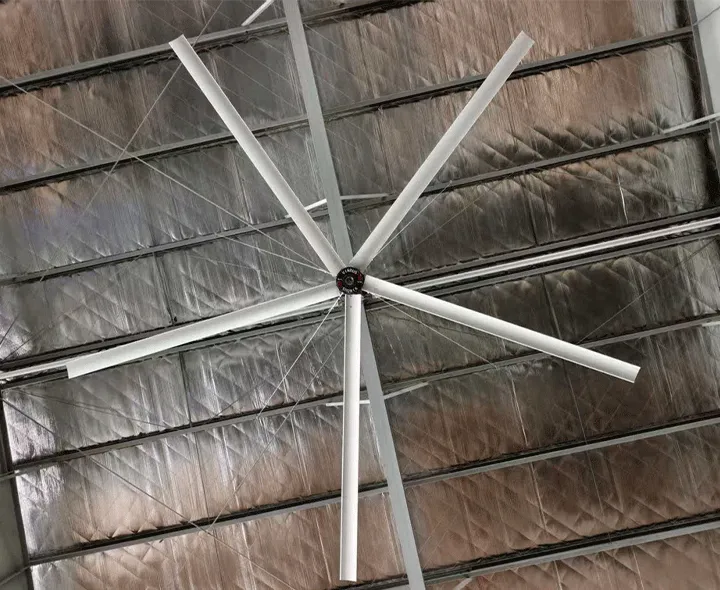
As a reference point, Vindus’s P780 Series is built in 20 ft and 24 ft diameters and is rated for ceiling heights of 20–33 ft. That range isn’t arbitrary — it reflects the clearance a blade of that size needs to fully develop airflow before it disperses across the floor. If your facility’s clear height falls below that range, a smaller-diameter model is the correct fix, not a lower-mounted large fan.
Completion check: your building’s clear height at the fan location falls inside the manufacturer’s stated ceiling-height range for the diameter you’re considering.
Step 3: Set the Mounting Clearance
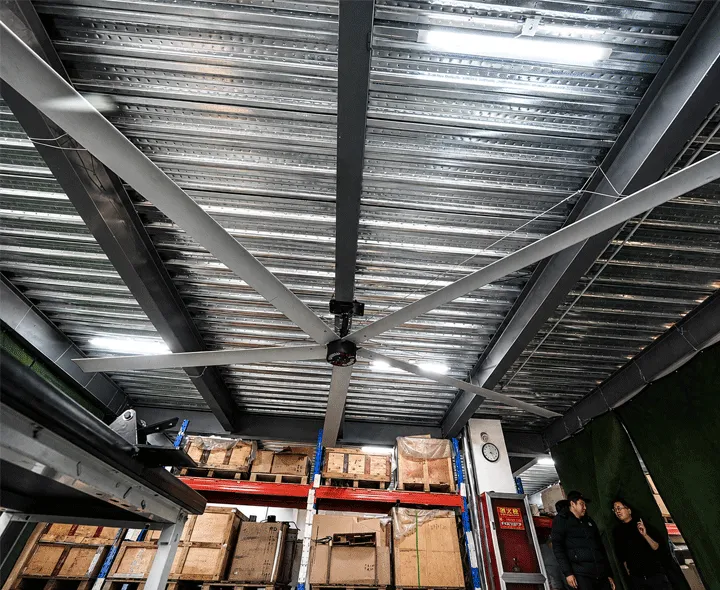
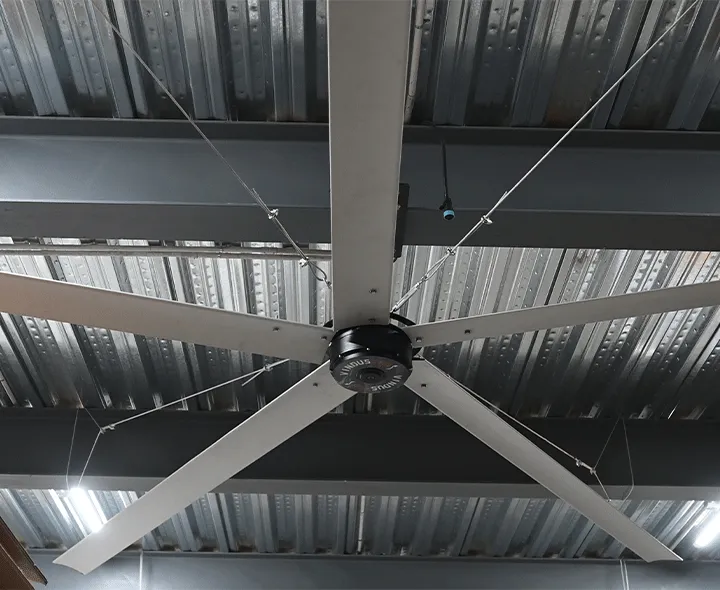
Beyond matching the diameter to the ceiling, leave clearance above the blade tips for the mounting hardware and any required service access, and confirm nothing — sprinkler heads, lighting fixtures, ductwork — sits inside the blade’s rotational sweep. This is a structural and safety step, not just a performance one; it’s also where a lot of retrofit installs run into trouble, because the original ceiling layout was designed before an HVLS-Ventilator was part of the plan.
Completion check: the blade sweep zone is clear of fixed obstructions, and the mounting point has been checked against the structural load rating for the fan and bracket combined.
Step 4: Space Multiple Units for Overlapping Coverage
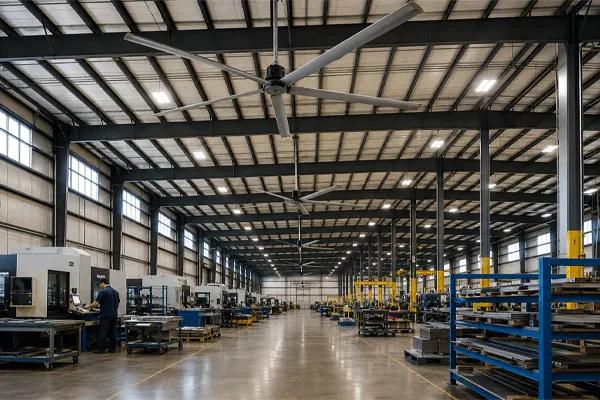
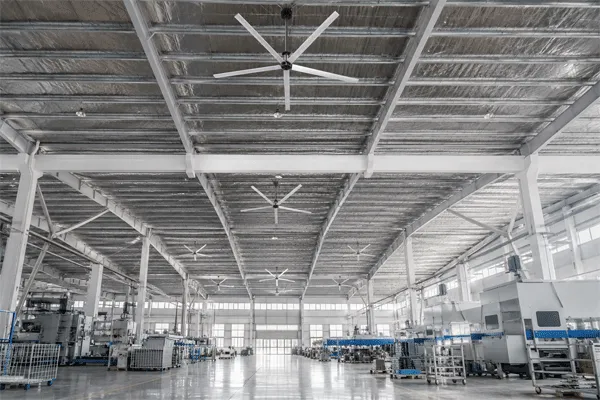
One large fan covers a defined radius; it does not cover an entire building unless the building is small enough that one radius is all you need. For larger footprints, units are spaced so their coverage areas overlap slightly rather than sitting edge to edge with gaps between them. Edge-to-edge spacing looks efficient on paper but leaves noticeable dead zones in practice, particularly along the perimeter where airflow from a single fan is already weaker than at its center.
Column grid spacing is a useful starting reference in industrial buildings, since HVLS fans are typically hung from or near structural columns anyway. Aligning fan placement to the existing column grid, rather than fighting it, usually produces better coverage with fewer units than an idealized radial layout would suggest.
Completion check: adjacent fan coverage circles overlap on your floor plan, and no working area falls entirely outside every circle.
HVLS Fan Airflow Optimization: Sizing, Placement and Coverage for Large Spaces
Step 5: Size the Motor to Your Duty Cycle
Power draw matters less for occupant comfort than for operating cost and duty cycle planning. The P780 Series uses a permanent magnet synchronous motor (PMSM) and draws under 1,000 W at maximum speed — a gearless direct-drive design, which typically means fewer moving parts subject to wear than a belt- or gear-driven equivalent. For a facility running fans continuously across two or three shifts, that power draw compounds into a meaningful line item on the utility bill, so it’s worth sizing against actual run hours rather than nameplate capability alone.
Completion check: you’ve estimated daily run hours for the space and checked the resulting energy cost against the facility’s HVAC or supplemental cooling budget it’s meant to offset.
Step 6: Verify Performance Against a Recognized Standard
Airflow claims are only as good as the test method behind them. Vindus fans are tested to AMCA 230-15, the Air Movement and Control Association’s standard for laboratory airflow testing, and follow ANSI/ASHRAE 216P, which addresses HVLS-specific performance measurement rather than the small-fan test protocols originally written for ceiling and box fans. When comparing airflow claims across manufacturers, checking which standard (if any) backs the number is a faster filter than comparing marketing language.
Completion check: any airflow or coverage figure you’re evaluating cites a specific test standard, not just a stated CFM number with no methodology attached.
Where Airflow Optimization Actually Breaks Down
The most common mistake isn’t undersizing the fan — it’s assuming one large unit can substitute for proper zoning in an irregularly shaped space. An L-shaped warehouse or a floor with a mezzanine cutting across part of the ceiling height needs the space mapped in Step 1 broken into separate zones, each sized independently, rather than one oversized fan aimed at the geometric center of the whole footprint.
A second frequent error is mounting height creep during installation: contractors sometimes mount a fan a few feet lower than specified to simplify bracket routing or clear a nearby duct run. That small deviation can meaningfully change how the air column develops before reaching occupant level, particularly for larger-diameter units where the design clearance was already close to the minimum. Compared to typical fixed-speed setups where a lower mount mostly just changes noise level, a direct-drive HVLS fan’s coverage pattern is more sensitive to mounting height, since the blade needs a defined vertical run to develop full airflow before it spreads outward.
P780 Series: The Numbers Behind the Coverage Claim
| Specification |
P780 Series |
| Blade diameter |
20 ft or 24 ft |
| Recommended ceiling height |
20–33 ft |
| Typ des Motors |
PMSM (permanent magnet synchronous, direct drive) |
| Power draw |
Under 1,000 W at maximum speed |
| Control interface |
Floor-level integrated HMI |
| Wiring |
Single ceiling-to-floor cable |
| Market availability |
USA |
| Pricing |
Request a quote — Vindus does not publish list pricing for this series |
These are the figures Vindus publishes for this line; the company does not release exact rated CFM or decibel figures per model on its site, so treat any such number attributed to a specific model with caution unless it comes with a cited test method.

HVLS Fan Airflow Optimization: Sizing, Placement and Coverage for Large Spaces
Trade-offs Worth Knowing Before You Buy
Large-diameter HVLS fans genuinely reduce the number of units needed to cover a given floor area compared to arrays of smaller circulation fans, and a direct-drive PMSM motor cuts the maintenance points that come with belts or gearboxes. Those are real advantages, not marketing framing.
The trade-offs are just as real. A 20–24 ft diameter fan needs the ceiling height to support it — buildings under 20 ft clear can’t use the P780 Series regardless of floor area, and a smaller-diameter model or a different circulation strategy becomes the better fit. Installation also typically requires structural engineering sign-off given the weight and rotational forces involved, which adds lead time that a plug-in floor fan doesn’t. And because Vindus doesn’t publish list pricing, budgeting requires a quote request rather than a quick spec-sheet comparison — a genuine friction point for anyone trying to build a budget estimate before engaging a vendor.
Häufig gestellte Fragen
Q: How many HVLS fans does a warehouse need?
A: It depends on the coverage radius of the chosen diameter and how the floor plan is zoned, not on square footage alone. Map obstructions and duty zones first (Step 1), then size fan count from the overlap pattern in Step 4 rather than a flat square-footage ratio.
Q: Can an HVLS fan be mounted below the manufacturer’s recommended ceiling height?
A: Mounting below the stated range compromises how the air column develops before reaching occupant level. For the P780 Series, that range is 20–33 ft; below it, a smaller-diameter model is the appropriate fix rather than a non-standard mount.
Q: Does a bigger fan always mean better airflow coverage?
A: No. Coverage depends on the diameter-to-ceiling-height relationship and on unit spacing across the floor plan, not diameter in isolation. A large fan mounted too low or spaced incorrectly relative to neighboring units can underperform a correctly matched smaller one.
Q: What standard should airflow performance claims be tested against?
A: AMCA 230-15 for laboratory airflow testing and ANSI/ASHRAE 216P for HVLS-specific performance guidance are the two standards Vindus fans are tested to. Any airflow figure without a cited test method is difficult to verify against.
Q: Is P780 Series pricing available online?
A: No — Vindus uses a request-a-quote model and does not publish list prices for this series. Contact the company directly for a project-specific quote.