High Volume Low Speed Fans: How to Select the Right HVLS System for a Large Space
2026-09-16
Updated September 16, 2026 | Michael Danielsson, CEO, Vindus Fans
High volume low speed fans move a broad column of air at low rotational speed to circulate air through large spaces. Selecting an HVLS system requires more than choosing the biggest diameter: ceiling height, obstructions, occupied zones, supply and exhaust locations, motor architecture, controls, structural loads, and operating goals all affect the result.
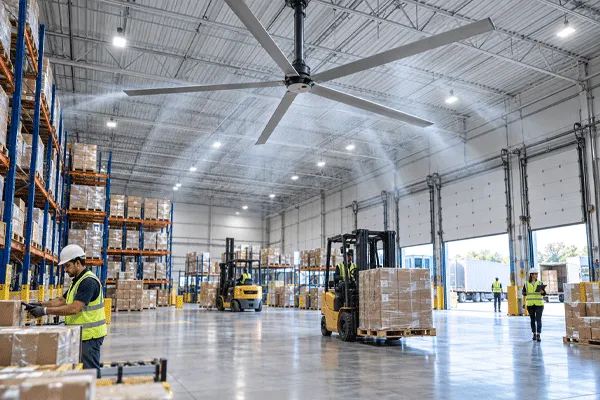
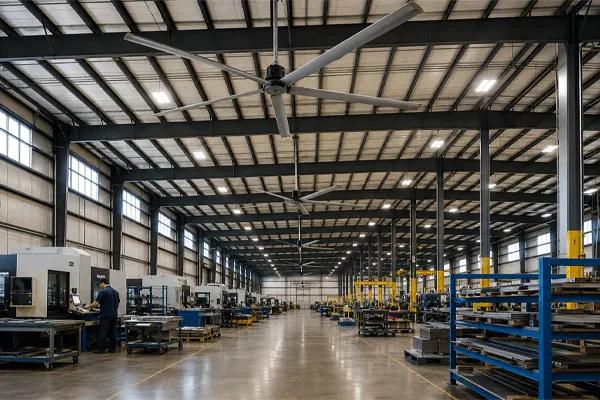
A warehouse HVLS fan must be positioned around racks, dock doors, lighting, sprinklers, traffic routes, and occupied work zones.
What high volume low speed fans actually do
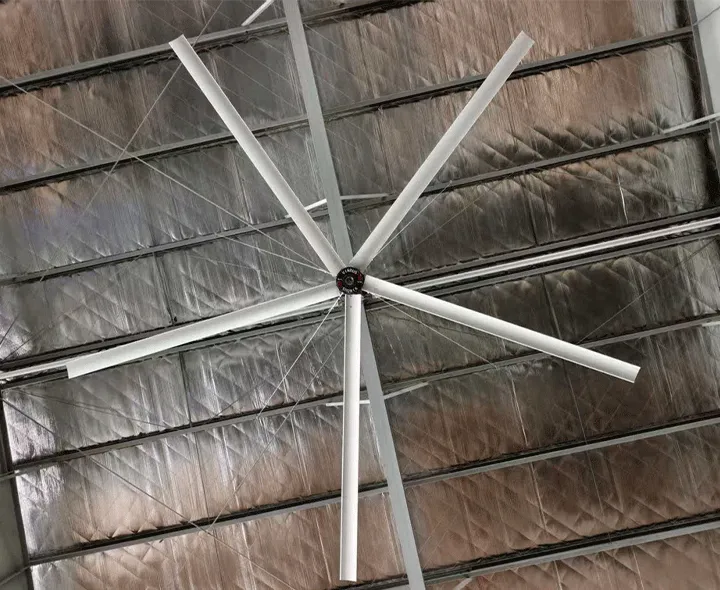
An HVLS fan uses a large diameter to move air across a wide area without the narrow, high-speed jet produced by many smaller directional fans. Air travels downward from the fan, spreads across the floor, and returns upward around the coverage area. The pattern depends on blade design, speed, height, walls, racks, equipment, doors, and neighboring fans.
In warm conditions, air movement over people can improve perceived comfort. In heating season, low-speed reverse or destratification operation can help redistribute warm air trapped near a high ceiling. An HVLS fan does not refrigerate air, create outdoor-air exchange, or replace source capture for dust, fumes, or combustion products.
The Air Movement and Control Association publishes technical education about fan selection, testing, and system effects through its AMCA Education resources. Use tested performance data and application-specific engineering rather than treating a generic coverage diameter as guaranteed in every building.
Start with the operating objective
A buying decision becomes clearer when the project states what must change and how success will be measured. “The warehouse feels hot” is not yet a design criterion. Map hot work zones, stagnant aisles, winter temperature layers, loading-door effects, process heat, HVAC supply locations, and employee complaints by shift.
Objective
Useful baseline
Post-installation check
Improve warm-season comfort
Air speed and temperature at occupied positions
Repeat readings at approved fan speeds and door conditions
Reduce thermal stratification
Temperature at floor, occupied level, and near ceiling
Compare vertical temperature difference before and after
Distribute supplied air
Supply temperature, airflow, and poorly served zones
Confirm distribution without short-circuiting to exhaust
Limit stagnant areas
Smoke visualization or air-speed map where appropriate
Verify aisles, corners, and sheltered work zones
Reduce fan operating energy
Measured input power and annual schedule of existing fans
Measure complete-system input under equivalent duty
Choose diameter and mounting height together
Larger diameter can provide broader low-speed coverage, but diameter alone does not define performance. A fan mounted too close to the roof, beams, or obstructions may have restricted inlet airflow. A fan installed too high for its diameter and speed may not create useful air movement at the occupied level. A low installation can cause drafts or reduce required clearances.
Measure the building rather than relying on nominal floor area. Record clear height, roof slope, beam spacing, cranes, ducts, lights, sprinklers, rack tops, mezzanines, partitions, large equipment, doors, and the actual occupied zones. Structural capacity and dynamic loading must be reviewed by qualified project professionals.
Multiple smaller HVLS fans may fit a divided or obstructed layout better than one very large fan. Conversely, adding many fans without coordinating their spacing can create interacting air patterns and unnecessary energy use. Compare layouts at the same target zones and operating conditions.
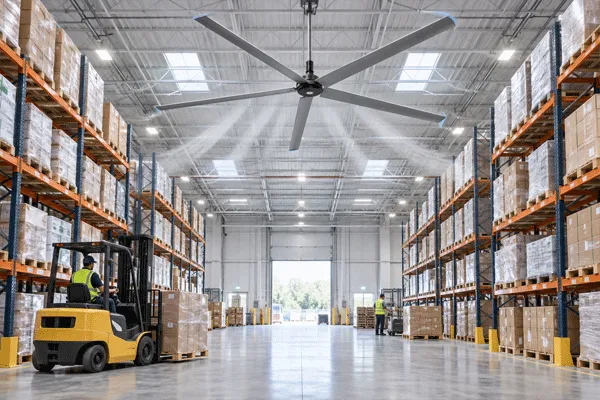
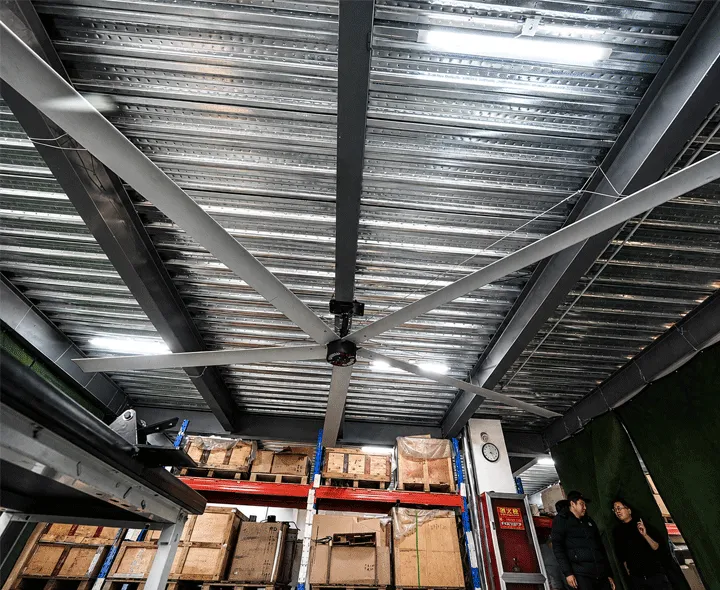
Rack rows and traffic aisles divide a warehouse into airflow zones; fan layout should follow those real boundaries.
Direct drive, geared drive, and maintenance
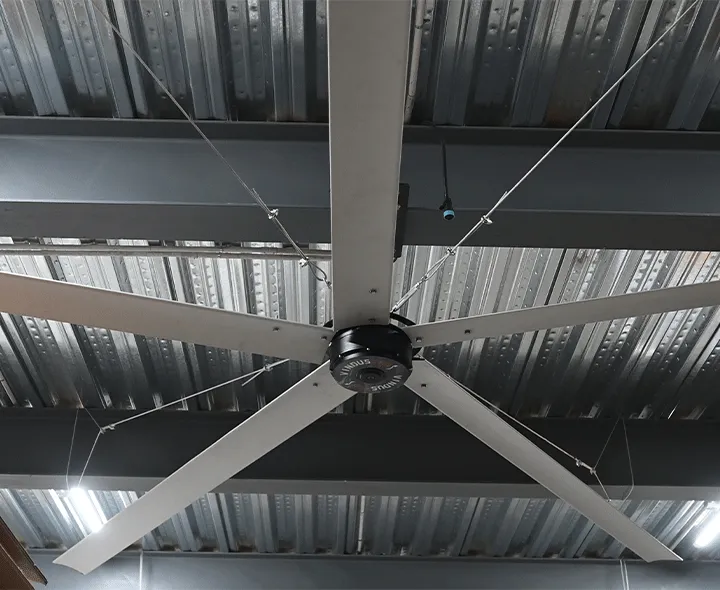
A direct-drive PMSM places the motor at the fan hub without a separate gearbox. This can remove gear oil, seals, belts, pulleys, and alignment tasks from the drive train. Permanent-magnet synchronous motors also suit precise variable-speed control and avoid the rotor losses associated with induction.
A geared induction-motor system remains a familiar industrial architecture. Standard motor availability and established maintenance knowledge can be advantages. Its lifecycle plan must include the gearbox or belt reduction, lubrication, seals, alignment, tension, guards, and added transmission losses where applicable.
Do not compare motor labels alone. Ask for complete-fan input power at equivalent speed or useful airflow, plus the inspection schedule, spare-parts route, warranty, diagnostics, controller replacement process, and expected service access. The Vindus comparison of PMSM and induction motors for industrial fans explains these tradeoffs in more detail.
Controls should match daily operation
An HVLS control system should make the approved operating modes easy to repeat. At minimum, define start, stop, normal speed range, directional mode where applicable, emergency response, fault reset, and operator permissions. Multi-fan sites should decide whether local controls, centralized control, scheduling, or building-automation integration is required.
Maximum speed is not automatically the best setting. Occupants near the fan may experience drafts before distant zones receive adequate movement. Open dock doors and exhaust systems can redirect the flow. Commission several speeds and document seasonal setpoints instead of leaving every fan at 100 percent.
P780 Series for large U.S. spaces
The Vindus P780 Series is a direct-drive PMSM option for large U.S.-market industrial and commercial buildings. Published configurations include 20 ft and 24 ft diameters for approximate blade heights of 20–33 ft. The series lists maximum-speed input below 1,000 W and uses a floor-level integrated HMI with a single ceiling-to-floor cable.
Compare coverage zones, spacing, obstructions, doors, racks, and neighboring fans
Approximate blade height of 20–33 ft
Verify roof structure, inlet clearance, sprinklers, lights, cranes, ducts, and service access
Direct-drive PMSM
Review complete-fan input, controller matching, diagnostics, warranty, and spare support
Maximum-speed input below 1,000 W
Estimate annual energy using actual speed, schedule, season, and fan quantity
Floor-level integrated HMI
Define operator access, approved setpoints, shutdown, fault response, and control coordination
The P780 specifications support preliminary selection, not a guaranteed coverage area or savings result. Vindus does not publish a fixed price. Model, quantity, controls, electrical work, installation, delivery, and project support must be defined before quotation.
Safety and installation cannot be separated from selection
The fan supplier, installer, building owner, structural professional, fire-protection stakeholders, and authority having jurisdiction may each control part of the installation. Review the mounting structure, hardware, safety restraints, blade clearance, electrical isolation, controller location, seismic or wind requirements where applicable, and access for inspection.
Coordinate the fan with sprinklers, smoke detection, lighting, cranes, doors, racks, and process exhaust. A circulation fan can disturb a local exhaust hood or move settled dust into the air. Where contaminants exist, ventilation and industrial-hygiene requirements take priority over comfort circulation.
A seven-step HVLS buying process
Define the outcome. State the comfort, destratification, distribution, or energy objective and the measurement method.
Survey the building. Record dimensions, heights, structures, obstructions, doors, racks, equipment, people, and current HVAC or exhaust.
Divide the floor into zones. Separate work areas, storage aisles, loading zones, mezzanines, and spaces with different operating schedules.
Compare layouts. Review fan diameter, quantity, mounting positions, expected air pattern, clearances, and interaction between fans.
Evaluate the complete product. Compare motor and drive, controller, blades, hub, safety system, tested performance, sound, power, warranty, and support.
Price the lifecycle. Include equipment, freight, structure, electrical work, installation, commissioning, inspections, maintenance, downtime, and spare parts.
Commission and document. Verify rotation, speed, vibration, power, controls, safety devices, airflow in target zones, and seasonal setpoints.
Common mistakes before quotation
Requesting a fan by floor area without giving ceiling height and obstructions.
Using a generic coverage circle as a guarantee for a racked or divided building.
Assuming the largest diameter is automatically the most efficient layout.
Comparing motor efficiency while ignoring gearbox, belt, controller, and fan losses.
Treating air movement as outdoor-air ventilation or contaminant extraction.
Ignoring structural review, sprinkler coordination, service access, and commissioning.
Häufig gestellte Fragen
What does HVLS mean?
HVLS means high volume low speed. The term describes large-diameter fans designed to move broad volumes of air at relatively low rotational speed.
How many high volume low speed fans does a building need?
Quantity depends on fan diameter and tested performance, mounting height, target zones, racks, walls, equipment, doors, HVAC, exhaust, and operating goals. A floor-area calculation alone is not enough.
Können HVLS-Ventilatoren eine Klimaanlage ersetzen?
No. They move air and can improve perceived comfort or distribute conditioned air, but they do not provide refrigeration. HVAC and HVLS fans can be coordinated as complementary systems.
Are direct-drive HVLS fans maintenance-free?
No. Direct drive can remove gearbox or belt maintenance, but bearings, blades, fasteners, safety devices, electrical connections, controls, and structural attachments still require inspection.
What information is needed for an accurate quote?
Provide building drawings, floor dimensions, clear height, roof structure, racks and obstructions, target zones, existing HVAC and exhaust, electrical supply, required controls, operating schedule, project location, quantity, and installation scope.
Michael Danielsson is CEO of Vindus Fans. His background includes fan product development, production, operations, and customer service for large-space airflow applications.
Updated September 16, 2026 | Michael Danielsson, CEO, Vindus Fans
High volume low speed fans move a broad column of air at low rotational speed to circulate air through large spaces. Selecting an HVLS system requires more than choosing the biggest diameter: ceiling height, obstructions, occupied zones, supply and exhaust locations, motor architecture, controls, structural loads, and operating goals all affect the result.
A warehouse HVLS fan must be positioned around racks, dock doors, lighting, sprinklers, traffic routes, and occupied work zones.
What high volume low speed fans actually do
An HVLS fan uses a large diameter to move air across a wide area without the narrow, high-speed jet produced by many smaller directional fans. Air travels downward from the fan, spreads across the floor, and returns upward around the coverage area. The pattern depends on blade design, speed, height, walls, racks, equipment, doors, and neighboring fans.
In warm conditions, air movement over people can improve perceived comfort. In heating season, low-speed reverse or destratification operation can help redistribute warm air trapped near a high ceiling. An HVLS fan does not refrigerate air, create outdoor-air exchange, or replace source capture for dust, fumes, or combustion products.
The Air Movement and Control Association publishes technical education about fan selection, testing, and system effects through its AMCA Education resources. Use tested performance data and application-specific engineering rather than treating a generic coverage diameter as guaranteed in every building.
Start with the operating objective
A buying decision becomes clearer when the project states what must change and how success will be measured. “The warehouse feels hot” is not yet a design criterion. Map hot work zones, stagnant aisles, winter temperature layers, loading-door effects, process heat, HVAC supply locations, and employee complaints by shift.
Objective
Useful baseline
Post-installation check
Improve warm-season comfort
Air speed and temperature at occupied positions
Repeat readings at approved fan speeds and door conditions
Reduce thermal stratification
Temperature at floor, occupied level, and near ceiling
Compare vertical temperature difference before and after
Distribute supplied air
Supply temperature, airflow, and poorly served zones
Confirm distribution without short-circuiting to exhaust
Limit stagnant areas
Smoke visualization or air-speed map where appropriate
Verify aisles, corners, and sheltered work zones
Reduce fan operating energy
Measured input power and annual schedule of existing fans
Measure complete-system input under equivalent duty
Choose diameter and mounting height together
Larger diameter can provide broader low-speed coverage, but diameter alone does not define performance. A fan mounted too close to the roof, beams, or obstructions may have restricted inlet airflow. A fan installed too high for its diameter and speed may not create useful air movement at the occupied level. A low installation can cause drafts or reduce required clearances.
Measure the building rather than relying on nominal floor area. Record clear height, roof slope, beam spacing, cranes, ducts, lights, sprinklers, rack tops, mezzanines, partitions, large equipment, doors, and the actual occupied zones. Structural capacity and dynamic loading must be reviewed by qualified project professionals.
Multiple smaller HVLS fans may fit a divided or obstructed layout better than one very large fan. Conversely, adding many fans without coordinating their spacing can create interacting air patterns and unnecessary energy use. Compare layouts at the same target zones and operating conditions.
Rack rows and traffic aisles divide a warehouse into airflow zones; fan layout should follow those real boundaries.
Direct drive, geared drive, and maintenance
A direct-drive PMSM places the motor at the fan hub without a separate gearbox. This can remove gear oil, seals, belts, pulleys, and alignment tasks from the drive train. Permanent-magnet synchronous motors also suit precise variable-speed control and avoid the rotor losses associated with induction.
A geared induction-motor system remains a familiar industrial architecture. Standard motor availability and established maintenance knowledge can be advantages. Its lifecycle plan must include the gearbox or belt reduction, lubrication, seals, alignment, tension, guards, and added transmission losses where applicable.
Do not compare motor labels alone. Ask for complete-fan input power at equivalent speed or useful airflow, plus the inspection schedule, spare-parts route, warranty, diagnostics, controller replacement process, and expected service access. The Vindus comparison of PMSM and induction motors for industrial fans explains these tradeoffs in more detail.
Controls should match daily operation
An HVLS control system should make the approved operating modes easy to repeat. At minimum, define start, stop, normal speed range, directional mode where applicable, emergency response, fault reset, and operator permissions. Multi-fan sites should decide whether local controls, centralized control, scheduling, or building-automation integration is required.
Maximum speed is not automatically the best setting. Occupants near the fan may experience drafts before distant zones receive adequate movement. Open dock doors and exhaust systems can redirect the flow. Commission several speeds and document seasonal setpoints instead of leaving every fan at 100 percent.
P780 Series for large U.S. spaces
The Vindus P780 Series is a direct-drive PMSM option for large U.S.-market industrial and commercial buildings. Published configurations include 20 ft and 24 ft diameters for approximate blade heights of 20–33 ft. The series lists maximum-speed input below 1,000 W and uses a floor-level integrated HMI with a single ceiling-to-floor cable.
Compare coverage zones, spacing, obstructions, doors, racks, and neighboring fans
Approximate blade height of 20–33 ft
Verify roof structure, inlet clearance, sprinklers, lights, cranes, ducts, and service access
Direct-drive PMSM
Review complete-fan input, controller matching, diagnostics, warranty, and spare support
Maximum-speed input below 1,000 W
Estimate annual energy using actual speed, schedule, season, and fan quantity
Floor-level integrated HMI
Define operator access, approved setpoints, shutdown, fault response, and control coordination
The P780 specifications support preliminary selection, not a guaranteed coverage area or savings result. Vindus does not publish a fixed price. Model, quantity, controls, electrical work, installation, delivery, and project support must be defined before quotation.
Safety and installation cannot be separated from selection
The fan supplier, installer, building owner, structural professional, fire-protection stakeholders, and authority having jurisdiction may each control part of the installation. Review the mounting structure, hardware, safety restraints, blade clearance, electrical isolation, controller location, seismic or wind requirements where applicable, and access for inspection.
Coordinate the fan with sprinklers, smoke detection, lighting, cranes, doors, racks, and process exhaust. A circulation fan can disturb a local exhaust hood or move settled dust into the air. Where contaminants exist, ventilation and industrial-hygiene requirements take priority over comfort circulation.
A seven-step HVLS buying process
Define the outcome. State the comfort, destratification, distribution, or energy objective and the measurement method.
Survey the building. Record dimensions, heights, structures, obstructions, doors, racks, equipment, people, and current HVAC or exhaust.
Divide the floor into zones. Separate work areas, storage aisles, loading zones, mezzanines, and spaces with different operating schedules.
Compare layouts. Review fan diameter, quantity, mounting positions, expected air pattern, clearances, and interaction between fans.
Evaluate the complete product. Compare motor and drive, controller, blades, hub, safety system, tested performance, sound, power, warranty, and support.
Price the lifecycle. Include equipment, freight, structure, electrical work, installation, commissioning, inspections, maintenance, downtime, and spare parts.
Commission and document. Verify rotation, speed, vibration, power, controls, safety devices, airflow in target zones, and seasonal setpoints.
Common mistakes before quotation
Requesting a fan by floor area without giving ceiling height and obstructions.
Using a generic coverage circle as a guarantee for a racked or divided building.
Assuming the largest diameter is automatically the most efficient layout.
Comparing motor efficiency while ignoring gearbox, belt, controller, and fan losses.
Treating air movement as outdoor-air ventilation or contaminant extraction.
Ignoring structural review, sprinkler coordination, service access, and commissioning.
Häufig gestellte Fragen
What does HVLS mean?
HVLS means high volume low speed. The term describes large-diameter fans designed to move broad volumes of air at relatively low rotational speed.
How many high volume low speed fans does a building need?
Quantity depends on fan diameter and tested performance, mounting height, target zones, racks, walls, equipment, doors, HVAC, exhaust, and operating goals. A floor-area calculation alone is not enough.
Können HVLS-Ventilatoren eine Klimaanlage ersetzen?
No. They move air and can improve perceived comfort or distribute conditioned air, but they do not provide refrigeration. HVAC and HVLS fans can be coordinated as complementary systems.
Are direct-drive HVLS fans maintenance-free?
No. Direct drive can remove gearbox or belt maintenance, but bearings, blades, fasteners, safety devices, electrical connections, controls, and structural attachments still require inspection.
What information is needed for an accurate quote?
Provide building drawings, floor dimensions, clear height, roof structure, racks and obstructions, target zones, existing HVAC and exhaust, electrical supply, required controls, operating schedule, project location, quantity, and installation scope.
Michael Danielsson is CEO of Vindus Fans. His background includes fan product development, production, operations, and customer service for large-space airflow applications.
Hallo, ich bin Michael Danielsson, CEO von Vindus Fans, mit über 15 Jahren Erfahrung in der Ingenieur- und Designbranche. Ich bin hier, um mein Wissen weiterzugeben. Wenn Sie Fragen haben, können Sie mich jederzeit kontaktieren. Lassen Sie uns gemeinsam wachsen!
Geben Sie in dieses Formular einfach Ihren Namen, Ihre E-Mail-Adresse und eine kurze Beschreibung Ihrer Anfrage ein. Wir werden Sie innerhalb von 24 Stunden kontaktieren.