Michael Danielsson | Chief Executive Officer, Vindus Fans | Published August 28, 2026
Circulation and ventilation solve different problems. HVLS fans move air already inside the building; they produce no air changes and remove no contaminants. Ventilation exchanges indoor air with outside air. Specify them together, and never buy a circulation fan to fix an air-quality problem.
Two different words that get used as one
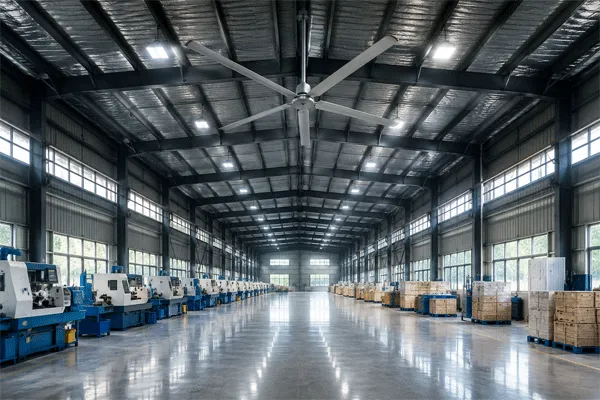
Walk through the search results for industrial airflow equipment and “ventilation” appears in the product name of things that do not ventilate. The word has drifted to mean “air movement of any kind,” and that drift produces a specific, expensive purchasing error: a facility with a fume, odor, or air-quality complaint installs large circulation fans, gets a temporary improvement in comfort, and discovers six months later that the underlying problem is unchanged.
The distinction is not semantic. It is about where the air comes from and where it goes.
Circulation moves the air that is already inside the envelope. Nothing enters, nothing leaves. Temperature distribution improves, occupants feel airflow, and the contents of the air are unchanged.
Ventilation replaces indoor air with outdoor air. The measure is air changes per hour or outside-air volume, and it is the only mechanism that dilutes or removes what is in the air.
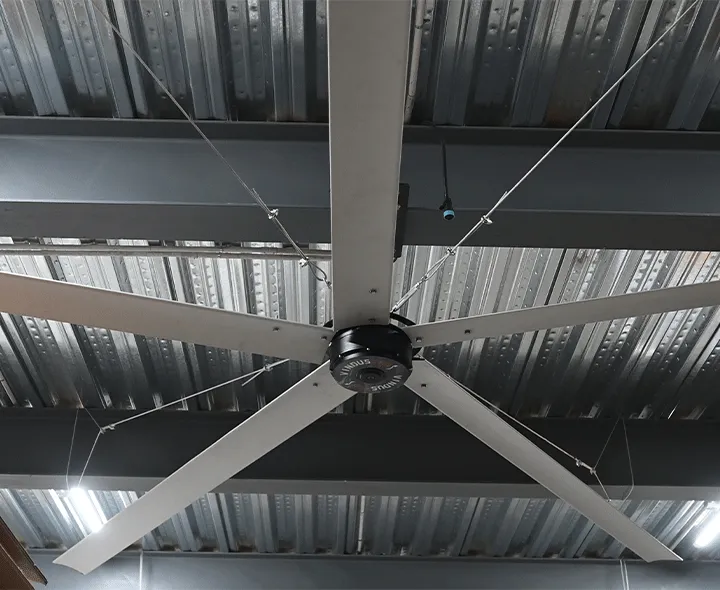
An HVLS fan is a circulation device. That is what it is for, it does that job with less input power per unit of air moved than smaller high-speed fans, and it does not become a ventilation device at any diameter or speed.
The comparison, dimension by dimension
| Dimension |
Circulation (HVLS fans) |
Ventilation (exhaust + make-up air) |
| Air source |
Air already inside the building |
Outdoor air drawn in; indoor air discharged |
| Primary metric |
Air speed at the occupied zone; airflow tested to AMCA 230-15 |
Air changes per hour, or outside-air CFM |
| Solves |
Temperature stratification, uneven temperature, perceived heat, stagnant pockets |
Contaminant concentration, odor, fume, excess humidity from an indoor source, oxygen depletion |
| Does not solve |
Anything about the composition of the air |
Temperature uniformity within the occupied zone |
| Effect on heating and cooling load |
Small; can allow revised setpoints when the design accounts for air movement |
Direct and often large; conditioned air leaves, unconditioned air enters |
| Runs when |
Continuously or on schedule, most of the year |
Sized to a required rate; often interlocked to process or occupancy |
| Governed by |
Performance standards for comparability (AMCA 230-15, ANSI/ASHRAE 216P) |
Building code, occupational health regulation, and process-specific requirements |
| Who specifies it |
Facility engineer, often with the supplier |
Mechanical engineer, with code compliance obligations |
| Typical failure when mis-applied |
Contaminants dispersed rather than removed |
Building depressurized; heating cost increases sharply |
The last row is the one to read twice. Both errors are common and neither is obvious at commissioning.
What HVLS fans actually do, stated without hedging
A large-diameter, low-speed fan produces a broad column of air that reaches the floor and spreads outward. Three verifiable effects follow.
It narrows the floor-to-ceiling temperature gradient by mechanically mixing air layers that would otherwise separate by buoyancy. In a 30 ft building this is the largest effect the equipment produces, and in heating season it is often worth more than the summer cooling effect.
It creates air movement across occupants, which increases the rate at which the body sheds heat. Occupants report feeling cooler at the same air temperature, which is a physiological effect, not a temperature reduction.
It eliminates stagnant pockets, which is why circulation is sometimes credited with air-quality improvement. Mixing does change how contaminants are distributed. It does not change how much of them is present.
What they cannot do, stated the same way
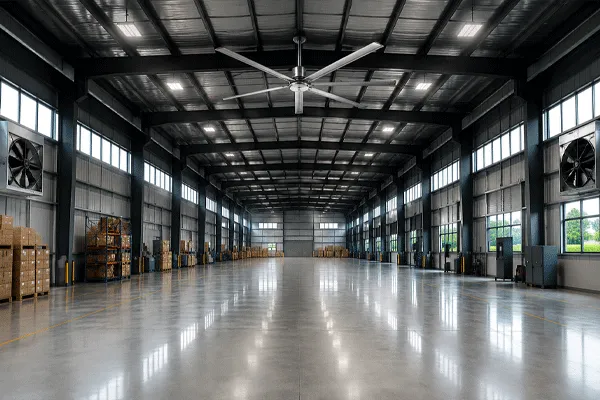
They produce no air changes. A circulation fan can move a very large volume of air per minute and still deliver an air change rate of exactly zero, because none of that air crosses the envelope. A CFM figure for a circulation fan and a CFM figure for outside-air ventilation are different quantities that share a unit, and treating them as interchangeable is the root of most mis-specification in this category.
They do not remove contaminants. Welding fume, solvent vapor, engine exhaust, grain dust, and ammonia are removed by capture and exhaust. A circulation fan operating in a space with an uncontrolled contaminant source distributes that contaminant through the building more evenly, which lowers the concentration at the source and raises it everywhere else. Whether that is an improvement or a regression is a question for an industrial hygienist, and in many cases it is a regression.
They do not dehumidify. Moving air over a wet surface accelerates evaporation, which moves water from the surface into the air. In a building where the moisture source is indoors and the envelope is tight, circulation relocates the moisture rather than removing it. Removal requires exhaust, dehumidification equipment, or both.
They do not supply combustion or process make-up air. If a building runs exhaust fans, direct-fired heaters, or fuel-burning equipment, the make-up air path is a mechanical design question with safety implications, and no amount of internal circulation substitutes for it.
Symptom to equipment: a diagnostic table
Most specification errors start with a symptom described in comfort terms. This table maps the symptom to the class of equipment that addresses it.
| Reported symptom |
Likely cause |
Equipment class |
HVLS fan role |
| Ceiling hot, floor cold in winter |
Thermal stratification |
Circulation |
Primary solution |
| Workers report heat stress in summer, air is clean |
Insufficient air movement at occupied zone |
Circulation |
Primary solution |
| Persistent odor |
Contaminant source and inadequate exchange |
Exhaust, source capture |
None; may spread the odor |
| Visible haze, welding or process fume |
Uncontrolled emission |
Source capture with exhaust |
None; dispersal is not control |
| Condensation on floors or steel |
Moisture source, envelope, or dew point issue |
Ventilation, dehumidification, envelope work |
Supporting only, after the source is addressed |
| Air feels stale and still, no known contaminant |
Stagnation, possibly low outside air |
Assess ventilation first |
Supporting; do not assume it is the fix |
| Doors hard to open, whistling at gaps |
Building depressurized by exhaust |
Make-up air |
None |
| Hot spot around a single process |
Localized heat source |
Source capture, then circulation |
Supporting |
| Uneven temperature between building sections |
Distribution and zoning |
Circulation, zoned |
Primary solution |
Two symptoms in that table — stale air and condensation — are the ones most often brought to a fan supplier first. Both deserve a ventilation assessment before any fan is quoted.
Where the two work together
Separating the two categories is not an argument for treating them independently. Circulation and ventilation interact, mostly favorably, once each is doing its own job.
Mixing improves how effectively supplied outside air reaches the occupied zone. Outside air introduced at high level in a building with strong stratification can short-circuit back to the exhaust without ever reaching the floor. Circulation reduces that short-circuiting, so the ventilation rate you paid to install is more of what the occupants actually receive.
Destratification also reduces the temperature of air leaving through exhaust. In a stratified building, exhaust removes the hottest air in the building in winter, which is exactly the air you paid to heat. Mixing lowers the temperature at the exhaust point.
Make-up air distributes better in a mixed space. Make-up air is often introduced at a limited number of points and can create cold streams along the floor near the inlet. Circulation blends that stream into the room air.
The sequence matters: size and fix the ventilation first, then add circulation. Reversing the order produces a building where circulation is compensating for a ventilation deficiency, which it cannot do.
Reading airflow numbers on a common basis
Because both categories report CFM, the comparability question deserves its own answer.
AMCA 230-15 is the Air Movement and Control Association’s laboratory method for rating the air performance of circulating fans. It specifies the mounting arrangement, the velocity traverse, and the reporting format, so that a figure produced under it means the same thing across manufacturers.
ANSI/ASHRAE 216P addresses performance rating for large-diameter ceiling fans, including how the airspeed field beneath the fan is characterized rather than reduced to one headline volume.
Neither standard converts a circulation figure into an air change rate, because no such conversion exists. When you receive a quotation, ask which standard the figure was produced under, at what mounting height, and at what speed setting. And when a supplier offers a CFM number as evidence of ventilation performance, the correct question is what fraction of that air came from outside. The answer is none.
Compared with the smaller high-speed circulation fans this equipment is usually benchmarked against, large-diameter low-speed fans move a given volume at lower input power because the work is done by swept area rather than by velocity. That comparison is valid within the circulation category. It says nothing about ventilation, and no supplier should present it as if it did.
P780 Series: what it is specified to do
The P780 covers 20 ft and 24 ft diameters for buildings with 20 to 33 ft of clear height, which is the range where stratification is most pronounced and where circulation delivers the most.
| Specification |
P780 Series |
| Equipment class |
Circulation — recirculates indoor air; produces no outside-air exchange |
| Diameter |
20 ft and 24 ft |
| Recommended ceiling height |
20–33 ft |
| Motor |
PMSM (permanent magnet synchronous), direct drive, gearless |
| Power draw |
Under 1,000 W at maximum speed |
| Control interface |
Floor-level integrated HMI |
| Wiring |
Single ceiling-to-floor cable |
| Airflow rating (CFM) |
Not published per model; issued with quotation, tested to AMCA 230-15 |
| Air change rate |
Not applicable — circulation equipment does not produce air changes |
| Sound level |
Not published per model; issued with quotation |
| Safety compliance |
CE, CB, EN, IEC |
| Warranty |
3 years, covering defective components causing improper operation |
The first and ninth rows are there deliberately. Most product tables in this category omit the equipment class, which lets the reader supply their own assumption. Stating it removes the ambiguity that causes the mis-purchase this article is about.
Specifying circulation and ventilation together: eight steps
- Write down the symptom in the words the people affected used.“It’s stuffy by the paint line” and “it’s hot in the mezzanine” lead to different equipment. Comfort language and air-quality language get conflated in the retelling.
- Determine whether a contaminant source exists.If any process emits fume, vapor, dust, or exhaust, that is a capture-and-exhaust question and it takes precedence over everything else.
- Get the existing ventilation rate assessed.Your mechanical engineer establishes what the building currently exchanges and what the applicable code requires. Equipment suppliers are not the right party for this.
- Verify the make-up air path before adding any exhaust.Exhaust without make-up air depressurizes the building, and in a facility with fuel-burning equipment that has safety consequences beyond the airflow problem.
- Measure the temperature gradient.Log floor level, mid-height, and near the deck on a cold day with the heat running. This is the number that establishes whether circulation has work to do.
- Resolve ventilation scope first, then size circulation against the remaining problem.The remaining problem is usually temperature distribution, which is what the fans are for.
- Check for interactions.Confirm that fan placement does not blow across a capture hood, disturb a fume extraction point, or push air toward an inlet in a way that short-circuits the exchange.
- Commission both, then re-measure.Re-check the gradient and, where relevant, have the ventilation performance verified. Two separate measurements, because they are two separate systems.
Step 7 is the one that gets missed on retrofits. A circulation fan installed above a welding bay with local exhaust can defeat the capture hood, and the resulting exposure problem is worse than the heat problem the fan was bought to solve.
Edge cases and misconceptions
“High volume” and “high air change” are not related. A fan moving a very large volume of indoor air produces zero air changes. The unit is the same; the quantity is not.
Cross-ventilation through open doors is ventilation, but it is uncontrolled. Opening dock doors does exchange air. It also depressurizes or pressurizes unpredictably, defeats heating, and depends on wind. It is not a design strategy, though it is frequently how buildings actually operate.
A circulation fan can make a humidity problem look better and be worse. Air movement over a damp slab speeds evaporation, so the floor dries and occupants feel more comfortable. The water is now airborne inside a building that may not be removing it, and it will condense somewhere cooler.
Agricultural and livestock buildings are the exception that proves the rule. These facilities need both, with genuinely high exchange rates for gas and moisture control, and circulation for temperature uniformity. Neither substitutes for the other, and the ventilation design belongs to a specialist in that sector.
Spaces with filtration or pressurization requirements need the fan reviewed as part of the design. Clean assembly, food processing, and pharmaceutical space have airflow patterns designed intentionally. Adding a large circulation fan changes those patterns and should be reviewed against the design, not added afterward.
Limitations of what this article can settle
This article draws a category boundary. It does not size anything. Ventilation rates depend on the occupancy, the process, the contaminants present, and the applicable code in your jurisdiction, and those determinations belong to a mechanical engineer with responsibility for compliance.
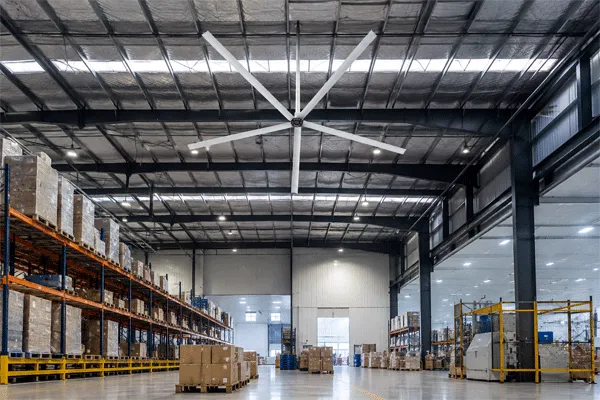
There are also buildings where circulation is the smaller half of the answer regardless of how well it is specified. Facilities with high air-change requirements lose mixed air quickly enough that the circulation benefit is reduced. Buildings under roughly 18 ft of clear height have less vertical separation to correct. And a building with an uncontrolled contaminant source has one problem, and it is not the one large fans address.
Nothing above should be read as a reason to defer circulation. It is a reason to sequence it correctly.
FAQ
Q: Do HVLS fans provide ventilation?
A: No. HVLS fans recirculate air already inside the building and produce no exchange with outside air, so their contribution to air change rate is zero. They improve temperature distribution and air movement at the occupied zone. Air quality problems require exhaust, source capture, or increased outside air, specified by a mechanical engineer.
Q: Can an HVLS fan replace exhaust fans in a factory?
A: No, and installing one in place of exhaust can make a contaminant problem worse by distributing the contaminant through the building rather than removing it. Circulation and exhaust are separate systems addressing separate problems. Where a process emits anything, capture and exhaust are specified first.
Q: My warehouse air feels stale. Will a large fan fix it?
A: It may make the space feel better without changing anything about the air. Stale air with no identified contaminant source is a ventilation question first, so have the current outside-air rate assessed before quoting fans. If the assessment shows adequate ventilation and the complaint is really about still air and uneven temperature, circulation is the right equipment.
Q: How do I compare a circulation fan’s CFM to a ventilation requirement in CFM?
A: You cannot, because they measure different things that share a unit. Circulation CFM describes indoor air moved past a plane; ventilation CFM describes outside air introduced. Ask suppliers which standard produced their circulation figure, at what mounting height and speed, and keep the ventilation calculation entirely separate.