Large High Capacity Fans for Industrial Applications: HVLS vs High-Velocity Options
2026-08-15
Reviewed August 15, 2026 | Michael Danielsson, CEO, Vindus Fans
Large high capacity fans for industrial applications fall into two broad approaches: large-diameter HVLS fans that move a wide column of air at low rotational speed, and high-velocity fans that direct faster airflow into a smaller zone. The right choice depends on the building geometry, work areas, obstructions, ventilation system, and operating objective.
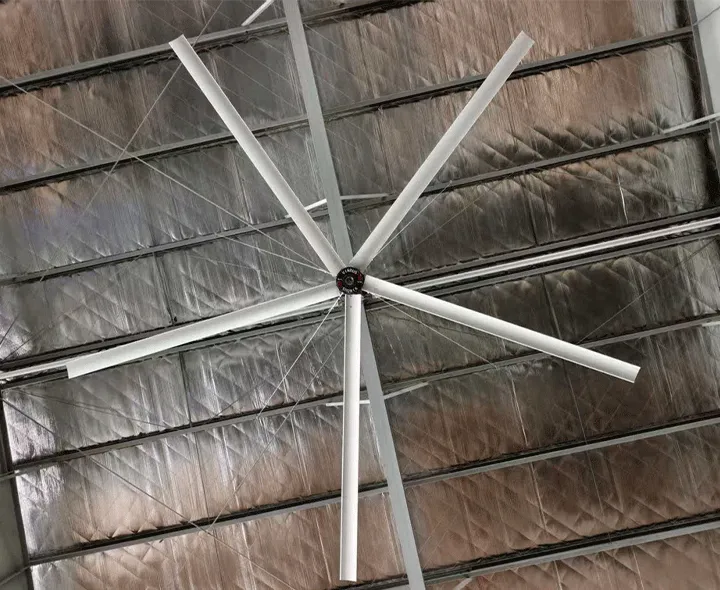
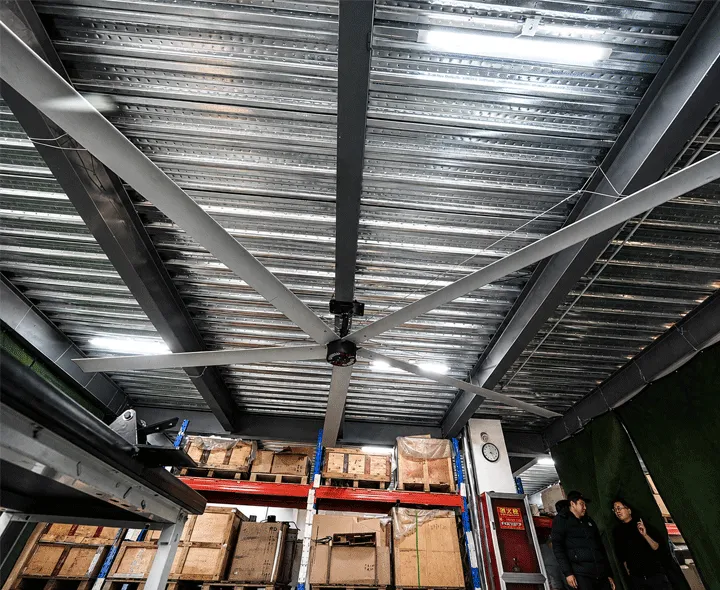
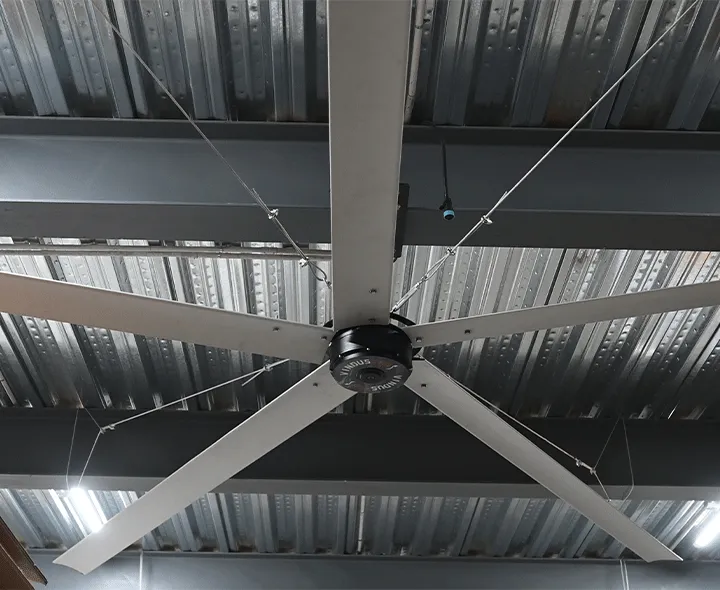
A P780 Series large-diameter HVLS fan for broad air circulation in a high-ceiling industrial space.
Neither category is automatically better. HVLS fans are often suited to broad occupied zones in warehouses, factories, logistics buildings, and other high-ceiling spaces. High-velocity axial, floor, wall, or portable fans can be more useful where a process or workstation needs concentrated air movement. Some facilities use both, provided the air paths do not conflict.
Large High Capacity Fans for Industrial Applications: the core difference
The most important distinction is the shape of the airflow. A large-diameter HVLS fan moves air downward over a broad area. After reaching the floor, that air spreads outward and circulates through the occupied zone. A high-velocity fan produces a narrower stream at greater local speed. Its effect is strongest close to the discharge path and becomes less uniform as distance, obstacles, and direction changes increase.
That difference changes how each fan should be specified. Fan diameter alone does not define useful coverage, and outlet velocity alone does not show how well air reaches multiple work zones. A defensible comparison uses the required air path, measured clearances, documented performance, speed range, installation position, and daily operating schedule.
Decision factor
Ventilateur HVLS
High-velocity fan
Primary airflow pattern
Broad, low-speed circulation across a large floor zone
Concentrated, directional airflow toward a defined target
Typical position
Ceiling-mounted above a clear air path
Floor, pedestal, wall, roof, duct, or portable position
Best-fit objective
Whole-zone circulation, comfort support, and destratification
Spot airflow, process support, local drying, or directed cooling
Effect of obstacles
Racks, cranes, mezzanines, and services can interrupt broad circulation
Equipment or partitions can block the directed air stream
Contrôles
Variable speed and seasonal operating modes are common planning needs
May use simple switching, speed control, positioning, or process interlocks
Installation planning
Structure, blade clearance, safety provisions, and electrical routing
Mounting stability, guarding, access, trip hazards, and target direction
Ventilation role
Recirculates indoor air; does not replace required exhaust or outdoor air
May circulate or exhaust air depending on fan design and system arrangement
When an HVLS fan is the stronger fit
Choose the HVLS approach when the objective covers a large occupied area rather than one workstation. Common examples include reducing stagnant zones across warehouse aisles, supporting more even air movement in an assembly area, or moving warm ceiling air back toward floor level during the heating season. The building must provide adequate mounting structure and clear space around the blade sweep.
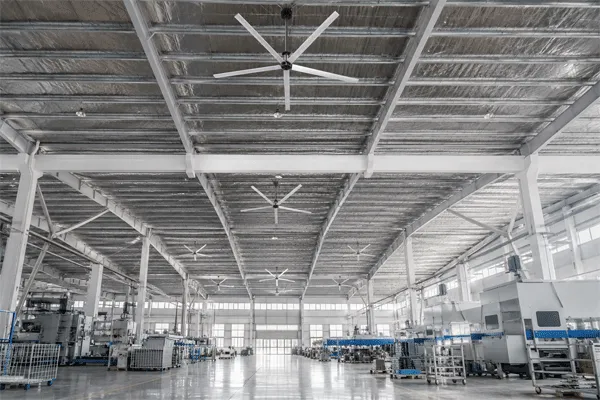
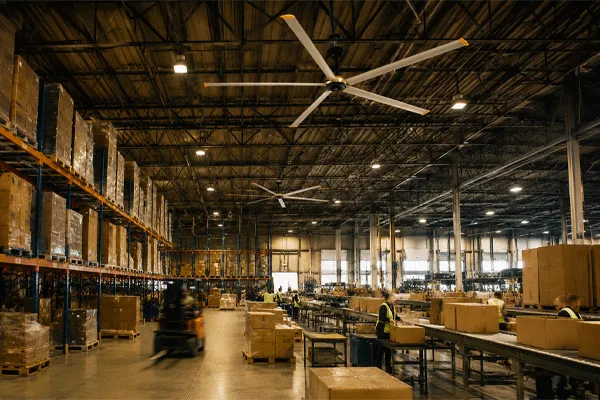
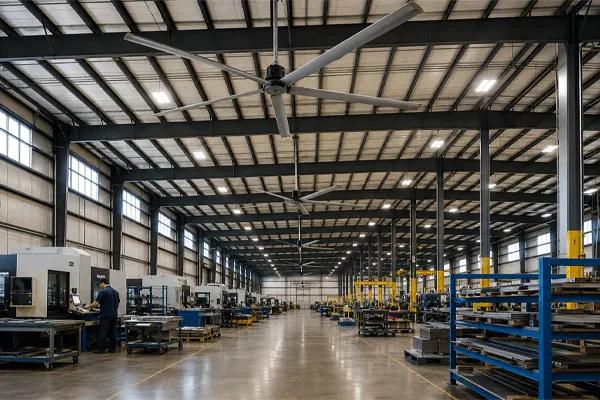
Large high capacity fans for industrial applications should be laid out around actual air paths, not an equal grid imposed on a floor plan. Tall racks, mezzanines, roof trusses, cranes, sprinklers, luminaires, ducts, heaters, and open loading doors can all alter circulation. Review the site’s HVLS fan airflow optimization guide before turning a nominal coverage figure into a purchase quantity.
An HVLS fan does not supply outdoor air or capture contaminants at their source. The U.S. Occupational Safety and Health Administration’s ventilation guidance separates general and local exhaust requirements from simple circulation. Where heat, fumes, dust, moisture, charging gases, or process emissions require engineered ventilation, the HVLS layout must work with that system.
Where high-velocity fans make more sense
A high-velocity unit can be the better choice when air must reach a small, defined target. Examples include a loading position that is occupied for part of a shift, a maintenance bay, a local drying task, or temporary work in a space where permanent ceiling installation is not justified. A portable fan can also be repositioned as the work moves.
The tradeoff is distribution. A strong air stream near the fan does not prove that a distant or obstructed zone receives useful airflow. Noise, guarding, floor space, cable routing, and the risk of blowing dust or light materials also deserve attention. For a deeper comparison of local air speed and broader circulation, see high-velocity fans versus industrial fans.
Do not use a recirculating high-velocity fan where the task calls for contaminant capture or a specified outdoor-air rate. An exhaust or supply fan is selected as part of a ventilation system, using pressure, flow, duct, inlet, outlet, and control requirements that are different from those of a portable air circulator.
A hybrid layout can solve two different problems
Some industrial spaces need broad background circulation and a separate local air stream. An HVLS fan can serve the larger occupied zone while a smaller directional fan addresses an intermittent workstation or loading position. This is a hybrid layout, not a reason to aim multiple fans at one another without analysis.
Test the interaction at normal operating speeds. A local fan may distort the intended floor-level spread from the HVLS system, while an open door or exhaust inlet can redirect both air paths. Document which fans run in each season and shift. If smoke control, hazardous exhaust, or a code-required pressure relationship is involved, obtain professional engineering review before operation.
P780 Series planning reference
For U.S.-market projects, the Vindus P780 Series provides a concrete HVLS reference within this comparison. Published options include 20 ft and 24 ft diameters for blade heights of approximately 20-33 ft. The series uses a direct-drive permanent-magnet synchronous motor, consumes less than 1,000 W at maximum speed, and uses a floor-level integrated HMI with a single ceiling-to-floor cable.
P780 item
Published reference
Information required from the project
Diamètre
20 ft or 24 ft
Clear span, obstructions, rack layout, and target zones
Blade height
Approximately 20-33 ft
Roof structure, services, clearances, and occupied level
Drive
Direct-drive PMSM
Electrical supply and controller location
Maximum input
Less than 1,000 W
Expected speed, hours, seasons, and local electricity tariff
Contrôle
Floor-level integrated HMI
Operator access, permissions, and documented setpoints
These published references narrow the selection but do not complete it. Vindus does not publish a single airflow, coverage, or noise figure that applies to every model and installation, so this article does not invent one. Buyers should request model-specific performance data, mounting requirements, electrical details, safety provisions, and test conditions for the proposed project.
State whether the project needs whole-zone circulation, local air speed, heating-season destratification, process exhaust, outdoor-air delivery, or a combination. Avoid using the vague instruction “improve ventilation” without defining what must change.
2. Map the building and occupied zones
Record length, width, clear height, blade height, racks, mezzanines, machinery, cranes, doors, heaters, ducts, sprinklers, lighting, workstations, and seasonal layout changes. Mark the people and processes that need airflow.
3. Separate circulation from air exchange
Confirm which existing equipment supplies outdoor air, removes contaminants, or controls building pressure. ASHRAE maintains an overview of its standards and guidelines; the applicable code and engineering criteria still depend on location, occupancy, and process.
4. Compare documented fan data
Request input power across the proposed speed range, control method, sound data where available, mounting requirements, safety components, service access, warranty terms, and the test method used for performance ratings. Compare equivalent operating points rather than marketing labels.
5. Estimate operation by shift and season
Use expected speed and operating hours, not maximum input multiplied by every hour of the year. Include shutdown periods, winter settings, loading-door schedules, maintenance access, and any process interlock.
6. Validate the layout before final quantity
Review the proposed air path on a dimensioned drawing. For complex facilities, confirm assumptions with model-specific engineering data or field measurements. The site’s HVLS fan sizing guide lists additional information to collect before procurement.
Energy and maintenance considerations
Energy use depends on input power at the selected speed and the actual operating schedule. A broad HVLS system may cover a large occupied zone with fewer fan locations, while several high-velocity fans may be appropriate when only a few local positions need airflow. Neither statement determines energy cost without the proposed quantity, speed, power data, and hours.
Direct drive removes belts and gearboxes from the transmission path, but it does not remove the need for inspection. Mounting hardware, safety restraints, blades, wiring, controller messages, unusual vibration, and service access remain part of the maintenance plan. Portable and wall-mounted high-velocity fans need their own checks for guards, bases, brackets, cords, plugs, bearings, cleanliness, and secure positioning.
Common selection mistakes
Choosing by diameter or velocity alone: neither number describes the complete air path through an obstructed building.
Treating circulation as ventilation: recirculating fans do not establish a required outdoor-air rate or capture a contaminant source.
Ignoring future layout changes: new racks, conveyors, cranes, or services can block airflow and reduce clearances.
Using maximum power as the annual estimate: calculate with realistic speed and operating hours.
Skipping access planning: every fan needs a safe inspection, cleaning, isolation, and service route.
FAQ
Are HVLS fans considered high-capacity industrial fans?
Yes. HVLS fans move a large volume of air through a broad, low-speed circulation pattern. The useful capacity for a project must still be evaluated using the specific model, installation height, obstructions, target zones, and documented performance.
Do high-velocity fans cool an industrial building better?
They can create stronger local air movement, which may suit a workstation or temporary zone. They do not automatically provide more even airflow across a large building. HVLS fans and high-velocity fans solve different distribution problems.
Can an HVLS fan replace an industrial exhaust fan?
No. An HVLS fan recirculates indoor air. An exhaust system removes air and is designed around flow, pressure, discharge, make-up air, contaminants, and applicable codes.
How many large high capacity fans for industrial applications are needed?
Quantity depends on the building dimensions, clear height, fan model, target zones, racks, machinery, doors, and required air path. Begin with a dimensioned plan and operating objective rather than a generic square-foot coverage claim.
Prepare the site data for a fan comparison
Send Vindus a dimensioned plan, clear blade height, roof and mounting photographs, rack and machinery layout, occupied zones, door schedules, existing ventilation, electrical supply, seasonal objectives, and expected operating hours. Use the Vindus contact page to request a project-specific comparison and P780 Series recommendation.
Reviewed August 15, 2026 | Michael Danielsson, CEO, Vindus Fans
Large high capacity fans for industrial applications fall into two broad approaches: large-diameter HVLS fans that move a wide column of air at low rotational speed, and high-velocity fans that direct faster airflow into a smaller zone. The right choice depends on the building geometry, work areas, obstructions, ventilation system, and operating objective.
A P780 Series large-diameter HVLS fan for broad air circulation in a high-ceiling industrial space.
Neither category is automatically better. HVLS fans are often suited to broad occupied zones in warehouses, factories, logistics buildings, and other high-ceiling spaces. High-velocity axial, floor, wall, or portable fans can be more useful where a process or workstation needs concentrated air movement. Some facilities use both, provided the air paths do not conflict.
Large High Capacity Fans for Industrial Applications: the core difference
The most important distinction is the shape of the airflow. A large-diameter HVLS fan moves air downward over a broad area. After reaching the floor, that air spreads outward and circulates through the occupied zone. A high-velocity fan produces a narrower stream at greater local speed. Its effect is strongest close to the discharge path and becomes less uniform as distance, obstacles, and direction changes increase.
That difference changes how each fan should be specified. Fan diameter alone does not define useful coverage, and outlet velocity alone does not show how well air reaches multiple work zones. A defensible comparison uses the required air path, measured clearances, documented performance, speed range, installation position, and daily operating schedule.
Decision factor
Ventilateur HVLS
High-velocity fan
Primary airflow pattern
Broad, low-speed circulation across a large floor zone
Concentrated, directional airflow toward a defined target
Typical position
Ceiling-mounted above a clear air path
Floor, pedestal, wall, roof, duct, or portable position
Best-fit objective
Whole-zone circulation, comfort support, and destratification
Spot airflow, process support, local drying, or directed cooling
Effect of obstacles
Racks, cranes, mezzanines, and services can interrupt broad circulation
Equipment or partitions can block the directed air stream
Contrôles
Variable speed and seasonal operating modes are common planning needs
May use simple switching, speed control, positioning, or process interlocks
Installation planning
Structure, blade clearance, safety provisions, and electrical routing
Mounting stability, guarding, access, trip hazards, and target direction
Ventilation role
Recirculates indoor air; does not replace required exhaust or outdoor air
May circulate or exhaust air depending on fan design and system arrangement
When an HVLS fan is the stronger fit
Choose the HVLS approach when the objective covers a large occupied area rather than one workstation. Common examples include reducing stagnant zones across warehouse aisles, supporting more even air movement in an assembly area, or moving warm ceiling air back toward floor level during the heating season. The building must provide adequate mounting structure and clear space around the blade sweep.
Large high capacity fans for industrial applications should be laid out around actual air paths, not an equal grid imposed on a floor plan. Tall racks, mezzanines, roof trusses, cranes, sprinklers, luminaires, ducts, heaters, and open loading doors can all alter circulation. Review the site’s HVLS fan airflow optimization guide before turning a nominal coverage figure into a purchase quantity.
An HVLS fan does not supply outdoor air or capture contaminants at their source. The U.S. Occupational Safety and Health Administration’s ventilation guidance separates general and local exhaust requirements from simple circulation. Where heat, fumes, dust, moisture, charging gases, or process emissions require engineered ventilation, the HVLS layout must work with that system.
Where high-velocity fans make more sense
A high-velocity unit can be the better choice when air must reach a small, defined target. Examples include a loading position that is occupied for part of a shift, a maintenance bay, a local drying task, or temporary work in a space where permanent ceiling installation is not justified. A portable fan can also be repositioned as the work moves.
The tradeoff is distribution. A strong air stream near the fan does not prove that a distant or obstructed zone receives useful airflow. Noise, guarding, floor space, cable routing, and the risk of blowing dust or light materials also deserve attention. For a deeper comparison of local air speed and broader circulation, see high-velocity fans versus industrial fans.
Do not use a recirculating high-velocity fan where the task calls for contaminant capture or a specified outdoor-air rate. An exhaust or supply fan is selected as part of a ventilation system, using pressure, flow, duct, inlet, outlet, and control requirements that are different from those of a portable air circulator.
A hybrid layout can solve two different problems
Some industrial spaces need broad background circulation and a separate local air stream. An HVLS fan can serve the larger occupied zone while a smaller directional fan addresses an intermittent workstation or loading position. This is a hybrid layout, not a reason to aim multiple fans at one another without analysis.
Test the interaction at normal operating speeds. A local fan may distort the intended floor-level spread from the HVLS system, while an open door or exhaust inlet can redirect both air paths. Document which fans run in each season and shift. If smoke control, hazardous exhaust, or a code-required pressure relationship is involved, obtain professional engineering review before operation.
P780 Series planning reference
For U.S.-market projects, the Vindus P780 Series provides a concrete HVLS reference within this comparison. Published options include 20 ft and 24 ft diameters for blade heights of approximately 20-33 ft. The series uses a direct-drive permanent-magnet synchronous motor, consumes less than 1,000 W at maximum speed, and uses a floor-level integrated HMI with a single ceiling-to-floor cable.
P780 item
Published reference
Information required from the project
Diamètre
20 ft or 24 ft
Clear span, obstructions, rack layout, and target zones
Blade height
Approximately 20-33 ft
Roof structure, services, clearances, and occupied level
Drive
Direct-drive PMSM
Electrical supply and controller location
Maximum input
Less than 1,000 W
Expected speed, hours, seasons, and local electricity tariff
Contrôle
Floor-level integrated HMI
Operator access, permissions, and documented setpoints
These published references narrow the selection but do not complete it. Vindus does not publish a single airflow, coverage, or noise figure that applies to every model and installation, so this article does not invent one. Buyers should request model-specific performance data, mounting requirements, electrical details, safety provisions, and test conditions for the proposed project.
State whether the project needs whole-zone circulation, local air speed, heating-season destratification, process exhaust, outdoor-air delivery, or a combination. Avoid using the vague instruction “improve ventilation” without defining what must change.
2. Map the building and occupied zones
Record length, width, clear height, blade height, racks, mezzanines, machinery, cranes, doors, heaters, ducts, sprinklers, lighting, workstations, and seasonal layout changes. Mark the people and processes that need airflow.
3. Separate circulation from air exchange
Confirm which existing equipment supplies outdoor air, removes contaminants, or controls building pressure. ASHRAE maintains an overview of its standards and guidelines; the applicable code and engineering criteria still depend on location, occupancy, and process.
4. Compare documented fan data
Request input power across the proposed speed range, control method, sound data where available, mounting requirements, safety components, service access, warranty terms, and the test method used for performance ratings. Compare equivalent operating points rather than marketing labels.
5. Estimate operation by shift and season
Use expected speed and operating hours, not maximum input multiplied by every hour of the year. Include shutdown periods, winter settings, loading-door schedules, maintenance access, and any process interlock.
6. Validate the layout before final quantity
Review the proposed air path on a dimensioned drawing. For complex facilities, confirm assumptions with model-specific engineering data or field measurements. The site’s HVLS fan sizing guide lists additional information to collect before procurement.
Energy and maintenance considerations
Energy use depends on input power at the selected speed and the actual operating schedule. A broad HVLS system may cover a large occupied zone with fewer fan locations, while several high-velocity fans may be appropriate when only a few local positions need airflow. Neither statement determines energy cost without the proposed quantity, speed, power data, and hours.
Direct drive removes belts and gearboxes from the transmission path, but it does not remove the need for inspection. Mounting hardware, safety restraints, blades, wiring, controller messages, unusual vibration, and service access remain part of the maintenance plan. Portable and wall-mounted high-velocity fans need their own checks for guards, bases, brackets, cords, plugs, bearings, cleanliness, and secure positioning.
Common selection mistakes
Choosing by diameter or velocity alone: neither number describes the complete air path through an obstructed building.
Treating circulation as ventilation: recirculating fans do not establish a required outdoor-air rate or capture a contaminant source.
Ignoring future layout changes: new racks, conveyors, cranes, or services can block airflow and reduce clearances.
Using maximum power as the annual estimate: calculate with realistic speed and operating hours.
Skipping access planning: every fan needs a safe inspection, cleaning, isolation, and service route.
FAQ
Are HVLS fans considered high-capacity industrial fans?
Yes. HVLS fans move a large volume of air through a broad, low-speed circulation pattern. The useful capacity for a project must still be evaluated using the specific model, installation height, obstructions, target zones, and documented performance.
Do high-velocity fans cool an industrial building better?
They can create stronger local air movement, which may suit a workstation or temporary zone. They do not automatically provide more even airflow across a large building. HVLS fans and high-velocity fans solve different distribution problems.
Can an HVLS fan replace an industrial exhaust fan?
No. An HVLS fan recirculates indoor air. An exhaust system removes air and is designed around flow, pressure, discharge, make-up air, contaminants, and applicable codes.
How many large high capacity fans for industrial applications are needed?
Quantity depends on the building dimensions, clear height, fan model, target zones, racks, machinery, doors, and required air path. Begin with a dimensioned plan and operating objective rather than a generic square-foot coverage claim.
Prepare the site data for a fan comparison
Send Vindus a dimensioned plan, clear blade height, roof and mounting photographs, rack and machinery layout, occupied zones, door schedules, existing ventilation, electrical supply, seasonal objectives, and expected operating hours. Use the Vindus contact page to request a project-specific comparison and P780 Series recommendation.
Salut, je suis Michael Danielsson, PDG de Vindus Fans, avec plus de 15 ans d'expérience dans le secteur de l'ingénierie et de la conception. Je suis ici pour partager ce que j'ai appris. Si vous avez des questions, n'hésitez pas à me contacter à tout moment. Grandissons ensemble !
Remplissez simplement votre nom, votre adresse e-mail et une brève description de votre demande dans ce formulaire. Nous vous contacterons dans les 24 heures.