Destratification Fans: How They Improve Airflow and Reduce Heating Waste
2026-08-17
Reviewed August 17, 2026 | Michael Danielsson, CEO, Vindus Fans
Destratification fans redistribute warm air that collects near a high ceiling and return some of that heat toward the occupied level. In large warehouses, factories, sports venues, and agricultural buildings, the goal is a more even temperature profile, not a promise of a fixed energy saving. Building height, heating system, insulation, doors, and control settings determine the result.
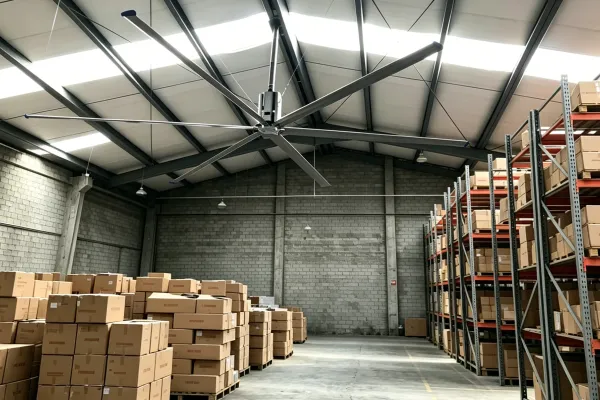
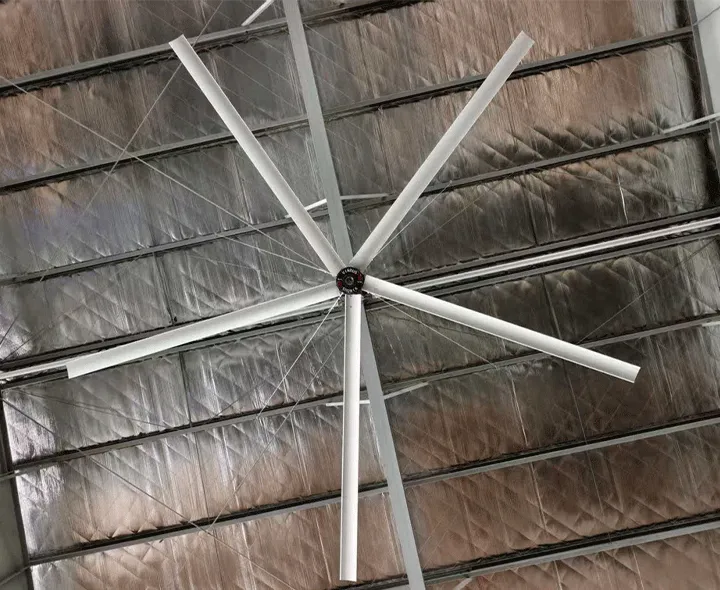
A Vindus HVLS fan positioned to support air circulation in a high-ceiling warehouse.
What thermal stratification means
Warm air is less dense than cool air, so a heated building can develop layers: warmer air near the roof and cooler air around the floor. The difference may be easy to miss when a thermostat is mounted at one level. It becomes more important in buildings with tall clear heights, frequent door openings, large radiant heaters, or areas where people work close to the floor.
Destratification is the controlled mixing of these layers. A ceiling-mounted HVLS fan draws or pushes air through the upper volume and creates a broad downward circulation pattern. The floor-level temperature may become more consistent, but the fan does not create heat, repair insulation, or replace a required heating or ventilation system.
How destratification fans change the air path
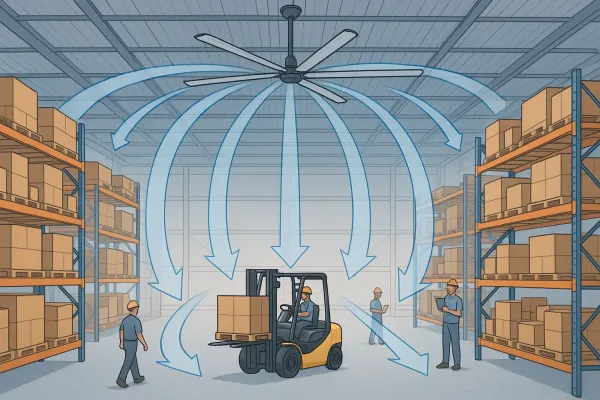
An HVLS fan normally moves a wide column of air downward. After the air reaches the lower zone, it spreads outward and returns upward at the edges of the circulation pattern. In a suitable building, this loop can reduce the difference between roof-level and occupied-level temperatures. The actual pattern changes when racks, mezzanines, cranes, partitions, supply diffusers, exhaust points, or open doors interrupt the flow.
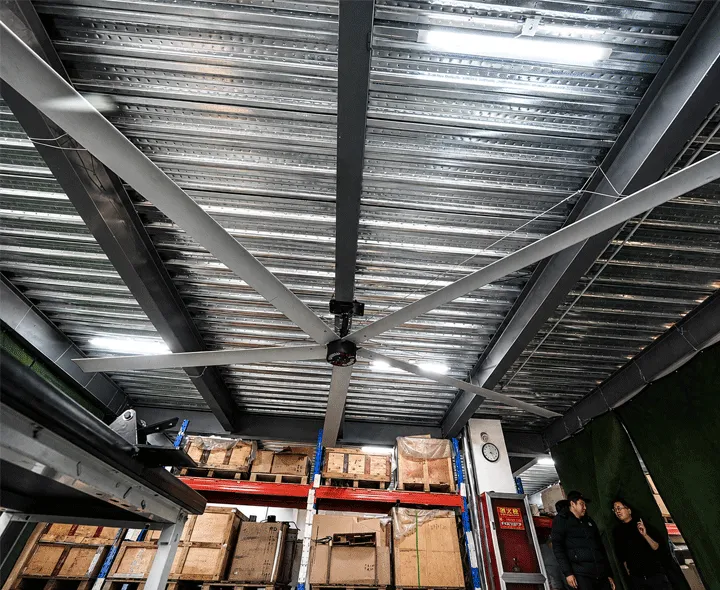
An airflow illustration showing how a large-diameter fan can move air through occupied warehouse aisles.
Use a measured floor plan instead of a generic coverage circle. The Vindus airflow optimization guide covers clearance and obstruction checks that also matter when the heating objective is destratification.
Where destratification fans are useful
Destratification fans are most useful where a high ceiling and a vertical temperature difference are part of the problem. Typical applications include:
Warehouses and logistics buildings: tall storage, loading doors, and long operating hours can produce uneven temperatures between the roof zone and picking aisles.
Factories and workshops: heaters, roof structure, and machinery can create warm upper pockets and cooler workstations.
Sports and agricultural buildings: large open volumes need an airflow plan that considers occupants, animals, equipment, humidity, and door conditions.
These are suitable application types, not customer case claims. A fan should be selected only after the building’s heating, ventilation, occupancy, and safety conditions are reviewed.
When an HVLS fan is not the complete answer
Air destratification does not equal outdoor-air ventilation. If a building needs exhaust for dust, fumes, moisture, charging gases, or process contaminants, the required exhaust and make-up air system must be designed separately. The U.S. Occupational Safety and Health Administration explains the role of workplace ventilation; a recirculating fan should not be presented as a substitute for that requirement.
Similarly, a fan cannot compensate for a damaged roof, missing insulation, an incorrectly sized heater, or uncontrolled air leakage at doors. Those issues may dominate the heating load. Use destratification as one part of a building review and measure the result rather than assuming that more fan speed is always better.
Placement checks before choosing a quantity
1. Measure the vertical temperature profile
Record temperatures near the occupied level and at one or more upper points during representative heating periods. Note the heating schedule, outside conditions, door openings, and the location of the sensors. A single thermostat reading cannot describe stratification across a large building.
2. Map the air interruptions
Mark racks, mezzanines, roof trusses, cranes, lights, sprinklers, ducts, radiant heaters, exhaust inlets, supply diffusers, and future equipment. A fan centered on the floor plan may be poorly placed if its downward path meets a dense obstruction.
3. Keep the blade zone clear
Confirm structural support, blade clearance, safety provisions, service access, and the required installation height. Do not select a diameter until the mounting point and surrounding services have been surveyed.
4. Coordinate with doors and ventilation
Loading doors and exhaust systems can pull air away from the intended circulation loop. Review winter operation separately from summer operation. If the building uses smoke control, hazardous exhaust, or pressure-sensitive processes, involve a qualified engineer before changing fan settings.
P780 Series planning reference
For U.S.-market projects, the Vindus P780 Series is a relevant planning reference for large-space destratification. Published options include 20 ft and 24 ft diameters for approximate blade heights of 20-33 ft. The series uses a direct-drive permanent-magnet synchronous motor, lists input consumption below 1,000 W at maximum speed, and provides a floor-level integrated HMI with a single ceiling-to-floor cable.
Planning item
P780 published reference
Site information still required
Diamètre
20 ft or 24 ft
Clear span, obstructions, and target zones
Blade height
Approximately 20-33 ft
Roof structure, services, and occupied level
Drive
Direct-drive PMSM
Electrical supply and controller location
Maximum input
Less than 1,000 W
Actual speed, hours, and seasonal schedule
Contrôle
Floor-level integrated HMI
Operator access and documented setpoints
These figures are screening inputs, not a guaranteed heating result. Ask for model-specific performance data, mounting requirements, safety components, and test conditions for the proposed installation. The P780 Series product page provides the published product context.
Controls and operating modes
Destratification fans usually need a heating-season mode that differs from a summer comfort mode. A low or moderate speed may be appropriate when the objective is to mix upper and lower air layers without creating an unwanted draft. The correct setting depends on fan height, building geometry, heater location, occupancy, and measured temperatures.
Define who can change the setting, when the mode starts, what happens while doors are open, and how the result will be checked. Use a simple record with date, outside condition, upper temperature, occupied-level temperature, fan speed, heater state, and door condition. That record is more useful than claiming a fixed percentage reduction without project measurements.
Potential benefits and real tradeoffs
Potential benefit
Condition that must be true
Tradeoff to manage
More even floor-level temperatures
The circulation path reaches the occupied zone
Racks, mezzanines, or partitions can break the loop
Better use of warm upper air
The upper air is actually warmer and the heater schedule is suitable
Mixing can create drafts or move heat toward open doors
Adjustable seasonal operation
Controls and setpoints are documented
Incorrect settings can add runtime without a measurable benefit
Reduced reliance on a roof-level temperature reading
Temperatures are measured at more than one height
Sensors and maintenance require a repeatable process
FAQ
Do destratification fans reduce heating costs automatically?
No. They can help redistribute heat that has collected near the ceiling, but the result depends on the building envelope, heater controls, doors, fan settings, and measured temperature profile. Verify the change with comparable operating records.
Can an HVLS fan replace a heating system?
No. An HVLS fan moves and mixes air; it does not generate heat. It can be coordinated with a heating system when upper and lower temperatures are uneven.
Should destratification fans run at maximum speed?
Not by default. Start with a documented setting, check floor-level comfort and upper temperatures, and adjust for occupancy, doors, heaters, and seasonal conditions. Maximum speed is not a substitute for a measured operating plan.
How many destratification fans does a warehouse need?
Quantity depends on clear height, floor shape, obstructions, fan diameter, heater arrangement, door locations, and the target air path. A dimensioned layout and temperature measurements are the correct starting point.
Plan the measurement before the purchase
Prepare a dimensioned drawing, clear blade height, roof and mounting photographs, rack and machinery layout, heater and ventilation locations, door schedule, temperature readings, electrical supply, and expected operating hours. Use the Vindus contact page to request a project-specific P780 Series review.
Reviewed August 17, 2026 | Michael Danielsson, CEO, Vindus Fans
Destratification fans redistribute warm air that collects near a high ceiling and return some of that heat toward the occupied level. In large warehouses, factories, sports venues, and agricultural buildings, the goal is a more even temperature profile, not a promise of a fixed energy saving. Building height, heating system, insulation, doors, and control settings determine the result.
A Vindus HVLS fan positioned to support air circulation in a high-ceiling warehouse.
What thermal stratification means
Warm air is less dense than cool air, so a heated building can develop layers: warmer air near the roof and cooler air around the floor. The difference may be easy to miss when a thermostat is mounted at one level. It becomes more important in buildings with tall clear heights, frequent door openings, large radiant heaters, or areas where people work close to the floor.
Destratification is the controlled mixing of these layers. A ceiling-mounted HVLS fan draws or pushes air through the upper volume and creates a broad downward circulation pattern. The floor-level temperature may become more consistent, but the fan does not create heat, repair insulation, or replace a required heating or ventilation system.
How destratification fans change the air path
An HVLS fan normally moves a wide column of air downward. After the air reaches the lower zone, it spreads outward and returns upward at the edges of the circulation pattern. In a suitable building, this loop can reduce the difference between roof-level and occupied-level temperatures. The actual pattern changes when racks, mezzanines, cranes, partitions, supply diffusers, exhaust points, or open doors interrupt the flow.
An airflow illustration showing how a large-diameter fan can move air through occupied warehouse aisles.
Use a measured floor plan instead of a generic coverage circle. The Vindus airflow optimization guide covers clearance and obstruction checks that also matter when the heating objective is destratification.
Where destratification fans are useful
Destratification fans are most useful where a high ceiling and a vertical temperature difference are part of the problem. Typical applications include:
Warehouses and logistics buildings: tall storage, loading doors, and long operating hours can produce uneven temperatures between the roof zone and picking aisles.
Factories and workshops: heaters, roof structure, and machinery can create warm upper pockets and cooler workstations.
Sports and agricultural buildings: large open volumes need an airflow plan that considers occupants, animals, equipment, humidity, and door conditions.
These are suitable application types, not customer case claims. A fan should be selected only after the building’s heating, ventilation, occupancy, and safety conditions are reviewed.
When an HVLS fan is not the complete answer
Air destratification does not equal outdoor-air ventilation. If a building needs exhaust for dust, fumes, moisture, charging gases, or process contaminants, the required exhaust and make-up air system must be designed separately. The U.S. Occupational Safety and Health Administration explains the role of workplace ventilation; a recirculating fan should not be presented as a substitute for that requirement.
Similarly, a fan cannot compensate for a damaged roof, missing insulation, an incorrectly sized heater, or uncontrolled air leakage at doors. Those issues may dominate the heating load. Use destratification as one part of a building review and measure the result rather than assuming that more fan speed is always better.
Placement checks before choosing a quantity
1. Measure the vertical temperature profile
Record temperatures near the occupied level and at one or more upper points during representative heating periods. Note the heating schedule, outside conditions, door openings, and the location of the sensors. A single thermostat reading cannot describe stratification across a large building.
2. Map the air interruptions
Mark racks, mezzanines, roof trusses, cranes, lights, sprinklers, ducts, radiant heaters, exhaust inlets, supply diffusers, and future equipment. A fan centered on the floor plan may be poorly placed if its downward path meets a dense obstruction.
3. Keep the blade zone clear
Confirm structural support, blade clearance, safety provisions, service access, and the required installation height. Do not select a diameter until the mounting point and surrounding services have been surveyed.
4. Coordinate with doors and ventilation
Loading doors and exhaust systems can pull air away from the intended circulation loop. Review winter operation separately from summer operation. If the building uses smoke control, hazardous exhaust, or pressure-sensitive processes, involve a qualified engineer before changing fan settings.
P780 Series planning reference
For U.S.-market projects, the Vindus P780 Series is a relevant planning reference for large-space destratification. Published options include 20 ft and 24 ft diameters for approximate blade heights of 20-33 ft. The series uses a direct-drive permanent-magnet synchronous motor, lists input consumption below 1,000 W at maximum speed, and provides a floor-level integrated HMI with a single ceiling-to-floor cable.
Planning item
P780 published reference
Site information still required
Diamètre
20 ft or 24 ft
Clear span, obstructions, and target zones
Blade height
Approximately 20-33 ft
Roof structure, services, and occupied level
Drive
Direct-drive PMSM
Electrical supply and controller location
Maximum input
Less than 1,000 W
Actual speed, hours, and seasonal schedule
Contrôle
Floor-level integrated HMI
Operator access and documented setpoints
These figures are screening inputs, not a guaranteed heating result. Ask for model-specific performance data, mounting requirements, safety components, and test conditions for the proposed installation. The P780 Series product page provides the published product context.
Controls and operating modes
Destratification fans usually need a heating-season mode that differs from a summer comfort mode. A low or moderate speed may be appropriate when the objective is to mix upper and lower air layers without creating an unwanted draft. The correct setting depends on fan height, building geometry, heater location, occupancy, and measured temperatures.
Define who can change the setting, when the mode starts, what happens while doors are open, and how the result will be checked. Use a simple record with date, outside condition, upper temperature, occupied-level temperature, fan speed, heater state, and door condition. That record is more useful than claiming a fixed percentage reduction without project measurements.
Potential benefits and real tradeoffs
Potential benefit
Condition that must be true
Tradeoff to manage
More even floor-level temperatures
The circulation path reaches the occupied zone
Racks, mezzanines, or partitions can break the loop
Better use of warm upper air
The upper air is actually warmer and the heater schedule is suitable
Mixing can create drafts or move heat toward open doors
Adjustable seasonal operation
Controls and setpoints are documented
Incorrect settings can add runtime without a measurable benefit
Reduced reliance on a roof-level temperature reading
Temperatures are measured at more than one height
Sensors and maintenance require a repeatable process
FAQ
Do destratification fans reduce heating costs automatically?
No. They can help redistribute heat that has collected near the ceiling, but the result depends on the building envelope, heater controls, doors, fan settings, and measured temperature profile. Verify the change with comparable operating records.
Can an HVLS fan replace a heating system?
No. An HVLS fan moves and mixes air; it does not generate heat. It can be coordinated with a heating system when upper and lower temperatures are uneven.
Should destratification fans run at maximum speed?
Not by default. Start with a documented setting, check floor-level comfort and upper temperatures, and adjust for occupancy, doors, heaters, and seasonal conditions. Maximum speed is not a substitute for a measured operating plan.
How many destratification fans does a warehouse need?
Quantity depends on clear height, floor shape, obstructions, fan diameter, heater arrangement, door locations, and the target air path. A dimensioned layout and temperature measurements are the correct starting point.
Plan the measurement before the purchase
Prepare a dimensioned drawing, clear blade height, roof and mounting photographs, rack and machinery layout, heater and ventilation locations, door schedule, temperature readings, electrical supply, and expected operating hours. Use the Vindus contact page to request a project-specific P780 Series review.
Salut, je suis Michael Danielsson, PDG de Vindus Fans, avec plus de 15 ans d'expérience dans le secteur de l'ingénierie et de la conception. Je suis ici pour partager ce que j'ai appris. Si vous avez des questions, n'hésitez pas à me contacter à tout moment. Grandissons ensemble !
Remplissez simplement votre nom, votre adresse e-mail et une brève description de votre demande dans ce formulaire. Nous vous contacterons dans les 24 heures.