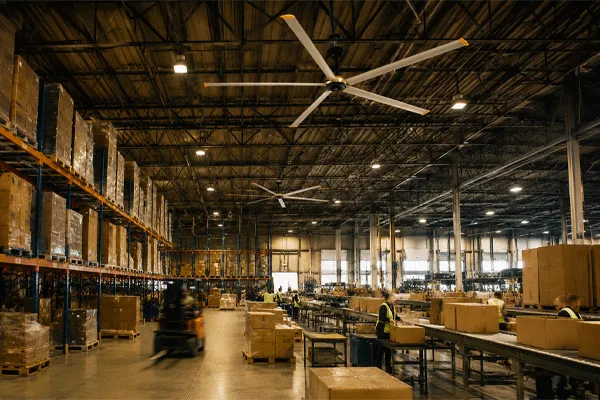
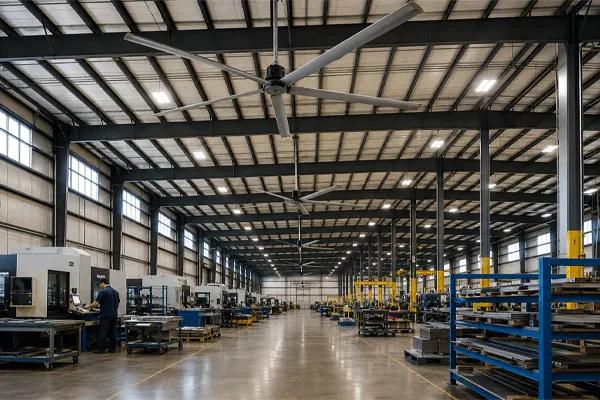
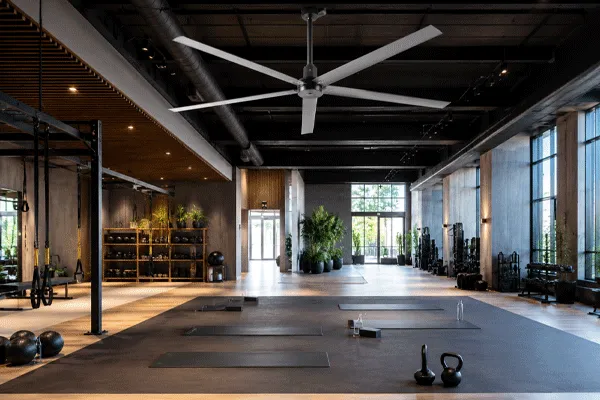
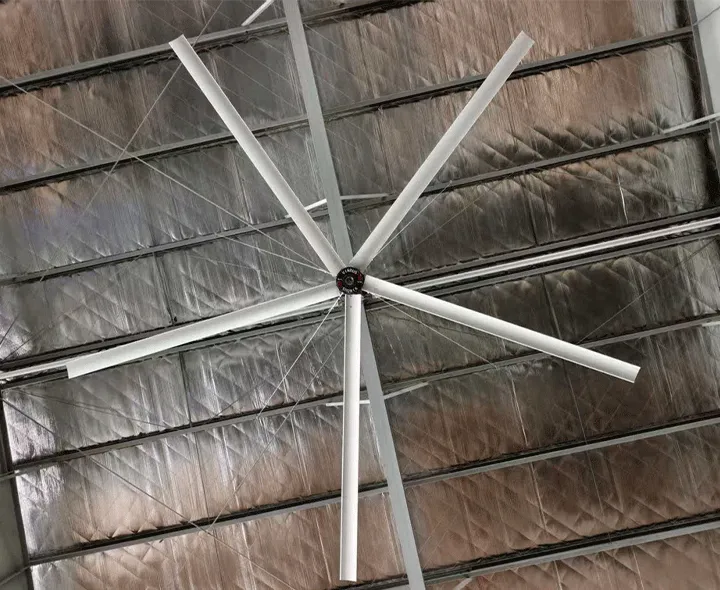
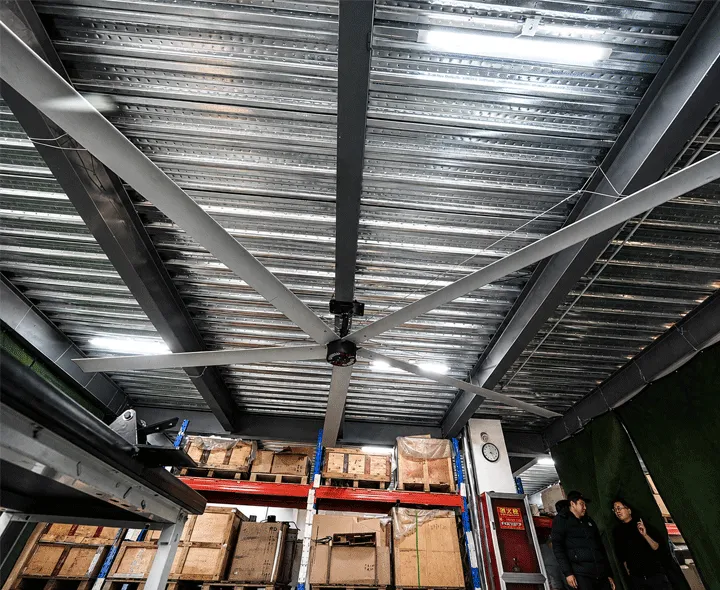
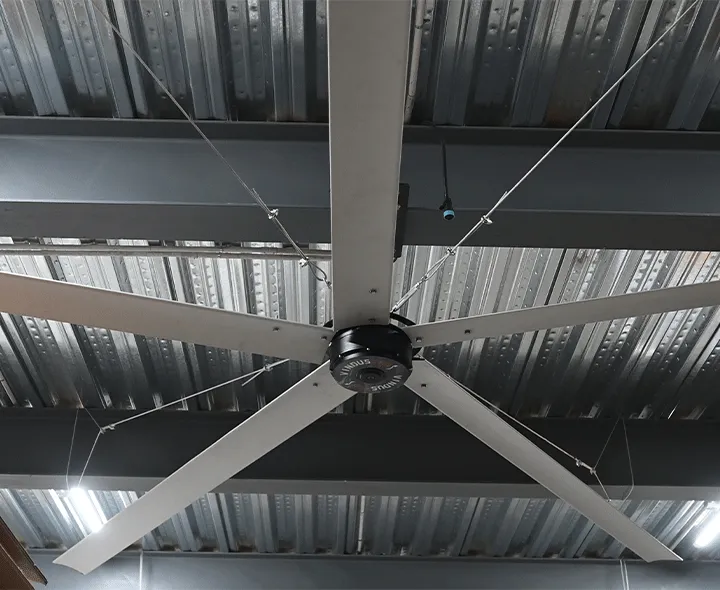
A busy gym can become hot, stuffy, and uncomfortable fast. High ceilings trap warm air while crowded workout zones add heat and moisture. Adding many small fans may create noise without fixing the whole space. A properly selected HVLS fan can provide broad, steady cooling airflow.
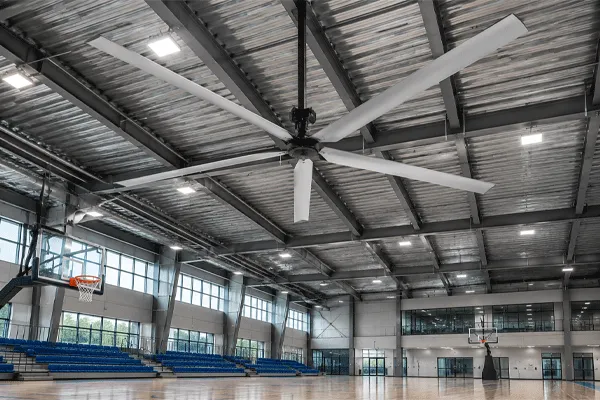
Big industrial ceiling fans cool gyms by moving large volumes of air slowly across wide floor areas. An Ventilateur de plafond HVLS increases air speed around occupants, improves air circulation, reduces stagnant zones, and can complement HVAC systems. The best fan depends on gym size, ceiling height, diameter, occupancy, obstacles, noise goals, and required airflow—not fan size alone.
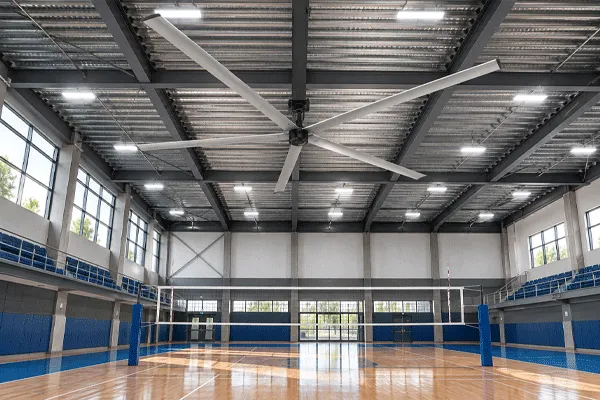
Big Industrial Ceiling Fans for Cooling Gyms: HVLS Fan Selection Guide
For gym owners, sports center developers, HVAC contractors, and commercial building operators, the real question is not simply, “How big should the fan be?” You need to know where people exercise, how high the ceiling is, how conditioned air enters the room, and where heat builds up.
As a Sino-US joint venture manufacturer and airflow solution provider, we specialize in HVLS fans, industrial ceiling fans, commercial ceiling fans, large industrial fans, and intelligent airflow control systems. We design solutions for sports centers, warehouses, factories, logistics facilities, shopping malls, agriculture, and other large spaces where comfort and energy use matter.
Why Are Big Industrial Ceiling Fans Useful in a Gym?
A large gym creates a demanding cooling problem. People generate body heat while exercising. Cardio equipment, lighting, windows, and outdoor conditions add more. If the ceiling is high, warm air can also collect well above the occupied zone.
An HVLS fan addresses this by creating wide, gentle air movement. Instead of focusing a strong jet on one treadmill or weight bench, it distributes air over a much larger area.
ASHRAE guidance explains that elevated air speed can improve thermal comfort in warm conditions because moving air increases heat loss from the skin. This is one reason a large ceiling fan can make occupants feel cooler even if the room’s actual dry-bulb temperature changes little.
For large sports buildings, that distinction is important:
A fan does not create refrigerated air. It helps people exchange heat with the surrounding air more effectively.
This makes an hvls ceiling fan especially useful where broad occupied areas need consistent circulation rather than intense spot cooling.
What Is an HVLS Fan and How Does It Cool a Large Space?
HVLS means high volume low speed.
An HVLS system uses a large diameter and relatively low rpm to move substantial amounts of air through a wide area. Air moves downward beneath the fan, reaches the occupied zone, and spreads across the floor.
AMCA defines a large-diameter ceiling fan as a fan with a blade-tip diameter of at least 84.5 inches in its current testing standard. U.S. regulatory treatment generally uses a diameter greater than 7 feet for large-diameter ceiling fans. HVLS products fall within this broader large-fan category but have specific performance characteristics.
The large sweep area allows one fan to influence a much wider zone than many conventional small electric fans.
That is why HVLS systems are also common in:
- sports centers;
- warehouse buildings;
- distribution centers;
- manufacturing facilities;
- airport or maintenance hangar spaces;
- automotive shops;
- commercial halls;
- large agricultural buildings such as a barn.
The basic idea remains the same: move more air through a larger space without depending on a narrow high-speed air stream.
How Does a Ceiling Fan Make Gym Users Feel Cooler?
Think about stepping outside on a warm day.
If there is no wind, you feel hotter. When a breeze begins, the temperature may stay exactly the same, but you often feel more comfortable.
A gym ceiling fan works through the same basic principle.
Moving air increases convective and evaporative heat transfer from the body. For someone walking slowly, lifting weights, or using a treadmill, that extra airflow can improve comfort.
ASHRAE’s thermal-comfort guidance specifically allows elevated air speeds to extend the range of conditions that occupants may find comfortable. The exact benefit depends on temperature, radiant conditions, clothing, activity level, humidity, and air velocity.
This matters because exercise intensity varies greatly.
A yoga area may need gentle airflow.
A free-weight area may need more.
A high-energy training zone may require another airflow strategy altogether.
A good HVLS fan system therefore should not blast every person with the same strong breeze. It should create broad circulation and give the operator useful control options.
HVLS Fan vs. Traditional Industrial Fan: Which Is Better for a Gym?
Neither technology wins every application.
A conventional industrial fan is often useful when you need concentrated air in a limited area. Wall units, pedestal units, and axial fans can direct air toward a specific zone.
An HVLS system is better suited to broad coverage.
| Fonctionnalité |
Ventilateur HVLS |
High-Speed Industrial Fan |
| Main airflow pattern |
Broad and distributed |
Focused |
| Typical operating approach |
High-volume, low-speed |
Higher-speed local airflow |
| Best use |
Whole-room circulation |
Local cooling |
| Noise potential |
Often lower at normal operating speeds |
May rise with speed |
| Couverture |
Large floor zones |
Smaller targeted zones |
| Installation |
Overhead |
Wall, floor, column, ceiling |
| Visual clutter |
Fewer units may be needed |
More units may be required |
For a large open workout hall, a large industrial ceiling fan may handle general circulation while smaller units support special areas.
This is similar to what we see in factory projects. Our hvls fans for manufacturing facilities use broad circulation for the whole building while local fans handle individual workstations when required.
The same logic can work inside a sports center.
What Fan Diameter Is Best for a Gym?
There is no universal answer.
HVLS fans are available across a broad size range. Depending on the product series and project requirements, buyers may consider designs ranging from relatively compact commercial models to very large fans of 8 to 24 feet.
You may see searches such as:
- 8 ft HVLS;
- 14 feet HVLS fan;
- 20 foot HVLS fan;
- large gym fan;
- foot HVLS fan;
- HVLS large ceiling fan.
But diameter alone should never determine selection.
Consider two sports centers with the same floor area.
The first has a 30-foot clear roof with very few obstructions.
The second has a lower ceiling, basketball hoops, scoreboards, lighting rigs, ductwork, speakers, and structural beams.
A 20 feet fan may work well in one and be unsuitable in the other.
Important factors include:
| Selection Factor |
Why It Matters |
| Diamètre du ventilateur |
Affects sweep area and coverage |
| Hauteur du plafond |
Affects mounting and air distribution |
| Court/equipment layout |
Determines usable airflow zones |
| Ductwork |
Can obstruct blades and airflow |
| Lighting |
Requires safe clearance |
| Sprinklers |
Must be considered during layout |
| Seating |
Changes occupancy and comfort needs |
| HVAC supply locations |
Influences circulation patterns |
A properly selected ceiling fan starts with the building drawing—not a diameter chart.
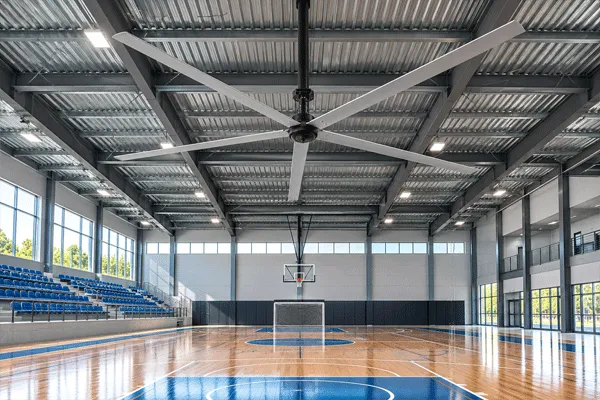
Big Industrial Ceiling Fans for Cooling Gyms: HVLS Fan Selection Guide
How Does Ceiling Height Affect an HVLS Ceiling Fan?
Ceiling height is one of the first measurements our engineers request.
A high ceiling gives a large fan room to develop broad airflow, but fan location and mounting height still matter. Installing the unit too high, too low, or near major obstructions can reduce useful air distribution.
The relationship is not simply:
Higher ceiling = larger fan.
A 24-foot ceiling above an open training hall may support one layout. The same height over tiered seating, climbing equipment, or structural trusses may require something different.
When evaluating a project, we look at:
- finished ceiling height;
- lowest structural element;
- lights and speakers;
- HVAC ductwork;
- basketball hoops;
- nets;
- scoreboards;
- sprinkler systems;
- movable sports equipment;
- maintenance access.
For this reason, HVLS industrial ceiling selection must combine fan diameter, mounting location, clearance, and expected occupied-zone airflow.
The goal is not to fill the roof with the biggest possible fan.
The goal is to deliver useful air where people actually exercise.
Should a Gym Use 5 Blades or Another Blade Configuration?
Buyers often focus on blade count.
They may search for 5 blades, six-blade designs, or other configurations and assume that more blades always mean more airflow.
That is too simple.
The blade profile, pitch, diameter, hub design, motor, rotational speed, and control system work together. A fan with fewer highly engineered airfoils may perform very differently from a fan with more blades.
You should therefore compare actual performance data rather than appearance.
A useful B2B evaluation should ask:
- What tested airflow performance is available?
- What is the fan’s efficiency?
- At what rpm was the rating measured?
- How does performance change with speed?
- How is each blade attached?
- What safety retention system is provided?
- Is the performance independently verified?
AMCA maintains certified performance programs for large-diameter ceiling fans, and its current HVLS guidance emphasizes standardized testing and verified performance data.
This matters more than simply choosing an attractive big size fan.
PMSM Motor vs. Traditional Drive: What Should Gym Owners Consider?
Motor design affects efficiency, noise, maintenance, weight, and control.
A PMSM motor, or permanent magnet synchronous motor, is commonly used in modern direct-drive fan designs because it can provide efficient variable-speed operation without some of the mechanical components found in traditional geared drive systems.
For gym applications, buyers often care about:
- smooth speed control;
- low operating sound;
- reduced maintenance;
- compact drive design;
- energy efficiency;
- reliable low-speed operation.
A PMSM design can be a strong option, but you should still evaluate the entire fan rather than selecting it from the motor label alone.
Precision engineering across the motor, controller, blades, hub, mounting system, and software determines the final performance.
As manufacturers, we also consider how the fan will operate with other equipment. An intelligent controller may allow speed changes by schedule, temperature, or building zone instead of running every fan at maximum output.
That is where energy saving becomes a system-level discussion rather than a motor-marketing claim.
Can Industrial Ceiling Fans Reduce Gym HVAC Costs?
Potentially, yes—but there is no single savings percentage that applies to every building.
A large ceiling fan can support an HVAC system in two main ways.
First, during warm conditions, increased air speed may allow occupants to remain comfortable at conditions that would otherwise feel too warm. ASHRAE recognizes elevated air speed as an important thermal-comfort variable.
Second, in cooler seasons, slow fan operation can mix warm air that collects near a high ceiling with cooler air below. This process is called destratification.
AMCA notes that large-diameter ceiling fans are used for cooling effects, air mixing, and destratification in commercial, industrial, agricultural, and other buildings.
A simple building-energy relationship is:
Fan Energy Use = Input Power × Operating Hours
But total savings require a wider calculation:
Total Building Impact = Fan Energy + HVAC Energy Change + Operating Schedule + Climate + Occupancy
That is why we do not promise a fixed HVAC saving without project data.
Un système efficace ventilateurs de plafond industriels layout should complement the HVAC design instead of fighting against it.
How Can HVLS Fans Improve Air Circulation in a Large Gym?
A large sports building can develop stagnant air even when mechanical ventilation is installed.
Air may move well around supply diffusers but poorly in the center of a court. Equipment zones may block circulation. Upper-level warm air may remain separated from lower zones.
An HVLS fan creates a much larger circulation pattern.
The fan moves air downward. When it approaches the occupied zone, that air spreads outward. The process supports air circulation across wide areas and encourages greater mixing within the room.
This is particularly useful in:
- basketball courts;
- indoor training halls;
- badminton centers;
- tennis buildings;
- fitness clubs;
- indoor sports arenas;
- large school gyms;
- commercial recreation centers.
For buildings that need more than simple circulation, a complete ventilateurs commerciaux strategy can combine HVLS equipment with exhaust systems, air conditioning, sensors, and other ventilation equipment.
Remember the difference:
Circulation moves indoor air. Ventilation replaces indoor air. HVAC conditions indoor air.
A good gym may need all three.
Big Industrial Ceiling Fans for Cooling Gyms: HVLS Fan Selection Guide
What Is the Difference Between a Commercial Ceiling Fan and Industrial HVLS Fan?
A commercial ceiling fan may be designed for restaurants, retail stores, studios, offices, hospitality spaces, or moderate-size fitness facilities.
An industrial HVLS system usually targets much larger floor areas, higher mounting positions, and more demanding duty cycles.
That does not mean every gym needs industrial equipment.
A boutique studio with a moderate ceiling may need a different product from a 5,000 m² sports complex.
| Application |
Typical Direction |
| Small fitness studio |
Commercial ceiling system |
| Boutique gym |
Commercial/HVLS depending on layout |
| Large training hall |
Système de levage à grande vitesse |
| Indoor basketball center |
Grand HVLS |
| Multi-court sports hall |
Multiple HVLS zones |
| Warehouse-style gym |
Industrial HVLS |
| Arena auxiliary space |
Application-specific |
A commercial ceiling fan is therefore not automatically better or worse than a larger industrial unit.
It serves a different range of applications.
The right choice depends on air circulation needs, room dimensions, ceiling structure, noise limits, and occupancy.
How Important Is Noise in a Gym Ceiling Fan?
Noise can easily be overlooked during fan purchasing.
In a factory, moderate equipment noise may blend into the background. In a yoga studio, coaching space, premium fitness club, or indoor sports venue, the same sound can become distracting.
A buyer may encounter generic internet claims such as 70 to 85 decibels, but such numbers should not be assumed for every product or installation.
Ask for actual fan-specific acoustic information when noise matters.
Sources of fan sound may include:
- motor operation;
- gearbox operation;
- aerodynamic blade noise;
- structural vibration;
- electrical switching;
- poor mounting;
- excessive operating speed.
A high-quality HVLS fan should be selected around the required performance at practical operating speeds.
This is another reason not to compare products only by maximum airflow.
If the fan only reaches the required performance at an undesirable noise level, it may not be the correct solution for the gym.
How Should HVLS Fans Work With Ventilation and HVAC?
The fan should be part of the building system.
Suppose an air-conditioned fitness center already has supply diffusers around the perimeter. If large circulation fans are positioned correctly, they can help distribute conditioned air more evenly.
But poor positioning can interfere with other air patterns.
That is why cooling and ventilation should be reviewed together.
Our normal engineering questions include:
- Where are HVAC supply diffusers?
- Where are return-air grilles?
- Is outdoor-air ventilation mechanical or natural?
- Where do people gather?
- Which zones run hottest?
- Does the building have large exterior doors?
- What hours is the facility occupied?
- Are different zones conditioned separately?
The answers help determine whether the fan should run continuously or change speed throughout the day.
A smart system may use temperature sensors and schedules so a ceiling fan does not operate harder than necessary.
Why Are HVLS Fans Different From Warehouse Fans?
The equipment may be similar, but the design priorities can be different.
In a warehouse, the main concerns may include employee comfort, rack obstructions, loading doors, stored goods, and aisle airflow.
In a gym, human comfort becomes even more important because occupants are exercising.
A ceiling fan for warehouse applications may prioritize broad worker-area coverage, while a sports facility may require more careful control over drafts near seating, courts, or low-activity zones.
Our warehouse fans use the same core airflow-engineering principles but apply them to logistics layouts.
This distinction is important for buyers comparing hunter fans, hunter industrial products, general ventilateurs d'entrepôt, a Titan HVLS ceiling fan, or other fan manufacturers.
Brand searches can help you build a shortlist.
Engineering data should make the final decision.
What Should You Look for in a Large Industrial HVLS Ceiling Fan?
Price matters, but price alone is a poor specification.
Searching for a cheap industrial fan may lead to a low initial purchase price but does not tell you anything about airflow performance, motor efficiency, safety, control capability, durability, or support.
For a serious commercial project, compare:
- tested airflow;
- fan diameter;
- motor efficiency;
- drive type;
- safety retention systems;
- blade design;
- controller functions;
- installation requirements;
- maintenance;
- warranty;
- replacement-part availability;
- technical support.
AMCA’s current program for HVLS products relies on standardized test methods and verification so performance ratings can be evaluated on a consistent basis.
This is particularly useful for global B2B buyers.
A large fan may run thousands of hours over its service life. Purchase price represents only one part of the total cost.
The better question is:
What airflow performance, reliability, control, efficiency, and support am I buying for the project?
What Does the Installation Process Involve?
The installation process begins well before a technician lifts the fan toward the ceiling.
Large fans require structural and clearance review.
A professional project should examine:
- mounting structure;
- fan weight;
- ceiling geometry;
- blade clearance;
- sprinklers;
- lighting;
- scoreboards;
- nets;
- basketball hoops;
- HVAC ducts;
- electrical supply;
- emergency equipment;
- access for future maintenance.
The exact requirements depend on the fan model and local building and fire rules.
This means easy installation should never mean skipping engineering review.
When we prepare a project, we use building dimensions and layout information to recommend the fan position before installation begins. This reduces interference with other systems and makes the final airflow more predictable.
For complex facilities, intelligent HVLS industrial systems can also coordinate several fan zones from one control platform.
A Practical Gym Cooling Example
Consider a large warehouse-style fitness center.
It has a high metal roof, several exercise zones, cardio equipment along one wall, free weights in the center, and an HVAC system that struggles during busy summer afternoons.
The operator is considering several high-speed fans.
Before adding equipment, we would first map the problem.
Step 1: Measure the space
Record floor dimensions, ceiling height, structural beams, HVAC ducts, and exercise zones.
Step 2: Identify heat zones
Look at sunny walls, cardio areas, crowded training zones, and upper-level heat accumulation.
Step 3: Review existing ventilation
Confirm outdoor-air supply, exhaust, and HVAC return locations.
Step 4: Determine useful fan diameter
Compare one very large ceiling fan with several medium-size HVLS units.
Step 5: Check obstacles
Sports equipment, lighting, speakers, and ductwork may alter the design.
Step 6: Create operating zones
A low-activity stretching area should not necessarily receive the same air velocity as a crowded functional-training zone.
Step 7: Add intelligent controls
Schedule speeds according to occupancy and thermal conditions.
This approach produces a solution rather than simply filling the roof with big industrial fans.
That is how we approach both sports facilities and commercial ceiling applications: understand the people, the building, and the required airflow first.
Frequently Asked Questions About Big Industrial Ceiling Fans for Gyms
What size HVLS fan is best for a gym?
There is no universal size. Fan diameter depends on floor dimensions, ceiling height, obstructions, activity zones, desired air velocity, and the number of fans. A building drawing is more useful than a generic size chart.
Can an HVLS ceiling fan replace air conditioning?
No. An HVLS ceiling fan for cooling mainly increases air velocity and circulation. It can improve perceived comfort and complement air conditioning, but it does not provide refrigeration like an HVAC system.
Is a 20-foot HVLS fan too large for a gym?
Not necessarily. A 20 foot HVLS fan may work in a large open sports facility with sufficient mounting height and clearance. In a smaller or more obstructed room, several smaller units may create better coverage.
Are HVLS fans energy efficient?
HVLS technology can move broad volumes of air at relatively low rotational speeds. However, high efficiency depends on the actual motor, controller, fan design, operating speed, and system layout. Compare verified performance data rather than diameter alone.
How many ceiling fans does a gym need?
The number depends on the building shape, fan diameter, mounting height, required coverage, obstructions, and airflow targets. One fan may suit one open room, while a multi-court building may need several independently controlled zones.
Can HVLS fans run with air conditioning?
Yes. Properly designed HVLS systems can operate alongside HVAC equipment. The key is to position and control the fans so their airflow complements supply and return patterns rather than disturbing them.
Choose a Gym Fan Based on Airflow, Not Just Big Size
A big industrial ceiling fan can dramatically change how a large gym feels, but size alone does not guarantee comfort.
A successful project connects five things:
building dimensions + ceiling height + fan performance + HVAC design + occupant needs
That combination matters more than a brand name, blade count, or maximum diameter.
As a Sino-US joint venture manufacturer and solution provider, we develop HVLS fans, industrial and commercial ceiling fans, large industrial airflow equipment, and intelligent control systems for sports buildings, warehouses, manufacturing plants, logistics centers, agricultural facilities, malls, and other large spaces.
For a gym project, we recommend starting with a floor plan.
Show us the room dimensions, ceiling height, HVAC arrangement, exercise zones, obstacles, and the problem you want to solve. From there, we can determine fan diameter, quantity, position, speed strategy, and control requirements.
That approach gives you something much more useful than simply buying the biggest fan available.
Key Things to Remember
- HVLS fans use high-volume, low-speed airflow to serve large occupied areas.
- A gym ceiling fan improves perceived cooling mainly through increased air speed.
- A fan supports HVAC; it does not replace refrigeration or required outdoor-air ventilation.
- Ceiling height and fan diameter must be considered together.
- More blades do not automatically mean more airflow.
- PMSM systems can offer efficient variable-speed operation, but total fan design matters more than motor type alone.
- Large fans can help reduce stagnant zones and improve circulation.
- Different workout zones may need different air speeds.
- Noise matters in premium gyms, studios, coaching spaces, and sports centers.
- Installation must consider structure, sprinklers, lighting, HVAC ducts, and sports equipment.
- Winter low-speed operation can support destratification in suitable high-ceiling spaces.
- Compare tested performance, efficiency, safety, controls, service, and total operating cost—not purchase price alone.
- The best large industrial HVLS ceiling fan is the one designed around your actual building and comfort target.