Michael Danielsson | CEO, Vindus Fans | Published August 7, 2026
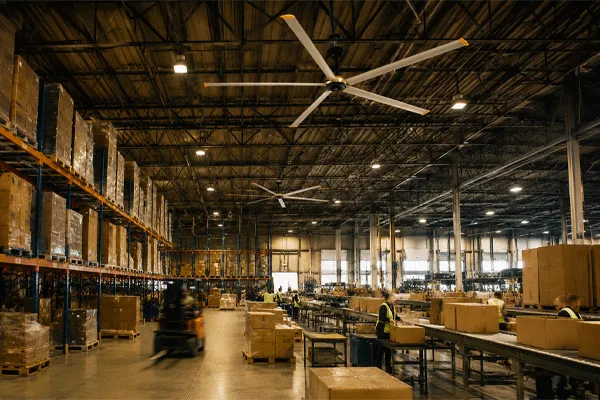
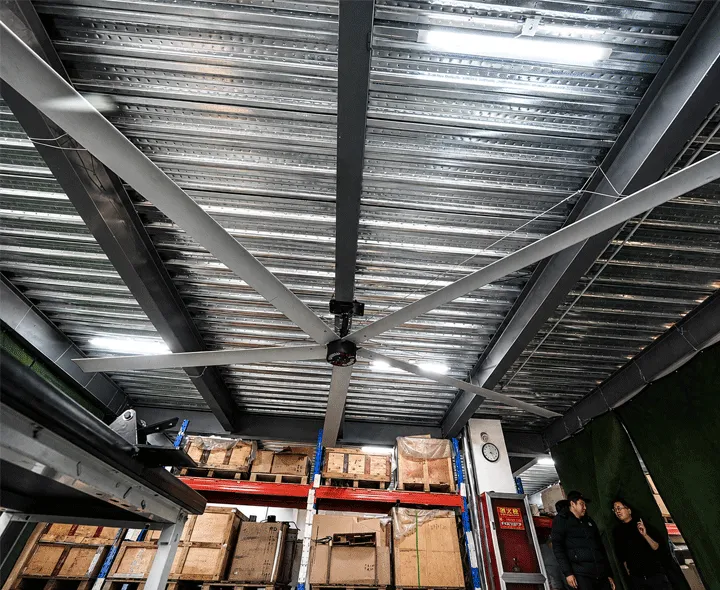
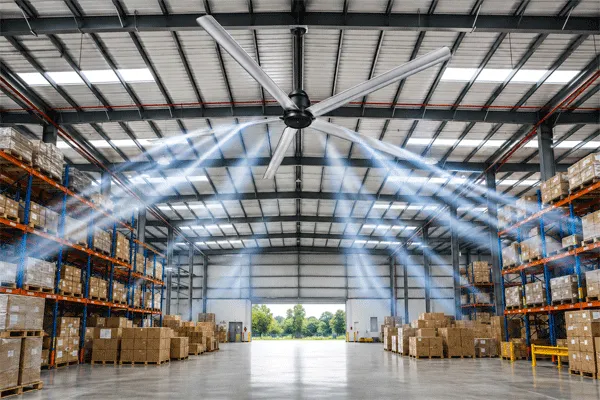
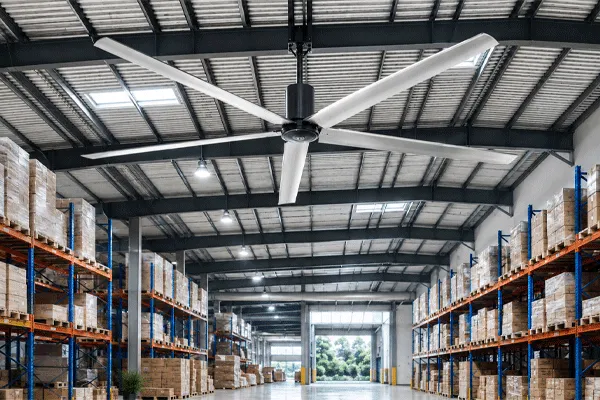
A single large-diameter fan moving slow, high-volume air can cover 15,000–20,000 sq ft of warehouse floor, replacing dozens of pedestal or box fans while pulling stratified heat down from the ceiling instead of just stirring hot air in place.
HVLS Fans for Warehouse Cooling and Ventilation
The Warehouse Cooling Problem HVLS Fans Actually Solve
Most warehouses don’t have a cooling problem so much as a distribution problem. Heat rises and pools near the roof deck — sometimes 15–20°F warmer than floor level in a tall building — while workers, forklifts, and inventory sit in the cooler air below without benefiting from it. Traditional pedestal or floor fans move air laterally in a small radius; they don’t touch that stratified heat layer at all.
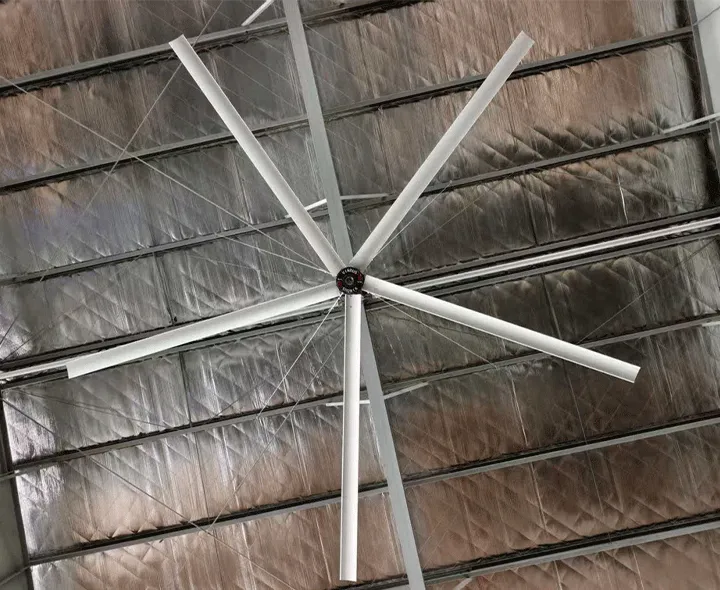
Ventilateurs HVLS work differently because of scale and speed. A large-diameter fan turning slowly moves a high volume of air straight down in a column, then out across the floor in a wide, low-velocity sheet. That column reaches up into the stratified layer near the ceiling and pulls it back down, which is the mechanism — destratification — behind most of the temperature evening-out that gets attributed to “HVLS cooling.”
How Destratification Changes Through the Seasons
Destratification isn’t a single mode. Direction and speed both change depending on the goal:
- Summer / cooling mode— blades run in the standard direction, pushing air down and out at higher speed to create the direct wind-chill effect that makes occupants feel cooler even though the ambient air temperature hasn’t dropped.
- Winter / heat-recovery mode— blades reverse and run at low speed, drawing the warm air pooled near the ceiling back down without generating a noticeable draft. This is where a entrepôt running overhead heating actually gets a return on that heat instead of losing it upward.
- Transitional mode— many facilities run fans at reduced speed year-round in forward direction simply to keep air moving and prevent localized hot or cold pockets from settling near loading docks, mezzanines, or areas with limited natural airflow.
The mistake worth flagging here: buying and sizing a fan purely for summer cooling performance, then discovering in the first winter that low-speed reverse mode doesn’t cover the space as evenly, because the effective coverage radius differs between modes. Direction and speed control need to be part of the sizing conversation, not an afterthought.
What This Means for HVAC Load, Not Just Comfort
HVLS fans don’t replace HVAC systems, and any claim that they do should be treated with skepticism. What they can do is reduce how hard an HVAC system has to work to hit the same comfort target, because moving air makes occupants feel several degrees cooler than the thermostat reading — the same principle behind a ceiling fan raising the recommended AC setpoint in a house. In a warehouse with high-bay HVAC or evaporative cooling already installed, HVLS fans distribute that conditioned air more evenly instead of letting it settle near the units and leave the far end of the building undercooled.
Compared to running that same square footage on floor-standing or wall-mounted circulation fans alone, a smaller number of large-diameter units means fewer motors drawing power, fewer units to relocate as racking or layout changes, and — because the airflow is a continuous column rather than dozens of overlapping narrow streams — fewer dead zones where two fan streams cancel each other out at floor level.
P780 Series: Specs Relevant to Warehouse-Scale Installations
For teams sizing this specifically around warehouse floor plans, the parameters that matter are:
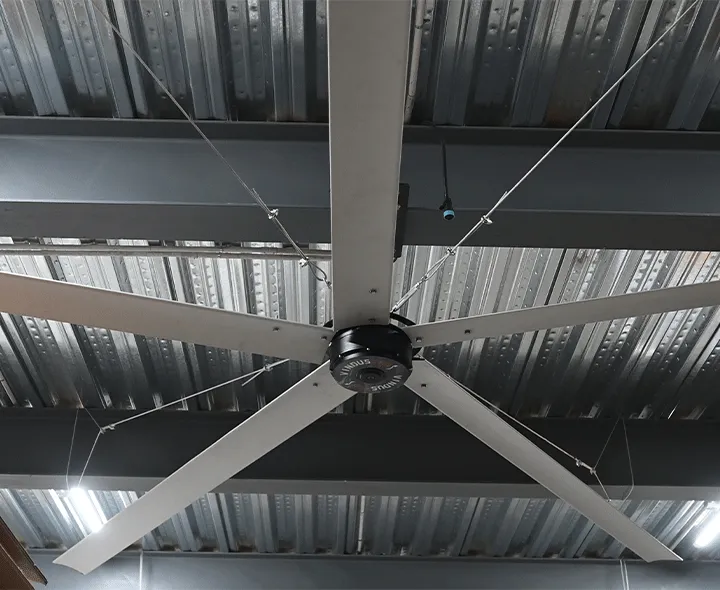
- Diameter:20 ft and 24 ft options
- Ceiling height range:20–33 ft — matches most clear-span warehouse and distribution-center construction
- Motor:PMSM (permanent magnet synchronous motor), direct-drive, no gearbox
- Power draw:Under 1,000 W at maximum speed
- Control:Floor-level integrated HMI panel — speed, direction, and scheduling adjustments don’t require a lift or roof access, which matters in a warehouse where that equipment is often tied up elsewhere on the floor
- Wiring:Single cable run from ceiling mount to the floor-level control point
Vindus Fans does not publish exact CFM or decibel ratings for the P780 on public materials. Facilities specifying against a hard airflow requirement for engineering sign-off should request that data directly rather than relying on estimated figures from third-party comparisons.
HVLS Fans for Warehouse Cooling and Ventilation
Where HVLS Sizing Goes Wrong in Warehouses Specifically
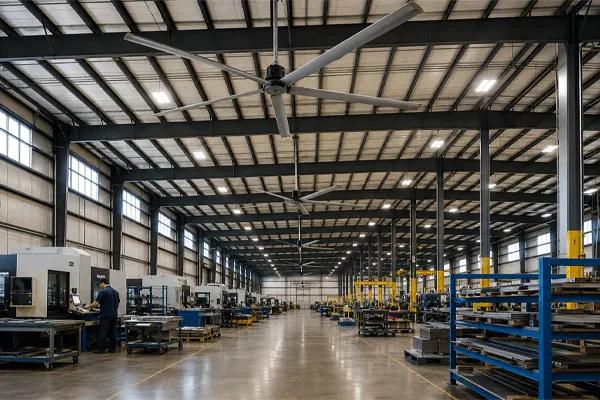
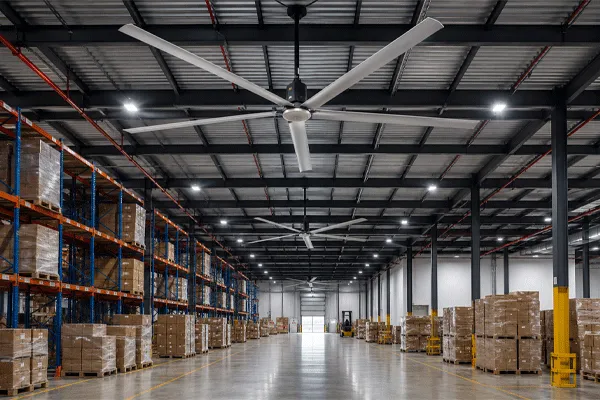
The edge case that trips up warehouse installations more than most other facility types: racking height. A fan sized correctly for the building’s ceiling height can still underperform if tall racking sits close enough to the mounting point to interrupt the air column before it spreads. This is different from the obstruction check done for open-floor manufacturing space — racking is usually denser, taller, and rearranged more often, so a layout that works at installation can degrade six months later after a racking reconfiguration. Facilities running dynamic storage layouts should treat fan placement as something to revisit alongside major racking changes, not a one-time decision.
Direct-Drive vs. Gearbox: Why It Matters More in a Warehouse Than It Looks
| Facteur |
Gearbox-Driven |
PMSM Direct-Drive |
| Maintenance access |
Typically roof-level or lift-required |
Floor-level HMI, no lift |
| Downtime during a warehouse operating shift |
Higher — lift access often means clearing forklift traffic beneath the unit |
Lower — floor panel doesn’t require clearing the aisle below |
| Moving parts between motor and blade |
Gearbox, drive shaft |
None |
| Power draw at max speed |
Varies by model/gear ratio |
Under 1,000 W (P780) |
The maintenance-access difference matters more in an active warehouse than in, say, an empty manufacturing bay, because scheduling a lift under a fan means routing forklift traffic around it during business hours. That said, this isn’t a decisive factor for every facility — a warehouse that runs fans continuously without much service history simply won’t see this advantage play out the same way a facility with frequent maintenance cycles would.
HVLS Fans for Warehouse Cooling and Ventilation
FAQ
Q: How many HVLS fans does a warehouse need?
A: It depends on ceiling height, floor obstructions like racking, and diameter — not square footage alone. A single P780 unit can cover roughly 15,000–20,000 sq ft of open floor, but that figure drops in zones with tall racking or partial mezzanines.
Q: Can HVLS fans replace air conditioning in a warehouse?
A: No. They reduce the load on existing HVAC or evaporative cooling by distributing conditioned air more evenly and by creating a wind-chill effect that lets occupants feel cooler at the same ambient temperature — they don’t lower the actual air temperature on their own.
Q: Do HVLS fans work in winter, or just for summer cooling?
A: Both, but the fan needs to run in reverse at low speed during winter to pull warm ceiling-level air back down (destratification) rather than creating a cooling draft. Sizing and placement should account for both modes.
Q: What does a P780 Series installation cost for a typical warehouse?
A: Vindus Fans doesn’t publish price ranges publicly. Pricing is quote-based and depends on unit count, ceiling height, and site-specific installation requirements — contact Vindus Fans directly for a quote.