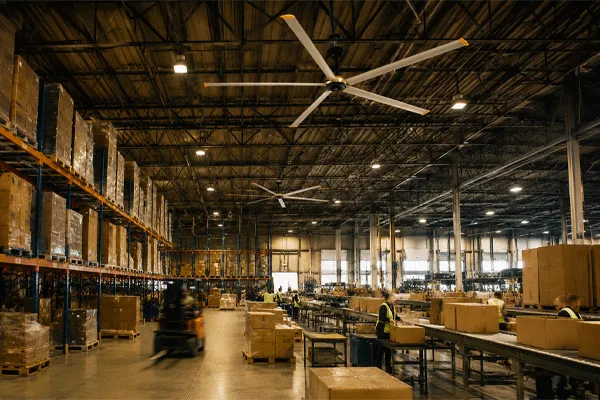
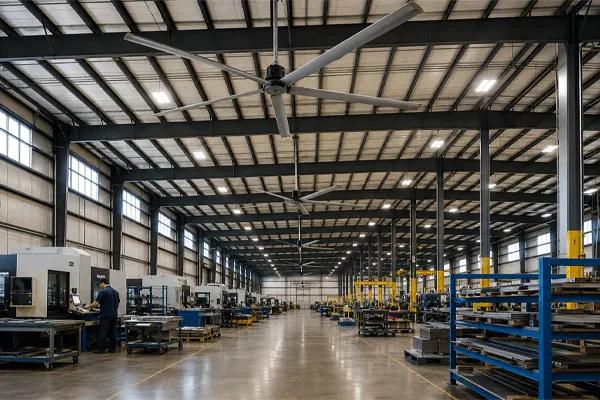
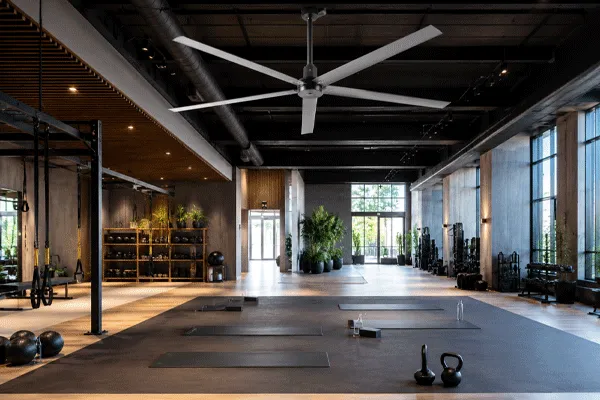
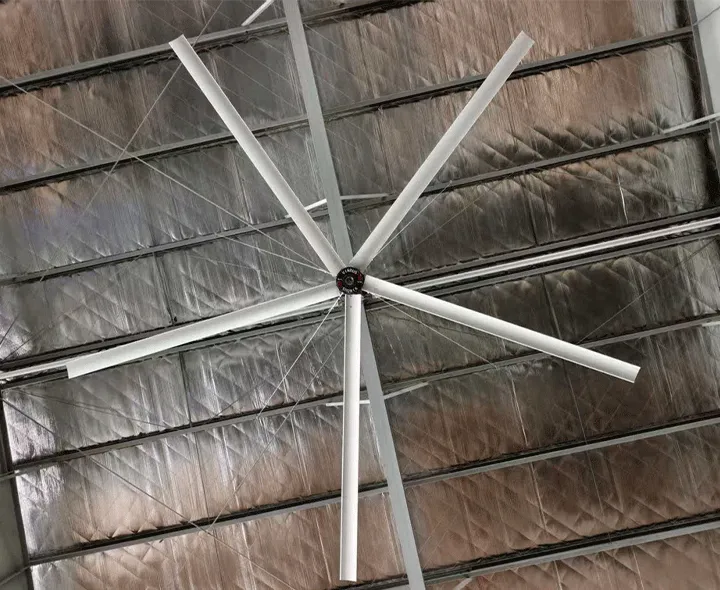
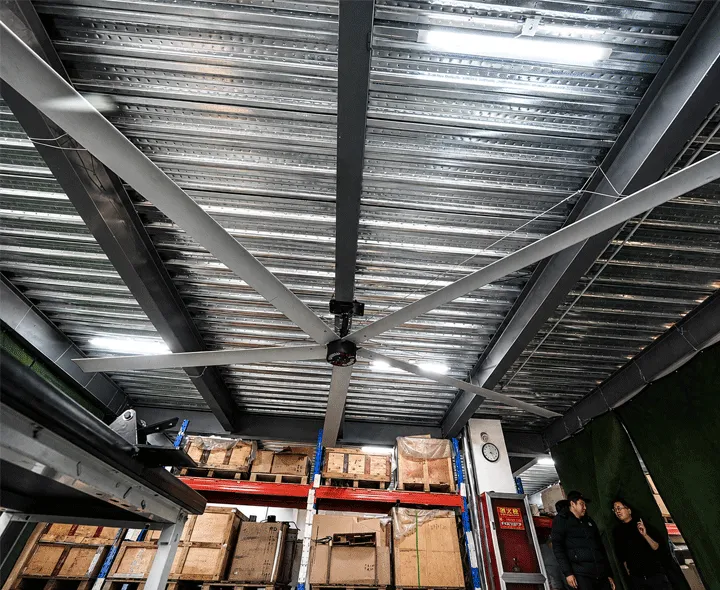
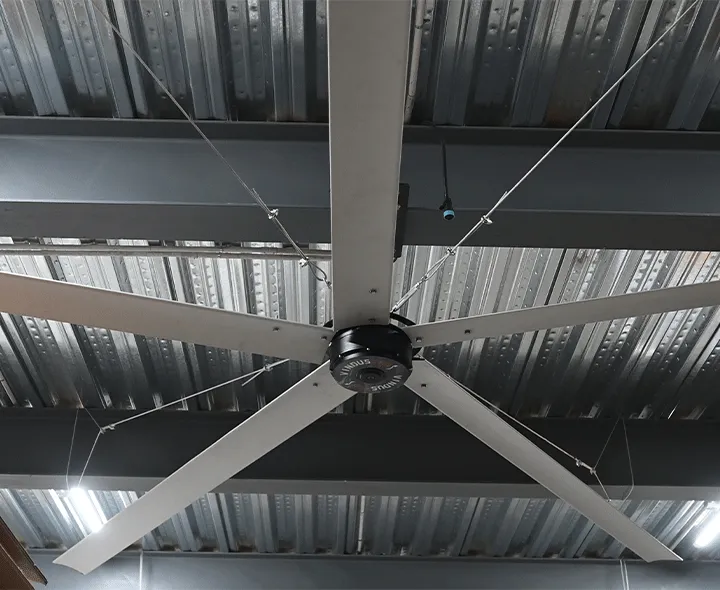
Large warehouses often face the same challenge: rising indoor temperatures, poor air movement, and increasing HVAC costs. A properly selected ventilateur de plafond industriel can improve airflow, reduce heat buildup, and create a more comfortable working environment while helping businesses lower energy consumption.
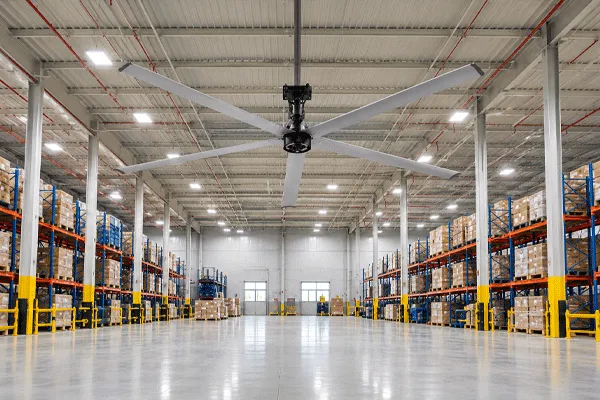
Industrial ceiling fans for warehouses are designed to move large volumes of air across wide areas. By creating consistent airflow from the ceiling level to the floor, HVLS solutions help cool workers, improve ventilation, and support energy-efficient climate control in large industrial and commercial buildings.
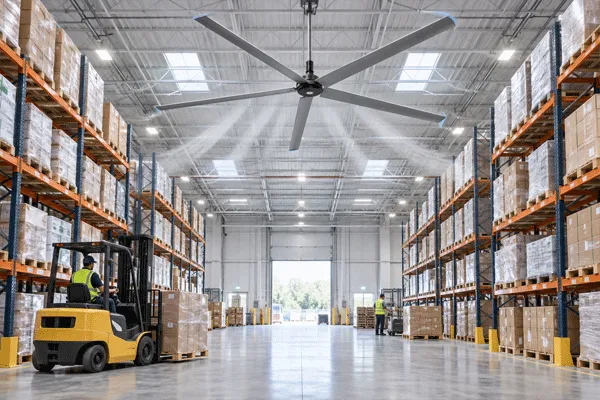
Industrial Ceiling Fans for Cooling Warehouse and Storage Areas
Why Are Industrial Ceiling Fans Important for Cooling a Warehouse?
A hot warehouse creates more than just discomfort. Excessive heat can reduce worker productivity, increase equipment stress, and force HVAC systems to operate harder. Traditional cooling methods often struggle in buildings with high ceilings, large open areas, and constantly changing air conditions.
Many facilities rely only on air conditioning, but this approach can become expensive when applied to spaces such as warehouses, factories, distribution centers, and logistics hubs. Heat naturally rises toward the ceiling, creating temperature layers where the upper area becomes much hotter than the working zone below.
An industrial ceiling fan solves this problem by generating continuous airflow. Instead of simply lowering temperature, it improves perceived comfort by increasing air movement around people and equipment.
For modern facilities, the goal is not only to cool the air but also to create balanced airflow throughout the entire building.
What Is an Industrial Ceiling Fan and How Does It Work?
An industrial ceiling fan is a large-scale airflow device designed for industrial environments, commercial buildings, and other large spaces. Unlike residential ceiling fans, these systems are engineered for high ceilings, long operating hours, and demanding conditions.
The main principle behind an industrial fan is simple: move a large amount of air slowly and efficiently. This is why many large facilities choose HVLS technology.
HVLS means High Volume Low Speed. A large HVLS fan uses wide blades rotating at a low speed to create a broad airflow pattern that reaches a large floor area.
| Fonctionnalité |
Ventilateur de plafond traditionnel |
Ventilateur de plafond industriel |
| Taille de la lame |
Petit |
Large diameter blades |
| Mouvement de l'air |
Local airflow |
Wide-area airflow |
| Installation |
Low ceilings |
High ceilings |
| Application |
Homes and offices |
Warehouses, factories, commercial buildings |
| Efficacité énergétique |
Couverture limitée |
Designed for large-scale airflow |
A properly designed warehouse fan does not replace every HVAC system. Instead, it works together with heating and cooling equipment to improve overall efficiency.
For example, during summer, airflow helps workers feel cooler. During winter, reverse operation can push warm air trapped near the ceiling back down to occupied areas.
Comment faire Ventilateurs HVLS Improve Warehouse Airflow?
The biggest advantage of an HVLS fan is its ability to create stable airflow across a large area.
In a typical warehouse, hot air rises because of natural convection. Without proper circulation, the temperature difference between the floor and ceiling can become significant. This issue is especially common in buildings with high ceiling height.
An hvls fan creates a downward airflow column that spreads horizontally when it reaches the floor. This creates a circular air pattern that improves air distribution.
Key airflow benefits include:
- Reducing hot and cold spots
- Improving worker comfort
- Supporting ventilation in a warehouse
- Reducing humidity accumulation
- Helping HVAC systems operate more efficiently
- Improving overall air circulation
A large ceiling fan can move air across thousands of square meters, making it suitable for warehouses, manufacturing plants, sports facilities, and agricultural buildings.
The reason businesses choose HVLS technology is efficiency. One large fan may replace multiple smaller fans while providing more consistent air movement.
Why Choose Ceiling Fans for Warehouses Instead of Smaller Fans?
Many warehouse operators initially consider installing multiple small fans. While this may seem affordable, it often creates uneven airflow and higher maintenance requirements.
Small fans mainly provide localized cooling. They may cool one workstation but cannot effectively influence airflow throughout a large building.
By contrast, ceiling fans for warehouses are designed specifically for wide coverage.
| Application |
Small Fans |
Industrial Ceiling Fans |
| Small work area |
Suitable |
More than required |
| Large warehouse |
Limitée |
Excellent |
| High ceiling building |
Poor performance |
Designed for this purpose |
| Efficacité énergétique |
Inférieur |
Plus haut |
| Airflow coverage |
Local |
Large area |
For facilities such as distribution centers and logistics warehouses, fewer large fans can often provide better results than many smaller units.
This is why fans for warehouses have become an important part of modern energy-saving ventilation strategies.
A warehouse fan can help maintain comfortable working conditions while reducing dependence on mechanical cooling systems.
What Factors Should You Consider When Choosing Industrial Ceiling Fans?
Choosing the right industrial ceiling fan requires more than selecting the largest available model. Building size, ceiling structure, operating conditions, and airflow requirements all influence the correct solution.
The most important factors include:
1. Warehouse Size and Layout
The first step is understanding the total floor area. Large open warehouses require fans capable of creating airflow across wide zones.
Facilities with storage racks, production lines, or frequently occupied areas may require different airflow patterns.
2. Ceiling Height
The ceiling height directly affects fan selection.
Buildings with higher ceilings need fans designed for longer airflow reach. Installing a fan that is too small may result in weak air movement at worker level.
3. Blade Diameter and Airflow Coverage
A larger fan can move more air at lower speeds. This creates comfortable airflow without producing excessive wind noise.
For large industrial applications, selecting the correct blade size is essential for achieving efficient coverage.
4. Operating Environment
Different industries have different requirements.
For example:
- Manufacturing plants may need durable fans for continuous operation.
- Food processing facilities may focus on hygiene and airflow control.
- Agricultural buildings may need solutions for humidity management.
- Logistics centers may prioritize worker comfort and energy savings.
Modern industrial ceiling fans are used in many applications because they can be customized according to different industrial conditions.
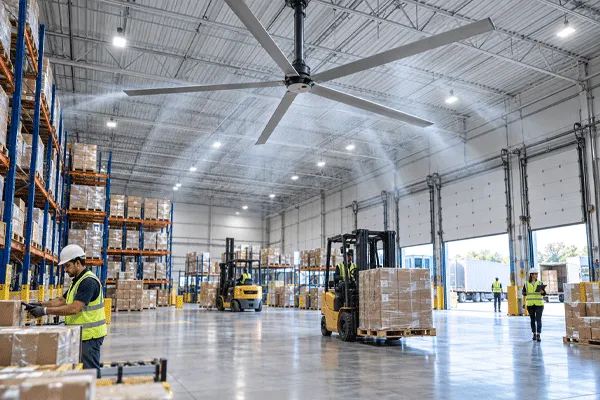
Industrial Ceiling Fans for Cooling Warehouse and Storage Areas
HVLS Ceiling Fan vs Traditional Industrial Fan: Which Is Better for Large Spaces?
When businesses compare airflow solutions, they often consider traditional fans, ventilation equipment, and modern HVLS technology. The right choice depends on the size of the building, airflow requirements, and operating conditions.
A traditional industrial fan usually creates high-speed airflow in a limited area. It can be useful for specific workstations or smaller zones, but it may not provide uniform air movement throughout a large building.
An hvls ceiling fan, on the other hand, uses a large blade diameter and low rotational speed to move a large volume of air. This makes it especially suitable for warehouses, factories, logistics centers, and other large industrial environments.
| Comparaison |
Ventilateur industriel traditionnel |
Ventilateur de plafond HVLS |
| Airflow Style |
High-speed local airflow |
Low-speed wide-area airflow |
| Couverture |
Limited area |
Large floor coverage |
| Niveau de bruit |
Higher at close range |
Lower operating noise |
| Consommation d'énergie |
Higher when many units are required |
Lower with fewer units |
| Meilleure application |
Small zones and specific cooling points |
Warehouses, factories, and large buildings |
For example, a distribution center with thousands of square meters of floor space may need many smaller fans to achieve acceptable airflow. A properly designed large ceiling fan system can cover the same area with fewer units while maintaining comfortable air movement.
This is why many companies choose industrial ceiling fans in warehouses as part of their long-term ventilation and energy management strategy.
How Do Industrial Ceiling Fans Reduce Warehouse Cooling Costs?
Energy costs are one of the biggest concerns for warehouse owners and facility managers. Cooling a warehouse with high ceilings can require significant HVAC capacity because warm air naturally collects near the roof area.
An industrial ceiling fan helps reduce this challenge by improving air distribution.
During hot seasons, the airflow created by the fan increases evaporation from human skin, making workers feel cooler without dramatically lowering the actual air temperature. This allows HVAC systems to operate at a higher temperature setting while maintaining comfort.
During colder seasons, many HVLS systems can operate in reverse mode. The fan pushes warm air from the upper ceiling area downward, reducing temperature differences between the floor and roof.
Main energy-saving advantages include:
- Better temperature balance
- Reduced HVAC workload
- Improved worker comfort
- Lower cooling demand
- More efficient air circulation
A well-designed warehouse fan system can support energy-saving goals in warehouses and factories by improving the performance of existing heating and cooling equipment.
For large industrial buildings, the goal is not simply to add more cooling equipment. It is to create smarter airflow management.
How Do Ceiling Fans for Warehouses Improve Working Conditions?
Employee comfort directly affects productivity, safety, and workplace satisfaction. Hot and poorly ventilated spaces can make workers tired faster and reduce concentration.
In spaces such as warehouses, loading areas, manufacturing plants, and logistics centers, temperature problems often happen because of:
- Large building volume
- High ceilings
- Heat generated by machines
- Limited natural ventilation
- Frequent door opening and closing
Installing ceiling fans for warehouses helps solve these problems by creating continuous airflow throughout the occupied area.
Unlike air conditioning systems that mainly change air temperature, fans focus on air movement. This difference is important because workers often feel uncomfortable due to stagnant air rather than temperature alone.
A properly selected industrial fan can create a more pleasant environment by improving circulation around work areas.
For example, a manufacturing facility may install several HVLS units above production lines. The airflow helps reduce heat buildup while maintaining comfortable working conditions without creating strong drafts.
Where Are Industrial Ceiling Fans Commonly Used?
Modern industrial ceiling fans are used across many industries because large buildings share similar airflow challenges.
Entrepôts et centres de distribution
Warehouses often have large storage areas, tall ceilings, and constant employee activity. HVLS systems help maintain balanced airflow across storage zones and working areas.
Typical applications include:
- Logistics warehouses
- E-commerce fulfillment centers
- Cold storage transition areas
- Distribution hubs
- Loading and unloading zones
Factories and Manufacturing Plants
Factories generate heat from machines, production processes, and workers. A suitable industrial ceiling fan improves air movement and supports a healthier working environment.
Applications include:
- Automotive factories
- Metal processing plants
- Assembly workshops
- Packaging facilities
Bâtiments agricoles
Agricultural operations require airflow management to control heat and humidity.
HVLS systems are commonly used in:
- Livestock buildings
- Poultry farms
- Greenhouses
- Agricultural storage buildings
Bâtiments commerciaux
A commercial ceiling fan can also support ventilation in:
- Sports centers
- Exhibition halls
- Shopping malls
- Retail warehouses
These applications show why HVLS solutions are suitable for both industrial and commercial projects.
What Makes HVLS Fans Suitable for Large Industrial Buildings?
The main advantage of an HVLS system is its ability to move air efficiently across a wide area.
A standard small fan may create strong airflow near the fan itself but lose effectiveness over distance. HVLS technology works differently.
A large blade system rotates slowly and creates a wide airflow pattern. The air travels downward and spreads across the floor, creating consistent air movement.
Important design features include:
| Fonctionnalité |
Bénéfice |
| Large blade diameter |
Covers more floor area |
| Low-speed operation |
Creates comfortable airflow |
| Efficient motor system |
Reduces energy consumption |
| Intelligent control |
Adjusts speed according to conditions |
| Durable construction |
Suitable for industrial conditions |
For large spaces, airflow planning is more important than simply selecting the biggest fan available.
A professional supplier evaluates:
- Building dimensions
- Ceiling structure
- Occupancy level
- Heat sources
- Existing HVAC system
- Required airflow pattern
This approach ensures that the selected industrial ceiling fan provides maximum value.
How Can Businesses Select the Right Industrial Ceiling Fans?
Choosing the correct system requires careful evaluation. Different buildings need different airflow solutions.
When choosing industrial ceiling fans, buyers should consider the following:
Building Dimensions
Measure:
- Floor area
- Hauteur du plafond
- Available installation positions
- Obstructions such as racks and equipment
A warehouse with very high ceilings may require different specifications compared with a low industrial building.
Fan Coverage Area
The number of fans depends on:
- Diamètre du ventilateur
- Motor power
- Installation height
- Required airflow
Using fewer but correctly sized fans is often more effective than installing many small units.
Environnement d'exploitation
Industrial environments can include:
- Dust
- Humidity
- Heat
- Long operating hours
Therefore, fans are built with different protection levels depending on application requirements.
Control System Requirements
Modern intelligent airflow solutions can include:
- Contrôle de la vitesse variable
- Temperature sensors
- Smart monitoring
- Automated adjustment
These features help facilities optimize energy use.
Example Application: HVLS Solution for a Large Warehouse
A logistics company operating a large distribution warehouse faced several challenges:
- High indoor temperatures during summer
- Uneven airflow between storage aisles
- Increased HVAC operation costs
- Worker complaints about heat
The company installed an HVLS airflow solution designed for its warehouse layout.
After installation, the system provided:
- More consistent air movement
- Improved employee comfort
- Better temperature distribution
- Reduced dependence on maximum HVAC cooling
The project demonstrated an important principle:
Effective warehouse cooling is not only about lowering temperature. It is about creating balanced airflow throughout the entire building.
For warehouse owners and engineering contractors, selecting the right industrial warehouse fans can improve both operational efficiency and workplace conditions.
Why Choose Our HVLS Fan Solutions for Industrial and Commercial Applications?
Selecting an airflow solution is not only about purchasing a fan. For warehouses, factories, and commercial buildings, the supplier’s engineering capability, product reliability, and project support are equally important.
As a Sino-US joint venture manufacturer and solution provider, we specialize in industrial ceiling fan, HVLS technology, commercial airflow systems, and intelligent ventilation solutions for global B2B customers.
Our solutions are designed for customers who need reliable airflow performance in demanding applications, including:
- Warehouse owners
- Logistics companies
- Usines de fabrication
- HVAC engineering contractors
- Commercial developers
- Agricultural operators
- Sports facilities
- Equipment distributors
We understand that every building has different requirements. A logistics center may focus on worker comfort and energy savings, while a factory may need stronger airflow management because of heat generated by production equipment.
Therefore, we provide project-based recommendations instead of offering a one-size-fits-all product.
Our engineering process considers:
| Evaluation Area |
But |
| Building size |
Determine airflow coverage |
| Hauteur du plafond |
Select suitable fan specifications |
| Application environment |
Ensure reliable operation |
| Existing HVAC system |
Improve overall efficiency |
| Control requirements |
Enable intelligent management |
This approach helps customers choose the right industrial ceiling fan system for their specific building conditions.
How Do Industrial Ceiling Fans Support Energy-Efficient Ventilation?
Energy efficiency has become a major concern for industrial and commercial facilities. Rising electricity costs encourage companies to find solutions that improve comfort without increasing operational expenses.
A modern industrial ceiling fan supports energy efficiency by improving airflow instead of depending only on mechanical cooling.
The fan works together with HVAC systems by:
- Distributing conditioned air more evenly
- Reducing temperature differences
- Preventing heat accumulation near the ceiling
- Improving ventilation efficiency
- Supporting comfortable working conditions
For example, in a high-bay warehouse, warm air often stays near the upper part of the building. Without proper airflow, HVAC systems must work harder to maintain comfortable temperatures.
An HVLS solution helps solve this issue by pushing air downward and creating natural circulation.
This is especially valuable in large open areas where traditional cooling methods may struggle.
Many customers searching for fans for warehouses are not simply looking for a cooling device. They need a complete airflow strategy that improves efficiency and reduces long-term operating costs.
What Applications Need Large Industrial Ceiling Fans?
Large buildings have different airflow challenges depending on their industry. The flexibility of HVLS technology makes it suitable for many applications.
Warehouses and Logistics Centers
Modern warehouses require stable airflow because workers, forklifts, lighting systems, and equipment continuously generate heat.
A properly designed warehouse ceiling fan solution can improve:
- Employee comfort
- Air distribution
- Temperature balance
- Qualité de l'air intérieur
Common locations include:
- Distribution centers
- E-commerce warehouses
- Storage facilities
- Transportation hubs
Installations de fabrication
Factories often experience localized heat from machines and production processes.
Industrial airflow solutions help reduce stagnant air and create a more comfortable working environment.
Applications include:
- Automotive plants
- Machinery workshops
- Assembly factories
- Metal processing facilities
Agricultural and Livestock Buildings
Agricultural buildings require effective air movement to manage heat and humidity.
HVLS systems help maintain healthier environments for:
- Poultry houses
- Livestock farms
- Greenhouses
- Agricultural storage buildings
Commercial and Public Buildings
A commercial ceiling fan solution can improve airflow in:
- Sports arenas
- Exhibition centers
- Shopping malls
- Salles d'événements
For these applications, appearance, noise control, and intelligent operation are often important considerations.
Installation and Maintenance Guide for Industrial Ceiling Fans
Proper installation is essential for achieving maximum airflow performance.
Even the best industrial fan cannot perform effectively if the installation location, mounting height, or control settings are incorrect.
Installation Considerations
Before installation, engineers should evaluate:
- Roof structure
- Mounting points
- Ceiling clearance
- Fan spacing
- Airflow direction
- Safety requirements
For buildings with high ceiling structures, installation height directly affects airflow coverage.
A fan installed too high may lose effectiveness at worker level, while a fan installed too low may create unnecessary airflow pressure.
Maintenance Requirements
Although modern HVLS systems are designed for long service life, regular inspection improves reliability.
Recommended maintenance includes:
- Checking blade connections
- Inspecting motor operation
- Cleaning dust accumulation
- Checking control systems
- Confirming safety components
Industrial facilities often operate fans for many hours every day, so preventive maintenance helps reduce unexpected downtime.
Reliable industrial warehouse fans should be designed for continuous operation under demanding conditions.
Traditional airflow systems usually operate manually. However, modern buildings increasingly require intelligent control.
An intelligent HVLS solution can integrate:
- Temperature monitoring
- Speed adjustment
- Building management systems
- Remote control
- Automated operation
This allows facilities to adjust airflow according to real conditions.
For example:
- During cooler periods, the fan speed can decrease.
- During peak heat conditions, airflow can increase automatically.
- Different warehouse zones can receive different airflow settings.
This makes industrial and commercial ceiling fans more efficient and easier to manage.
For large facilities, intelligent airflow control is becoming an important part of energy-saving building strategies.
Questions fréquemment posées sur les ventilateurs de plafond industriels
What is an industrial ceiling fan used for?
An industrial ceiling fan is designed to improve airflow in large buildings such as warehouses, factories, logistics centers, agricultural facilities, and commercial spaces. It helps create comfortable air movement, improve ventilation, and support energy-efficient cooling.
Are HVLS fans better than traditional cooling fans?
HVLS fans are often more suitable for large buildings because they can move large volumes of air across wide areas using lower rotational speeds. Traditional fans may provide stronger airflow in a small area, but they usually cannot cover the same space efficiently.
How many industrial ceiling fans does a warehouse need?
The required number depends on several factors, including warehouse size, ceiling height, fan diameter, layout, and airflow requirements. Professional evaluation is recommended to determine the correct fan quantity and installation position.
Can industrial ceiling fans replace air conditioning?
Usually, they work together with air conditioning rather than replacing it completely. An industrial ceiling fan improves air movement and helps HVAC systems distribute cooled air more effectively, which may reduce cooling demand.
Are HVLS fans suitable for factories and warehouses?
Yes. HVLS systems are widely used in factories and warehouses because they are designed for large spaces, high ceilings, and continuous operation. They help improve worker comfort and airflow efficiency.