Michael Danielsson | CEO, Vindus Fans | Published/Updated: August 20, 2026
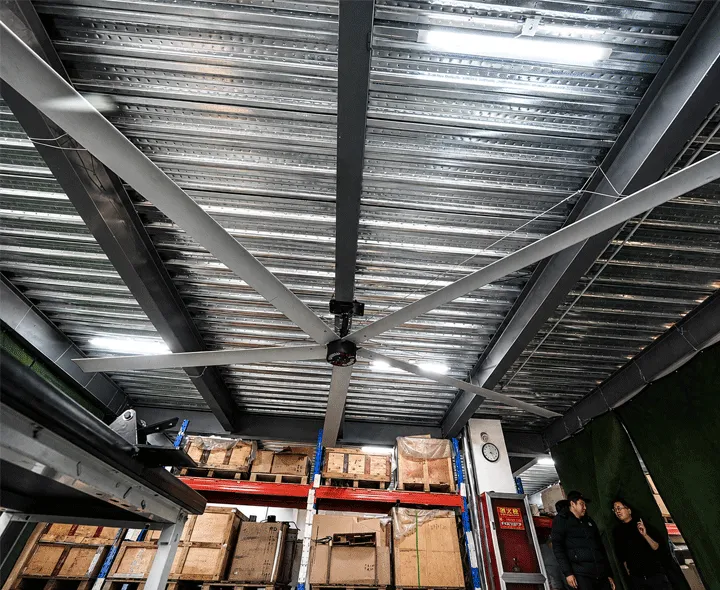
HVLS fans cool large commercial and industrial spaces by moving a slow, wide column of air down to the occupied zone, rather than driving narrow high-velocity jets across it. Above roughly 20 ft of ceiling height, one 20 ft or 24 ft fan covers floor area that would otherwise need a dozen small units running continuously.
HVLS Fans for Cooling Large Commercial and Industrial Spaces
For workplace ventilation fundamentals and hazard-specific design considerations, consult OSHA ventilation guidance alongside local codes and qualified engineering review.
How big is “large”?
The phrase gets used loosely, so here is the threshold that actually matters: a space is large enough to need HVLS when small fans can no longer reach the people in it without making them uncomfortable.
That happens for a reason that has nothing to do with floor area. A small fan produces its airflow by accelerating a modest amount of air to high speed. That jet loses coherence quickly. Double the distance and you have lost most of the useful movement, so you compensate by adding fans, moving them closer, or running them faster. In a 30 ft-high bay, running them faster is what turns a comfort project into a complaint about wind noise and scattered paperwork.
A large-diameter fan works the other way round. It moves a much greater volume of air at low speed, producing a column wide enough to reach the floor and spread outward across it. The column has to have room to develop, which is why ceiling height matters more than square footage when you are deciding whether the category fits your building at all.
Practical marker: below about 10 ft of clear height, the column has no distance to form and occupants sit in a narrow fast zone. Between 10 and 20 ft, mid-size HVLS units work but the calculation is tighter. Above 20 ft, the large-diameter case is usually straightforward.
What you are actually comparing against
Nobody buys HVLS fans in a vacuum. The realistic alternatives in a large building are more small fans, more mechanical cooling, or accepting the conditions. Setting them side by side clarifies where the category earns its place.
| Dimension |
Large-diameter HVLS |
Multiple small high-speed fans |
Additional mechanical cooling |
| Coverage per unit |
Wide column reaching the full occupied zone below |
Narrow jet losing coherence with distance |
Depends on duct and diffuser layout |
| Units needed for a large bay |
Few |
Beaucoup |
Equipment sized to load |
| Air velocity at occupants |
Low, broad |
High, localised |
Depends on diffuser design |
| Effect on stratification |
Mixes the full volume |
Minimal at height |
Depends on return air design |
| Winter usefulness |
Reduced-speed destratification |
Little |
Heating only |
| Power draw pattern |
One unit under 1,000 W at maximum speed (P780) |
Sum of many units running continuously |
Compressor load |
| Noise sources |
Motor and aerodynamic, at low speed |
Many motors, higher tip speeds |
Air handling equipment |
| Maintenance points |
Few, at height |
Many, at height |
Filters, coils, refrigerant circuit |
| Effect on air temperature |
None; perceived cooling only |
None; perceived cooling only |
Genuine temperature reduction |
Two honest readings of that table. First, the last row is not a rhetorical concession. If your space has a real cooling load, HVLS fans reduce and extend it, they do not remove it. Second, the maintenance column favours HVLS mainly because of unit count. Twelve small fans mounted at 28 ft are twelve lift-equipment visits.
Compared with the gearbox-driven large fans still sold widely in this category, the differences appear once the units are in the building rather than in the airflow spec.
What scale does to the drivetrain
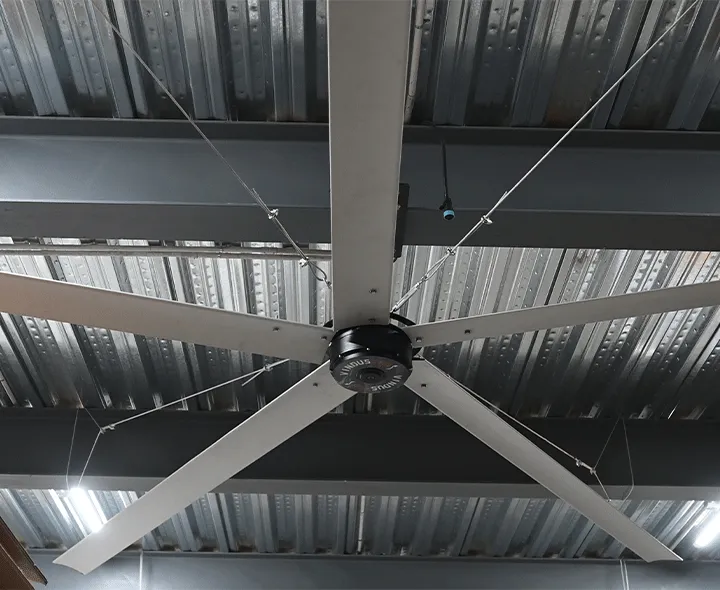
Fan diameter drives torque, and torque is where the transmission choice stops being an engineering preference and starts showing up on invoices. Vindus builds the P780 on a permanent magnet synchronous motor with direct drive.
| At 20–24 ft diameter |
Direct drive (PMSM) |
Gearbox-driven |
| Torque path |
Rotor to hub, no intermediate stage |
Motor through reduction gearset to hub |
| Assembly mass at the mounting point |
Lower for the same diameter |
Higher, and the gap widens with size |
| Consequence for structure |
More buildings mount to existing steel |
More projects need supplementary steel |
| Lubricant |
None |
Gear oil, with scheduled changes |
| Contamination risk below the unit |
None from the drivetrain |
Seepage onto floor, product or feed |
| Loss stages |
Motor only |
Motor plus gear mesh |
| Diagnosing an unfamiliar noise |
Motor or aerodynamic |
Motor, aerodynamic, or gear mesh |
| Speed control |
Electronic across the range |
Often stepped or drivetrain-limited |
The structural row is the one that changes project budgets. A heavier assembly at 24 ft can be the difference between bolting to what is already there and paying a steel contractor. Ask any supplier for assembly weight and mounting load in writing, and give it to your structural engineer before hardware is ordered rather than after.
I led development of direct drive HVLS models at MacroAir before the approach was standard in this category, and the argument has not aged. At large diameters the transmission is the component under the most stress and the one that most reliably generates service calls. Removing it removes both.

HVLS Fans for Cooling Large Commercial and Industrial Spaces
P780 Series specifications
The P780 is the Vindus series built for the buildings this article is about.
| Specification |
P780 Series |
| Diamètre |
20 ft and 24 ft |
| Ceiling height range |
20–33 ft |
| Type de moteur |
PMSM (permanent magnet synchronous) |
| Power draw at maximum speed |
Under 1,000 W |
| Drive |
Direct drive, no gearbox |
| Operator interface |
Floor-level integrated HMI |
| Cabling |
Single ceiling-to-floor cable |
| Control system |
FanBrain™ control with integrated VFD; BAS integration and multi-unit centralised control supported |
| Rated CFM |
Not published per model; issued during quotation under AMCA 230-15 / ANSI/ASHRAE 216P |
| Sound level (dB) |
Not published per model |
| Ingress protection rating |
Not published per model |
| Safety compliance |
CE, CB, EN, IEC |
Three notes on reading it.
The floor-level HMI matters more in large buildings than the spec line suggests. If the control is at height, every setting change becomes a lift booking, and in practice that means the fans get set once and never adjusted seasonally.
The single-cable design is an installation and inspection variable. One run from ceiling to floor instead of separate power and control paths reduces both the electrical work and the number of things to check later.
Blank performance figures are blank on purpose. An airflow number without its test condition and speed setting cannot be compared against another supplier’s number, which is why Vindus issues them against a specific configuration rather than publishing a headline figure. When comparing suppliers, ask each one which standard their number was measured under — AMCA 230-15 and ANSI/ASHRAE 216P are the two that make figures comparable, and Vindus product performance follows both.
Certificate images for CE, CB, EN and IEC compliance are published; certificate numbers and issuing bodies are not, so request documentation directly if your specification process requires it.
HVLS Fans for Cooling Large Commercial and Industrial Spaces
The same fan, five different buildings
Large-space cooling looks different depending on what the building does.
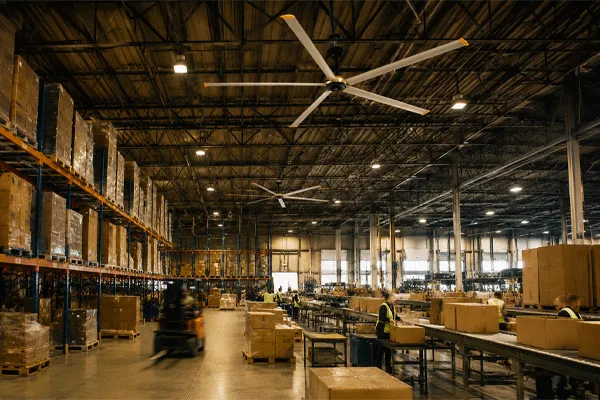
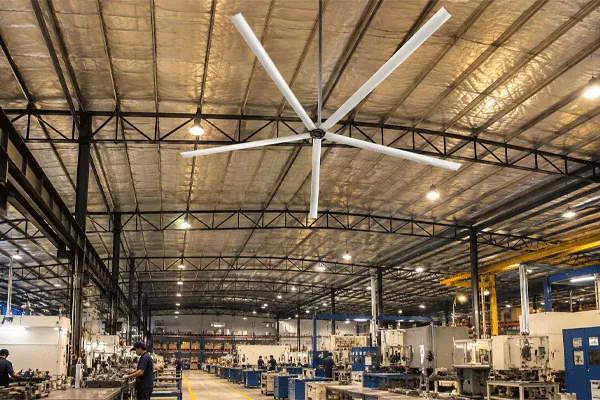
Distribution and storage warehouses. Ceiling heights suit the P780 range well, but racking is the constraint. Fans placed for a clean grid will push air into the side of a racking run. Placement follows aisles and pick zones, and the winter destratification case is often stronger financially than the summer comfort case that prompted the enquiry.
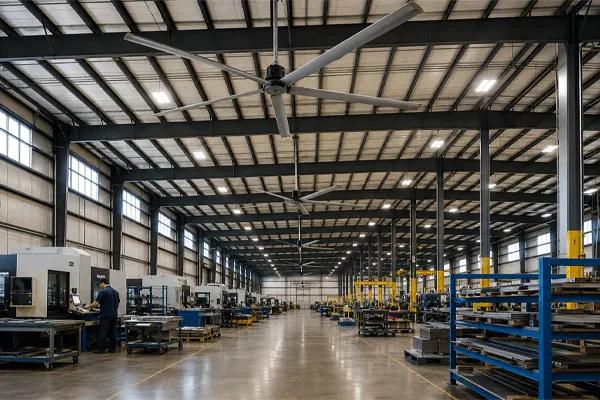
Planchers de fabrication. Process heat sources make the temperature distribution uneven, so uniform coverage is rarely the goal. Air movement is wanted where operators stand, and specifically not wanted over certain processes — welding screens, coating stations, anything with a controlled atmosphere. Fan positions get negotiated with process engineering, not drawn on the plan first.
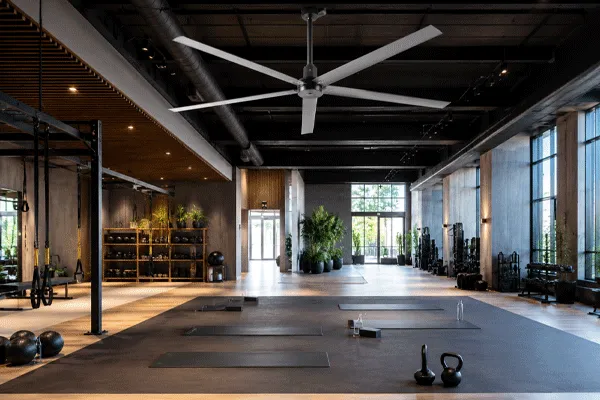
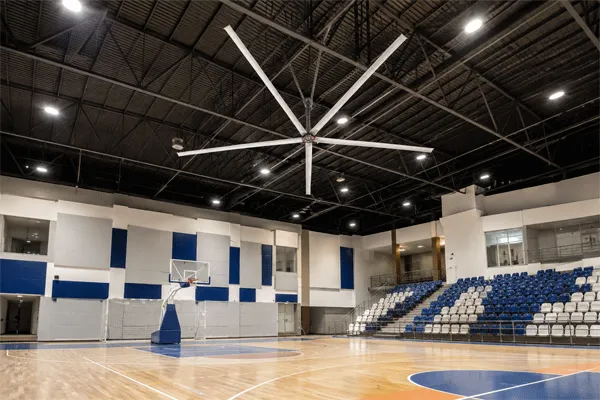
Gyms and sports venues. Occupant density is high and variable, and expectations for quiet are higher than in industrial buildings. Speed range matters more than peak airflow, because the fan needs to run gently during a yoga class and harder during a tournament without anyone touching a lift.
Agricultural and livestock buildings. Longer annual run hours, dirtier air, and consequences for downtime that are biological rather than commercial. Material and ingress specification against the actual environment is not optional, and the absence of gear oil above feed and bedding is a substantive advantage rather than a maintenance convenience.
Large commercial and retail interiors. Showrooms, garden centres, transport terminals, event halls. Here the fan is visible and people are close to it, so appearance and low-speed acoustic behaviour carry weight that they do not carry in a warehouse.
The costs that scale with fan size
Larger fans solve coverage cheaply and create expense elsewhere. Both belong in the budget.
- Structural assessment.Non-negotiable at these diameters, and it is a structural engineer’s written determination rather than an installer’s judgement. Where existing steel is inadequate, supplementary steel is a real line item.
- Lift equipment and floor loading.Access at 30 ft needs equipment, and the equipment needs floor capacity and a clear drop zone.
- The shutdown.Installing over a working area means stopping that area. In facilities that cannot stop during shift, this becomes out-of-hours labour rates, which is frequently the largest single surprise in an HVLS budget.
- Fire system coordination.Clearance to sprinkler heads and any required interlock are determined by the authority having jurisdiction and your fire protection design. Settle it during design, because relocating a mounted fan is expensive.
- Commissioning documentation.Easy to skip and worth having. A recorded baseline across the speed range is what lets you diagnose a noise complaint eighteen months later instead of guessing.
Edge cases
Assuming bigger fans mean cooler air. They do not lower air temperature. They produce convective and evaporative cooling on skin and they mix stratified air. In an unoccupied, unstratified space, more fans mean more electrical load and nothing else.
Spacing two large units too closely. Overlapping columns interfere and produce a turbulent zone that delivers less useful floor-level movement than either fan would alone. At 24 ft diameter the spacing error is proportionally larger and harder to correct after mounting.
Dust-sensitive and open-product areas. Fine powders, open food product, paint and coating work. Large-scale circulation moves particulate efficiently, including into places it must not go. These zones need direction and speed constrained at design stage, and sometimes need excluding from the scheme while the rest of the building is fine.
Corrosive and washdown environments. Coastal facilities, wastewater treatment, fertiliser storage, washdown bays. Since per-model IP ratings are not published, confirm material and ingress suitability against the actual exposure during quotation rather than assuming a general-purpose unit will last.
Mixed-height buildings. A single building with a 32 ft main bay and a 16 ft annexe is two projects. The annexe is not a smaller version of the main bay; it falls outside the P780 range entirely and needs a different series.
Buildings where the complaint is air quality. Circulating contaminated air distributes it more evenly. If the underlying issue is fumes, dust generation or inadequate fresh air, HVLS is not the intervention and installing it can make the perception worse.
Where the case is weak
Being straight about it: large-diameter HVLS is a poor fit in spaces under about 20 ft where a mid-size series would do the job for less, in buildings with low annual operating hours where the payback arithmetic never closes, in facilities with genuine cooling loads that need mechanical cooling regardless, and in any building where the structural situation means the steel costs more than the fans.
Payback depends on climate, energy tariff, operating hours and what equipment you already run. Any supplier quoting a universal figure has quoted a number calculated for a different building than yours.
FAQ
Q: How many HVLS fans does a large warehouse need?
A: Fewer than most floor-area calculations suggest, and the number depends on obstructions rather than square footage. A clear bay allows wide spacing between 24 ft units; the same floor area broken up by racking, mezzanines or process equipment needs more units placed to serve the sections, or a mix of series. Send a floor plan with clear ceiling height and obstruction heights and the layout can be worked through during quotation, because a unit count produced without an obstruction map is a guess.
Q: What is the difference between a 20 ft and a 24 ft P780 in practice?
A: Coverage area per unit, and therefore unit count and spacing. Both sit in the same 20–33 ft ceiling height range and share the drive, control and cabling design. The 24 ft covers more floor per unit, which suits wide open bays; the 20 ft gives more placement flexibility where the floor is divided. There is also a structural dimension — larger diameter means more assembly mass at the mounting point, so the answer sometimes comes back from the structural engineer rather than the airflow calculation.
Q: Can one HVLS fan replace several small industrial fans?
A: In a high-ceiling space, usually yes, and that is the core of the category’s economics. Small high-speed fans lose their jet over distance, so covering a large bay with them requires many units running continuously, each with its own power draw, mounting point and maintenance visit at height. A single P780 draws under 1,000 W at maximum speed and covers the area those units were collectively trying to reach. In low-ceiling spaces, or where the requirement is genuinely spot cooling at a workstation, small fans remain the better tool.
Q: How loud are HVLS fans in a commercial space where people are close by?
A: Sound levels are not published per model, because a decibel figure without its measurement distance and speed setting is not comparable between suppliers. What can be said structurally is that low tip speed and the absence of a gear mesh remove two of the sources that make large fans noisy, and that in venues where quiet matters the relevant question is behaviour at low and mid speeds rather than at maximum. Request measured figures for your configuration and specify the measurement conditions when you ask.
Michael Danielsson | CEO, Vindus Fans | Published/Updated: August 19, 2026
HVLS fans cool large commercial and industrial spaces by moving a slow, wide column of air down to the occupied zone, rather than driving narrow high-velocity jets across it. Above roughly 20 ft of ceiling height, one 20 ft or 24 ft fan covers floor area that would otherwise need a dozen small units running continuously.
HVLS Fans for Cooling Large Commercial and Industrial Spaces
How big is “large”?
The phrase gets used loosely, so here is the threshold that actually matters: a space is large enough to need HVLS when small fans can no longer reach the people in it without making them uncomfortable.
That happens for a reason that has nothing to do with floor area. A small fan produces its airflow by accelerating a modest amount of air to high speed. That jet loses coherence quickly. Double the distance and you have lost most of the useful movement, so you compensate by adding fans, moving them closer, or running them faster. In a 30 ft-high bay, running them faster is what turns a comfort project into a complaint about wind noise and scattered paperwork.
A large-diameter fan works the other way round. It moves a much greater volume of air at low speed, producing a column wide enough to reach the floor and spread outward across it. The column has to have room to develop, which is why ceiling height matters more than square footage when you are deciding whether the category fits your building at all.
Practical marker: below about 10 ft of clear height, the column has no distance to form and occupants sit in a narrow fast zone. Between 10 and 20 ft, mid-size HVLS units work but the calculation is tighter. Above 20 ft, the large-diameter case is usually straightforward.
What you are actually comparing against
Nobody buys HVLS fans in a vacuum. The realistic alternatives in a large building are more small fans, more mechanical cooling, or accepting the conditions. Setting them side by side clarifies where the category earns its place.
| Dimension |
Large-diameter HVLS |
Multiple small high-speed fans |
Additional mechanical cooling |
| Coverage per unit |
Wide column reaching the full occupied zone below |
Narrow jet losing coherence with distance |
Depends on duct and diffuser layout |
| Units needed for a large bay |
Few |
Beaucoup |
Equipment sized to load |
| Air velocity at occupants |
Low, broad |
High, localised |
Depends on diffuser design |
| Effect on stratification |
Mixes the full volume |
Minimal at height |
Depends on return air design |
| Winter usefulness |
Reduced-speed destratification |
Little |
Heating only |
| Power draw pattern |
One unit under 1,000 W at maximum speed (P780) |
Sum of many units running continuously |
Compressor load |
| Noise sources |
Motor and aerodynamic, at low speed |
Many motors, higher tip speeds |
Air handling equipment |
| Maintenance points |
Few, at height |
Many, at height |
Filters, coils, refrigerant circuit |
| Effect on air temperature |
None; perceived cooling only |
None; perceived cooling only |
Genuine temperature reduction |
Two honest readings of that table. First, the last row is not a rhetorical concession. If your space has a real cooling load, HVLS fans reduce and extend it, they do not remove it. Second, the maintenance column favours HVLS mainly because of unit count. Twelve small fans mounted at 28 ft are twelve lift-equipment visits.
Compared with the gearbox-driven large fans still sold widely in this category, the differences appear once the units are in the building rather than in the airflow spec.
What scale does to the drivetrain
Fan diameter drives torque, and torque is where the transmission choice stops being an engineering preference and starts showing up on invoices. Vindus builds the P780 on a permanent magnet synchronous motor with direct drive.
| At 20–24 ft diameter |
Direct drive (PMSM) |
Gearbox-driven |
| Torque path |
Rotor to hub, no intermediate stage |
Motor through reduction gearset to hub |
| Assembly mass at the mounting point |
Lower for the same diameter |
Higher, and the gap widens with size |
| Consequence for structure |
More buildings mount to existing steel |
More projects need supplementary steel |
| Lubricant |
None |
Gear oil, with scheduled changes |
| Contamination risk below the unit |
None from the drivetrain |
Seepage onto floor, product or feed |
| Loss stages |
Motor only |
Motor plus gear mesh |
| Diagnosing an unfamiliar noise |
Motor or aerodynamic |
Motor, aerodynamic, or gear mesh |
| Speed control |
Electronic across the range |
Often stepped or drivetrain-limited |
The structural row is the one that changes project budgets. A heavier assembly at 24 ft can be the difference between bolting to what is already there and paying a steel contractor. Ask any supplier for assembly weight and mounting load in writing, and give it to your structural engineer before hardware is ordered rather than after.
I led development of direct drive HVLS models at MacroAir before the approach was standard in this category, and the argument has not aged. At large diameters the transmission is the component under the most stress and the one that most reliably generates service calls. Removing it removes both.
HVLS Fans for Cooling Large Commercial and Industrial Spaces
P780 Series specifications
The P780 is the Vindus series built for the buildings this article is about.
| Specification |
P780 Series |
| Diamètre |
20 ft and 24 ft |
| Ceiling height range |
20–33 ft |
| Type de moteur |
PMSM (permanent magnet synchronous) |
| Power draw at maximum speed |
Under 1,000 W |
| Drive |
Direct drive, no gearbox |
| Operator interface |
Floor-level integrated HMI |
| Cabling |
Single ceiling-to-floor cable |
| Control system |
FanBrain™ control with integrated VFD; BAS integration and multi-unit centralised control supported |
| Rated CFM |
Not published per model; issued during quotation under AMCA 230-15 / ANSI/ASHRAE 216P |
| Sound level (dB) |
Not published per model |
| Ingress protection rating |
Not published per model |
| Safety compliance |
CE, CB, EN, IEC |
Three notes on reading it.
The floor-level HMI matters more in large buildings than the spec line suggests. If the control is at height, every setting change becomes a lift booking, and in practice that means the fans get set once and never adjusted seasonally.
The single-cable design is an installation and inspection variable. One run from ceiling to floor instead of separate power and control paths reduces both the electrical work and the number of things to check later.
Blank performance figures are blank on purpose. An airflow number without its test condition and speed setting cannot be compared against another supplier’s number, which is why Vindus issues them against a specific configuration rather than publishing a headline figure. When comparing suppliers, ask each one which standard their number was measured under — AMCA 230-15 and ANSI/ASHRAE 216P are the two that make figures comparable, and Vindus product performance follows both.
Certificate images for CE, CB, EN and IEC compliance are published; certificate numbers and issuing bodies are not, so request documentation directly if your specification process requires it.
HVLS Fans for Cooling Large Commercial and Industrial Spaces
The same fan, five different buildings
Large-space cooling looks different depending on what the building does.
Distribution and storage warehouses. Ceiling heights suit the P780 range well, but racking is the constraint. Fans placed for a clean grid will push air into the side of a racking run. Placement follows aisles and pick zones, and the winter destratification case is often stronger financially than the summer comfort case that prompted the enquiry.
Planchers de fabrication. Process heat sources make the temperature distribution uneven, so uniform coverage is rarely the goal. Air movement is wanted where operators stand, and specifically not wanted over certain processes — welding screens, coating stations, anything with a controlled atmosphere. Fan positions get negotiated with process engineering, not drawn on the plan first.
Gyms and sports venues. Occupant density is high and variable, and expectations for quiet are higher than in industrial buildings. Speed range matters more than peak airflow, because the fan needs to run gently during a yoga class and harder during a tournament without anyone touching a lift.
Agricultural and livestock buildings. Longer annual run hours, dirtier air, and consequences for downtime that are biological rather than commercial. Material and ingress specification against the actual environment is not optional, and the absence of gear oil above feed and bedding is a substantive advantage rather than a maintenance convenience.
Large commercial and retail interiors. Showrooms, garden centres, transport terminals, event halls. Here the fan is visible and people are close to it, so appearance and low-speed acoustic behaviour carry weight that they do not carry in a warehouse.
The costs that scale with fan size
Larger fans solve coverage cheaply and create expense elsewhere. Both belong in the budget.
- Structural assessment.Non-negotiable at these diameters, and it is a structural engineer’s written determination rather than an installer’s judgement. Where existing steel is inadequate, supplementary steel is a real line item.
- Lift equipment and floor loading.Access at 30 ft needs equipment, and the equipment needs floor capacity and a clear drop zone.
- The shutdown.Installing over a working area means stopping that area. In facilities that cannot stop during shift, this becomes out-of-hours labour rates, which is frequently the largest single surprise in an HVLS budget.
- Fire system coordination.Clearance to sprinkler heads and any required interlock are determined by the authority having jurisdiction and your fire protection design. Settle it during design, because relocating a mounted fan is expensive.
- Commissioning documentation.Easy to skip and worth having. A recorded baseline across the speed range is what lets you diagnose a noise complaint eighteen months later instead of guessing.
Edge cases
Assuming bigger fans mean cooler air. They do not lower air temperature. They produce convective and evaporative cooling on skin and they mix stratified air. In an unoccupied, unstratified space, more fans mean more electrical load and nothing else.
Spacing two large units too closely. Overlapping columns interfere and produce a turbulent zone that delivers less useful floor-level movement than either fan would alone. At 24 ft diameter the spacing error is proportionally larger and harder to correct after mounting.
Dust-sensitive and open-product areas. Fine powders, open food product, paint and coating work. Large-scale circulation moves particulate efficiently, including into places it must not go. These zones need direction and speed constrained at design stage, and sometimes need excluding from the scheme while the rest of the building is fine.
Corrosive and washdown environments. Coastal facilities, wastewater treatment, fertiliser storage, washdown bays. Since per-model IP ratings are not published, confirm material and ingress suitability against the actual exposure during quotation rather than assuming a general-purpose unit will last.
Mixed-height buildings. A single building with a 32 ft main bay and a 16 ft annexe is two projects. The annexe is not a smaller version of the main bay; it falls outside the P780 range entirely and needs a different series.
Buildings where the complaint is air quality. Circulating contaminated air distributes it more evenly. If the underlying issue is fumes, dust generation or inadequate fresh air, HVLS is not the intervention and installing it can make the perception worse.
Where the case is weak
Being straight about it: large-diameter HVLS is a poor fit in spaces under about 20 ft where a mid-size series would do the job for less, in buildings with low annual operating hours where the payback arithmetic never closes, in facilities with genuine cooling loads that need mechanical cooling regardless, and in any building where the structural situation means the steel costs more than the fans.
Payback depends on climate, energy tariff, operating hours and what equipment you already run. Any supplier quoting a universal figure has quoted a number calculated for a different building than yours.
FAQ
Q: How many HVLS fans does a large warehouse need?
A: Fewer than most floor-area calculations suggest, and the number depends on obstructions rather than square footage. A clear bay allows wide spacing between 24 ft units; the same floor area broken up by racking, mezzanines or process equipment needs more units placed to serve the sections, or a mix of series. Send a floor plan with clear ceiling height and obstruction heights and the layout can be worked through during quotation, because a unit count produced without an obstruction map is a guess.
Q: What is the difference between a 20 ft and a 24 ft P780 in practice?
A: Coverage area per unit, and therefore unit count and spacing. Both sit in the same 20–33 ft ceiling height range and share the drive, control and cabling design. The 24 ft covers more floor per unit, which suits wide open bays; the 20 ft gives more placement flexibility where the floor is divided. There is also a structural dimension — larger diameter means more assembly mass at the mounting point, so the answer sometimes comes back from the structural engineer rather than the airflow calculation.
Q: Can one HVLS fan replace several small industrial fans?
A: In a high-ceiling space, usually yes, and that is the core of the category’s economics. Small high-speed fans lose their jet over distance, so covering a large bay with them requires many units running continuously, each with its own power draw, mounting point and maintenance visit at height. A single P780 draws under 1,000 W at maximum speed and covers the area those units were collectively trying to reach. In low-ceiling spaces, or where the requirement is genuinely spot cooling at a workstation, small fans remain the better tool.
Q: How loud are HVLS fans in a commercial space where people are close by?
A: Sound levels are not published per model, because a decibel figure without its measurement distance and speed setting is not comparable between suppliers. What can be said structurally is that low tip speed and the absence of a gear mesh remove two of the sources that make large fans noisy, and that in venues where quiet matters the relevant question is behaviour at low and mid speeds rather than at maximum. Request measured figures for your configuration and specify the measurement conditions when you ask.