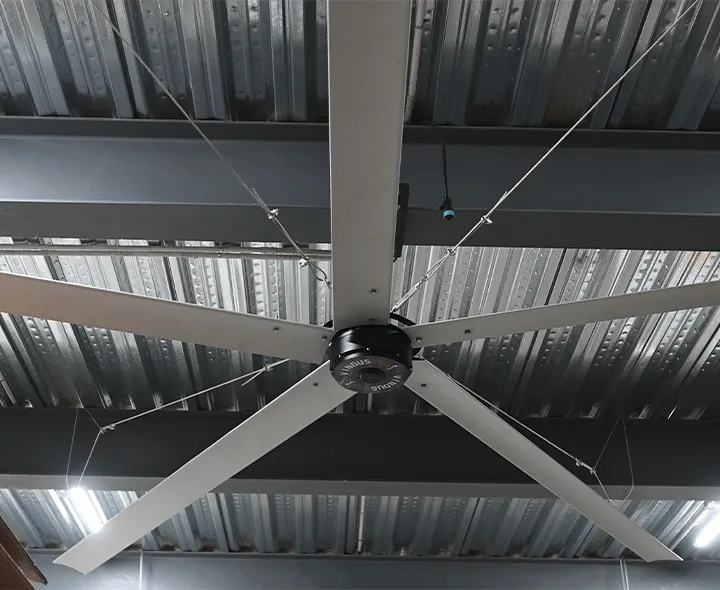
Aircraft hangars are among the most challenging large buildings to ventilate. High ceilings, wide hangar doors, aircraft occupying large floor areas, and maintenance activities can create uneven airflow and uncomfortable working conditions. A properly planned HVLS fan system can help improve air movement, but it must work alongside the hangar’s dedicated ventilation and safety systems.
HVLS fans can support aircraft hangar air circulation by moving large volumes of air at low speed, helping improve worker comfort and reduce temperature differences between floor-level and upper areas. The best solution combines suitable fan placement, structural clearance, and coordination with mechanical ventilation, exhaust, fire protection, and aircraft maintenance requirements.
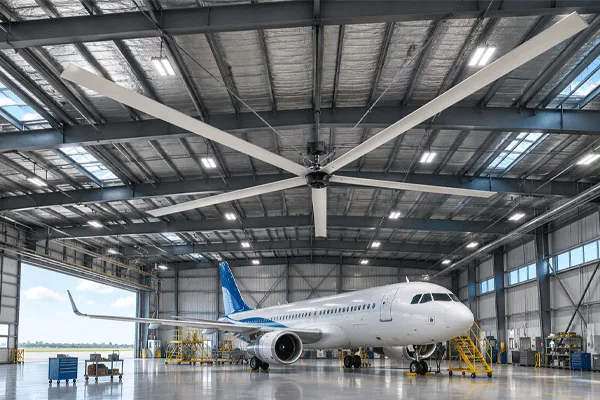
HVLS Fans for Aircraft Hangars: Airflow, Worker Comfort, and Ventilation Planning
1. Why Do Aircraft Hangars Need a Different Airflow Strategy?
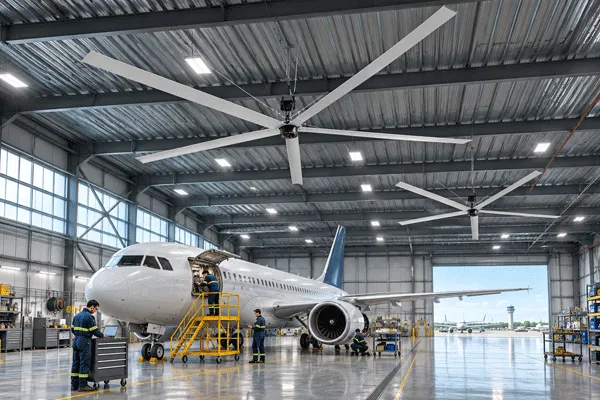
An aircraft hangar is not an ordinary warehouse. It may contain large aircraft, maintenance platforms, overhead cranes, lighting systems, fuel-related equipment, and multiple workstations. The building also has a very high roof and large doors that open and close throughout the working day.
These conditions make air distribution difficult. Warm air can collect near the roof, while the occupied area may experience uneven temperatures. Aircraft wings and fuselages can also interrupt air movement, leaving some maintenance positions with very little airflow.
The National Institute for Occupational Safety and Health (NIOSH) evaluated ventilation in four aircraft maintenance and restoration hangars. Its investigation found areas around aircraft wings and fuselages with little or no air movement. Some supply and exhaust fans were also not operating as designed, while stored equipment blocked other exhaust outlets.
This research highlights an important point: a hangar can have several fans and still have poor airflow in important working areas.
A good air management plan should therefore consider:
- Air movement across the occupied working zone.
- Temperature differences between the floor and roof.
- Aircraft size and parking positions.
- Hangar door operating conditions.
- Existing supply and exhaust equipment.
- Maintenance activities and possible air contaminants.
The objective is not simply to install more fans. It is to create a coordinated airflow strategy for the entire building.
2. What Can HVLS Fans Do in Aircraft Hangars?
HVLS stands for High Volume, Low Speed. An HVLS fan uses large blades that rotate at relatively low speeds to move a large volume of air across an open area.
Unlike a small high-speed fan, an HVLS fan creates broad air movement. The airflow moves downward and spreads across the floor, helping reduce stagnant areas and improve thermal comfort for employees working below.
In aircraft hangars, HVLS fans can provide three main benefits.
First, they support worker comfort. Maintenance technicians may spend long hours inspecting aircraft, working on engines, or servicing equipment. Consistent air movement can make warm working areas more comfortable.
Second, they help reduce temperature stratification. During colder seasons, warm air often collects near the roof. An appropriately operated HVLS fan can mix this air with cooler air below, supporting more even temperatures.
Third, they support general air mixing. Large open hangars can have areas with limited air movement. A properly planned fan arrangement can help improve circulation throughout the occupied space.
Importantly, HVLS fans do not replace mechanical ventilation or local exhaust systems. The U.S. Department of Defense’s Unified Facilities Criteria for Aircraft Maintenance Hangars specifically recognizes HVLS fans as an option for air mixing and floor-level comfort, while stating that they are not a replacement for required exhaust systems.
This distinction is essential when planning an industrial airflow solution for aviation facilities.
3. How Should You Divide an Aircraft Hangar into Airflow Zones?
A large hangar should not be treated as one uniform space. Different areas have different airflow requirements, and each zone needs to be considered separately.
Aircraft storage and service bays
These are the main open areas where aircraft are parked, inspected, and maintained. HVLS fans can support broad air circulation in suitable locations, provided that the installation does not interfere with aircraft clearance, lifting equipment, or maintenance operations.
Aircraft engine and component maintenance areas
These areas may generate heat, odors, or other airborne contaminants. General air circulation can improve comfort, but specialized extraction may be necessary for particular maintenance tasks.
Workshop and parts service areas
Workshops may contain cleaning stations, electrical repair benches, and component servicing equipment. Some operations need dedicated local exhaust rather than general air movement.
Offices and support areas
Administrative offices, meeting rooms, and staff areas often require separate HVAC and outdoor-air ventilation arrangements.
| Hangar zone |
Main requirement |
Potential equipment |
| Aircraft service bay |
Broad air circulation |
Ventilateurs HVLS |
| Engine maintenance area |
Local heat and contaminant management |
Dedicated exhaust and ventilation |
| Parts workshop |
Task-specific ventilation |
Local extraction |
| Electrical repair area |
Fume capture |
Local exhaust equipment |
| Office area |
Temperature and fresh-air control |
Dedicated HVAC |
| Loading and entrance zone |
Air management during door operation |
Designed supply and ventilation systems |
This zone-based approach helps avoid using one fan type for every task.
4. How Do Aircraft Size and Hangar Door Operations Affect Airflow?
Aircraft size is one of the most important factors in hangar airflow planning.
A small aircraft and a wide-body aircraft create very different conditions inside the same building. Large wings, fuselages, engine sections, and maintenance platforms can interrupt air movement and create areas where airflow is weak.
The location of each aircraft also matters. A fan arrangement that works well when the hangar is empty may perform differently when an aircraft is positioned in the center of the building.
Hangar doors introduce another variable. Large doors allow substantial air exchange with the outside, but wind direction, outdoor temperature, and door operating schedules can change the indoor airflow pattern.
For this reason, engineers should assess several operating conditions:
- Hangar doors fully closed.
- Hangar doors partially or fully open.
- One aircraft positioned inside the service bay.
- Multiple aircraft occupying the hangar.
- Aircraft maintenance equipment in working positions.
- Different seasonal temperature conditions.
The NIOSH evaluation showed that airflow around aircraft could vary significantly depending on supply and exhaust fan performance and the location of obstructions. It also found that portable fans alone could produce uneven air movement in restoration hangars.
A reliable design should consider the hangar as it is actually used, not just as it appears on an empty building drawing.
HVLS Fans for Aircraft Hangars: Airflow, Worker Comfort, and Ventilation Planning
5. Which HVLS Fan Size Is Suitable for Aircraft Hangars?
Fan diameter, mounting height, and structural conditions must all be considered before selecting an HVLS fan.
A larger fan can move air across a wider area, but that does not mean it is always the best option. The actual mounting position, roof structure, aircraft clearance, and nearby equipment can affect the final choice.
VINDUS provides several HVLS fan series for different commercial and industrial building conditions.
VINDUS HVLS product selection reference
| Série |
Available diameter |
Hauteur de pales recommandée |
Application typique |
| P680 |
8–14 ft |
10–25 ft |
Smaller workshops and support areas |
| P730 |
16–18 ft |
20–33 ft |
Large maintenance and service areas |
| P780 |
20 à 24 pieds |
20–33 ft |
Large open hangar areas where height permits |
These are published product selection ranges, not a confirmed aircraft hangar design. A project with a mounting height outside these ranges requires a separate engineering assessment.
Série P730
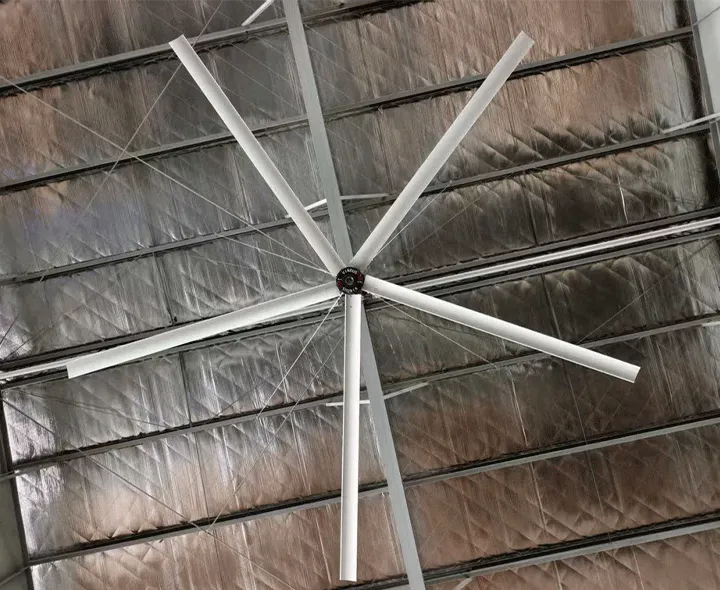
The P730 Series uses a permanent magnet synchronous motor (PMSM) and direct-drive technology. Its 16 ft and 18 ft models have five anodized aluminum blades and published power ratings of 450 W and 460 W respectively.
Découvrez les Ventilateurs HVLS série P730.
Série P780
The P780 Series is designed for larger industrial and commercial spaces. Its 20 ft and 24 ft models also feature five blades and PMSM direct-drive technology. Published power ratings are 560 W and 950 W respectively.
Découvrez les Ventilateurs HVLS série P780.
Both series feature adjustable speed, safety cables, and blade retention components according to their published product specifications.
For aircraft hangars, the final product choice must also consider the operating environment, electrical classification, and applicable safety requirements. A standard product certification should never be assumed to establish suitability for a hazardous classified area.
6. What Installation Clearances and Safety Factors Should Engineers Check?
Installing an HVLS fan in an aircraft hangar requires careful coordination with the building structure and other overhead systems.
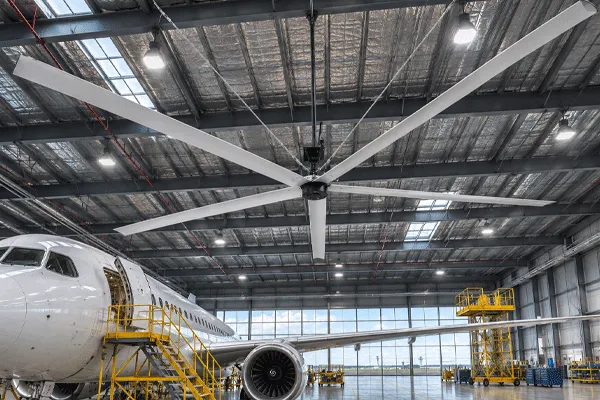
The roof may contain steel trusses, bridge cranes, radiant heaters, sprinkler pipes, fire suppression equipment, lights, and fall protection systems. These components can limit where a fan can be installed.
The Department of Defense’s UFC 4-211-01 specifically identifies the need to coordinate HVLS fan installation with overhead radiant heaters, fall protection, high-expansion foam generators, lighting, bird netting, bridge cranes, and sprinklers. It also calls for coordination with NFPA 13 sprinkler requirements.
Before approving an installation, the project team should review:
Soutien structurel
- Roof truss and beam capacity.
- Fan weight and mounting loads.
- Forces dynamiques pendant le fonctionnement.
- Vibration and structural connections.
- Required secondary safety components.
Overhead clearance
- Aircraft tail and wing clearance.
- Bridge crane travel paths.
- Hangar door tracks and moving equipment.
- Lighting and sprinkler locations.
- Fire suppression system components.
Electrical and environmental suitability
- Supply voltage and frequency.
- Applicable electrical area classification.
- Temperature and humidity conditions.
- Dust, chemicals, and corrosive exposure.
- Maintenance access and emergency procedures.
The structural engineer, mechanical engineer, electrical engineer, fire protection designer, and facility operator should review the proposed arrangement.
This is especially important in facilities that perform aircraft painting, fuel-related maintenance, hot work, or other operations with special fire and explosion risks.
7. How Should HVLS Fans Work with Hangar Ventilation and Exhaust Systems?
An aircraft hangar needs more than air circulation. It also needs a properly designed ventilation system that supplies outdoor air and removes heat, odors, and contaminants where required.
HVLS fans and mechanical exhaust equipment have different jobs.
| Équipement |
Primary function |
| Ventilateurs HVLS |
General air mixing and occupant comfort |
| Supply fans |
Introduce outdoor or conditioned air |
| ventilateurs d'extraction |
Extraire l’air intérieur |
| Hottes d'extraction localisée |
Capture contaminants near their source |
| HVAC equipment |
Control temperature and humidity |
| Air monitoring equipment |
Evaluate environmental conditions |
Consider an aircraft maintenance operation involving cleaning chemicals or engine servicing. An HVLS fan may improve general comfort, but it should not be used to push contaminated air away from one location and toward another occupied area.
The UFC aircraft hangar design criteria describe exhaust systems at heat or contamination sources and provide specific requirements for hangar exhaust and make-up air. Those criteria apply to their defined project context and should not be treated as a universal ventilation rate for every commercial hangar.
The ventilation engineer should determine the correct exhaust capacity, air intake locations, and pressure relationships according to the applicable design standards and actual maintenance activities.
The best hangar solution combines air mixing with correctly designed contaminant control.
8. How Can You Measure and Verify HVLS Fan Airflow Performance?
Installing fans does not automatically guarantee that the entire hangar receives useful airflow.
A proper commissioning process should confirm that the system performs as intended under actual operating conditions.
Useful verification methods include:
- Air velocity measurements: Measure air movement at selected working heights and locations.
- Smoke visualization: Observe how air travels around aircraft, equipment, and structural obstacles.
- Temperature measurements: Compare floor-level and roof-level temperatures.
- Pressure measurements: Evaluate the relationship between hangar areas and adjacent spaces.
- Operating checks: Confirm that fan speed, direction, controls, and safety components work correctly.
The NIOSH aircraft hangar investigation provides a useful example. Researchers used smoke visualization, measured air speed and direction, and evaluated pressure differences to identify areas with limited airflow.
They also found that blocked equipment and poorly operating ventilation fans could reduce actual system performance.
For a new HVLS project, the commissioning team should record baseline conditions before installation and compare them with measurements after the system is operating.
The results can help facility managers identify weak airflow areas and determine whether additional adjustments are necessary.
9. Can Intelligent HVLS Fan Controls Improve Hangar Operations?
Aircraft hangars often operate according to changing maintenance schedules. Some days may involve intensive aircraft servicing, while other days may have fewer employees and less equipment activity.
Running every fan at maximum speed throughout the day may not be necessary.
An intelligent control system can help operators adjust fan operation according to temperature, schedule, and working zones.
The VINDUS FanBrain system provides several useful functions:
- Centralized control of up to 10 fans from one HMI touchscreen.
- Independent control of different fan groups.
- Adjustable speed and rotation direction.
- Scheduled start and stop operation.
- Temperature-based fan operation.
- Integration support through Modbus and building management systems.
For example, a hangar can organize fans into separate groups according to the main service bay and other approved working areas.
Operators can then manage different operating schedules rather than treating the entire building as one control zone.
The system also supports temperature-based operation using roof-level and floor-level sensors, helping manage temperature differences under suitable conditions.
En savoir plus sur Système de commande intelligent HVLS FanBrain.
For aircraft hangars, any automatic control sequence should be reviewed with the facility’s fire protection, ventilation, and building management systems. It should not override safety interlocks or required exhaust operation.
HVLS Fans for Aircraft Hangars: Airflow, Worker Comfort, and Ventilation Planning
10. How Should You Select an HVLS Fan Supplier for an Aircraft Hangar Project?
Choosing a supplier is not simply about comparing fan prices.
Aircraft hangars have special structural, operational, and safety requirements. Buyers should look for a manufacturer that understands large-space airflow and can provide reliable technical information for project evaluation.
Avant de demander un devis, préparez les informations suivantes :
| Information required |
Why it matters |
| Hangar length and width |
Defines the building footprint |
| Roof and mounting height |
Determines suitable product configurations |
| Aircraft types and dimensions |
Helps identify clearance restrictions |
| Crane and equipment layout |
Identifies overhead obstructions |
| Existing ventilation system |
Helps coordinate air movement |
| Maintenance activities |
Identifies special ventilation requirements |
| Alimentation électrique |
Confirms product compatibility |
| Fire protection drawings |
Supports installation coordination |
| Operating schedule |
Helps plan controls and energy use |
What should buyers evaluate in a manufacturer?
Product engineering: Does the manufacturer offer different diameters and suitable mounting configurations?
Motor technology: Can the supplier provide information about motor design, power consumption, and maintenance requirements?
Safety documentation: Are the required product certifications, mounting details, and safety components available?
Control capability: Can multiple fans be controlled according to operating schedules and different building zones?
After-sales service: Are technical support, spare parts, and warranty arrangements clearly explained?
As a Sino-US joint venture manufacturer and solution provider, VINDUS specializes in HVLS fans, industrial ceiling fans, commercial ceiling fans, and intelligent airflow control systems.
We support global B2B buyers, HVAC contractors, industrial project developers, and facility operators with products for large industrial, commercial, logistics, agricultural, and sports facilities.
For aircraft hangar projects, our team can help evaluate suitable HVLS product configurations based on the supplied building information. Final installation design, ventilation engineering, hazardous-area suitability, and fire protection approval must be completed by the qualified project professionals.
Découvrez les VINDUS HVLS fan product range ou contact our team to discuss your project.
A successful aircraft hangar airflow project starts with the building’s real operating conditions. Share your floor plan, ceiling height, aircraft dimensions, and existing ventilation information with our team to begin evaluating a suitable solution.
Questions fréquemment posées
Can HVLS fans be installed in aircraft hangars?
HVLS fans can be considered for suitable hangar bays to support air mixing and worker comfort. However, the design must account for aircraft clearance, structural support, overhead equipment, sprinkler systems, fire protection, and applicable electrical requirements.
Do HVLS fans replace aircraft hangar exhaust systems?
No. HVLS fans provide general air circulation and temperature mixing. They do not replace dedicated exhaust systems or local fume extraction required for aircraft maintenance activities.
What size HVLS fan is suitable for an aircraft hangar?
The correct size depends on mounting height, building dimensions, aircraft positions, overhead obstructions, and required airflow. VINDUS offers P730 models in 16 ft and 18 ft diameters and P780 models in 20 ft and 24 ft diameters. A project-specific engineering review is required before selecting a model.
Can HVLS fans improve winter comfort in aircraft hangars?
Yes. In suitable installations, HVLS fans can help move warm air trapped near the roof back toward occupied areas. This process, known as destratification, can support more even temperature distribution.
How do hangar doors affect HVLS fan performance?
Open hangar doors can change indoor air movement due to outdoor wind, temperature differences, and air infiltration. Engineers should consider both open-door and closed-door conditions when planning fan placement and ventilation operation.
What safety standards should be considered when installing HVLS fans in aircraft hangars?
The project team should review applicable aircraft hangar fire protection standards, electrical requirements, structural design criteria, sprinkler coordination, and local building codes. NFPA 409, NFPA 13, and relevant mechanical and electrical standards may apply depending on the project.
Principaux points à retenir
- Aircraft hangars need an airflow plan that accounts for aircraft size, maintenance activities, and building conditions.
- HVLS fans can support general air mixing, worker comfort, and temperature destratification.
- Fan placement must consider aircraft wings, fuselages, cranes, hangar doors, lighting, and fire protection equipment.
- HVLS fans do not replace mechanical exhaust or local contaminant extraction.
- P730 and P780 provide different diameter options for large industrial spaces, subject to mounting-height suitability.
- Smoke visualization and air velocity measurements help verify actual airflow performance.
- Intelligent controls can support different fan operating schedules and zones.
- Qualified engineers and the local authority must review the final design and installation.
- Choose a supplier that can provide product specifications, safety documentation, technical support, and project-oriented recommendations.
Planning an aircraft hangar ventilation or cooling project? Contact VINDUS to discuss your building dimensions, mounting conditions, and HVLS fan requirements.