Michael Danielsson | CEO, Vindus Fans | Published July 28, 2026
HVLS fan energy savings come from destratification — pushing warm air trapped near the ceiling back down to occupant level, which lets heating systems run at a lower setpoint. Published field studies on large-space destratification report gas or heating-cost reductions ranging roughly from 19% to 30%, though the actual figure depends on ceiling height, climate zone, and the existing HVAC setup.
HVLS Fan Energy Savings: How Big Industrial Fans Lower HVAC Costs
Why Warm Air at the Ceiling Costs You Money
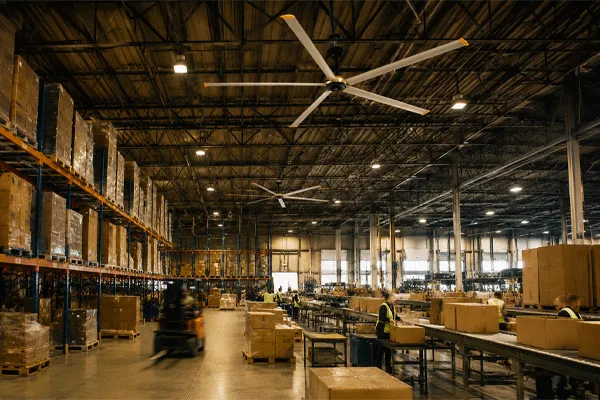
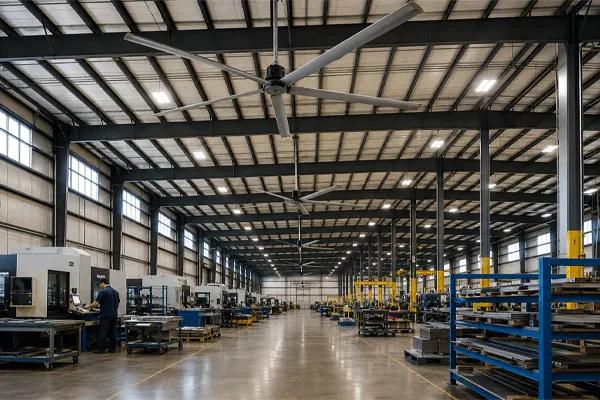
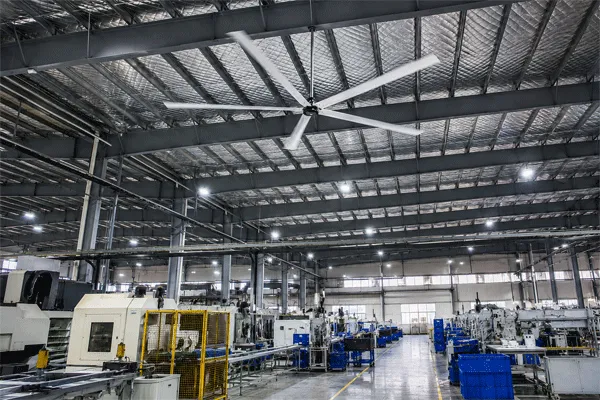
Warm air is less dense than cool air, so in any building with real ceiling height, it rises and pools near the roof while cooler air settles at floor level. In a warehouse or gym with a 25-foot ceiling, that gap between floor-level and ceiling-level temperature can run several degrees — and every degree of that gap is heat your furnace produced but your occupants never felt. The heating system keeps firing to hit the floor-level setpoint, while the roof deck loses that trapped heat to the outdoors faster than it should.
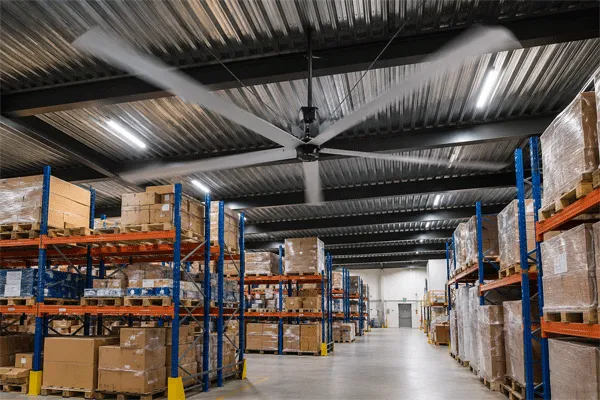
An HVLS fan addresses this directly. Running in forward rotation at low speed, it pushes a column of air down from the ceiling, which spreads out at floor level and recirculates back upward at the walls. Once floor and ceiling temperatures equalize, the thermostat is reading the room’s actual condition instead of a cold pocket at floor level — which means the heating system stops overcompensating.
What the Published Research Actually Shows
Company marketing pages for HVLS fans often cite energy savings without a source. Independent field studies exist, and the range they report is wider than any single “X% savings” headline suggests.
| Study / Source |
Setting |
Reported Result |
| ASHRAE Journal, April 2020 |
Airplane hangar, HVLS fan on vs. off |
Floor-to-ceiling gradient fell from 6°F to 0.7°F; normalized gas use dropped 29%The HVLS fan also reduced the normalized gas use by 29%, which consequently translated to significantly lower winter heating costs |
| 2009 ASHRAE Annual Conference paper |
Warehouse, five destratification fans |
Ceiling temperature down 4.0°C, floor temperature up 1.5°C, average 19.3% gas saving over the test period |
| Concordia University thesis (reviewing Aynsley’s warehouse data) |
Distribution warehouse |
26.4% reduction in gas usage from destratification |
| 2015 study, Building and Environment (as cited by industry publisher Brucker Co.) |
Large-space heating and cooling combined |
Reported roughly 30% of both heating and cooling costs saved through de-stratification and the cooling effect |
Notice none of these land at a round, marketable 20% or 30% by coincidence — they’re facility-specific measurements, and a hangar with single-corner gas heaters behaves differently than a warehouse with rooftop units. That spread is the honest answer: expect meaningful savings, not a fixed percentage.
The Misconception Thfat Trips Up ROI Estimates
The most common mistake in HVLS energy planning is assuming the savings percentage from one facility type transfers directly to another. A 25-foot warehouse ceiling with a single rooftop unit destratifies differently than a 15-foot retail space with wall-mounted heaters, and airplane hangars — the setting for some of the most-cited destratification studies — have unusually severe stratification because of large unheated air volumes and perimeter heating. Applying a hangar’s 29% figure to a mid-size distribution center’s budget will overstate the payback. The percentage matters less than the mechanism: bigger the existing floor-to-ceiling temperature gap, bigger the potential savings from closing it.
HVLS Fan Energy Savings: How Big Industrial Fans Lower HVAC Costs
Where the P780 Series Fits the Cost Side of the Equation
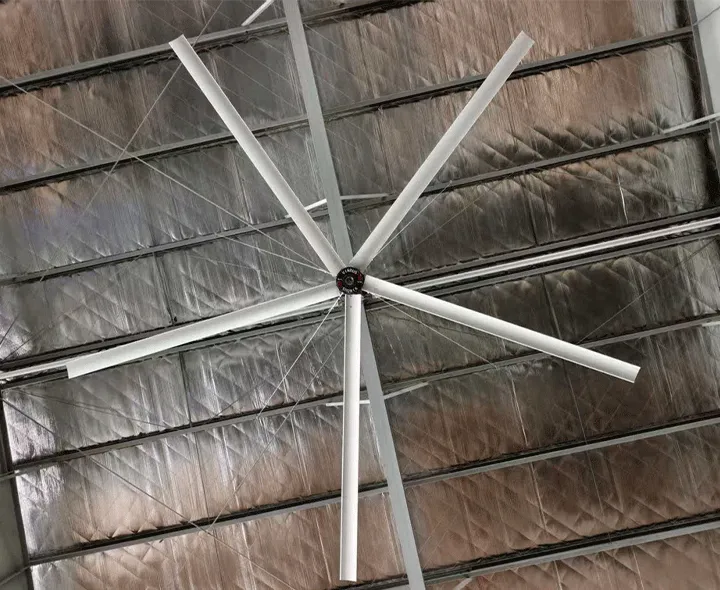
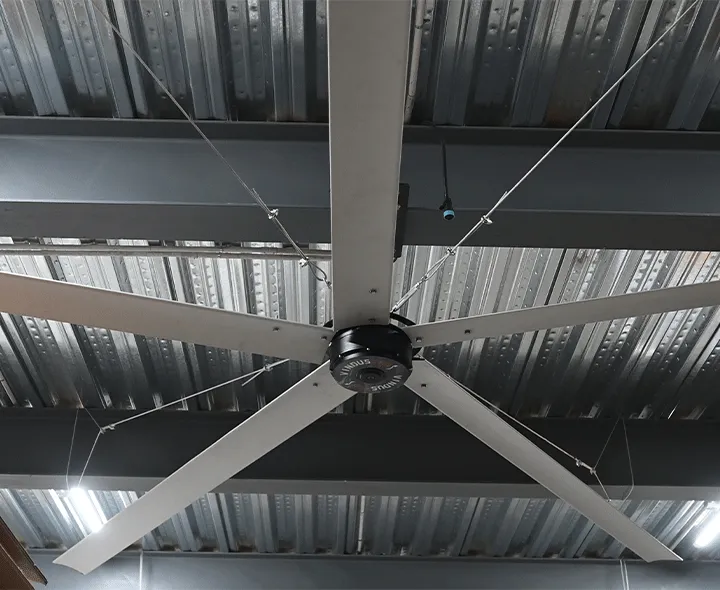
Savings only tell half the story — the other half is what the fan itself costs to run. The Vindus P780 Series is built around a permanent magnet synchronous motor (PMSM), which drives the blades directly with no gearbox stage. That matters for two reasons: fewer mechanical losses at the drivetrain, and a specified maximum draw under 1,000 W even at top speed, regardless of whether the unit is the 20 ft or 24 ft diameter model.
Compared to gearbox-driven HVLS designs — where torque passes through a reduction gearbox before reaching the blades — direct-drive PMSM systems lose less energy to mechanical friction along the way. That’s a design-level efficiency gain independent of the destratification savings above; it affects only what the fan itself consumes, not what it saves you on heating.
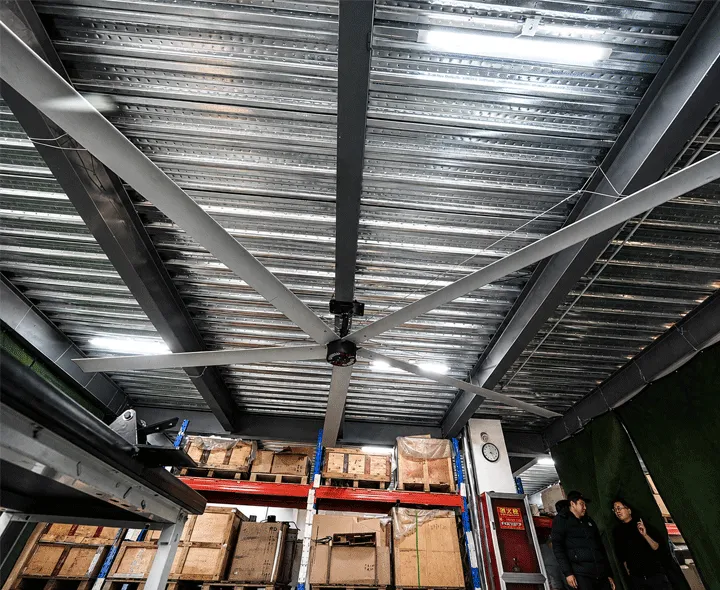
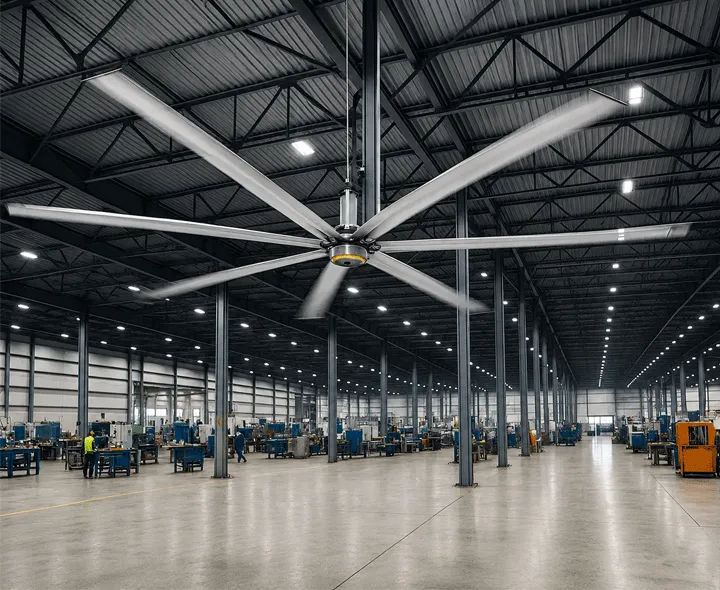
Le P780 is rated for ceiling heights of 20 to 33 feet, which puts it squarely in the range where destratification studies report their largest gaps — tall ceilings are exactly where warm air has the most room to pool. Controls run through a floor-level HMI connected by a single ceiling-to-floor cable, so speed adjustments (relevant if you’re tuning the fan for winter heating vs. summer cooling mode) don’t require sending someone up to the hub.
Working Out Your Own Payback, Step by Step
Vindus doesn’t publish fixed pricing — quotes are facility-specific, so exact dollar paybacks vary. Here’s the calculation framework used in published destratification analyses, which you can run with your own numbers:
- Pull your current annual heating (and cooling, if relevant) costfrom utility bills for the space in question, isolated from the rest of the facility if it’s metered separately.
- Estimate your floor-to-ceiling temperature gapduring heating season. A rough read with two thermometers — one at floor level, one near the roof deck — during a cold morning gives you a working number.
- Apply a conservative savings range, not a single figure. Given the published range above, model both a 19% and a 29% scenario rather than picking whichever number looks best.
- Add the fan’s own operating cost.At under 1,000 W and a typical local commercial electricity rate, running a P780 for a full heating season adds a modest, calculable draw — small relative to the heating savings, but it belongs in the math, not left out.
- Subtract fan operating cost from projected heating savingsto get net annual savings, then divide the fan’s installed cost (from your Vindus quote) by that net figure for a payback period in years.
This isn’t a substitute for a site visit — ceiling height, existing insulation, and current heater type all shift the numbers — but it gives you a defensible estimate before you request pricing.
HVLS Fan Energy Savings: How Big Industrial Fans Lower HVAC Costs
The Trade-Off Worth Naming
Destratification savings are real, but they’re heating-season-dependent by nature — buildings in mild climates with minimal winter heating load simply have less stratification to correct, so the percentage savings shown in the table above won’t scale down proportionally to a warm-climate facility with a small heating bill to begin with. A facility running mostly on cooling load, not heating, gets its savings mainly from the summer cooling-effect mode instead, which is a separate mechanism (moving air across occupants, not correcting a temperature gradient) and a different calculation entirely.
FAQ
Q: Do HVLS fans reduce cooling costs the same way they reduce heating costs?
A: No — cooling savings come from the fan’s cooling effect on occupants (moving air lets people feel comfortable at a higher thermostat setpoint), while heating savings come from destratification correcting the floor-to-ceiling temperature gap. They’re different mechanisms with different math.
Q: What’s a realistic energy savings percentage to plan around?
A: Published field studies range from about 19% to 30% on heating costs, varying by ceiling height, climate zone, and building type. Airplane hangars and tall warehouses tend toward the higher end; lower-ceiling or milder-climate spaces should plan conservatively.
Q: Does the P780’s low power draw meaningfully affect payback?
A: It reduces the operating-cost side of the equation, since a sub-1,000 W draw is what you subtract from your projected heating savings — but it’s a secondary factor compared to how large your existing floor-to-ceiling temperature gap is.