Síganos:
Teléfono: +1 951 565 7769
CORREO ELECTRÓNICO: [email protected]

HVLS Fan for Livestock Barns: Improve Dairy Farm Ventilation, Cooling and Animal Comfort

2026-09-15

Hot barns, poor air quality, and uneven airflow can reduce livestock performance and increase operating costs. Many dairy farms struggle with heat stress, ammonia buildup, and uncomfortable barn conditions during warm seasons. A properly designed HVLS fan system creates consistent airflow, improves ventilation, and provides a healthier environment for livestock.

An HVLS fan for livestock barns is a large-diameter ceiling fan designed to move high volumes of air at low speed. It improves air circulation, reduces heat stress in cattle, controls humidity and ammonia levels, and supports better animal comfort in dairy barns, cattle facilities, and modern livestock facilities.
Esquema del artículo

  1. Why Are HVLS Fans Important for Livestock Barn Ventilation?

  2. How Does an HVLS Fan Improve Airflow in Dairy Barns?

  3. What Are the Main Barn Fan Benefits for Livestock Farms?

  4. How Do HVLS Ceiling Fans Help Reduce Heat Stress in Cattle?

  5. Why Choose a Barn Ceiling Fan Instead of Traditional Fans?

  6. How Do HVLS Industrial Fans Improve Air Quality and Productivity?

  7. What Size HVLS Fan Does Your Dairy Farm Need?

  8. How Do AmeriWind HVLS Industrial Ceiling Fans Work in Large Barns?

  9. How Should Farmers Install and Maintain Barn Fans for Livestock?

  10. Frequently Asked Questions About HVLS Fans for Livestock Barns

Why Are HVLS Fans Important for Livestock Barn Ventilation?

Livestock farms face a constant challenge: animals generate heat, moisture, and gases every day. In enclosed barns, poor ventilation can quickly create uncomfortable conditions. Dairy cows, cattle, and other livestock need fresh air movement to maintain health, feeding behavior, and productivity.

Traditional ventilation methods often depend on small high-speed fans or panel fans. These systems may create strong airflow in limited areas but cannot move enough air across large barn spaces. As a result, some areas remain hot while others receive excessive airflow.

A large HVLS fan solves this problem by creating a wide column of air movement. Instead of pushing air in a narrow direction, the fan distributes airflow across the entire barn floor.

For dairy farmers, this means:

  • Better temperature control
  • Reduced humidity
  • Lower ammonia concentration
  • Improved animal comfort
  • More consistent airflow throughout the barn
  • Reduced dependence on air conditioning or cooling systems

Our Sino-US joint venture company specializes in HVLS fans, ventiladores de techo industriales, commercial ceiling fans, and intelligent airflow control systems. We design energy-saving ventilation solutions for agricultural buildings, warehouses, factories, sports facilities, and other large spaces.

How Does an HVLS Fan Improve Airflow in Dairy Barns?

An HVLS fan works by rotating large fan blades at a low-speed operation. The blades move large volumes of air downward and outward, creating natural air circulation throughout the barn.

Unlike conventional fans that only affect nearby areas, HVLS ceiling fans create a continuous airflow pattern that covers large spaces.

In dairy barns, airflow affects several important factors:

Barn Environment Factor Impact of HVLS Fan
Temperature Helps remove accumulated heat around animals
Humidity Supports moisture control
Ammonia Helps reduce stagnant air zones
Bedding condition Improves drying around bedding areas
Feed alleys Creates comfortable working areas
Animal comfort Provides cooling airflow at animal level

Cows are especially sensitive to heat. When temperatures rise, cattle reduce feed intake and spend more energy trying to cool themselves. This can directly influence milk production and farm profitability.

A properly positioned barn fan improves airflow where animals actually live — near the floor level — rather than only moving air near the ceiling.

What Are the Main Barn Fan Benefits for Livestock Farms?

Installing barn fans for livestock provides more than simple cooling. Modern farms use airflow management as part of their overall production strategy.

The biggest barn fan benefits include improved animal welfare, better working conditions, and lower energy consumption.

1. Reduce Heat Stress in Cattle

Heat stress is one of the biggest challenges for dairy operations.

When cows experience excessive heat, common signs include:

  • Reduced feed intake
  • Lower milk production
  • Increased water consumption
  • More standing behavior
  • Reduced reproduction performance

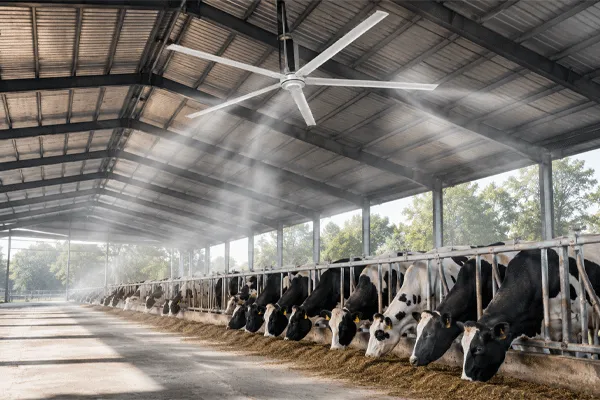
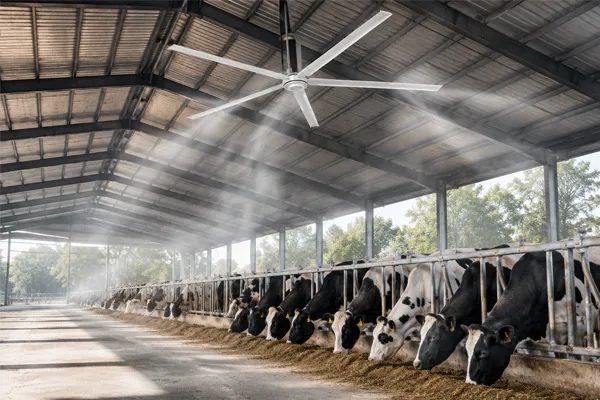
A high-volume HVLS fan creates cooling airflow over cattle, helping animals release body heat naturally.

Compared with high-speed fans, an HVLS fan provides gentle but powerful airflow without creating uncomfortable drafts.
2. Improve Barn Air Quality

Poor air quality is often caused by:

  • Humedad elevada
  • Manure gases
  • Ammonia accumulation
  • Limited fresh air exchange

A barn fan improves ventilation by continuously moving stale air away from animal areas.

Better air movement helps maintain healthier barn conditions and supports a cleaner environment for livestock.

3. Support Dairy Farm Productivity

Comfortable cows usually show better feeding behavior and improved daily performance.

Studies from agricultural extension organizations have shown that heat stress can negatively affect dairy cattle productivity. Proper ventilation and cooling strategies are widely recommended management practices.

For modern dairy farms, airflow is not just a comfort feature. It is a productivity investment.

How Do HVLS Ceiling Fans Help Reduce Heat Stress in Cattle?

Heat stress management has become a major priority for dairy farms worldwide.

Cattle naturally produce significant body heat. In hot climates, especially during summer, barns can develop hot spots where animals experience uncomfortable temperatures.

A large HVLS big fan reduces these problems by creating continuous airflow.

The working principle is simple:

  1. Large fan blades rotate slowly.
  2. The fan moves high-volume air downward.
  3. Air spreads across the barn floor.
  4. Moving air increases evaporation from the animal surface.
  5. Cattle experience a natural cooling effect.

This process is similar to wind cooling. The actual air temperature may not change dramatically, but animals feel cooler because heat leaves their bodies faster.

For farms using evaporative cooling systems, HVLS fans can improve cooling efficiency by distributing cooled air more evenly.

Why Airflow at Animal Level Matters

Many farmers focus only on ceiling height and ventilation openings. However, the most important airflow measurement is the airflow experienced by animals.

A good barn ceiling fan installation considers:

  • Altura del techo
  • Altura de montaje
  • Barn dimensions
  • Cow resting areas
  • Feed alleys
  • Bedding locations

The goal is not simply moving air near the ceiling. The goal is creating comfortable airflow where cattle spend their time.
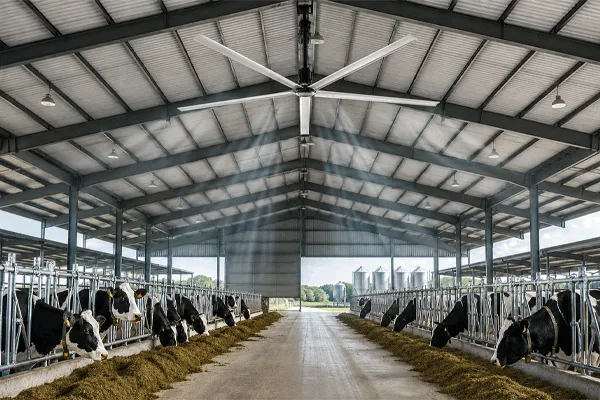
A properly designed system provides:

  • Consistent air movement
  • Stable temperature conditions
  • Reduced moisture accumulation
  • Improved animal comfort

Why Choose a Barn Ceiling Fan Instead of Traditional Fans?

Many livestock farms still use traditional high-speed fans, but these systems often have limitations in large agricultural buildings. Small fans can provide strong airflow in a specific area, yet they cannot effectively move air across the entire barn.

A modern barn ceiling fan works differently. By using a large diameter design and low-speed rotation, it creates a wider airflow pattern with lower energy consumption.

For large dairy barns and cattle facilities, this difference is important because animals are distributed across a large space. Cooling only one section of a barn does not solve the overall ventilation problem.

A comparison between traditional fans and HVLS systems:

Característica Ventiladores tradicionales de alta velocidad HVLS Fans for Livestock
Air movement range Limited area Covers large barn spaces
Operating speed High-speed rotation Low-speed operation
Consumo de energía Más alto Better energy efficiency
Noise level More noticeable Quiet operation
Airflow pattern Narrow airflow Wide air distribution
Solicitud Small areas Dairy barns, livestock facilities, industrial spaces

For farms with large ceiling heights, installing hvls ceiling fans can provide a more balanced solution.

The large diameter design allows the fan to move significant amounts of air while consuming less power compared with multiple smaller fans.

Our company provides industrial and commercial airflow solutions for agriculture, warehouses, manufacturing facilities, and public buildings. Each project is designed according to barn size, climate conditions, and livestock requirements.

How Do HVLS Industrial Fans Improve Air Quality and Productivity?

Large livestock facilities require more than cooling. They need a complete ventilation strategy that manages temperature, humidity, and air quality.

An industrial ceiling fan creates continuous air circulation that helps remove stagnant air areas inside the barn.

This is especially important in enclosed dairy facilities where gases such as ammonia can accumulate.

Managing Ammonia and Moisture

Ammonia comes mainly from animal waste and manure management systems. High ammonia levels may affect animal health and worker comfort.

Proper airflow helps:

  • Reduce ammonia concentration
  • Remove humid air
  • Improve fresh air distribution
  • Maintain cleaner bedding areas
  • Support healthier barn conditions

For dairy farms, ventilation is directly connected with animal welfare.

A well-designed hvls industrial ceiling airflow system can work together with natural ventilation openings, exhaust systems, and cooling equipment.

Supporting Livestock Productivity

Comfortable animals generally perform better.

When cattle are exposed to excessive heat, they may spend less time eating and more time trying to cool themselves. This can influence milk production and overall farm efficiency.

HVLS fans support productivity by creating a stable environment for livestock.

Benefits include:

  • Better feeding conditions
  • Improved resting behavior
  • Reduced heat stress
  • More comfortable working conditions for employees

For commercial dairy operations, investing in airflow management is not only an environmental improvement but also a long-term business decision.

What Size HVLS Fan Does Your Dairy Farm Need?

Choosing the correct fan size depends on several factors. There is no single solution for every barn.

Professional selection considers:

  • Barn dimensions
  • Altura del techo
  • Animal density
  • Climate conditions
  • Existing ventilation equipment
  • Desired airflow coverage

Common HVLS fan sizes include:

Diámetro del ventilador Typical Application
12-16 feet Small barns and livestock areas
18 feet Medium dairy barns and agricultural buildings
20-foot HVLS fan Large livestock facilities
24 pies Very large barns, warehouses, and industrial buildings

For example, an 18ft AmeriWind HVLS industrial ceiling fan can be suitable for many medium-to-large agricultural buildings where wide airflow coverage is needed.

A larger fan does not simply mean stronger cooling. The correct combination of diameter, speed, and installation height creates the best airflow performance.

Factors Affecting HVLS Fan Selection

1. Barn Dimensions

The length, width, and ceiling height determine how many fans are required.

Large barns with higher ceilings often benefit from fewer large fans instead of many small fans.

2. Mounting Height

Correct mounting height allows the fan to create a large air column that reaches animal areas.

A fan installed too high may not deliver enough airflow near the livestock level.

3. Climate Conditions

Hot and humid regions may require stronger airflow strategies.

Some farms combine:

  • Ventiladores HVLS
  • Enfriamiento evaporativo
  • Ventilation curtains
  • Exhaust systems

to create a complete environmental control solution.

How Do AmeriWind HVLS Industrial Ceiling Fans Work in Large Barns?

The AmeriWind HVLS industrial ceiling fan is designed for large-space airflow applications, including livestock barns, warehouses, factories, and commercial buildings.

As a Sino-US joint venture manufacturer, we focus on reliable airflow technology, energy-saving operation, and intelligent control systems.

The AmeriWind fan features include:

  • Large-diameter fan design
  • Efficient motor system
  • Control de velocidad variable
  • Intelligent airflow adjustment
  • Durable fan blades
  • Low operating noise
  • Long service life

These features help farms maintain stable airflow throughout changing weather conditions.

Why Large Farms Choose HVLS Big Fans

A traditional industrial fan pushes air in one direction. An HVLS big fan creates a large circulation pattern.

The fan generates a downward airflow column that spreads outward after reaching the floor.

This creates:

  • Wider air coverage
  • Better air circulation
  • More comfortable animal-level airflow
  • Lower energy requirements

For modern livestock facilities, this approach provides a practical alternative to installing many smaller fans.

How Should Farmers Install and Maintain Barn Fans for Livestock?

Correct installation determines the final performance of any ventilation system.

Before installing barn fans for livestock, professional engineers should evaluate:

  • Barn layout
  • Animal locations
  • Ceiling structure
  • Electrical supply
  • Airflow requirements

Recommended Installation Considerations

Installation Factor Recomendación
Mounting position Centered above important animal areas
Altura del techo Match fan specification
Spacing Based on airflow coverage
Control system Use adjustable speed control
Mantenimiento Regular inspection and cleaning

A variable speed system allows farmers to adjust airflow according to seasons.

During mild weather, lower speeds may be enough. During extreme heat, higher airflow levels can help cattle stay comfortable.

Maintenance Tips for Long-Term Performance

Regular maintenance helps maintain energy efficiency and reliability.

Recommended checks include:

  • Inspecting fan blades
  • Checking motor operation
  • Cleaning dust buildup
  • Testing control systems
  • Checking mounting hardware

Because livestock environments contain dust and moisture, regular inspection is important for maintaining consistent airflow.

Frequently Asked Questions About HVLS Fans for Livestock Barns

Can HVLS fans really help dairy cows during hot weather?

Yes. HVLS fans improve airflow around cattle and help animals release body heat more effectively. By creating continuous air movement, they can reduce heat stress and improve comfort during warm seasons.

Are HVLS fans suitable for small livestock barns?

Yes. HVLS fans are available in different sizes. Smaller agricultural buildings can use compact models, while large dairy barns and commercial farms can use larger industrial ceiling fans.

How much energy can an HVLS fan save compared with traditional fans?

Energy savings depend on fan size, operating hours, and barn conditions. In many large facilities, one large HVLS fan can replace multiple smaller high-speed fans while providing broader airflow coverage.

What is the ideal height for installing a barn ceiling fan?

The correct installation height depends on the fan diameter and barn structure. Professional installation considers ceiling height, airflow requirements, and animal-level comfort.

Can HVLS fans reduce ammonia levels in dairy barns?

HVLS fans do not remove ammonia directly, but improved ventilation and air movement help prevent stagnant air areas where ammonia can accumulate.

Do HVLS fans work with other livestock ventilation systems?

Yes. HVLS fans can work together with exhaust fans, cooling pads, natural ventilation systems, and smart environmental controls to create a complete barn ventilation solution.

Conclusion: Why HVLS Fans Are a Smart Investment for Livestock Facilities

Modern livestock production requires more than simply providing shelter. Farmers need efficient solutions that improve animal comfort, reduce operating costs, and maintain healthy barn conditions.

A properly designed HVLS fan system helps dairy farms achieve these goals by creating reliable airflow, improving ventilation, and supporting better livestock environments.

For large barns, cattle facilities, and agricultural buildings, HVLS technology provides an effective way to manage heat, humidity, and air quality.

Key points to remember:

  • HVLS fans move high-volume airflow across large livestock spaces.
  • They help reduce heat stress in dairy cattle and improve animal comfort.
  • Better ventilation supports healthier barn conditions and improved air quality.
  • Large ceiling fans can reduce the need for multiple smaller fans.
  • Proper fan sizing depends on barn dimensions, ceiling height, and airflow requirements.
  • Variable speed HVLS systems provide flexible control for changing weather conditions.
  • Professional installation ensures consistent airflow throughout the barn.

Choosing the right HVLS fan for livestock barns is not only about cooling. It is about creating a healthier, more productive, and more energy-efficient future for modern dairy farming.

Hola, soy yo Michael Danielsson, CEO de Vindus Fans, con más de 15 años de experiencia en la industria de la ingeniería y el diseño. Estoy aquí para compartir lo que he aprendido. Si tienes alguna pregunta, no dudes en contactarme en cualquier momento. ¡Crezcamos juntos!

Contáctenos
Simplemente complete su nombre, dirección de correo electrónico y una breve descripción de su consulta en este formulario. Nos comunicaremos con usted dentro de las 24 horas.