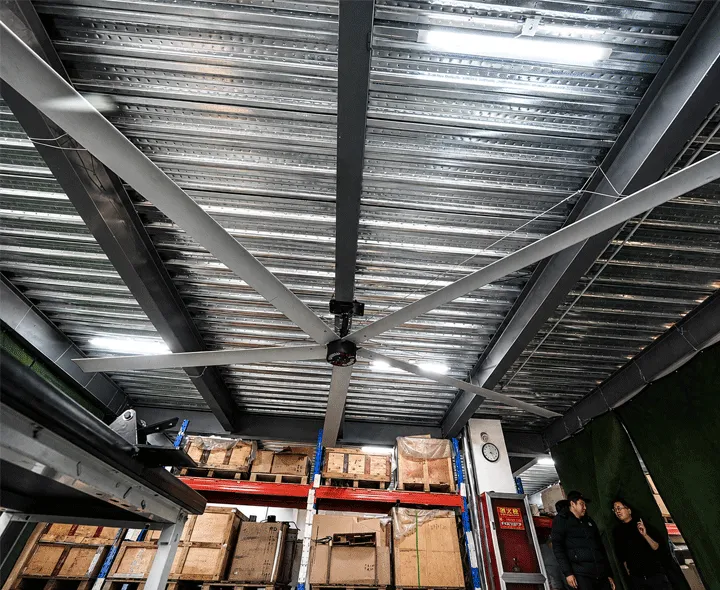
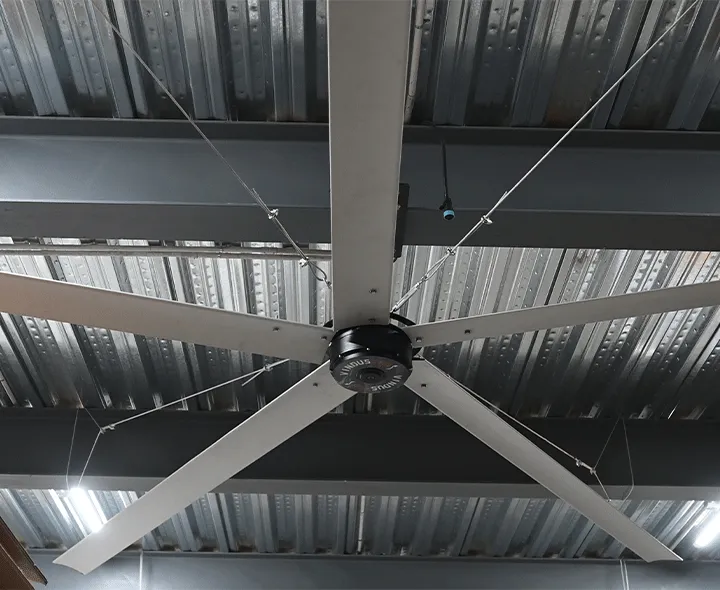
Hot, still air makes workers tired, customers uncomfortable, and buildings expensive to cool. When regular fans cannot reach every corner, the problem grows. A well-designed HVLS ceiling fan can move air gently, lower heat stress, and support better comfort with less energy waste.
Commercial industrial ceiling fans are large, high-efficiency fans designed to move large volumes of air across factories, warehouses, gyms, schools, and commercial buildings. An HVLS fan uses a large blade span and low-speed motor to create steady airflow, improve air circulation, support HVAC performance, and reduce operating costs in large spaces.
文章提纲
- What Are Commercial Industrial Ceiling Fans?
- Why Do Large Spaces Need an HVLS Fan?
- How Does HVLS Fan Technology Improve Airflow?
- Industrial Ceiling Fan vs Regular Fans: What Is the Difference?
- What Size Fan Do You Need for a Warehouse, Gym, or Factory?
- Which Motor and Blade Design Should You Choose?
- Do Commercial Ceiling Fans Help Reduce HVAC Costs?
- Should You Choose a Fan With Light, Remote, or Without Lights?
- What Styles and Mounting Options Are Available?
- How Can a Manufacturer Help You Choose the Right Industrial HVLS Solution?
- 常见问题解答
- 关键要点
What Are Commercial Industrial Ceiling Fans?
A commercial industrial ceiling fan is a large air-moving system used in big buildings where comfort, ventilation, and energy control matter every day. Unlike a small household ceiling fan, it is built for long operating hours, wider coverage, and safer performance in demanding spaces.
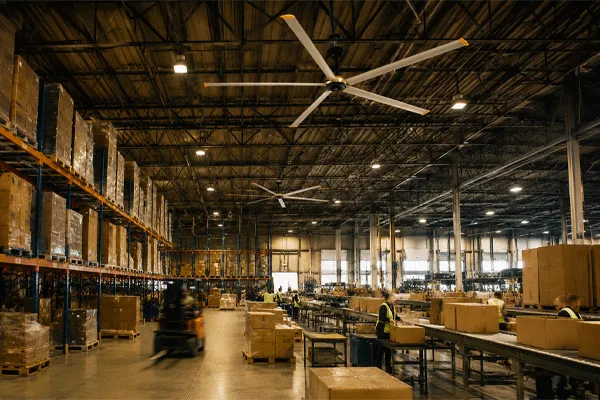
In our HVLS fans manufacturing plant, we often support projects for a warehouse, factory, school hall, sports center, and gym. These buildings have one thing in common: they need steady airflow over a wide area. A normal fan can cool one corner. A large system can support the whole space.
The term HVLS means high volume, low speed. An 超低烟无卤风扇 uses long blades and a strong motor to move massive amounts of air slowly and smoothly. This creates comfort without harsh wind, noise, or high energy consumption.
What Are Commercial Industrial Ceiling Fans?
Why Do Large Spaces Need an HVLS Fan?
Large buildings often have high roofs, open floors, and uneven temperatures. Warm air rises. Cool air stays lower. Without proper movement, people feel hot in one area and cold in another. This is why large spaces need better air circulation.
A large ceiling fan helps mix the air from top to bottom. It can eliminate hot spots, reduce stuffiness, and make workers feel more comfortable during long shifts. In spaces like factories and warehouses, comfort is not just a nice extra. It affects safety, mood, and productivity.
For B2B buyers, the main goal is simple: move air better while using less power. A good hvls ceiling fan is designed to move air over wide floor areas. It works well in large spaces like warehouses, workshops, logistics centers, and indoor sports facilities.
How Does HVLS Fan Technology Improve Airflow?
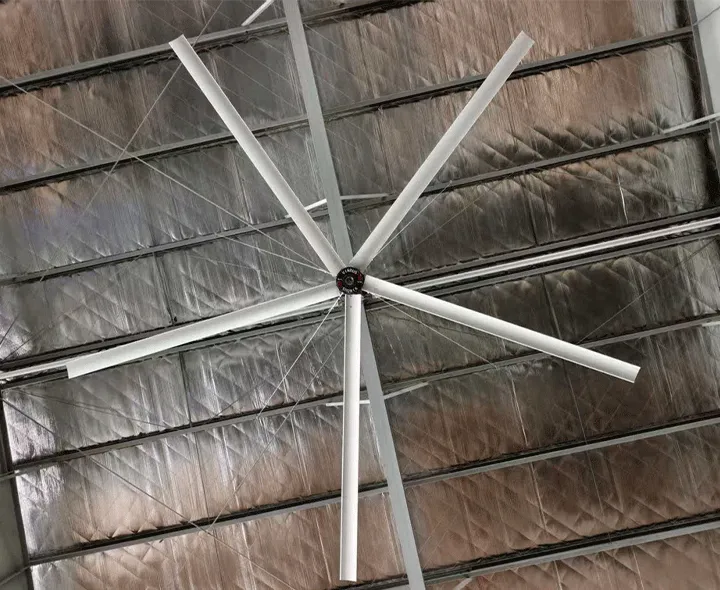
HVLS fan technology works by moving amounts of air with a wide blade diameter at low speed. Instead of blasting air in one direction, it creates a wide air column that travels down to the floor and spreads outward. This makes the space feel fresher and more balanced.
The wide blade design is important. A longer blade moves more air with fewer revolutions. That means quieter operation, smoother movement, and better comfort. HVLS fans are built for this type of slow, stable performance.
Here is a simple airflow comparison:
| 风扇类型 |
空气流动 |
覆盖范围 |
最佳用途 |
| Small fans |
Fast, narrow airflow |
Local area |
Small rooms or workstations |
| Standard industrial fan |
Strong direct wind |
Medium zone |
Spot cooling |
| HVLS 风扇 |
Wide, gentle airflow |
Large areas |
Warehouses, factories, gyms |
| Integrated HVLS + HVAC |
Balanced air support |
Whole building |
Energy-saving comfort control |
Industrial Ceiling Fan vs Regular Fans: What Is the Difference?
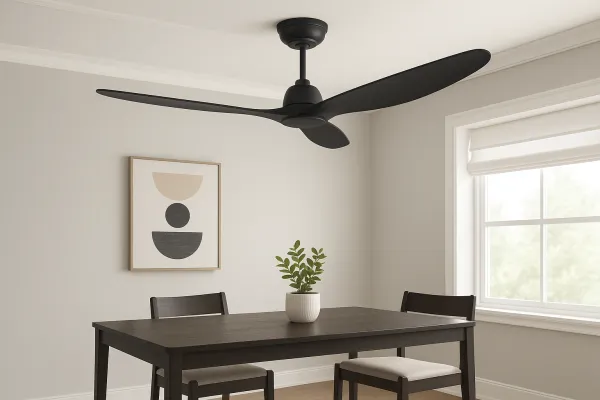
An industrial ceiling fan is not just a larger home fan. It has stronger parts, a more durable frame, and a heavy duty structure for commercial use. Industrial ceiling fans are designed to run for long hours in busy buildings.
Regular fans often create strong wind near the unit but fail to cover big spaces. By contrast, large industrial ceiling fans are made to move large volumes of air across wide floor areas. They help reduce stagnant air and support more even temperatures.
A small ceiling fan with light may suit a home, café, or small office. But commercial ceiling fans for industrial sites must focus first on safety, balance, blade strength, and reliable motor control. For a plant, warehouse, or sports center, performance matters more than decoration.
Industrial Ceiling Fan vs Regular Fans: What Is the Difference?
What Size Fan Do You Need for a Warehouse, Gym, or Factory?
Fan size depends on roof height, floor area, obstacles, and building use. A 12-foot fan may fit a smaller shop, while a 24-foot industrial hvls system can serve large production or storage areas. The right size prevents both weak airflow and excessive wind.
For lower ceilings, some buyers ask about industrial 56 inch models, inch industrial ceiling fans, or inch ceiling fans for smaller commercial rooms. For wider spaces, a 72 inch industrial ceiling model may help, but true HVLS systems are usually much larger.
A good rule is this: choose based on coverage, not just diameter. Our engineering team checks roof structure, floor layout, installation height, and safety clearance before recommending fan options.
| 应用 |
Common Need |
Suggested Fan Direction |
| 仓库 |
Heat control, worker comfort |
Large HVLS coverage |
| 健身房 |
Fresh feeling, quiet operation |
Wide and smooth airflow |
| Factory |
Safer working temperature |
Durable industrial structure |
| School hall |
Comfort and low noise |
Balanced speed control |
| Commercial building |
Customer comfort |
Modern appearance and efficiency |
| Shop ceiling |
Focused but steady air movement |
Smaller commercial model |
Which Motor and Blade Design Should You Choose?
The motor is the heart of any large fan. A reliable dc motor can improve control, reduce noise, and support energy efficiency. For heavy commercial use, buyers should look for stable torque, low maintenance, and safe speed regulation.
For large industrial buildings, the M750 系列 HVLS 风扇 can be a strong option when buyers need large-diameter coverage, low-speed air movement, and dependable performance for high-ceiling spaces. For medium-sized commercial and industrial buildings, the M650 系列 HVLS 风扇 may be a practical fit.
An industrial dc motor works especially well when paired with smart control systems. A 6 speed remote or control panel can help teams adjust speed based on season, shift, or occupancy. A ceiling fan with remote may be useful in commercial rooms where simple operation matters.
The blade should be strong, balanced, and shaped for airflow with minimal drag. Fans are engineered to move air efficiently, not just spin fast. Better blade design can improve comfort while reducing strain on the motor.
Do Commercial Ceiling Fans Help Reduce HVAC Costs?
Yes, the right system can support hvac performance. In summer, the fan helps people feel cooler by moving air in summer across the skin. In winter, slow reverse operation can push warm air down from the roof area. This helps the building use heating and cooling more wisely.
Many facilities use HVLS fans with hvac systems to improve cooling and ventilation. In suitable buildings, this can help reduce operating costs by up to 30 percent, depending on layout, climate, fan placement, and HVAC settings.
Simple energy impact chart:
| Area Improved |
HVLS 之前 |
HVLS 之后 |
| Air comfort |
不均匀 |
More balanced |
| Hot spots |
Common |
减少 |
| HVAC load |
更高 |
Lower support load |
| Worker comfort |
Unstable |
More consistent |
| Energy use |
Less controlled |
Better managed |
Ceiling fans improve comfort by moving air efficiently. That does not mean they replace air conditioning in every building. Instead, they help the whole system work smarter. If your facility has long working hours, dust exposure, or tough operating conditions, you can also review heavy duty industrial ceiling fans for stronger industrial applications.
Should You Choose a Fan With Light, Remote, or Without Lights?
Some commercial buyers want a fan that includes lighting. A ceiling fan with light may work in showrooms, retail spaces, offices, or smaller commercial areas. Fans with lights can save ceiling space when both lighting and airflow are needed.
In industrial buildings, many buyers prefer a fan without light. Large HVLS equipment is often installed high above work areas where separate lighting systems already exist. For this reason, industrial ceiling fans without lights are common in production halls, storage areas, and sports centers.
A light and remote package can be practical for smaller rooms, but not always for heavy industrial projects. The best choice depends on safety, maintenance access, roof height, and building purpose. In many warehouses, without lights is the cleanest and safest option.
What Styles and Mounting Options Are Available?
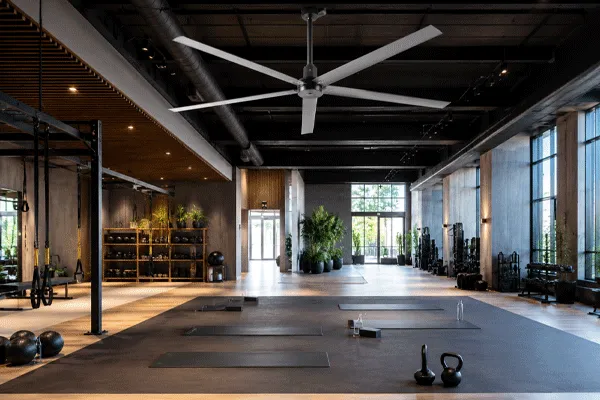
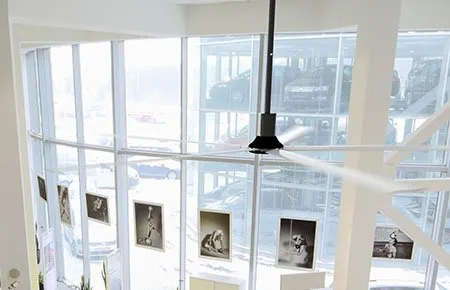
Commercial buyers now care about both function and appearance. A black industrial ceiling design can match modern gyms and retail-style spaces. A modern black ceiling fan or black ceiling fan with remote can work well in customer-facing areas.
For lighter commercial design, brushed nickel, brushed nickel ceiling finishes, and modern brushed nickel styles can suit schools, halls, restaurants, and public buildings. A matte black finish often fits sports centers and modern industrial interiors.
Mounting also matters. A downrod mount ceiling fan is useful when the roof is high and the fan needs to sit at the right height. For a foot ceiling above work areas, the mounting plan must consider blade clearance, roof beams, lights, sprinklers, and safe service access.
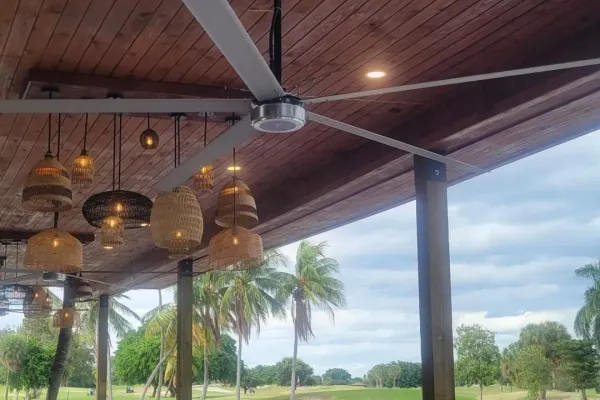
Where Can Outdoor and Industrial Style Ceiling Fans Be Used?
An outdoor ceiling fan is made for areas with moisture, dust, or open-air exposure. An outdoor industrial ceiling solution may be used in loading bays, covered sports areas, livestock facilities, and semi-open workshops.
An industrial style ceiling fan can also be used in commercial interiors where the owner wants a bold, modern look. Industrial style ceiling fans are popular in gyms, cafés, training centers, and large retail areas. But style should never come before safety.
For buyers comparing the market, names such as big ass fans may appear often. However, many global B2B customers also choose factory-direct HVLS manufacturers because they need custom size planning, export support, and cost-effective project solutions. For shopping malls, airports, breweries, retail halls, and other public buildings, large 商用吊扇 can also support steady comfort and air movement.
Where Can Outdoor and Industrial Style Ceiling Fans Be Used?
How Can a Manufacturer Help You Choose the Right Industrial HVLS Solution?
As an HVLS fans manufacturing plant, we do more than provide products. We help customers match fan size, roof height, blade span, motor type, installation method, and control system to the real building. This is important because every site is different.
Fans are built for movement, but the right project design makes the difference. Fans are built to last only when material, balance, safety system, and installation plan match the building. That is why we review drawings, photos, roof details, and usage needs before selection.
For B2B buyers, this support reduces risk. Factories, commercial buildings, sports centers, schools, and warehouses need reliable air movement, safe operation, and lower long-term costs. A professional manufacturer helps you choose a solution that is practical, durable, and easy to maintain.
Case Study: Improving Comfort in a Manufacturing Facility
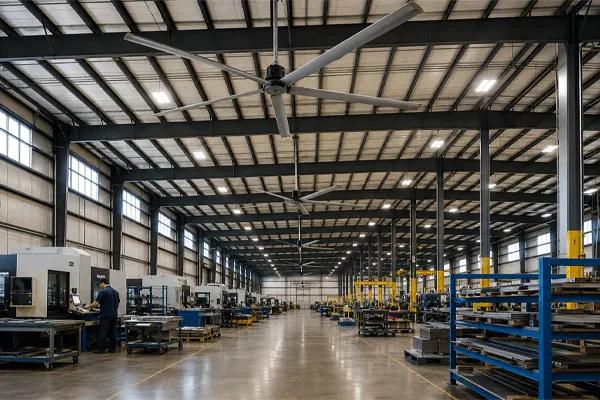
A metal parts manufacturer had a common problem. In summer, workers near the center of the workshop felt hot and tired. The building had a high roof, several production lines, and uneven cooling. Small fans helped only in limited spots.
After reviewing the layout, we recommended several HVLS units placed above key work zones. The goal was not to create strong wind. The goal was circulating air gently across the floor area and mixing trapped warm air near the roof.
After installation, the plant reported better comfort during long shifts and more stable temperature feeling across the workshop. The customer also adjusted its HVAC setpoint, which helped reduce power pressure during hot days.
Project result summary:
- Better comfort in production zones
- Fewer hot spots around equipment
- More even airflow across work areas
- Reduced need for many small fans
- Easier building-wide air management
Quick Buyer Checklist Before Ordering
Before buying a large commercial fan, prepare the following details:
- Building length, width, and roof height
- Ceiling structure and beam position
- Photos or drawings of the installation area
- Main purpose: cooling, ventilation, destratification, or all three
- Existing HVAC layout
- Power supply requirements
- Indoor, outdoor, or semi-outdoor environment
- Preferred control method
- Any safety or local compliance needs
This helps the manufacturer recommend the right system faster and more accurately.
常见问题解答
What is an HVLS fan?
An HVLS fan is a high-volume, low-speed fan. It uses a large blade span and slow rotation to move a wide column of air. This helps cool people, balance temperature, and improve comfort in large buildings.
Are industrial ceiling fans good for warehouses?
Yes. They are ideal for warehouses because they move air across wide open floors. They help reduce heat buildup, improve worker comfort, and support HVAC performance in storage and logistics areas.
Can a large ceiling fan replace air conditioning?
Not always. A large fan does not lower air temperature like air conditioning. It improves the way air feels by creating movement. In many buildings, it works best together with HVAC.
What is the best fan for a gym?
A quiet HVLS model is often a good choice for a gym. It moves air gently across courts, training zones, and seating areas without creating strong direct wind.
Should I choose a reversible ceiling fan?
A reversible ceiling fan can be useful because it supports seasonal air control. In summer, it helps people feel cooler. In winter, it can push warm air down from the roof area.
How long do industrial fans last?
A well-built industrial fan can run for many years with proper installation and maintenance. Key factors include motor quality, blade balance, control system, operating hours, and service environment.
关键要点
- Commercial industrial ceiling fans help improve comfort in warehouses, factories, gyms, schools, and commercial spaces.
- HVLS systems move large volumes of air slowly, quietly, and efficiently.
- The right motor, blade design, and installation height are critical for performance.
- Large fans can support HVAC systems and may help reduce energy costs in suitable buildings.
- Some projects need lights or remote control, while many industrial sites prefer fans without lights.
- A professional HVLS fans manufacturing plant can help you choose the right size, layout, control system, and installation plan.
- For large commercial and industrial buildings, the best fan is not always the biggest one. It is the one matched correctly to your space.