Michael Danielsson | CEO, Vindus Fans | Published August 6, 2026
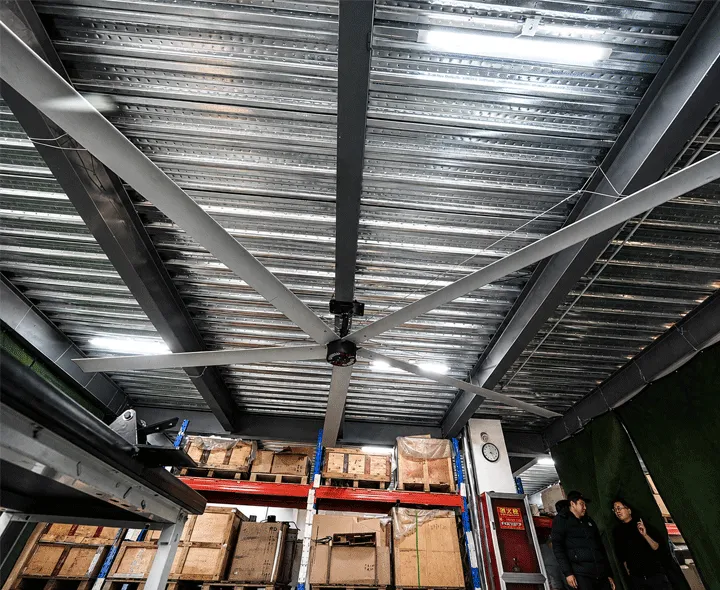
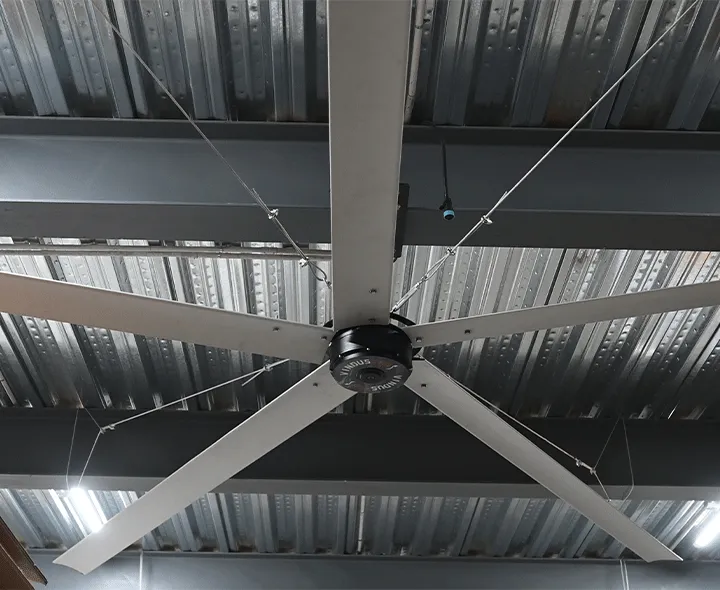
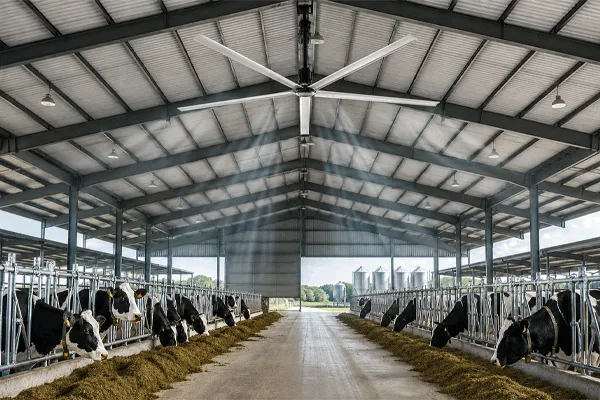
In agricultural buildings, Ventiladores HVLS move slow, wide columns of air to break up trapped heat layers, keep moisture from settling on surfaces, and hold air moving through the occupied zone during still weather. They circulate air. They do not condition it.
That distinction is the whole basis for whether one belongs in your building, so it is worth being unusually clear about before anything else.
HVLS Fans for Agricultural Cooling and Ventilation
Farm Buildings Have an Air Problem That Warehouses Do Not
A dry-goods warehouse fights heat and stagnation. An agricultural building fights heat, stagnation, and water — most of it produced inside the building, continuously, by whatever is living or stored in it.
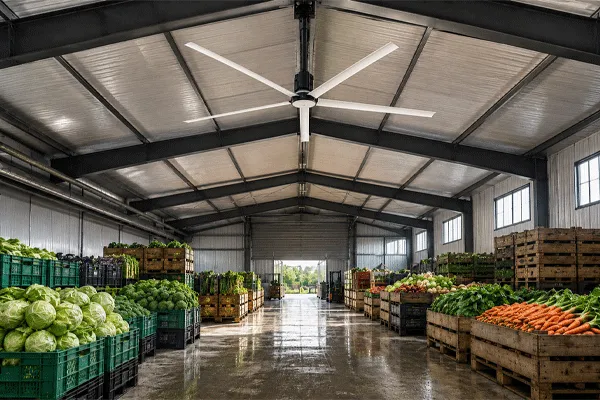
Animals respire and perspire. Bedding and manure release moisture and ammonia. Wash-down water evaporates. Freshly harvested produce and stored grain give off both heat and water vapour as they respire. Add a heated space in cold weather and that moisture goes looking for the coldest surface available, which is the underside of the roof deck, the purlins, and any uninsulated steel. It condenses there, then drips back down.
Meanwhile the same building has the vertical gradient every tall structure has. Warm air rises to the apex and sits. In summer that heat sits above the animals or the crop instead of leaving, and in winter it sits above the heater’s thermostat, which then keeps calling for heat the building already has.
Natural ventilation is designed to solve this and often does. On a windless August afternoon, or a still, damp November morning, it does not. Those are precisely the hours when the building is under the most stress, and they are the hours an HVLS fan is bought for.
What the Fan Actually Does to That Air
Three effects, and they are worth separating because they operate on different things.
Destratification. A wide, slowly rotating blade set pushes a broad column of air down to the floor, where it spreads outward and rises again along the walls. The building’s air turns over as one volume. The apex-to-floor temperature difference narrows. In a heated building this is a direct reduction in heating demand, because heat produced at floor level stops disappearing upward and staying there.
Surface drying. Air moving continuously across a floor, a wall, or a bedding surface raises the evaporation rate at that surface. Damp bedding dries faster between changes. Condensation has less opportunity to form and pool, because moving air prevents the still, saturated boundary layer that condensation needs. This is where the moisture-control benefit actually comes from — not dehumidification, but disruption of stagnant film.
Convective and evaporative cooling on living things. Air movement over skin or a coat carries heat and moisture away, which lowers the perceived temperature without the dry-bulb temperature changing. This is the same mechanism that makes a fan feel good to a person, and it is why circulation matters most on hot, still days.
Ask any supplier for airflow measured under AMCA 230-15, the Air Movement and Control Association’s ceiling-fan air performance standard, alongside ANSI/ASHRAE 216P, which covers HVLS fan performance specifically. Numbers produced any other way cannot be compared between brands. Vindus publishes performance descriptions rather than per-model figures on the site; the measured report for a specific model is available on request, and you should be requesting it from every vendor you are considering.
HVLS Fans for Agricultural Cooling and Ventilation
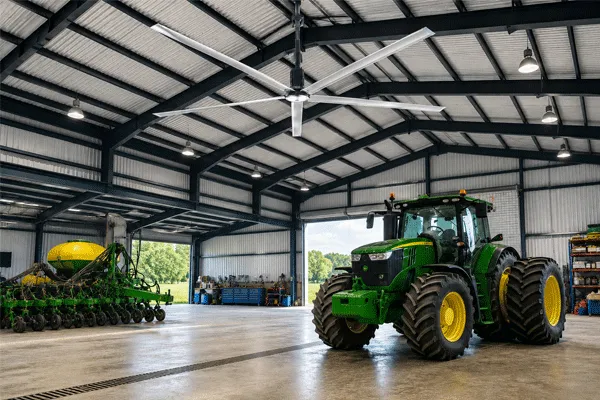
Most agricultural structures are not 30 ft to the deck. Barns, sheds, poultry houses, packing rooms and machinery buildings typically sit far lower, and that puts them in the P680’s range rather than the larger P780’s.
| Specification |
P680 Series |
| Diameters available |
8 ft to 14 ft |
| Suitable ceiling height |
10–25 ft |
| Designed for |
Medium-size spaces — workshops, logistics areas, retail, restaurants, outdoor patios |
| Motor architecture |
PMSM direct drive, no gearbox |
| Performance standards referenced |
AMCA 230-15, ANSI/ASHRAE 216P |
| Safety compliance |
CE, CB, EN, IEC |
| Garantía |
3 years on defective components and premature failure |
Two rows deserve comment.
The 10–25 ft window is the deciding constraint. Not floor area, not herd size, not bay count. Measure to the underside of the structure at the actual mounting point. A monopitch shed whose low eave is 11 ft and whose ridge is 22 ft may accept a fan near the ridge and refuse one two bays over. If the building runs above 25 ft — some modern free-stall barns and large machinery halls do — the P780 Series covers 20–33 ft with 20 ft and 24 ft diameters.
The gearless drivetrain matters more here than elsewhere. A direct-drive PMSM has no reduction gearbox, so there is no gear oil to check, change, or leak. Over a feed alley, a bedding pack, a milking parlour, or a produce grading line, an oil drip is not a housekeeping issue — it is a contamination event with a paper trail. Removing the gearbox removes that failure mode entirely rather than managing it.
A note on availability, because it causes confusion: the E680 Series, which covers 2.4 m to 4.3 m diameters at 3–8 m ceiling heights, is not sold in the United States. For U.S. agricultural projects the P680 is the relevant line.
HVLS Circulation Compared With the Alternatives
Farms rarely choose between an HVLS fan and nothing. The realistic comparison is against equipment already in the building.
| Dimension |
HVLS fan (P680) |
Box / panel fans on posts |
Tunnel ventilation |
Natural ventilation only |
| Air pattern |
Wide, slow, whole-volume mixing |
Narrow, fast, localised beam |
Directional end-to-end flow |
Wind and buoyancy dependent |
| Effect on stratification |
Direct — mixes apex air down |
Minimal above beam height |
Removes rather than mixes |
Poor in still conditions |
| Performance on a windless day |
Unaffected |
Unaffected |
Unaffected |
Substantially reduced |
| Winter usability |
Yes, low speed, heat recovery |
Draughts at animal level |
Usually shut down |
Limited |
| Floor / wall space used |
Ninguno |
Posts and cabling in the way |
Wall openings, end walls |
Ninguno |
| Units for equivalent coverage |
Few |
Muchos |
Fixed system |
N/A |
| Dust re-suspension risk |
Lower tip speed, gentler |
Higher, directional |
Higher along flow path |
Bajo |
Against the high-velocity fans still common in this category, the trade is coverage for intensity: a post-mounted fan feels stronger where it points and does nothing three metres to the side, while a large slow blade produces a weaker but continuous effect across the whole bay. Against tunnel ventilation, the two are not really competitors — tunnel systems remove air and heat from the building, HVLS fans redistribute what is inside. Buildings running tunnel ventilation often add circulation fans for the shoulder seasons and for the periods when tunnel operation is not warranted.
Where This Equipment Does Not Belong
The honest limits, because agricultural environments contain several that other applications do not.
- Corrosive and high-ammonia atmospheres.Poultry houses, some swine buildings, and manure-adjacent spaces are aggressive toward fasteners, electronics, and coatings. Confirm with the supplier which materials and protection ratings apply before assuming any ceiling fan is suited to the atmosphere in your building. This is a specification question with a real answer, not a formality.
- Heavy wash-down zones.Direct high-pressure washing of overhead equipment demands an ingress protection level that must be verified, not assumed.
- Buildings under 10 ft or over 25 ft to the structure.Outside the P680’s range in both directions.
- Grain storage where dust is airborne.Combustible-dust environments have their own electrical and equipment classification requirements that sit outside general-purpose ceiling fan specification.
- Buildings where the actual problem is heat removal.If a building is generating more heat than the structure can shed, mixing that heat more evenly does not remove it. You need exhaust, inlet area, or cooling, with circulation as a complement rather than a substitute.
- Where the actual problem is humidity load.Moving air changes how moisture behaves at surfaces. It does not take water out of the building. A structure with a genuine moisture excess needs air exchange.
There are cost realities too. The mounting point needs structural review against dead and dynamic load — agricultural buildings vary enormously in structural capacity, and a purlin that carries a light is not a purlin that carries a fan. Installation requires licensed electrical work and lift access. Service, though light on a gearless unit, means lockout/tagout and work at height. Vindus covers defective components and premature failure for three years and does not cover damage from installation or use outside intended conditions, which puts the weight on getting the structural and environmental review right at the start.
Working Through a Farm Building Selection
- Measure clear height at each candidate mounting point.Underside of structure, not ridge line. Record the number for each bay, and check each against the 10–25 ft range.
- Describe the atmosphere in writing.Ammonia exposure, dust load, wash-down frequency and method, humidity extremes. Send this to the supplier before selecting a model. It is the single most common omission in agricultural enquiries and the one most likely to cause a warranty dispute later.
- Map obstructions and the occupied zone.Feed alleys, stalls, storage stacks, gantries, lighting runs, sprinkler heads. Mark where animals or workers actually spend time — that is what the fan is aimed at, not the building centroid.
- Get the mounting point structurally reviewed.Have an engineer confirm the attachment against the fan’s dead load plus dynamic load, and document it.
- Confirm electrical supply and control placement.Decide where the controls live, who operates them, and whether the fans run on a schedule or manually.
- Request the AMCA 230-15 airflow report and a layout drawing for your building.Same standard from every vendor, same floor plan, then compare.
Step 2 is the one specific to agriculture. Skipping it is how a fan that would have been correct in a machinery shed ends up in a poultry house.
HVLS Fans for Agricultural Cooling and Ventilation
What Does an Agricultural HVLS Fan Cost?
Vindus does not publish prices. Cost depends on diameter, quantity, mounting arrangement, controls, environmental protection requirements, and site conditions, so the number comes from a quotation rather than a list. Ask for the quote to itemise fans, mounting hardware, controls and commissioning separately, and request it together with the airflow report so performance and price are assessed as one decision.
Preguntas frecuentes
Q: Do HVLS fans lower the temperature in a barn?
A: No. They do not remove heat from a building or reduce the dry-bulb reading. They redistribute existing air, narrow the floor-to-apex temperature difference, and increase convective and evaporative heat loss from animals and people, which lowers perceived temperature.
Q: Will an HVLS fan reduce condensation?
A: It reduces the still, saturated air film at cold surfaces where condensation forms, and it raises evaporation rates at damp surfaces. It does not remove moisture from the building — that requires air exchange.
Q: Can I run these fans through winter?
A: Yes, at low speed. In a heated building this is often where the operating benefit is largest, because heat collected at the apex is returned to the occupied zone instead of being lost through the roof.
Q: What ceiling height suits the P680 Series?
A: 10 to 25 ft, with diameters from 8 to 14 ft. Buildings from 20 to 33 ft are covered by the P780 Series.
Q: Are these fans suitable for poultry or livestock housing with high ammonia levels?
A: Corrosion resistance and ingress protection must be confirmed against your specific atmosphere before ordering. Describe the environment to the supplier in writing and get the answer documented rather than assumed.
Q: Is there a gearbox to maintain?
A: No. The P680 uses a direct-drive PMSM, so there is no gear oil to check or replace and no oil-leak exposure over feed, bedding, or produce.
Q: What certifications do the fans carry?
A: CE, CB, EN and IEC for safety, with performance following AMCA 230-15 and ANSI/ASHRAE 216P.
The question that follows fan selection is scheduling. Air movement that helps a dairy herd in August is not the same speed, duration, or time of day that helps a heated packing room in January, and most agricultural buildings need both patterns from the same equipment across a year. Getting that annual schedule right is where the return on the installation is actually decided. Send us your building dimensions, clear heights, and a written description of the internal environment, and we will return a layout proposal with the measured airflow documentation to match.
About the author. Michael Danielsson is CEO of Vindus Fans. He worked at Luxfer and then at MacroAir, the company that pioneered HVLS technology, where he led development of several fan models including the direct-drive design that removed gearbox-driven systems from the product line — an industry first. Vindus Fans designs and manufactures HVLS fans from facilities in Qingdao, China and Florida, USA.