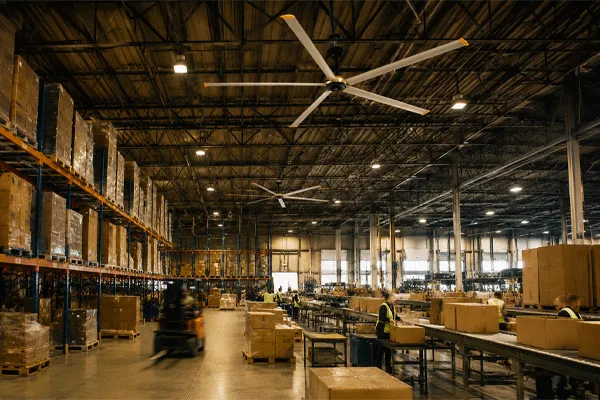
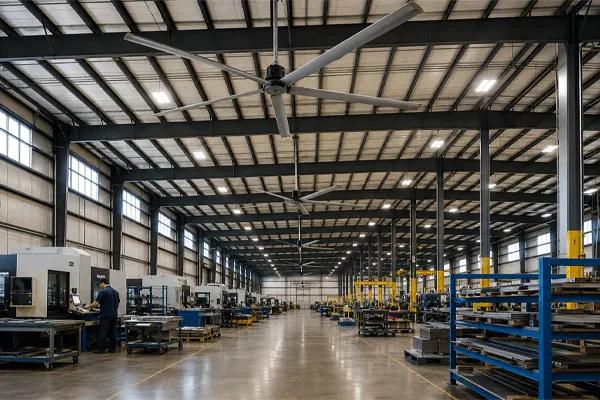
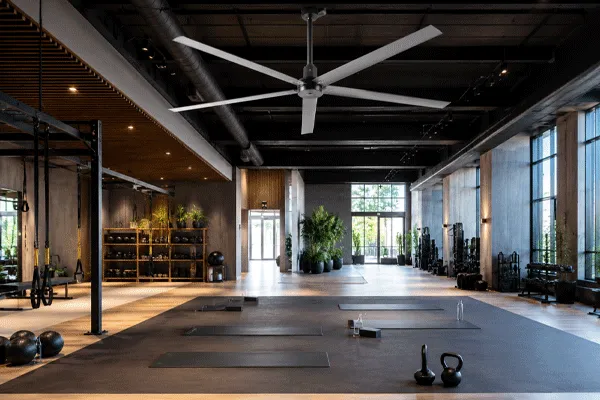
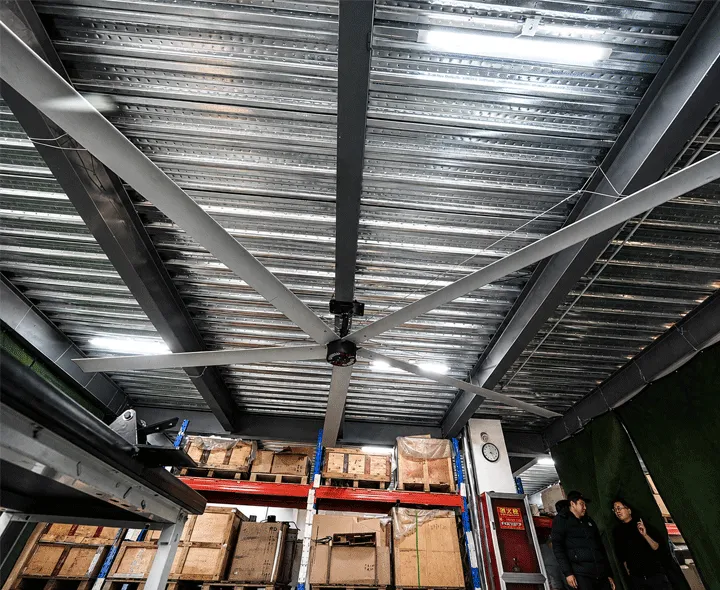
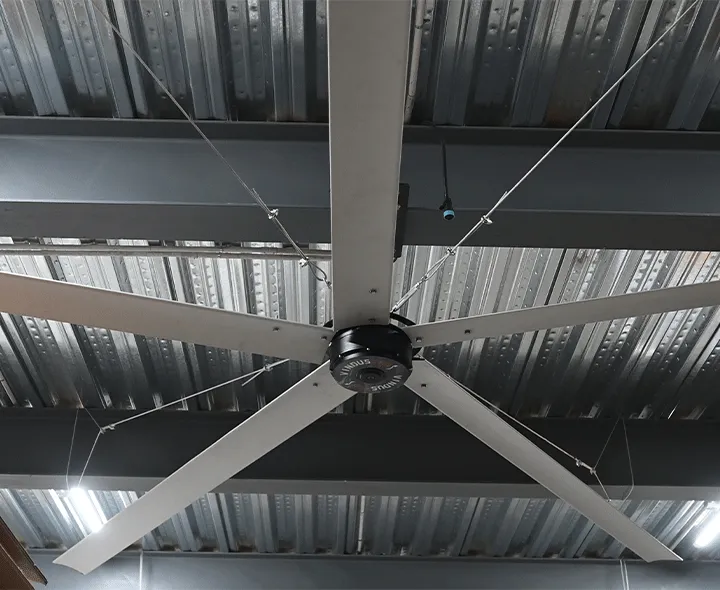
A hot warehouse cannot be cooled well by simply adding more small ceiling fans. The uneven airflow, rising energy costs, and uncomfortable work zones remain. An Ventilador HVLS solves this problem by moving a large volume of air slowly and evenly across a much wider area.
The main difference is size and airflow coverage. A traditional ceiling fan moves air in a small room, while an HVLS fan uses a large diameter and low rotational speed to circulate air across warehouses, factories, gyms, farms, and other large spaces. HVLS fans provide broader, more consistent airflow and can work with an HVAC system to improve comfort and energy efficiency.
What Is the Difference Between an HVLS Fan and a Ceiling Fan?
Article Overview
This guide explains:
- How an HVLS fan differs from a traditional ceiling fan
- Why fan diameter matters more than rotational speed
- How each fan creates airflow
- Which fan works better in a warehouse or large commercial space
- How ceiling height affects fan selection
- Whether HVLS fans can reduce HVAC energy consumption
- How HVLS fans support summer cooling and winter destratification
- What to consider before HVLS fan installation
- How to compare fan performance
- How to choose a qualified HVLS fan supplier
What Is the Basic Difference Between an HVLS Fan and a Ceiling Fan?
A traditional ceiling fan is designed to move air within a relatively small occupied area. You commonly see these fans in homes, offices, restaurants, small shops, classrooms, and hotel rooms. Their smaller blades rotate faster to create a noticeable breeze directly below or near the fan.
An HVLS fan, which means high volume low speed fan, works differently. It uses a much larger fan diameter and rotates at a low speed. Rather than creating a narrow, fast air stream, the HVLS fan creates a broad column of air that moves toward the floor and then spreads outward in all directions.
In the United States, large-diameter ceiling fans are technically distinguished from small-diameter fans by blade-tip diameter. ANSI/AMCA Standard 230 defines a large-diameter ceiling fan as having a blade-tip diameter greater than 84.5 inches, or 216 centimeters. AMCA also notes that not every large-diameter ceiling fan is automatically an HVLS fan, because actual airflow and operating characteristics still matter.
Here is the basic comparison:
| Característica |
Traditional ceiling fan |
Ventilador HVLS |
| Typical application |
Homes and small rooms |
Industrial and commercial spaces |
| Diámetro del ventilador |
Pequeña a mediana |
Gran diámetro |
| Rotational speed |
Relatively high |
Baja velocidad |
| Airflow pattern |
Localized airflow |
Wide, consistent airflow |
| Cobertura |
One room or small zone |
Large floor area |
| Altura del techo |
Low or standard ceilings |
Medium to high ceilings |
| Motor and control |
Basic speed controller |
Industrial motor and intelligent control |
| HVAC integration |
Limited |
Often integrated |
| Instalación |
Relatively simple |
Requires professional planning |
| Main goal |
Personal comfort |
Whole-space air circulation |
The important point is simple: an HVLS fan is not only a larger version of a normal fan. Its blade design, motor, controller, safety system, mounting structure, and airflow strategy are developed for large buildings.
Our HVLS fan systems for large-space air circulation are designed for industrial, commercial, agricultural, logistics, and public-building applications.
How Does the Airflow of an HVLS Fan Differ from a Ceiling Fan?
A smaller ceiling fan normally creates a fast-moving stream within a limited area. People directly under the fan feel the strongest breeze, but airflow quickly becomes weaker as they move farther away.
An HVLS fan moves a much larger volume of air at a lower speed. Its wide blades push air downward over a broad area. When that air reaches the floor, it moves horizontally across the building before gradually rising again. This creates a large circulation pattern.
The airflow pattern can be shown in a simple chart:
Traditional Ceiling Fan

       Fan
      ↓↓↓↓
      ↓↓↓↓
   Small comfort
       zone


HVLS Fan

          Large Fan
       ↓↓↓↓↓↓↓↓↓↓↓
     ↓↓↓↓↓↓↓↓↓↓↓↓↓
  ← ← ← Floor-level air → → →
       Wide coverage area
An HVLS fan therefore produces more consistent airflow across a large space. It can reduce hot and still-air zones between workstations, storage racks, machinery, production lines, loading areas, and other occupied zones.
Airflow is commonly reported in cubic feet per minute, or CFM. However, CFM alone does not show how well a fan distributes air across a real building. Fan diameter, blade geometry, mounting height, power input, obstructions, and air velocity at occupant level also affect fan performance.
ANSI/AMCA Standard 230 provides laboratory methods for measuring airflow rate, power, thrust, efficiency, and airflow efficacy at different fan speeds. Buyers can use independently tested data to make more reliable comparisons instead of depending only on marketing claims.
Why Does the Large Blade Design of an HVLS Fan Matter?
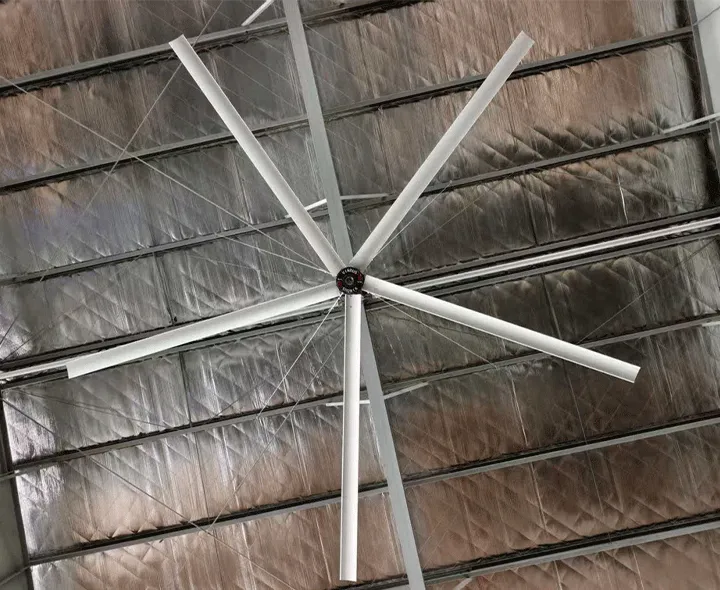
The blade of an HVLS fan is much longer than the blade of a traditional fan. This large swept area allows the fan to affect more air with each rotation.
The relationship is easy to understand. A small fan must turn quickly to move enough air within its limited diameter. A large fan can move a much greater volume of air even when its rotational speed is low.
Good blade design does more than increase fan size. The shape, angle, width, stiffness, and surface of each fan blade affect:
- Airflow volume
- Airflow uniformity
- Ruido
- Motor load
- Consumo de energía
- Vibration
- Coverage area
- Comfort at floor level
Poor blade design may create turbulence, uneven airflow, high noise, or extra energy consumption. A well-engineered HVLS fan uses aerodynamic blades to move air smoothly across the full fan diameter.
As a Sino-US joint venture manufacturer and airflow solution provider, we focus on the complete fan system rather than one isolated component. The motor, blade profile, hub, controller, mounting system, and safety structure must work together.
Our large industrial ceiling fans for factories and warehouses are developed to provide stable air movement while operating at controlled low speed.
What Is the Difference Between an HVLS Fan and a Ceiling Fan?
How Do Fan Size and Ceiling Height Affect Performance?
The appropriate tamaño del ventilador depends on more than the floor area. Ceiling height, roof shape, storage layout, equipment position, structural beams, lighting, cranes, sprinklers, ducts, and other obstacles can change the result.
A typical HVLS fan has a large diameter and needs enough open space around and below its blades. Installing a fan too close to a roof, beam, wall, rack, or large piece of equipment may restrict airflow. Installing it too high may also reduce the useful air speed at the occupied level.
A professional site survey should review:
- Total floor area
- Clear ceiling height
- Fan mounting height
- Roof and support structure
- Location of workers
- Machinery and production lines
- Warehouse rack layout
- Fire sprinklers and alarm systems
- HVAC supply and return points
- Doors and natural ventilation openings
The largest possible fan is not always the best choice. Several smaller commercial fans may work better in a building divided by walls, racks, or production equipment. In a clear and open warehouse, fewer large HVLS units may provide better coverage.
General selection direction
| Space condition |
Possible fan approach |
| Small room with a low ceiling |
Traditional ceiling fan |
| Small retail or dining area |
Commercial ceiling fan |
| Open warehouse with high ceilings |
Large HVLS fan |
| Factory with tall machinery |
Engineered HVLS fan placement |
| Gym or sports hall |
Quiet commercial HVLS fan |
| Livestock building |
Corrosion-resistant agricultural HVLS fan |
| Greenhouse |
Carefully controlled air-circulation system |
| Large mall atrium |
Commercial HVLS ceiling fan |
A qualified supplier should create a fan placement drawing rather than recommend equipment based only on square meters.
Is an HVLS Fan More Energy-Efficient Than a Traditional Ceiling Fan?
A traditional ceiling fan can be very efficient in a small room. The problem appears when a building owner tries to use many small fans to serve a large space.
Dozens of smaller fans require multiple motors, electrical connections, controllers, mounting points, and maintenance locations. Even then, the airflow may remain fragmented. One area feels windy, while another still feels hot.
An HVLS fan uses one large, low-speed air mover to serve a much wider area. In the right application, this design can be more energy-efficient than normal fans for large spaces.
However, responsible suppliers should not promise a fixed energy-saving percentage for every project. Actual energy savings depend on:
- Building size
- Indoor and outdoor temperatures
- Humidity
- HVAC system design
- Fan operating schedule
- Heating and cooling setpoints
- Building insulation
- Door-opening frequency
- Worker activity
- Local energy prices
The U.S. Department of Energy recommends evaluating the full fan system and using efficient equipment and control strategies rather than focusing only on one component. Variable-speed control is especially useful because it allows airflow to follow actual demand.
An HVLS fan does not produce refrigerated air. Instead, it creates air movement that helps people release body heat more effectively. This can improve perceived comfort without lowering the actual air temperature by the same amount.
How Can an HVLS Fan Work with an Air Conditioning or HVAC System?
In air-conditioned buildings, cooled air may not spread evenly. Some zones become too cold, while other zones remain warm. An HVLS fan can improve air circulation and help distribute conditioned air through the occupied area.
This allows the HVAC system and fan system to work as a team:
- The HVAC system controls air temperature and humidity.
- The HVLS fan distributes air through the large space.
- Occupants feel more comfortable because of air movement.
- Building managers may adjust cooling settings where conditions allow.
- Variable-speed controls can match airflow with actual demand.
ASHRAE recognizes air speed as an important part of human thermal comfort. Comfort depends on several factors, including air temperature, radiant temperature, humidity, air velocity, clothing, and activity level. Increased air movement can be useful when indoor conditions are warmer than neutral.
This makes the HVLS fan useful in:
- Air-conditioned warehouses
- Manufacturing plants
- Shopping malls
- Sports centers
- Airport terminals
- Exhibition halls
- Large restaurants
- espacios comerciales
- Public buildings
The fan should not fight against the HVAC system. Fan direction, speed, and placement must support supply-air distribution and return-air flow. Our commercial ceiling fans for large public spaces can be matched with building controls and HVAC operating schedules.
How Does an HVLS Fan Improve Comfort During Summer?
During hot weather, people feel more comfortable when air moves across their skin. The moving air supports heat transfer and evaporation. This is why a fan can make a worker feel cooler even though the fan does not reduce the actual indoor temperature like an air conditioner.
A traditional fan creates this effect in a limited zone. An HVLS fan spreads useful air movement over a much larger occupied area.
In a warehouse, for example, the HVLS fan can serve:
- Picking and packing stations
- Assembly areas
- Loading zones
- Quality-control areas
- Storage aisles
- Maintenance workspaces
- Employee rest zones
The low-speed airflow is usually gentler than the narrow blast from high-speed floor fans or box fans. Workers can receive steady air movement without papers, dust, packaging, or lightweight materials being disturbed as strongly.
This helps create a more comfortable work environment, especially in buildings where full mechanical cooling is too expensive or impractical.
Still, fan use must form part of a proper heat-management plan. A fan alone cannot remove extreme heat, control dangerous heat exposure, or replace drinking water, rest periods, shade, process controls, and other protective measures.
How Does an HVLS Fan Handle Warm Air in Winter?
Warm air rises. In a tall warehouse or factory, heated air can collect near the roof while workers remain in a colder zone near the floor. This condition is called thermal stratification.
An HVLS fan can operate at a very low speed to mix the warm upper air with the cooler lower air. This process is called destratification. It reduces the floor-to-ceiling temperature difference and returns useful heat to the occupied zone.
ASHRAE research has identified HVLS fans as a practical method for reducing temperature gradients in large buildings. A study of an aircraft hangar found that the fans could improve air mixing and reduce thermal stratification when properly operated.
The objective in winter is not to create a strong cooling breeze. The fan should turn slowly enough to mix the air without making workers feel cold.
Seasonal operating comparison
| Temporada |
Main purpose |
Typical operating approach |
| Verano |
Increase comfort through air movement |
Moderate speed |
| Spring and autumn |
Improve general air circulation |
Low to moderate speed |
| Invierno |
Mix warm ceiling air with lower air |
Very low speed |
| High-humidity periods |
Reduce stagnant zones and support evaporation |
Project-specific speed |
For facilities using unit heaters, radiant systems, or central heating, destratification may reduce unnecessary heat buildup near the roof. The exact benefit depends on building height, insulation, heating design, outdoor weather, and operating hours.
Can an HVLS Fan Control Humidity and Improve Air Quality?
An HVLS fan does not remove water vapor from the air in the same way as a dehumidifier. It also does not introduce clean outdoor air like a mechanical ventilation system. However, it can reduce stagnant zones and help moisture spread more evenly.
Improved air circulation may support:
- Faster drying of wet floors
- Reduced local condensation risk
- More even temperature and humidity
- Better air mixing around stored goods
- Reduced still-air zones in agricultural buildings
- Improved comfort in humid conditions
In livestock buildings, greenhouses, and food-processing areas, humidity management is important. Yet the fan must be selected for the specific environment. Moisture, dust, ammonia, cleaning chemicals, and corrosive air may require protected motors, suitable coatings, sealed components, or stainless-steel hardware.
It is also important to use the phrase improve air quality carefully. A circulating fan moves existing indoor air. It does not remove welding fumes, dust, chemicals, smoke, carbon dioxide, pathogens, or other contaminants.
OSHA describes ventilation as an important engineering control for maintaining workplace air quality. When a process creates hazardous contaminants, the facility may need source capture, local exhaust, filtration, or outdoor-air ventilation. An HVLS fan should complement these systems, not replace them.
Where Are HVLS Fans Better Than Traditional Fans?
HVLS fans are designed for large industrial and commercial spaces where broad coverage matters more than high-speed local airflow.
Warehouses and logistics centers
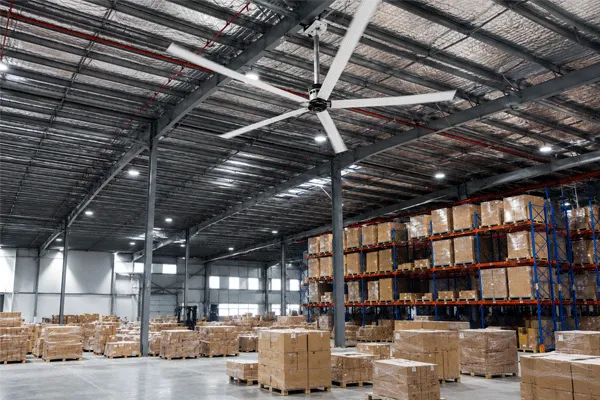
A warehouse often has high ceilings, loading doors, wide aisles, storage racks, and large temperature differences. HVLS fans can improve air circulation across picking zones, packing stations, and loading areas.
Manufacturing plants
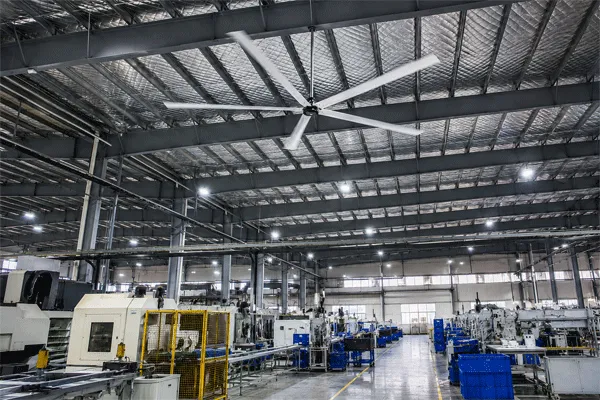
Factories may contain machinery, ovens, welding areas, production lines, and heat-producing processes. Correct fan placement helps move air around workers without creating many separate high-speed fan zones.
Sports centers and gyms
A gym needs quiet, even airflow across courts, seating, training zones, and spectator areas. A large commercial HVLS fan can move air without taking up valuable floor space.
Edificios agrícolas
Livestock farms, dairy barns, poultry buildings, and greenhouses need steady air movement. Fans may help manage animal comfort, moisture, and stagnant air when combined with appropriate ventilation.
Shopping malls and public buildings
An HVLS ceiling fan can provide air movement while also becoming part of the interior design. Commercial models often use quieter motors and refined blade finishes.
Other applications include aircraft hangars, exhibition centers, transport terminals, churches, event venues, vehicle service centers, and large food-processing facilities.
Our HVLS airflow solutions for different industries can be planned around the building layout, climate, work process, and comfort target.
What Should You Consider Before Installing an HVLS Fan?
Installing an HVLS fan requires more planning than installing a traditional ceiling fan. The mounting structure must carry the fan’s weight and operating forces. The installer must also maintain suitable clearance from the roof, beams, walls, cranes, lights, ducts, sprinkler systems, and stored goods.
A professional HVLS fan installation normally includes:
- Structural review
- Installation-height confirmation
- Fan placement design
- Obstruction assessment
- Electrical planning
- Controller location
- Safety-cable installation
- Blade and hub assembly
- Balance and vibration inspection
- Test operation and commissioning
Fire protection is especially important. Large-diameter fans may need to follow local building, mechanical, electrical, sprinkler, and fire-alarm requirements. In some sprinkler-protected applications, fan shutdown must be coordinated with the fire protection system. AMCA guidance highlights the need to follow relevant codes, listed equipment requirements, and manufacturer instructions.
Installing HVLS equipment without a site assessment can cause poor coverage, noise, vibration, restricted airflow, or conflicts with other building systems.
A qualified supplier should provide mounting guidance, electrical drawings, clearance requirements, commissioning support, and maintenance instructions. Learn more about our professional HVLS fan installation planning.
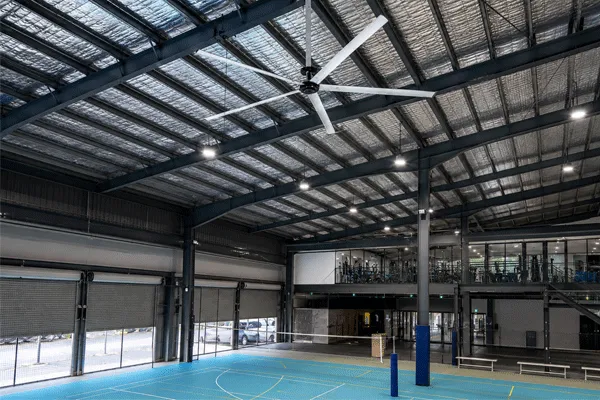
What Is the Difference Between an HVLS Fan and a Ceiling Fan?
How Should Buyers Compare HVLS Fan Performance?
Fan diameter is important, but it should not be the only selection factor. Two fans with the same diameter may provide different airflow, energy consumption, noise, control functions, and long-term reliability.
Buyers should compare:
| Performance factor |
What to check |
| Diámetro del ventilador |
Suitability for the available space |
| Flujo de aire |
Tested airflow at different speeds |
| Input power |
Electrical demand at operating points |
| Eficiencia |
Air output relative to power input |
| Tipo de motor |
Efficiency, control, heat, and maintenance |
| Diseño de la hoja |
Air distribution, strength, and noise |
| Controlador |
Variable speed and system integration |
| Ruido |
Suitability for the intended environment |
| Safety system |
Cables, fasteners, monitoring, and protection |
| Certification |
Relevant market and project requirements |
| Garantía |
Motor, controller, structure, and blades |
| Service support |
Installation and after-sales capability |
Ask whether the published fan performance comes from recognized laboratory testing. AMCA Standard 230 provides a uniform method for reporting airflow, thrust, power, efficacy, and efficiency. Certified ratings help buyers compare products on a more consistent basis.
Also ask about performance at partial speed. An HVLS fan may spend much of its working life below maximum speed. Efficient operation at 20%, 40%, 60%, and 80% speed can therefore matter as much as maximum output.
Intelligent controls can improve operation further. Useful features may include:
- Variable-speed adjustment
- Group fan control
- Timed schedules
- Temperature-based operation
- Building management system connection
- Fault monitoring
- Emergency shutdown
- Seasonal operating modes
- Remote status display
Illustrative Case: Traditional Fans vs an HVLS Fan in a Warehouse
Consider a distribution warehouse with a large open packing area. The company uses several wall fans and portable box fans. Workers near the fans feel strong drafts, but people farther away still report heat and stagnant air.
The facility manager considers adding more smaller fans. However, this would create more cables, mounting points, floor obstructions, maintenance tasks, and uneven airflow.
After reviewing ceiling height, rack layout, doors, lighting, sprinkler locations, and occupied zones, the project team selects an appropriately sized HVLS fan system.
The solution aims to:
- Create broad floor-level air movement
- Reduce isolated hot zones
- Improve comfort in packing and picking areas
- Keep portable fans away from busy aisles
- Support the existing HVAC system
- Provide low-speed winter destratification
This is an illustrative case, not a guaranteed performance result. The correct number, size, and position of fans must be calculated for each building.
The lesson is useful: do not compare one HVLS fan with one traditional fan only by purchase price. Compare the full coverage area, installation requirements, energy consumption, maintenance points, operating life, and comfort result.
How Can You Choose a Qualified HVLS Fan Supplier?
A qualified HVLS fan supplier should understand buildings, airflow, electrical systems, installation, safety, and operating conditions. Simply selling a large fan is not enough.
Ask potential suppliers for:
- Site-planning support
- Fan placement drawings
- Tested performance data
- Motor and controller details
- Blade material information
- Structural mounting requirements
- Electrical specifications
- Características de seguridad
- Applicable certifications
- Installation manuals
- Warranty terms
- Spare-parts availability
- Remote technical support
- Project references
For international distributors and global B2B buyers, additional factors matter:
- Export packaging
- Voltage and frequency options
- Language customization
- OEM and private-label services
- Distributor training
- Container loading
- Documentation
- After-sales response
- Long-term supply stability
As a Sino-US joint venture manufacturer and solution provider, we specialize in HVLS fans, industrial fans, commercial fans, large-space ventilation, destratification, cooling, and intelligent airflow control systems.
We work with warehouse owners, logistics companies, factories, HVAC contractors, commercial developers, agricultural operators, equipment distributors, and project companies. Our approach begins with the building and the customer’s operating problem—not with a standard fan recommendation.
Frequently Asked Questions About HVLS Fans and Ceiling Fans
Is an HVLS fan just a large ceiling fan?
No. An HVLS fan uses a large diameter, aerodynamic blades, low rotational speed, an industrial motor, variable controls, and a specialized mounting and safety system. It is designed to circulate air across a large area.
Does an HVLS fan lower the actual room temperature?
An HVLS fan normally does not refrigerate the air. It creates air movement that helps people feel cooler. When used with air conditioning, it can help distribute conditioned air more evenly.
Can I install an HVLS fan in a low-ceiling building?
It depends on the available clearance, fan diameter, mounting structure, and local regulations. Buildings with limited ceiling height may need a smaller commercial fan or another circulation solution.
How many HVLS fans does a warehouse need?
The number depends on floor area, ceiling height, fan diameter, storage racks, machinery, walls, work zones, and desired air speed. A placement plan is needed for an accurate answer.
Are HVLS fans suitable for winter?
Yes. At very low speed, an HVLS fan can mix warm air near the ceiling with cooler air near the floor. This process is called destratification.
Can an HVLS fan replace an HVAC or ventilation system?
No. An HVLS fan circulates air but does not provide refrigeration, outdoor air, contaminant capture, filtration, or dehumidification. It should support HVAC and ventilation systems, not replace functions they must perform.
Key Points to Remember
- An HVLS fan is designed for large industrial and commercial spaces.
- A traditional ceiling fan mainly serves a small room or local comfort zone.
- HVLS means high volume low speed.
- Large blades allow an HVLS fan to move more air at a lower rotational speed.
- An HVLS fan creates broad and consistent airflow rather than a narrow air stream.
- Fan diameter alone does not prove good performance.
- CFM, power, efficiency, airflow distribution, and partial-speed performance also matter.
- Ceiling height, obstacles, rack layout, sprinklers, and HVAC equipment affect fan placement.
- An HVLS fan can support summer comfort and winter destratification.
- It may contribute to energy savings when properly integrated with the HVAC system.
- An HVLS fan circulates indoor air but does not replace exhaust ventilation or air conditioning.
- Professional structural, electrical, airflow, and safety planning is required.
- Buyers should request tested performance data and clear installation documentation.
- A qualified HVLS fan supplier should provide a complete airflow solution, not only a fan.
The choice between a ceiling fan and an HVLS fan comes down to scale, coverage, and purpose. A traditional fan works well in a small room. An HVLS fan is the stronger choice when you need to improve air circulation across a warehouse, factory, gym, farm, shopping mall, logistics center, or another large space.
Contact our HVLS fan engineering team to discuss your building dimensions, ceiling height, application, climate, HVAC system, and airflow goals. We can help you select the appropriate fan size, installation position, control method, and large-space airflow solution.