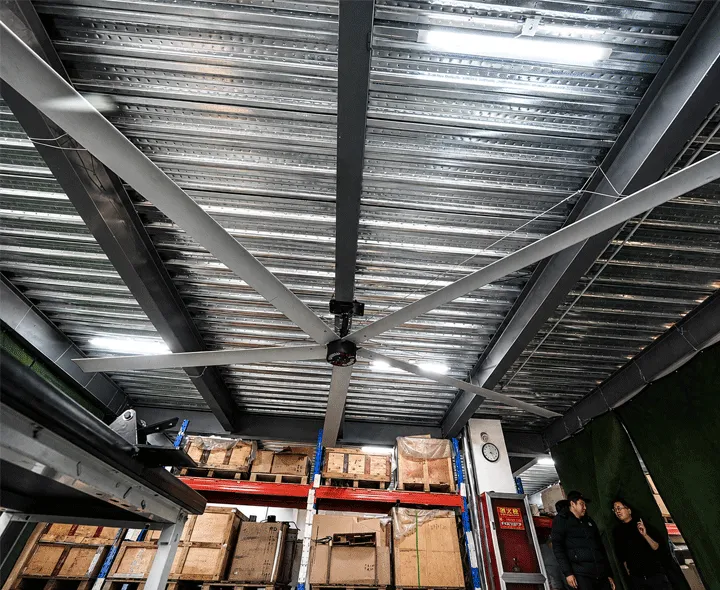
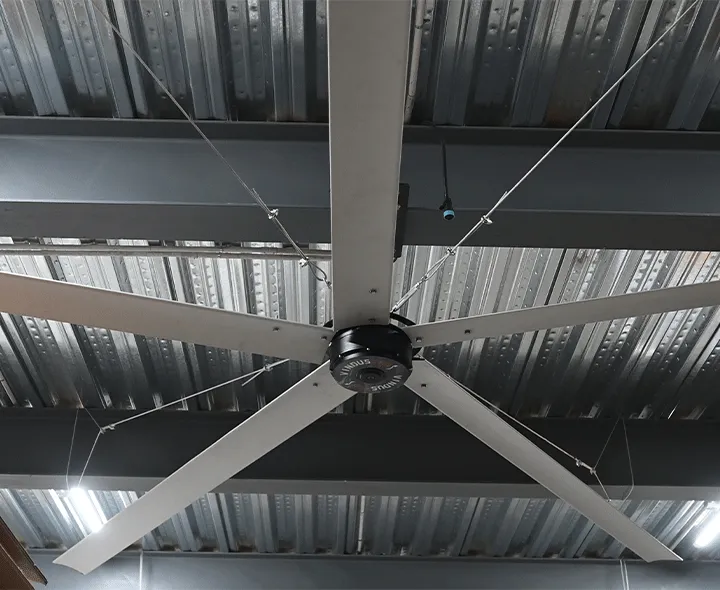
Hot, humid, stagnant air can quickly turn a large barn into an uncomfortable environment for animals and workers. Heat builds under the roof, moisture remains inside, and ordinary small fans may leave dead zones. A properly designed HVLS fan system can improve airflow, support cooling, and create more balanced conditions throughout the building.
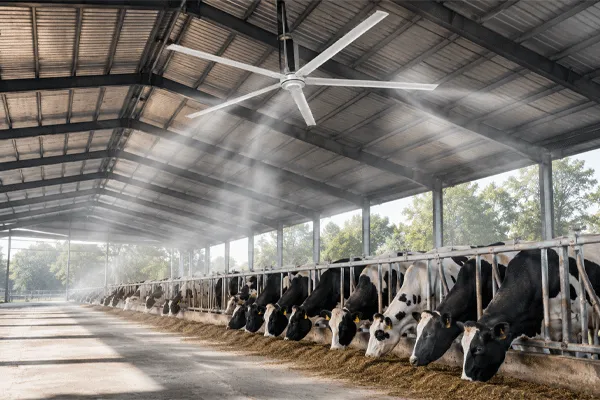
HVLS fans support large agricultural barn ventilation by moving high volumes of air slowly across wide areas. They create consistent airflow around livestock, reduce hot and stagnant zones, help manage humidity, and improve perceived cooling. However, an HVLS ceiling fan circulates indoor air rather than replacing exhaust or fresh-air ventilation, so the best system often combines circulation, air exchange, and smart controls.
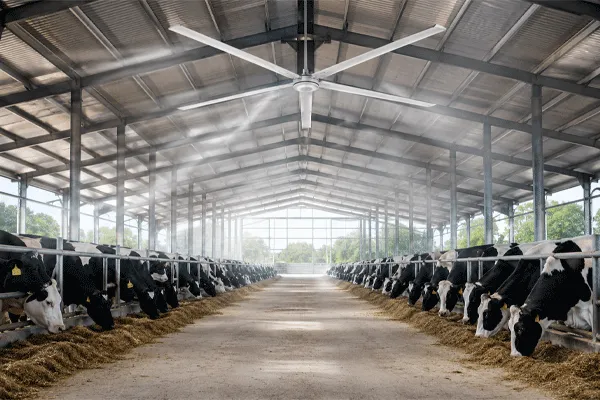
HVLS Fans for Large Agricultural Barn Ventilation: Improving Livestock Comfort and Airflow
For farms, warehouses, processing areas, and other large buildings, effective air management is rarely about buying the biggest fan available. It is about understanding the building, animals, climate, operating schedule, and desired airflow.
As a Sino-US joint venture manufacturer and solution provider specializing in HVLS fans, industrial ceiling fans, commercial ceiling fans, large industrial fans, and intelligent airflow control systems, we approach agricultural projects as complete airflow systems rather than isolated pieces of equipment.
Why Is Ventilation So Important in a Large Barn?
A large barn creates a unique airflow challenge. Animals release body heat and moisture. Wet floors, manure, watering systems, and outdoor weather add even more moisture. Without enough ventilation, heat and humidity can build up, especially around animal resting areas and beneath the roof.
Bien livestock ventilation has two different jobs:
- exchange stale indoor air with fresher outdoor air;
- create useful airflow around animals and occupied areas.
These jobs should not be confused.
University of Wisconsin Extension explains that ventilation helps maintain air quality, remove heat and moisture, and create a more comfortable dairy environment. It also distinguishes circulation fans, which move air inside a building, from exhaust fans, which help replace indoor air with outdoor air.
This distinction is important when choosing fans for barns. A circulation fan cannot remove ammonia or moisture by itself if the building does not have enough fresh-air exchange. Likewise, a strong exhaust system may replace indoor air without creating enough useful air velocity around the animals.
The best result comes when both functions work together.
How Does an HVLS Fan Improve Air Circulation in Livestock Facilities?
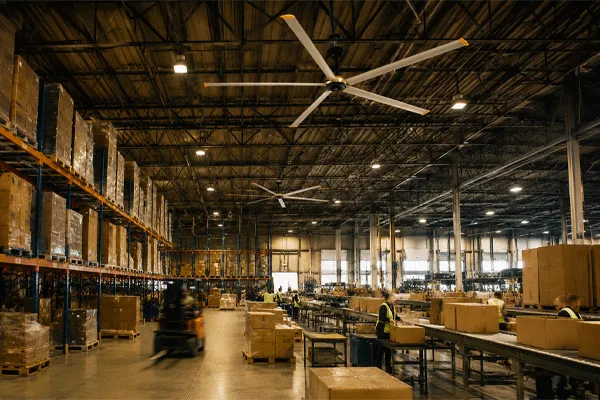
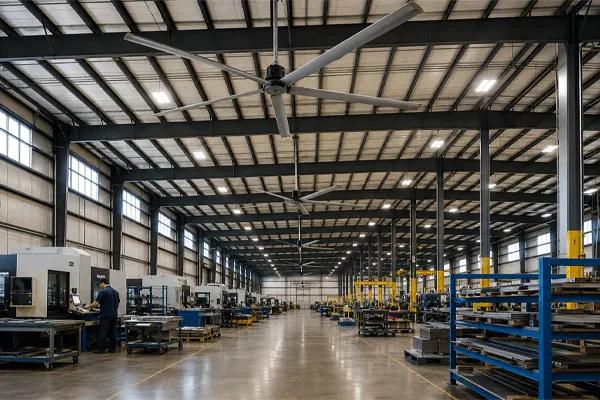
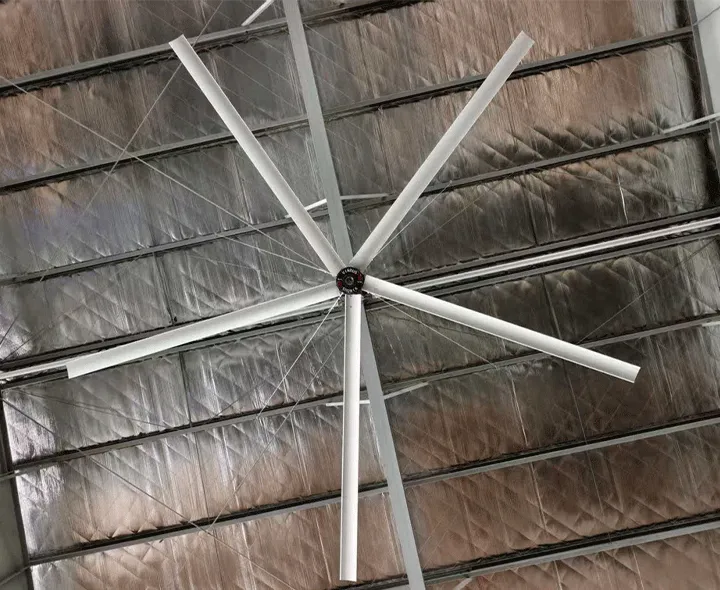
HVLS means high-volume, low-speed. Instead of creating a narrow, high-speed jet like many small fans, an HVLS fan uses a large diameter to move broad volumes of air over a wide floor area.
The rotating blades produce a large downward column of air. When this air reaches lower levels, it spreads horizontally. This helps create efficient air circulation across large spaces rather than cooling only the area directly beneath the fan.
That broad movement is useful in livestock facilities because animals may occupy feeding lines, resting areas, walkways, holding zones, and open pens.
Properly positioned Ventiladores de techo HVLS puede ayudar:
- reduce areas of stagnant air;
- create more uniform conditions across large pens;
- increase air velocity around animals;
- move warm air away from occupied zones;
- support evaporation from wet surfaces;
- improve airflow in spaces where natural wind is inconsistent.
Penn State Extension notes that large high-volume, low-speed fans can provide useful cow-level air movement when they are properly positioned over animals. It also emphasizes that air exchange remains essential for removing heat, moisture, gases, and pollutants.
So an HVLS system is best viewed as one part of a complete industrial airflow and circulation solution.
Can Agricultural Fans Help Reduce Heat Stress in Livestock?
Yes, but the mechanism matters.
A ceiling fan does not normally lower the actual dry-bulb air temperature in the same way as refrigeration. Instead, moving air across an animal’s body can increase convective and evaporative heat transfer. This can help the animal release body heat more effectively.
That is especially important for dairy cattle.
University of Wisconsin Extension recommends meaningful air movement over cow resting areas and explains that fast-moving air helps cows dissipate heat. Its dairy guidance also notes that summer ventilation requirements can be much greater than winter requirements.
Penn State likewise identifies shade, adequate air exchange, air movement, drinking water, and evaporative cooling as important tools for limiting dairy heat stress.
The practical lesson is simple:
Fans promote heat transfer, but good cooling starts with the entire barn environment.
An agricultural fan can therefore contribute to animal comfort, but fan placement, air velocity, outside temperature, relative humidity, animal density, water availability, and building design all matter.
For hot climates, the complete ventilation solution may combine large fans with exhaust systems, natural openings, curtains, evaporative pads, sprinklers, or automated controls.
HVLS Ceiling Fan vs. Small Fans: Which Works Better for Large Barns?
There is no universal winner. The right fan depends on what part of the building you need to ventilate.
Small high-speed fans can create concentrated air velocity. This makes them useful above individual stalls, feed lines, milking areas, or other targeted zones.
An HVLS ceiling system takes a different approach. Its purpose is to move massive volumes of air across a broad area at relatively low speed.
| Factor |
Ventilador HVLS |
Small High-Speed Fan |
| Typical coverage |
Amplia zona |
Localized zone |
| Air pattern |
Broad circulation |
Focused air stream |
| Best use |
Large open floor areas |
Targeted cooling |
| Number of units |
Often fewer |
Often more |
| Noise potential |
Generally low at normal operating speed |
Can increase at high speed |
| Instalación |
Requires adequate overhead structure and clearance |
More flexible mounting |
| System role |
Whole-area circulation |
Local air movement |
In practice, large barns may benefit from combining both technologies.
For example, a large HVLS barn fan may handle general circulation while smaller directional livestock fans deliver extra air velocity to critical areas.
This hybrid approach can be especially valuable in complex buildings with partitions, equipment, deep stalls, uneven ceiling heights, or obstructions that affect airflow.
Explore our HVLS industrial ceiling fan range for large agricultural and industrial spaces.
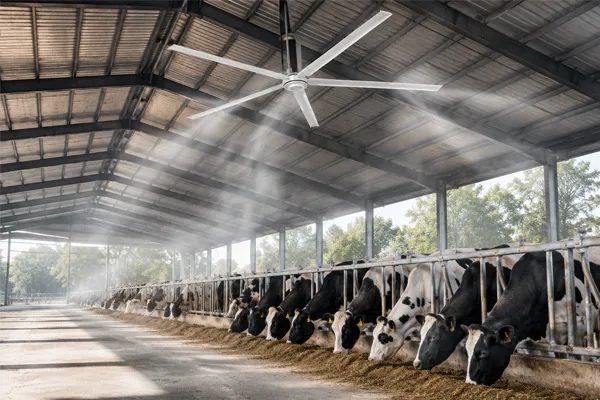
HVLS Fans for Large Agricultural Barn Ventilation: Improving Livestock Comfort and Airflow
How Do HVLS Fans Improve Air Quality and Humidity Conditions?
Air quality inside a farm building depends mainly on effective air exchange, sanitation, manure management, moisture control, and building design.
Fans support this process by keeping indoor air moving.
When air becomes motionless, pockets of moisture and warm air can remain around animals, walls, ceilings, or stored materials. Better air circulation also helps distribute incoming fresh air more evenly and can reduce local hot or damp zones.
This matters because agricultural environments may contain:
- animal-generated moisture;
- ammonia;
- dust;
- odors;
- wet bedding;
- condensation;
- heat from animals and equipment.
However, an HVLS unit should never be sold as a substitute for proper exhaust.
University of Wisconsin Extension specifically states that ventilation removes heat, moisture, and contaminants, while circulation fans help create more uniform temperature and humidity conditions.
Therefore, if your goal is to improve air quality, our engineers first look at fresh-air paths, exhaust capacity, natural openings, building pressure, and circulation patterns.
Then we determine how an agricultural ceiling fan can help distribute that air more effectively throughout the barn.
Where Should Large Barn Fans Be Installed?
Fan location is just as important as fan size.
Putting one very large fan in the center of a building does not automatically create ideal consistent airflow everywhere. Beams, lights, partitions, equipment, stored materials, sidewalls, stall structures, and neighboring fans can all change the final air pattern.
Before specifying large barn fans, we normally evaluate:
- building length and width;
- barn ceiling height;
- roof shape and structural mounting points;
- animal location;
- feeding and resting zones;
- doors and natural openings;
- exhaust fan positions;
- obstacles below the blades;
- required clearances;
- prevailing outdoor wind conditions.
The objective is not simply to install fans across large floor areas. We want useful air movement where workers and livestock actually spend time.
This is particularly important in a dairy barn, where the airflow experienced at cow level matters more than the airflow measured close to the roof.
Penn State guidance on dairy cooling similarly emphasizes fan location and animal-level air movement rather than relying only on equipment capacity.
A professional layout should therefore consider the complete air path inside the barn.
What Makes a Good Agricultural Fan for Barns and Greenhouses?
Agricultural environments are demanding.
Dust, dirt, moisture, changing temperatures, and corrosive gases can shorten equipment life. That means agriculture fans should be selected for more than airflow alone.
Important features include:
- durable motor and drive technology;
- stable structural mounting;
- corrosion-resistant components;
- suitable blade construction;
- electrical protection;
- low operating noise;
- variable-speed control;
- easy inspection and maintenance;
- safety systems appropriate to the installation.
University of Wisconsin Extension specifically highlights the need for fan components that withstand humidity and corrosive gases commonly found in animal buildings.
For barns and greenhouses, control strategy also matters. A greenhouse may require airflow for crop uniformity, temperature control, and moisture management, while an animal building focuses more strongly on heat removal, fresh-air exchange, and livestock comfort.
The equipment may look similar, but the airflow design is different.
That is why we design durable agricultural airflow systems around the application rather than treating every project like a standard warehouse.
See our commercial and industrial ceiling fan solutions for other large-space applications.
Can HVLS Fans Lower Agricultural Ventilation Energy Costs?
They can contribute to an energy-efficient airflow strategy, particularly when the goal is to circulate air over a large open floor area without operating many smaller circulation fans.
The exact savings cannot be calculated from fan diameter alone.
You need to compare:
Annual Energy Use = Fan Input Power × Operating Hours × Number of Fans
For example, imagine two proposed systems for the same building:
| Sistema |
Número de fans |
Input per Fan |
Daily Runtime |
Energía diaria |
| Layout A |
20 |
0.75 kW |
12 h |
180 kWh |
| Layout B |
5 |
1.5 kW |
12 h |
90 kWh |
This simplified example shows why system-level comparison matters. It does not represent guaranteed savings, because actual fan power, coverage, air velocity, operating schedules, and ventilation requirements vary by project.
Variable-speed operation can provide another advantage. When full output is unnecessary, controls can reduce fan speed instead of running every unit at maximum output.
University of Wisconsin Extension recommends comparing ventilation efficiency when selecting agricultural fans because fan efficiency affects both electricity cost and system performance.
For larger projects, our intelligent control systems can coordinate fan operation based on temperature, humidity, schedules, or defined environmental zones.
Learn more about smart HVLS fan control systems.
How Can Fans Support Health and Productivity in Livestock Buildings?
A better environment supports both animals and people.
High temperatures can change animal behavior, feed intake, resting patterns, and production. Penn State notes that heat-stressed cows can experience reductions in milk production and other performance effects.
Research summarized by Penn State also reported that calves cooled with fans in one study had improved average daily gain and feed efficiency compared with calves that did not receive fan cooling. This should not be interpreted as a universal performance guarantee, but it demonstrates the relationship between environmental control, animal health, and performance.
This is why comfort and productivity should be considered together.
When properly designed, fans provide useful air movement that can support:
- thermal comfort;
- more usable resting areas;
- better working conditions for employees;
- reduced hot-air pockets;
- more uniform environmental conditions.
In other words, barn fans help manage the environment in which animals live and people work.
They do not directly create productivity. They help create conditions that support health and productivity.
How Should You Choose the Right HVLS Fan Solution?
Start with the building, not the catalog.
A 7-meter fan that performs well in one facility may be inappropriate in another facility of similar size because mounting height, roof geometry, obstacles, livestock layout, inlet locations, climate, and operational goals may differ.
A professional evaluation should answer several questions:
- What problem are you trying to solve?
- Is the main issue heat, moisture, poor air, or uneven airflow?
- Is fresh-air exchange already adequate?
- Where are the hottest areas?
- Where do animals rest and feed?
- How high is the ceiling?
- Are sprinklers or evaporative systems installed?
- Does the facility need seasonal speed control?
- Are there corrosive environmental conditions?
- Will multiple fans interfere with each other?
We use these answers to develop fan solutions around the actual building.
Our product and engineering scope covers agricultural facilities, industrial and commercial buildings, factories, logistics centers, sports facilities, shopping malls, and other large-space applications.
For a livestock project, that may mean combining industrial barn fans, exhaust equipment, natural openings, intelligent controls, and targeted circulation units.
For another building, the answer may be completely different.
You can review our custom HVLS fan engineering and project solutions when planning a new building or upgrading an existing airflow system.
HVLS Fans for Large Agricultural Barn Ventilation: Improving Livestock Comfort and Airflow
Why Intelligent Airflow Control Matters for Agricultural Buildings
Modern ventilation does not have to operate at one fixed speed from morning until night.
Temperature and humidity change during the day. Animal activity changes. Doors open and close. Outdoor wind changes. Seasonal requirements also vary dramatically.
Smart controls allow fans today to respond more precisely to those conditions.
A control strategy may use:
- temperature sensors;
- humidity sensors;
- variable-speed drives;
- scheduled operation;
- multiple ventilation zones;
- centralized control;
- building management integration.
For example, fans can run faster during hot afternoon periods and slow down when temperatures fall. Multiple areas can also operate independently when one section of a building needs more airflow than another.
For livestock buildings, automation should complement—not replace—proper ventilation engineering.
University of Wisconsin Extension notes that variable-speed fans are receiving greater attention because they can improve energy efficiency, reduce noise, and provide more precise airflow control.
This is also where our background in intelligent airflow systems becomes valuable. We are not simply supplying a motor and blades. We help buyers determine how multiple pieces of equipment should operate together.
A Practical Agricultural Barn Ventilation Example
Consider a large cattle facility experiencing uncomfortable summer conditions.
The owner already has open sidewalls and natural barn ventilation, but during low-wind afternoons several interior zones become warm and still. Installing more exhaust capacity may increase air exchange, but it may not guarantee sufficient animal-level air speed in every resting area.
A possible system design could combine:
Stage 1 — Fresh-air strategy
Confirm that outdoor air can enter and leave the building without major restrictions.
Stage 2 — General circulation
Use properly positioned HVLS units to move large volumes of indoor air over broad zones.
Stage 3 — Targeted cooling
Use directional fans where higher localized velocity is required.
Stage 4 — Environmental control
Coordinate fan speed with temperature and humidity conditions.
Stage 5 — Verification
Measure actual air velocity in occupied zones rather than assuming the system works because the fans move.
This example illustrates an important point: fans can make a large difference, but successful agricultural ventilation is a system-design problem.
A fan should solve a measured need.
Frequently Asked Questions About Agricultural Barn Fans
Are HVLS fans suitable for a horse barn?
Yes, an HVLS fan can be used in a horse barn when the ceiling height, structure, safety clearance, stall arrangement, and fresh-air strategy support the installation. Ceiling fans for horse facilities should be positioned so animals cannot contact equipment and airflow reaches occupied zones safely.
Do HVLS fans replace exhaust ventilation fans?
Usually not. Ventilation fans and circulation fans perform different jobs. Exhaust equipment exchanges indoor and outdoor air, while HVLS units mainly circulate air within the building. Many successful systems use both.
Can an HVLS fan reduce barn temperature?
An HVLS fan mainly improves air movement rather than mechanically chilling the air. Moving air can increase convective and evaporative cooling around animals and workers, helping reduce heat stress even when measured room temperature changes little.
How many HVLS fans does a large barn need?
There is no reliable answer based only on floor area. The number depends on fan diameter, mounting height, roof structure, obstacles, target air velocity, building shape, animal location, and existing ventilation. A proper layout is more useful than a simple square-meter rule.
Are agricultural ceiling fans useful during winter?
Yes, in suitable buildings. Warm air naturally rises toward the roof. Carefully controlled slow fan operation can support destratification by mixing warmer upper air with cooler lower air. However, livestock buildings must avoid creating uncomfortable drafts during cold weather.
How often should agricultural fans be maintained?
Maintenance frequency depends on dust, moisture, operating hours, and the fan design. Inspect blades, fasteners, motors, electrical connections, safety systems, and accumulated dirt regularly. University of Wisconsin Extension notes that dirt on agricultural ventilation equipment can significantly reduce airflow and efficiency.
Build the Ventilation System Around Your Barn, Not Around a Fan
Selecting agricultural fans for barns is not simply a matter of choosing the largest diameter or highest advertised airflow.
Every farm is different.
A poultry building, dairy barn, greenhouse, horse facility, livestock shed, and food-processing building may all require different combinations of air exchange, local air velocity, humidity control, temperature management, and automation.
As a Sino-US joint venture manufacturer and airflow solution provider, we supply HVLS fans, agricultural ceiling fans, industrial ceiling fans, commercial fans, large industrial airflow equipment, and intelligent control systems for global B2B projects.
Our goal is straightforward: understand your building first, then design equipment around it.
If you are planning a new facility or trying to improve air conditions in an existing building, provide your building dimensions, ceiling height, application, livestock type, climate conditions, and current ventilation arrangement. Those details allow our engineering team to recommend a more accurate solution.
Key Things to Remember
- HVLS fans are designed to move high volumes of air across broad areas at low rotational speed.
- A large ceiling fan mainly supports circulation; it does not automatically replace fresh-air exchange.
- Good agricultural ventilation manages heat, moisture, gases, and stale indoor air.
- Effective airflow should reach animals and workers, not remain near the ceiling.
- Fan position, mounting height, building layout, and obstacles can be as important as fan diameter.
- Combining HVLS units with exhaust systems or directional fans may work better than relying on one technology.
- Variable-speed and intelligent controls can adapt fan operation to changing conditions.
- Durable components matter in humid, dusty, or corrosive agricultural buildings.
- Measure real airflow after installation whenever possible.
- The strongest solution starts with your building requirements—not with a product specification sheet.