Michael Danielsson | CEO, Vindus Fans | Published August 6, 2026
Everything useful about specifying one for a barn follows from that sentence, including the situations where a different fan type is the better buy.
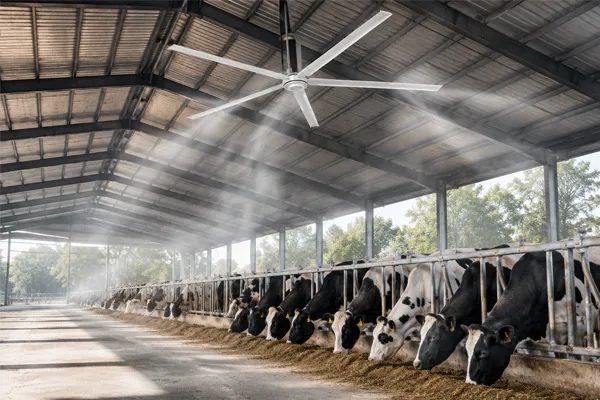
HVLS Fans for Livestock and Cattle Farm Cooling
The Threshold Cattle Actually Respond To
Heat stress in cattle is not triggered by temperature alone. It is usually assessed with the temperature-humidity index, which combines dry-bulb temperature and relative humidity into a single number.
Penn State Extension notes that productive dairy cows may begin experiencing heat stress at a THI of 68 or above, which in more humid climates can occur at air temperatures as low as 72 °F. University of Wisconsin dairy extension puts the range where milk production drops sharply at a THI of 68 to 72, corresponding to roughly 70 to 75 °F in a humid continental climate. A published literature review in Animals summarises the commonly used banding as comfort below 68, mild discomfort from 68 to 72, discomfort from 72 to 75, alert from 75 to 79, danger from 79 to 84, and emergency above 84.
Two implications for anyone specifying equipment.
First, the onset temperature is lower than most people expect. A 72 °F day does not feel like a cooling emergency to the person walking the barn. To a lactating cow producing substantial metabolic heat, it can already be one.
Second, humidity moves the threshold. The same thermometer reading means different things in a dry western climate and a humid midwestern one, which is why fan selection based on “we get to 90 in July” is an incomplete brief.
Wisconsin extension also points out that the consequences — reduced feed intake and milk yield — lag the discomfort itself, so by the time a change in production is visible the problem has usually been running for a day or more. Equipment is therefore specified against conditions, not against observed losses.
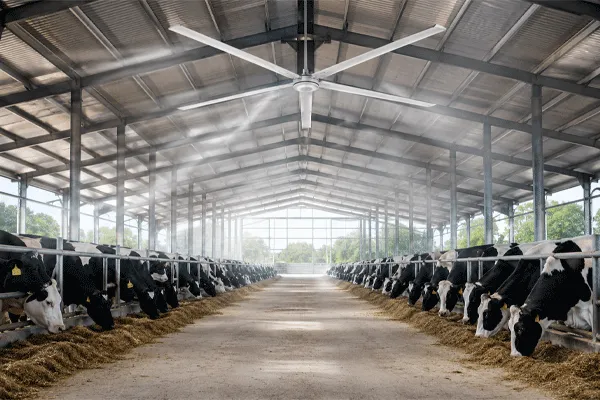
HVLS Fans for Livestock and Cattle Farm Cooling
Air Speed Is the Specification, Not Fan Size
The variable that matters at animal level is velocity across the animal, measured where the animal actually stands or lies.
Published targets are specific. A Cargill heat-stress abatement guide distributed through Kansas State recommends 4 to 5 mph air speed over cow beds and the feed alley. University of Minnesota Extension goes further, noting that raising air speed past a cow to 10 mph can bring her respiration rate down to a non-heat-stressed level, and that mixing fans are commonly mounted over free stalls and feed alleys where cows stand to eat.
Those numbers are the acceptance criterion. A fan that produces impressive volume but leaves 2 mph over the stall bed has not solved the problem it was bought for. When comparing products, ask for airflow measured to AMCA 230-15, the Air Movement and Control Association’s ceiling-fan performance standard, and to ANSI/ASHRAE 216P, which covers HVLS fans specifically, then ask separately what velocity the proposed layout produces at animal height in your building. Those are two different questions and vendors sometimes answer only the first.
Vindus publishes performance descriptions rather than per-model figures on the website; the measured report for a given model is available on request. Request the same document from every supplier on the list.
Where HVLS Fans Fit, and Where They Do Not
This is the section most livestock fan pages skip, and it decides more purchases than any product feature.
Penn State Extension’s guidance is direct on the point: axial circulation fans in the 36 to 52 inch range provide good air movement in animal spaces, and while large HVLS fans can also deliver air movement at cow level, they have to be positioned over the animals and spaced no more than twice their diameter apart. For in-line axial fans the same guidance allows spacing up to eight times fan diameter.
Read those two spacing rules together and the trade becomes clear. An HVLS fan covers a wide area from one mounting point with one electrical connection and no equipment in the animal’s way, but its coverage circle is tied tightly to its diameter, and the fan has to be over the animals rather than aimed at them from a post.
| Dimension |
HVLS fan (P680) |
36–52 in axial circulation fans |
Tunnel ventilation |
| Air pattern |
Wide, slow, downward and outward |
Directed horizontal jet |
End-to-end building flow |
| Spacing rule |
No more than 2× diameter, mounted over animals |
Up to 8× diameter in line |
Fixed system design |
| Velocity at animal level |
Depends heavily on mounting height and obstructions |
High directly in the jet path |
High along the flow path |
| Effect on stratification |
Mixes apex air down |
Limited above jet height |
Removes rather than mixes |
| Winter use |
Yes, low speed, returns ceiling heat |
Draughts at animal level |
Usually shut down |
| Units for equivalent coverage |
Few |
许多 |
Fixed |
| Obstruction in the animal space |
None |
Posts, brackets, cabling |
Wall openings |
Most working barns end up with more than one of these. A common pattern is HVLS units for whole-volume mixing and winter destratification, with axial fans concentrated over stalls and the feed bunk where the 4–5 mph target has to be met reliably. Presenting an HVLS fan as a replacement for stall-level cooling in a hot, humid climate is where these projects disappoint.
The P680 Series in Livestock Housing
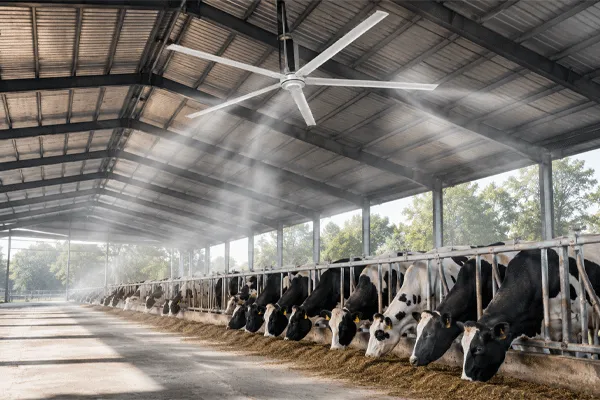
Barns, sheds, and covered yards are usually lower than industrial buildings, which puts them in the P680’s range rather than the larger P780’s.
| Specification |
P680 Series |
| Diameters available |
8 ft to 14 ft |
| Suitable ceiling height |
10–25 ft |
| Positioning |
Medium-size spaces |
| Motor architecture |
PMSM direct drive, no gearbox |
| Performance standards referenced |
AMCA 230-15, ANSI/ASHRAE 216P |
| Safety compliance |
CE, CB, EN, IEC |
| 保修单 |
3 years, defective components and premature failure |
Applying the spacing rule to those diameters produces a number you can lay out on a floor plan straight away. At no more than twice fan diameter, a 14 ft unit implies spacing on the order of 28 ft between fan centres over the animal area; a 10 ft unit implies roughly 20 ft. Multiply that against the length of your stall rows and you have a preliminary unit count before anyone visits the site.
Buildings above 25 ft to the underside of the structure fall outside this line — the P780 Series covers 20–33 ft with 20 ft and 24 ft diameters. Note also that the E680 Series, at 2.4 to 4.3 m diameters, is not sold in the United States.
The gearless drivetrain is worth a specific word in this application. With a direct-drive PMSM there is no reduction gearbox, so no gear oil to check, change, or leak over a feed alley, a bedding pack, or a milking parlour. On a gearbox-driven fan, a leak is uncommon but its consequence is contaminated feed rather than a mopped floor.
HVLS Fans for Livestock and Cattle Farm Cooling
Conditions That Rule This Equipment Out
- High-ammonia and corrosive atmospheres.Enclosed swine buildings, poultry housing, and manure-adjacent spaces are aggressive toward fasteners, coatings, and electronics. Get corrosion resistance and ingress protection confirmed in writing against your building’s atmosphere before ordering. This applies to every ceiling fan brand, including ours.
- Heavy overhead wash-down.Direct pressure washing of ceiling equipment demands a verified ingress rating, not an assumption.
- Clear height below 10 ft or above 25 ft.Outside the P680’s range in both directions.
- Buildings where the real problem is air exchange.Minnesota extension puts hot-weather barn ventilation at roughly 60 to 90 air exchanges per hour — that is a job for the building’s ventilation system. Circulation fans move the air that is already inside; they do not bring fresh air in or push stale air out.
- Humidity excess.Air movement changes how moisture behaves at surfaces and speeds evaporation. It does not remove water from the building.
- Stall-level cooling in severe conditions, on its own.Covered above. If the 4–5 mph figure cannot be met at bed level by the proposed layout, the layout needs axial fans as well, and any vendor who will not discuss that is selling rather than specifying.
The cost side is equally plain. Mounting points need structural review against dead and dynamic load, and agricultural structures vary widely in what a purlin will carry. Installation requires licensed electrical work and lift access. Servicing a gearless unit is light but still means lockout/tagout and work at height. Vindus covers defective components and premature failure for three years and does not cover damage from installation or use outside intended conditions, which puts the emphasis on the structural and environmental review happening before the order, not after.
Specifying a Livestock Installation
- Record clear height at each candidate mounting point.Underside of structure, not ridge. Check each against the 10–25 ft range.
- Mark where the animals actually are.Stall rows, bedded pack, feed bunk, holding pen, parlour. HVLS units have to sit over the animals to be effective, so the animal map, not the building outline, drives fan positions.
- State your climate in terms of humidity, not just temperature.The THI thresholds above shift with it, and this determines whether HVLS alone is a credible plan.
- Write down the atmosphere.Ammonia exposure, dust, wash-down method and frequency. Send it with the enquiry. This is the most common omission in livestock enquiries and the most likely source of a later warranty argument.
- Have the mounting point structurally reviewed and documented.Dead load plus dynamic load, signed off by an engineer.
- Ask for two documents, not one.The AMCA 230-15 airflow report, and a layout drawing showing expected air velocity at animal height for your building. Compare vendors on both.
- Plan verification.Agree how air speed will be checked at bed and bunk level after commissioning, with a handheld anemometer, and what happens if it falls short.
Step 7 is the one almost nobody asks for and the only one that tells you whether the money worked.
What Does a Livestock HVLS Fan Cost?
Vindus does not publish prices. Cost varies with diameter, quantity, mounting arrangement, controls, environmental protection requirements, and site access, so the figure comes from a quotation. Ask for fans, mounting hardware, controls, and commissioning to be itemised separately, and request the quote alongside the airflow report so performance and price are judged together.
常问问题
Q: At what temperature do cattle start suffering heat stress?
A: It depends on humidity as well as temperature. Penn State Extension indicates productive dairy cows may begin experiencing heat stress at a THI of 68 or above, which in humid conditions can occur at temperatures as low as 72 °F.
Q: What air speed should a fan deliver over the cows?
A: The Cargill abatement guidance recommends 4 to 5 mph over cow beds and the feed alley. Minnesota Extension notes that around 10 mph past the cow can bring respiration rates back to a non-stressed level. Measure it at animal height after installation.
Q: How far apart should HVLS fans be spaced in a barn?
A: Penn State Extension advises no more than twice the fan’s diameter, with the units positioned over the animals. For a 14 ft fan that is roughly 28 ft between centres.
Q: Can HVLS fans replace the axial fans over my stalls?
A: Not reliably in hot, humid conditions. HVLS units handle whole-volume mixing and winter destratification well; meeting a 4–5 mph target at bed level often still requires directed axial fans. Many barns run both.
Q: Do these fans reduce humidity in the barn?
A: No. They increase evaporation at surfaces and off the animals, which is where the cooling sensation comes from, but removing moisture from the building requires air exchange.
Q: Are they suitable for poultry or enclosed swine housing?
A: Corrosion resistance and ingress protection must be confirmed against that specific atmosphere before ordering. Describe the environment in writing and get a documented answer.
Q: Is there a gearbox to service?
A: No. The P680 uses a direct-drive PMSM, so there is no gear oil to change and no leak exposure over feed or bedding.