Michael Danielsson | CEO, Vindus Fans | Published August 5, 2026
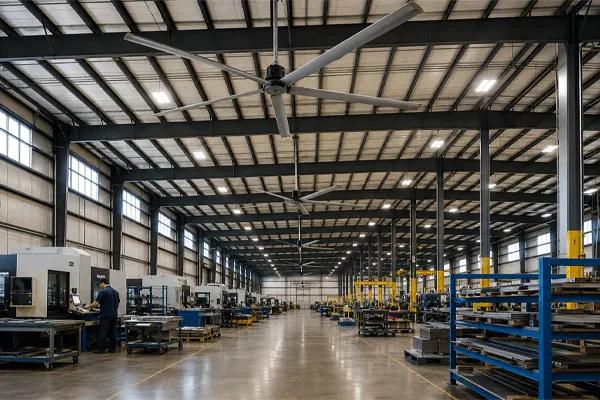
HVLS fans cool factories by moving large, slow columns of air across the floor, breaking up heat layers and creating an evaporative cooling effect on workers’ skin. In heated months they raise comfort without lowering the thermostat. In winter, slowed down, they push warm ceiling air back toward the occupied zone.
That is the short version. The longer version matters more, because the reason a fan works in one plant and disappoints in another has almost nothing to do with the fan itself and almost everything to do with what sits between it and the floor.
HVLS Fans for Factory and Manufacturing Plant Cooling
What Actually Happens to Air in an Un-Circulated Plant
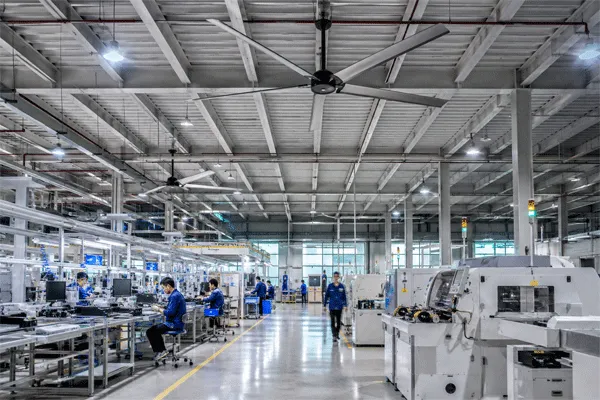
Warm air rises. In a building with a 30 ft ceiling, that single fact produces a temperature gradient that most plant managers underestimate until someone puts a thermometer on a scissor lift. Heat generated by presses, ovens, welding stations, compressors, and lighting collects near the roof deck, where it does nobody any good in summer and gets exhausted through the roof in winter, which is worse.
At floor level the opposite problem develops. Air sits. Around fixed equipment and along walls it forms pockets that barely exchange with the rest of the room. Humidity from washdown areas or process steam stays put. Workers in those pockets report the space as hotter than the thermostat says, and they are right about how it feels even when the dry-bulb reading says otherwise.
A high-volume, low-speed fan attacks both problems with the same motion. Its blades displace a wide column of air downward, which spreads outward along the floor when it lands and then rises again at the perimeter. The room turns over. Ceiling heat gets mixed back into the occupied zone in winter, and in summer that continuous floor-level movement carries humidity away from skin surfaces, which is the mechanism behind perceived cooling. No refrigeration involved.
Why Slow Beats Fast
A common instinct is to buy air speed. Ten small high-velocity fans, mounted on columns and aimed at workstations, feel powerful when you stand in front of one.
The trouble is what happens three meters to the left. High-velocity air decelerates quickly and turns turbulent, so the effect is a narrow beam with sharp edges: strong where it points, absent everywhere else. Workers move; the beam does not. Paper, dust, and lightweight components get disturbed. Noise adds up, and in a plant already fighting for speech intelligibility on the floor, ten motors running at high RPM is a measurable acoustic problem.
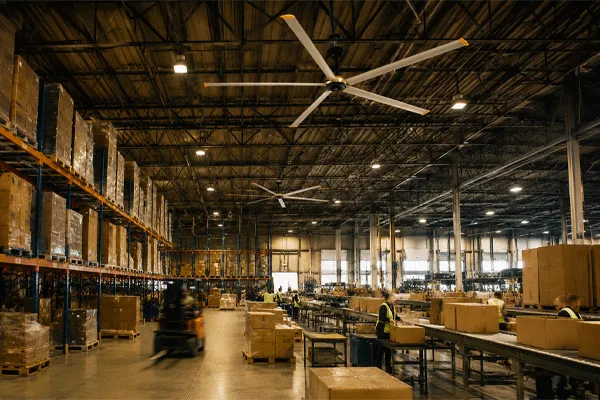
Large diameter at low RPM produces the opposite profile. The air column is wide, moves gently, and stays coherent for a long distance before dissipating. Coverage becomes continuous rather than spotty, and one fan can replace a cluster of small ones with a single electrical connection.
If you want to compare products on this basis, ask for airflow data measured to AMCA 230-15, the Air Movement and Control Association’s test standard for the air performance of ceiling fans, and to ANSI/ASHRAE 216P, which addresses HVLS 风扇 performance specifically. Airflow numbers generated any other way are not comparable across brands. Vindus publishes performance descriptions rather than per-model CFM tables on the website; the model-specific airflow report is available on request, and you should ask every vendor on your shortlist for the same document rather than accepting a marketing figure.
The P780 Series in a Manufacturing Building
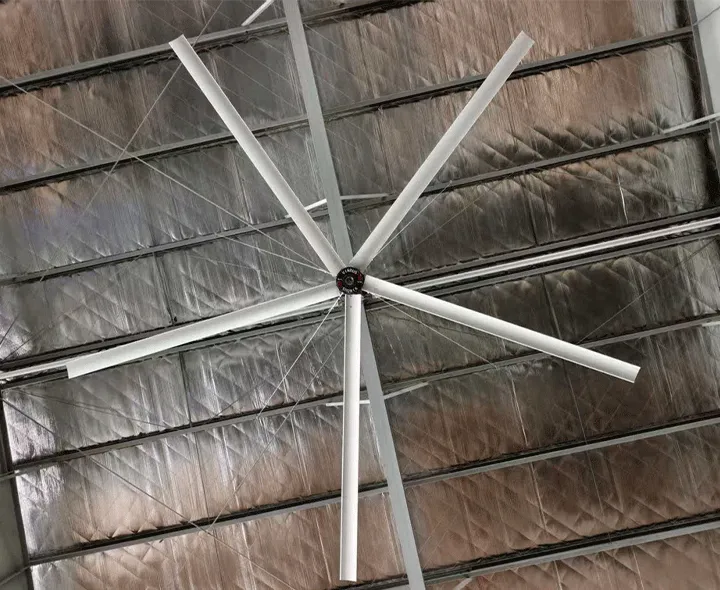
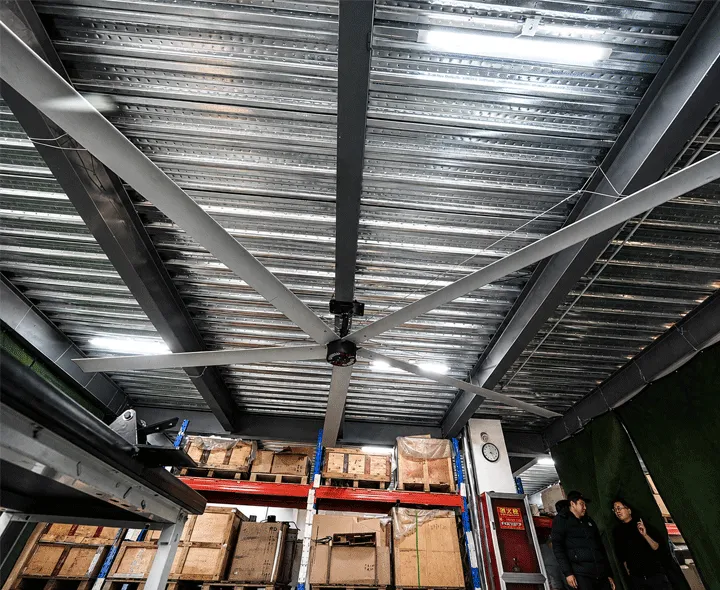
The P780 is the Vindus line aimed at large-span industrial buildings in the United States, and it is the reference model for most factory projects.
| Specification |
P780 Series |
| Diameters available |
20 ft and 24 ft |
| Suitable ceiling height |
20–33 ft |
| Motor type |
PMSM (permanent magnet synchronous), direct drive |
| Gearbox |
None |
| Power draw at maximum speed |
Under 1,000 W |
| Control interface |
Integrated HMI at floor level |
| Cabling |
Single ceiling-to-floor cable |
| Performance standards referenced |
AMCA 230-15, ANSI/ASHRAE 216P |
| Safety compliance |
CE, CB, EN, IEC |
Three of those rows carry more weight than they look like they do.
HVLS Fans for Factory and Manufacturing Plant Cooling
Ceiling height 20–33 ft. This is the constraint that decides the model, not the floor area. A building with an 18 ft deck is outside the P780’s range; the P680 Series covers 10–25 ft ceilings and 8–14 ft diameters for lower workshop and logistics bays. Specifying a 24 ft fan into a low building produces air movement that hits the floor too hard and too close, and the coverage you paid for does not materialize.
Under 1,000 W at maximum speed. Sub-kilowatt draw changes the arithmetic on circuit planning. Several units can often share existing capacity rather than triggering a service upgrade, and running cost per fan-hour stays low enough that continuous winter destratification is usually cheaper than the heat it saves.
Floor-level HMI on a single cable. Speed changes, scheduling, and diagnostics happen at eye level from the plant floor. On installations where the controller sits at the fan head, the same tasks require a lift, an aisle closure, and a work-at-height permit. In an operating plant, that difference shows up as production interruption rather than as a maintenance line item.
Direct Drive vs. Gearbox vs. High-Speed Fans
Compared with the gearbox-driven HVLS fans still common in this category, a direct-drive PMSM design removes an entire mechanical subsystem and everything attached to it.
| Dimension |
Direct-drive PMSM (P780) |
Gearbox-driven HVLS |
High-speed drum/pedestal fans |
| Drivetrain |
Motor drives hub directly |
Motor plus reduction gearbox |
Direct, small diameter |
| Recurring service |
No gear oil schedule |
Oil level checks and changes |
Filter/guard cleaning, bearings |
| Oil leak risk over product |
Not applicable |
Present; matters over food, electronics, painted goods |
Not applicable |
| Transmission losses |
None from gearing |
Losses at the gear stage |
Not applicable |
| Head weight |
降低 |
更高 |
N/A (floor-mounted) |
| Airflow pattern |
Wide, slow, continuous |
Wide, slow, continuous |
Narrow, fast, turbulent |
| Floor space consumed |
None |
None |
Occupies aisle or bay area |
| Units per given area |
Few |
Few |
许多 |
The gearbox column is the one to read carefully if your plant makes anything that cannot tolerate an oil drip: food and beverage, pharmaceutical packaging, electronics assembly, automotive paint. A leak is uncommon, but the consequence is a scrapped batch rather than a mopped floor.
Where an HVLS Fan Is the Wrong Answer
Two things get sold as HVLS benefits that are not.
The first is temperature reduction. An HVLS fan does not lower the dry-bulb temperature of a room; it does not remove heat from the building. It redistributes existing air and changes how warm people feel. If your plant has a genuine heat-load problem, a curing oven throwing off more energy than the roof can shed, air movement alone will not solve it. You need exhaust, make-up air, or spot cooling, with circulation as a complement.
The second is humidity. Moving air accelerates evaporation off skin, which is why it feels cooler. It does not dehumidify. In an environment already near saturation, the perceived benefit shrinks considerably.
Beyond that, there are physical situations where these fans underperform or do not belong:
- High-rack narrow-aisle storage areas.Racking blocks the descending column before it reaches the floor. Air moves across the top of the racks and very little reaches the picking aisle.
- Cleanrooms and controlled-particulate zones.Large-scale mixing is the opposite of what a directional filtration scheme is designed to do.
- Open-flame or open-solvent processes.Air movement across a flame or an evaporating surface changes process behavior and can create a hazard.
- Areas with fine settled powder.Floor-level air movement can re-suspend it.
- Bays with obstructed vertical clearance.Crane rails, ductwork runs, and sprinkler heads all impose minimum separation distances that are checked at design stage, not after the order.
- Buildings below 20 ft to the deck.Different model class, as noted above.
There is also a cost side worth stating plainly. A fan of this scale is a capital purchase requiring structural review of the mounting point, licensed electrical work, and a lift for installation. Servicing, though infrequent on a gearless unit, still requires lockout/tagout and work at height. Vindus covers defective components and premature failure for three years from the factory, and does not cover damage from installation or use outside intended conditions, so the structural and electrical review at the start is where risk is actually managed.
HVLS Fans for Factory and Manufacturing Plant Cooling
- Measure to the underside of the structure, not the roof.Record the clear height at the intended mounting point, accounting for joists, crane rails, and services. Confirm the result falls inside the 20–33 ft window for the P780.
- Map the obstructions on a floor plan.Mark racking over 8 ft, mezzanines, overhead conveyors, partition walls, and large fixed machinery. These define the zones a fan can and cannot reach.
- Identify the heat sources and the occupied zones separately.They are frequently not in the same place, and fan positions follow the occupied zones.
- Confirm the structural attachment.Get the mounting point reviewed by a structural engineer against the fan’s dead load plus dynamic load. Document it.
- Check electrical capacity and controls.With draw under 1,000 W per unit at maximum speed, confirm circuit availability and decide whether units run independently from their floor-level HMI panels or integrate into building automation.
- Request the AMCA 230-15 airflow report and a layout proposal for your building.Compare vendors on the same measured basis, and require that the layout reflect your obstruction map rather than an empty rectangle.
Completing all six leaves you with a document set a purchasing department can evaluate. Skipping step 2 or step 4 is where projects go wrong.
What Does a Factory HVLS Fan Cost?
Vindus does not publish list pricing. Fan cost varies with diameter, quantity, mounting configuration, control integration, and installation conditions, so the figure comes from a quotation rather than a price sheet. For a factory project the quote should itemize the fans, mounting hardware, controls, and any commissioning, and should be requested alongside the airflow report so that price and performance are evaluated together.
常问问题
Q: How many HVLS fans does a manufacturing plant need?
A: Quantity follows ceiling height, obstruction layout, and where people actually work, not floor area alone. An open 30 ft-deck assembly hall needs far fewer units than the same square footage divided by racking and mezzanines. Ask for a layout proposal based on your floor plan.
Q: Can HVLS fans run in winter?
A: Yes, and in a heated plant this is often the larger saving. Run at low speed, the fan pushes air that has collected under the roof back down to the occupied zone, reducing the vertical temperature gradient the heating system is fighting.
Q: Do these fans need a gearbox oil change?
A: The P780 uses a direct-drive PMSM with no gearbox, so there is no gear oil to check or replace, and no oil-leak exposure over product.
Q: How loud is an HVLS fan on a production floor?
A: Low tip speed and a direct-drive motor produce a lower acoustic signature than a bank of small high-RPM fans moving comparable volume. Request model-specific acoustic data for your ceiling height rather than relying on a general claim.
Q: What ceiling height do I need?
A: For the P780 Series, 20 to 33 ft. Buildings between 10 and 25 ft are addressed by the P680 Series.
Q: Are these fans certified?
A: Vindus products carry CE, CB, EN and IEC safety compliance, and performance follows AMCA 230-15 and ANSI/ASHRAE 216P.