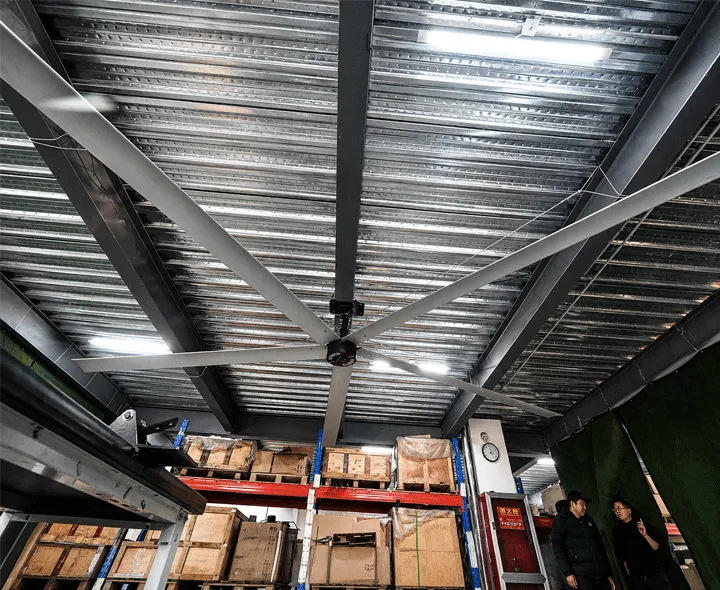
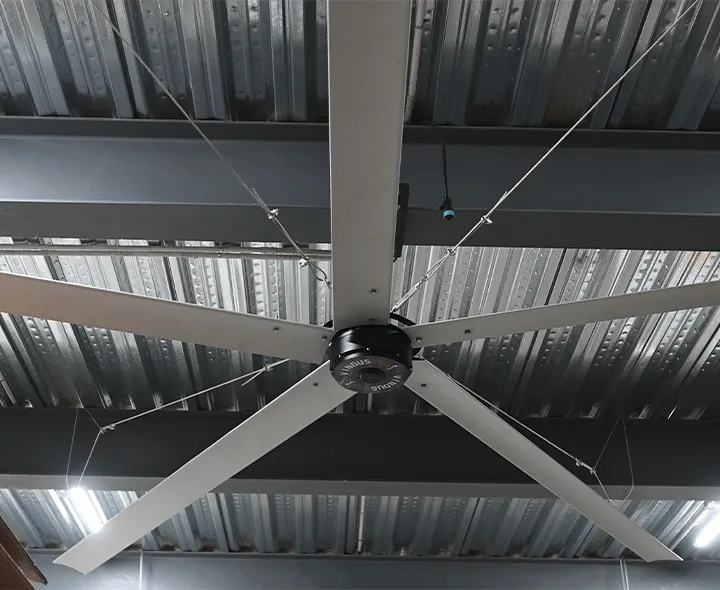
Poor air movement in a warehouse does more than make workers uncomfortable. It leaves hot or stagnant zones around racks, loading docks, and packing lines, while scattered portable units create noise and clutter. A well-planned fan system can solve these problems without treating the entire building as one space.
Large air movement fans for warehouses improve indoor comfort by distributing air across storage, production, picking, and loading areas. HVLS ceiling fans support broad, low-speed circulation, while directional and exhaust fans handle specific work zones and ventilation needs. Combining the right equipment creates a more balanced and efficient warehouse environment.
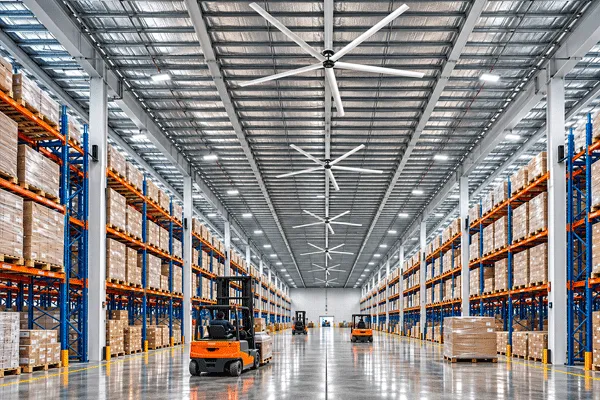
Large Air Movement Fans for Warehouses: Industrial Fan, HVLS Ceiling Fan & Warehouse Fan Systems
1. Why Does Warehouse Air Movement Need a Zone-Based Plan?
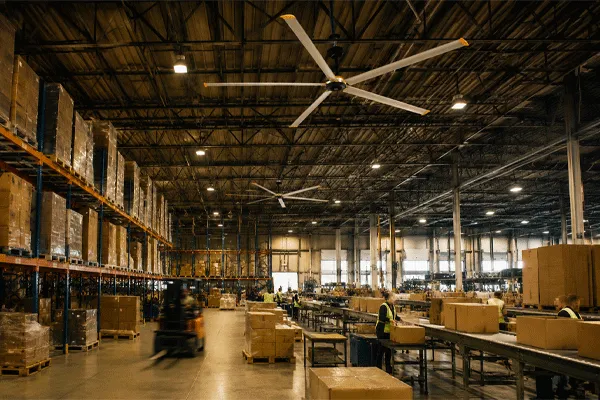
A warehouse is not one large, empty room. It is a working environment with different activities taking place at the same time. Employees move products, forklifts travel through aisles, machines generate heat, and loading doors open and close throughout the day.
These activities create different airflow needs. A fan that works well above an open storage area may not provide enough air movement around a narrow packing station. Likewise, a powerful directional fan may create uncomfortable high-velocity air in an area where employees work for several hours.
This is why warehouse managers should consider air movement by operating zone, rather than simply counting the square footage of the building.
A good industrial fan plan should address:
- Worker comfort in picking and packing areas.
- Heat buildup around production equipment.
- Air circulation in large storage areas.
- Temperature differences between floor and roof levels.
- Air movement near loading and receiving doors.
- Ventilation requirements in areas with dust, fumes, or other pollutants.
For industrial and commercial facilities, the goal is not simply to install more fans. It is to create a system that delivers the right airflow to the right location.
2. Which Warehouse Zones Need Different Air Movement Solutions?
Different warehouse activities create different airflow challenges. Before choosing equipment, divide the building into functional areas and identify what each area needs.
| Warehouse Zone |
Common Airflow Challenge |
Recommended Fan Approach |
| Storage areas |
Stagnant air between storage sections |
HVLS 吊扇 |
| Picking and packing |
Uneven airflow around employees |
HVLS with local directional fans |
| 装卸货区 |
Heat exchange and changing air conditions |
Directional fans and suitable ventilation |
| Production areas |
Heat from machines and equipment |
HVLS and targeted industrial fans |
| Maintenance workshops |
Local heat and work-related emissions |
Local fans and dedicated exhaust |
| Open staging areas |
温度分布不均 |
大型工业吊扇 |
Storage and distribution areas often benefit from broad air circulation. Large ceiling-mounted units can move air through open spaces and help reduce stagnant zones.
Picking and packing stations may require a different approach. Employees remain in specific positions for long periods, so additional directional airflow can improve local comfort without increasing the speed of the entire fan system.
Loading docks require careful planning because outdoor air, vehicle movement, and frequently opened doors affect indoor conditions. A warehouse fan should support the overall air movement plan rather than fight against the building’s ventilation design.
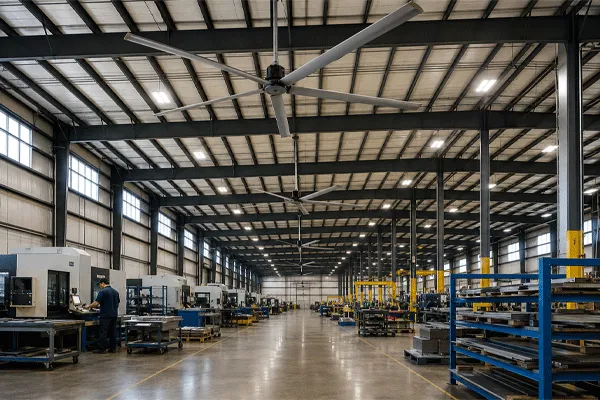
The same principle applies to manufacturing facilities and shop industrial operations: each working zone should have a clear airflow objective.
3. Which Industrial Fan Types Should Work Together in a Warehouse?
There are several industrial fan types available, but they do not perform the same job. Some move air across a large floor area, while others provide targeted cooling or remove air through a ventilation system.
Understanding these differences helps buyers avoid choosing a fan that is powerful but unsuitable for the actual application.
| 风扇类型 |
Main Function |
Suitable Application |
| HVLS 风扇 |
Broad, low-speed air movement |
Large warehouses and open buildings |
| 落地扇 |
Adjustable directional airflow |
独立工位 |
| 滚筒风机 |
Strong localized airflow |
Workshops and temporary cooling |
| Wall fans |
Directional airflow without using floor space |
Production lines and narrow areas |
| 落地扇 |
局部送风 |
Small working zones |
| Axial or exhaust fan |
Air supply or removal, depending on system design |
Ventilation applications |
| 离心鼓风机 |
Air movement against higher system resistance |
Ducted industrial applications |
Whole-building airflow versus local cooling
An HVLS fan works well when the objective is to circulate air across a large area. Directional fans, including pedestal fans and portable drum fans, are better suited to specific locations.
For example, a large distribution warehouse may use ceiling-mounted HVLS units as its main air circulation equipment, while a small maintenance station uses a separate floor-mounted unit.
Wall fans can also help where floor space is limited. They provide a more focused air stream without creating obstacles for forklifts or workers.
A commercial fan or industrial fan should therefore be selected according to its actual function. Even a super duty portable unit cannot automatically replace a complete large-space air movement system.
The best approach is often a combination of fan types, with each unit performing a clearly defined role.
4. Where Do HVLS Ceiling Fans Fit in Large Warehouse Spaces?
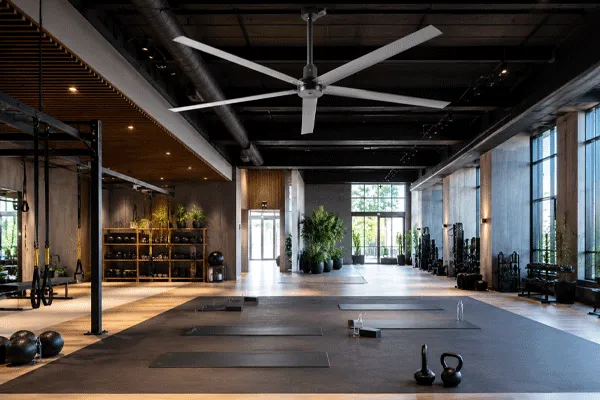
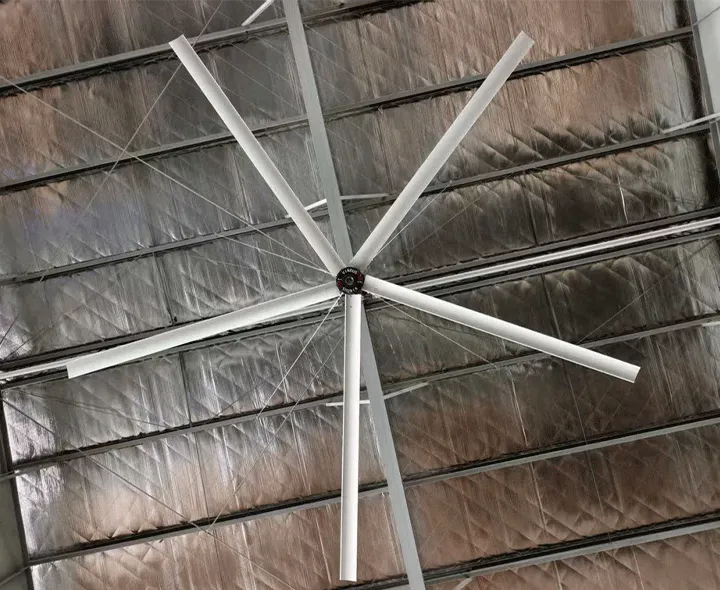
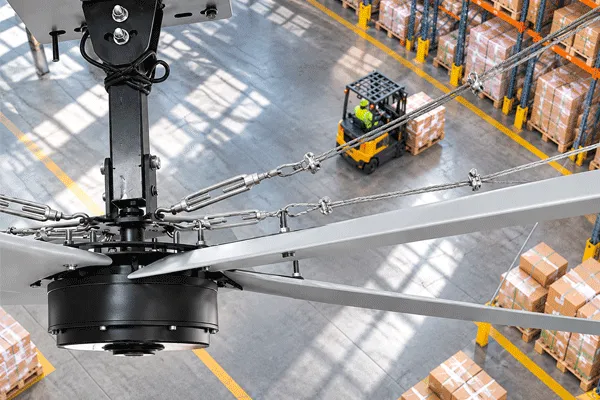
HVLS ceiling fans are designed to move a large volume of air at low rotational speeds. Instead of producing a narrow, high-speed stream, they create a broad column of air that travels downward and spreads outward across the floor.
This makes them particularly useful in large open warehouse buildings, distribution centers, and manufacturing facilities.
Compared with smaller mechanical fans, a properly selected HVLS system can provide more uniform air circulation across occupied areas. It can also support destratification by helping redistribute warm air trapped near the ceiling during colder months.
Why are large fans useful for warehouse applications?
- Broad coverage: One large fan can serve a substantial open area, depending on its diameter and installation conditions.
- Comfortable airflow: Low-speed operation helps create a more consistent air movement pattern.
- Year-round operation: Seasonal operating modes can support summer comfort and winter air mixing.
- HVAC support: Better air distribution can help an existing HVAC system serve occupied areas more effectively.
- Flexible control: Multiple fans can operate at different speeds according to the building’s needs.
For large industrial and commercial buildings, selecting the correct industrial ceiling fans is important for long-term performance.
了解 Vindus HVLS 风扇产品系列 to compare available models and configurations.
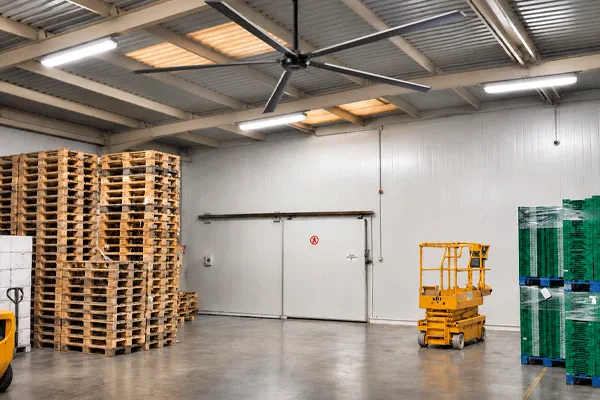
Large Air Movement Fans for Warehouses: Industrial Fan, HVLS Ceiling Fan & Warehouse Fan Systems
5. How Should Warehouse Fans Work with Ventilation and Exhaust Systems?
Air circulation and ventilation are related, but they are not the same thing.
A ceiling fan recirculates indoor air. It does not automatically introduce fresh outdoor air or remove harmful contaminants. This distinction matters in warehouses where forklifts, production equipment, cleaning processes, and other activities may generate pollutants.
An exhaust fan removes air from a specific area or building. A properly designed make-up air system then supplies replacement air to maintain the intended airflow balance.
In some applications, a warehouse may need several systems working together:
- HVLS fans to circulate air across large occupied areas.
- Exhaust fans to remove unwanted indoor air.
- Make-up air equipment to replace exhausted air.
- Local exhaust ventilation to capture dust, fumes, or vapors near their source.
- HVAC equipment to manage temperature and humidity.
For example, a warehouse with a general storage area and a separate welding workshop should not use the same airflow strategy in both locations.
The workshop may require source-capture ventilation, while the storage area may benefit from broad air circulation.
6. What Should an Industrial Ceiling Fan Layout Consider Beyond Floor Area?
A large warehouse may have enough floor space for big fans, but that does not mean every ceiling position is suitable.
The building’s internal structure can strongly affect how air moves. Racking, overhead cranes, mezzanines, lighting systems, sprinklers, and production equipment may interrupt airflow or limit safe installation positions.
A proper layout should consider the entire working environment.
Important layout factors
1. Storage rack arrangement
High racks can change airflow paths. Fan positions should be planned around rack orientation and occupied aisles instead of assuming that air will move freely through every section.
2. Loading and receiving doors
Large doors create changing air conditions. The fan layout should account for incoming outdoor air and avoid directing unwanted air toward sensitive storage or work areas.
3. Ceiling structure
The structural support must be suitable for the fan and its dynamic loads. A qualified engineer should review the mounting arrangement before installation.
4. Fire protection and electrical equipment
Maintain the required clearances around sprinklers, lights, cable trays, and other overhead services. Follow applicable local building and fire safety requirements.
5. Forklift and employee movement
Airflow should support occupied work zones without creating unnecessary interference with vehicle operations or material handling.
For harsh industrial environments, fan placement must also consider maintenance access and the risk of accidental impact.
The objective is simple: design an airflow path that works with the warehouse layout, not against it.
7. How Do You Choose Fan Sizes and the Number of Units for Each Zone?
Choosing the right fan requires more than measuring the total warehouse floor area.
Buyers should consider ceiling height, open floor dimensions, rack positions, fan diameter, blade clearance, and the required airflow in occupied areas.
A single fan may be enough for a smaller open section, while a large warehouse may need multiple units arranged in a coordinated pattern.
Example: Vindus HVLS fan configurations
The following specifications are taken from the published Vindus product pages.
| 模型 |
风扇直径 |
叶片数量 |
建议叶片高度 |
| P730-16 |
16 英尺 |
5 |
20–33 ft |
| P730-18 |
18 ft |
5 |
20–33 ft |
| P780-20 |
20 英尺 |
5 |
20–33 ft |
| P780-24 |
24 英尺 |
5 |
20–33 ft |
The P780 Series is designed for large industrial and commercial spaces. It uses a permanent magnet synchronous motor (PMSM) and offers direct drive technology. The published specifications list power consumption below 1,000 watts at maximum speed.
The P730 Series provides 16 ft and 18 ft configurations for applications that need a smaller fan diameter within a similar mounting-height range.
You can review the P780 系列 HVLS 风扇 for detailed technical information.
An illustrative warehouse planning approach
Consider a large warehouse with three main operating areas:
- Open storage: broad, continuous airflow from ceiling-mounted units.
- Packing area: general circulation combined with targeted local cooling.
- Maintenance workshop: local ventilation and dedicated directional airflow.
Rather than choosing the same fan for every location, the engineer should determine the number and size of units for each zone.
Actual fan spacing must be verified against the manufacturer’s specifications and the building’s geometry. Published model spacing is a planning reference, not a universal installation rule.
Vindus also documents a warehouse installation in France using an M800 fan with a 7.3 m diameter, completed in February 2019 for thermal comfort and energy-saving purposes. This provides a real application reference rather than an assumed performance result.
8. What Makes a Heavy-Duty Industrial Fan Supplier Worth Evaluating?
Buying a warehouse fan is a long-term equipment decision. The initial purchase price is only one part of the total cost.
A reliable supplier should be able to explain how its products perform, how they are installed, and what support is available after delivery.
When evaluating industrial fan manufacturers, consider the following points:
- Motor technology: Compare direct drive and geared systems, including maintenance requirements and operating efficiency.
- Blade construction: Review material quality, blade design, connection methods, and safety retention.
- Performance documentation: Request technical specifications and independently recognized performance information where available.
- Safety: Check mounting systems, safety cables, certifications, and electrical protection.
- Control options: Look for adjustable speeds, group operation, and automatic scheduling.
- After-sales support: Confirm warranty terms, spare parts availability, and technical assistance.
How should buyers compare competing brands?
Procurement teams may research Hunter Industrial, Big Ass Fans E-Series, and other commercial ceiling fans before making a decision.
The right comparison is not simply brand against brand. It should be based on equivalent technical requirements.
| 评估因素 |
Questions to Ask |
| 气流性能 |
What documented performance data is available? |
| 发动机 |
What motor technology does the model use? |
| 安装 |
What structural support is required? |
| 控制装置 |
Can multiple fans operate independently? |
| 安全 |
What certifications and safety features are provided? |
| 维护 |
How easy is inspection and servicing? |
| 保修单 |
What components and service periods are covered? |
The best industrial solution is the one that meets the facility’s actual needs and provides dependable support throughout its service life.
You can learn more about why choose Vindus Fans and its engineering, technology, performance, and safety approach.
Large Air Movement Fans for Warehouses: Industrial Fan, HVLS Ceiling Fan & Warehouse Fan Systems
9. How Can Warehouse Managers Verify Airflow After Installation?
Installing fans is only the first step. The final system should be checked under real operating conditions.
A warehouse may look well equipped, but that does not prove that air reaches every important working zone.
A commissioning process should include measurements and feedback from employees.
What should be checked?
Air speed at occupied level: Use suitable instruments to check whether air movement reaches the areas where employees work.
Temperature distribution: Compare temperatures at floor level and near the roof to understand whether the system helps reduce unwanted temperature differences.
Zone coverage: Check areas between racks, around packing lines, and near loading zones for weak or excessive air movement.
Noise and vibration: Confirm that the equipment operates within the specified limits.
Energy use: Record fan operating hours and power consumption to establish a baseline for future comparisons.
Employee feedback: Ask workers whether the new system improves comfort during normal shifts.
Smart controls can make this process easier. Vindus FanBrain supports centralized control of up to 10 fans, scheduled operation, temperature-based speed adjustment, and group control by area.
This allows warehouse managers to adjust different zones according to their operating schedules instead of running every unit at the same setting.
了解更多 FanBrain智能HVLS控制系统.
A good air movement system should be measurable, adjustable, and suitable for the daily needs of the facility.
10. Frequently Asked Questions About Warehouse Fan Systems
What is the best industrial fan for a large warehouse?
For large open warehouses with suitable ceiling heights, HVLS ceiling fans are often an effective choice for broad air circulation. Smaller directional fans can complement them in specific work areas. The best choice depends on the building layout and airflow requirements.
How many HVLS fans does a warehouse need?
The number depends on the warehouse’s floor dimensions, ceiling height, fan diameter, rack layout, structural conditions, and required coverage. An engineered layout is more reliable than selecting units based only on square footage.
Are HVLS fans better than pedestal fans?
They serve different purposes. HVLS fans are designed for broad air movement across large areas, while pedestal fans provide targeted airflow at individual workstations. Many facilities can benefit from using both.
Can warehouse ceiling fans replace ventilation systems?
No. HVLS fans circulate existing indoor air. They do not replace outdoor air supply, exhaust systems, or local exhaust equipment required to control contaminants.
Are direct-drive industrial fans suitable for continuous operation?
Direct-drive systems can be suitable for regular industrial operation when the motor, electrical components, mounting structure, and control system are properly specified. Buyers should review the manufacturer’s operating limits and maintenance instructions.
How can I reduce warehouse energy costs with industrial fans?
Start by identifying areas with uneven airflow and unnecessary cooling demand. A properly designed fan system can support HVAC operation and improve perceived comfort. Use variable-speed controls and suitable operating schedules to avoid unnecessary energy consumption.
Build a Better Warehouse Air Movement System with Vindus
A warehouse needs more than a collection of powerful fans. It needs an airflow plan that reflects how the building operates every day.
At Vindus Fans, we are a Sino-US joint venture manufacturer and solution provider specializing in HVLS fans, industrial ceiling fans, commercial fans, and intelligent airflow control systems.
We support warehouse owners, logistics companies, manufacturers, HVAC contractors, and equipment distributors with solutions for large industrial and commercial spaces.
Our product range includes P680, P730, P780, E680, and E730 Series HVLS fans, together with FanBrain intelligent controls.
Whether you are developing a new warehouse, upgrading an existing ventilation arrangement, or replacing multiple smaller units, our team can help evaluate your application and identify a suitable solution.
Contact Vindus Fans today to discuss your warehouse dimensions, ceiling height, operating zones, and airflow requirements.
- 访问我们的 warehouse HVLS fan application page.
- Explore our industrial HVLS fan products.
- Compare fan configurations and control options.
- Request a technical recommendation for your project.
Request a Quote from Vindus Fans