Michael Danielsson | Chief Executive Officer, Vindus Fans | Published August 26, 2026
A fan is eco-friendly only in ways you can verify on paper: measured power draw at a stated speed, airflow tested to a published standard, no consumable waste stream over its service life, and declared materials at end of life. Everything else is positioning, not specification.
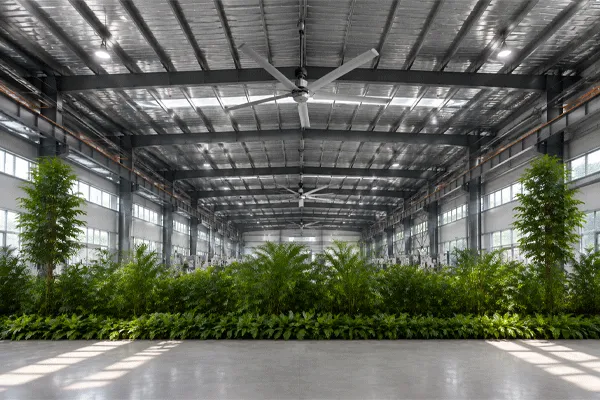
Eco-friendly Airflow Fans for Industrial Applications: What Actually Makes a Fan Sustainable
The working definition, and why most published ones fail
Across 供应商 literature in this 类别, “eco-friendly” functions as a synonym for “energy-efficient.” The claim reduces to: the fan uses less electricity than the HVAC capacity it offsets, therefore it is green. That statement may be true, but it is not auditable, and an auditable claim is the only kind that survives a sustainability report review.
A defensible definition covers four separate things, and a fan can score well on one while failing another:
- Energy at the point of use— how much power the unit draws, at what speed, under what test condition.
- Consumables and waste over the service life— what the fan needs replaced or disposed of during 15 to 20 years of operation.
- Material recoverability at end of life— what is in the unit and what can realistically be recovered.
- Whether the performance claim itself is testable— because an unverifiable airflow figure makes every downstream energy calculation unverifiable too.
The fourth is the one procurement teams skip, and it quietly invalidates the other three. If you cannot establish that Fan A and Fan B move the same air under the same test, you cannot claim either one saves anything relative to the other.
What you can verify, and what you cannot
| Claim you will encounter |
Verifiable? |
Evidence to request |
| “Consumes under 1,000 W at maximum speed” |
是 |
Rated input power, the speed it applies to, and the supply voltage/phase used |
| “Moves X CFM” |
Only with a test basis |
Which standard the figure was produced under, mounting height, and speed setting |
| “Zero gear oil over service life” |
是 |
Drive architecture confirmation; gearless designs have no oil charge to declare |
| “Reduces energy costs by 30%” |
No |
Nobody can produce building-independent evidence for this; treat as marketing |
| “Made from eco-friendly materials” |
No, as stated |
A material composition declaration by mass, per component |
| “Earns LEED points” |
No, as stated |
The specific credit and compliance path (see the LEED section below) |
| “Reduces carbon footprint” |
Only downstream |
Your own kWh baseline and grid emissions factor; the fan supplies an input, not a result |
| Safety compliance marks (CE, CB, EN, IEC) |
是 |
Declaration of conformity for the model and configuration you are buying |
Four of those eight are not claims at all in a procurement sense. They are conclusions that depend on the buyer’s building, and a supplier who states them as product attributes is transferring an unsupported number onto your submission.
The waste stream that never appears in the comparison
Operating energy dominates the sustainability conversation for fans because it is easy to talk about. The service-life waste stream is harder to talk about, so it goes unmentioned, and it is where the two drive architectures genuinely diverge.
A gearbox-driven HVLS fan carries an oil charge. That oil has a change interval, and every change produces three things a facility has to account for: used lubricant requiring documented disposal, the replacement charge itself, and a lift-equipment trip to reach a fan mounted 25 ft up. Multiply by the number of fans and by the years in the service life. For a facility tracking waste by stream — which any organization producing an ESG report already does — this is a recurring line item with a manifest attached.
A gearless PMSM direct-drive fan has no oil charge. There is nothing to change, nothing to dispose of, and no seal that can weep onto product below. That is not a marketing statement; it is a consequence of removing the reduction stage from the drive path.
If you are comparing two quotations, the question to put to both suppliers is specific: state the oil charge volume per unit, the manufacturer-specified change interval, and the disposal classification of the used lubricant. A gearless supplier answers “none” in one line. A gearbox supplier has to produce numbers, and those numbers belong in your total-cost and waste-stream analysis rather than in a footnote.
| Sustainability dimension |
Gearless PMSM direct drive |
Gearbox drive |
| Lubricant consumed over service life |
None |
Oil charge × number of changes × number of units |
| Hazardous waste manifest entries |
None from the drive |
One per oil change |
| Contamination risk to product below |
No drive-side oil path |
Seal weep possible; a documented concern in food, beverage, and pharmaceutical space |
| Service trips requiring lift equipment |
Inspection only |
Inspection plus scheduled lubrication service |
| Replaceable wear parts in the drive |
Motor bearings |
Gear set, seals, bearings, coupling |
| Failure modes that generate scrap |
Motor or controller |
Any of the above |
End of life: the question a PMSM raises, honestly
Permanent magnet synchronous motors use rare-earth permanent magnets. That construction is what delivers full torque at low speed without a gearbox, and it is the reason the drive consumes no lubricant. It also means the motor contains materials whose recovery infrastructure is less developed than the recovery infrastructure for steel and aluminum.
That is a real trade-off, and pretending otherwise would be the same behavior this article is arguing against. The honest position: the aluminum blade and hub assembly, the steel mounting hardware, and the copper windings all enter established recycling streams. The magnet assembly is the component to ask about. If your organization reports on circularity, request a material composition declaration by mass and ask the supplier what their stated end-of-life route is for the rotor assembly.
No supplier in this category, ourselves included, should be claiming a closed material loop. What we can do is tell you what is in the unit and let your reporting reflect it accurately.
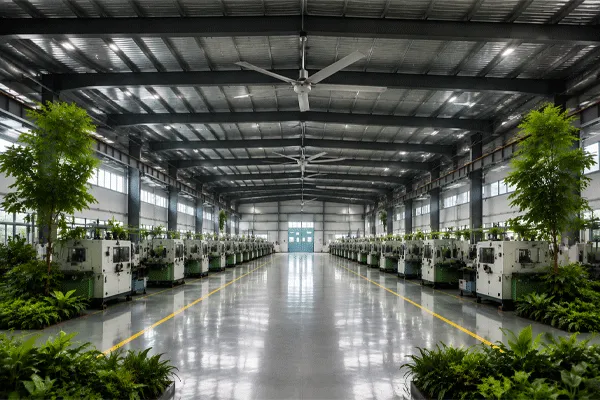
Eco-friendly Airflow Fans for Industrial Applications: What Actually Makes a Fan Sustainable
P730 Series: the specification lines that carry the argument
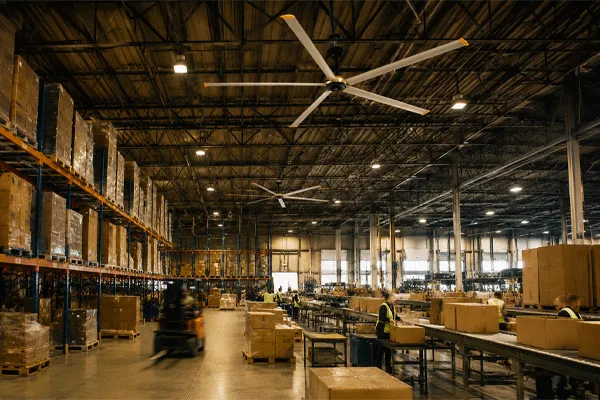
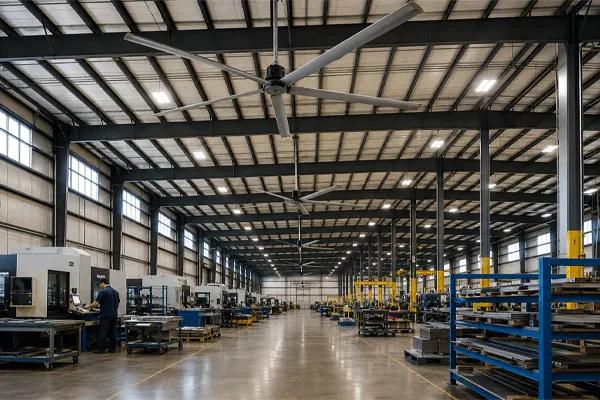
The P730 is the 16 ft and 18 ft range for buildings with 20 to 33 ft of clear height, which covers most manufacturing halls, distribution floors, and large assembly space in a sustainability retrofit.
| Specification |
P730 Series |
| 直径 |
16 ft and 18 ft |
| Recommended ceiling height |
20–33 ft |
| 发动机 |
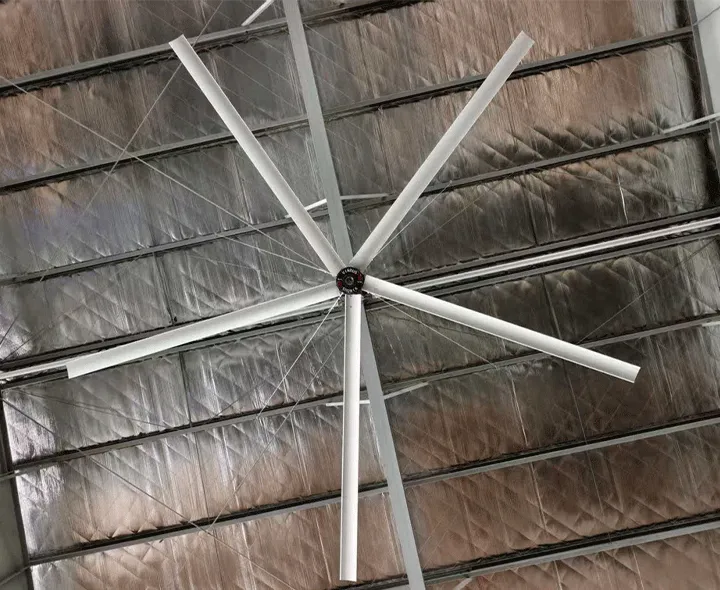
PMSM (permanent magnet synchronous), direct drive, gearless |
| Power draw |
Under 1,000 W at maximum speed |
| Lubricant requirement |
None — no gearbox, no oil charge, no change interval |
| Control interface |
Floor-level integrated HMI |
| Wiring |
Single ceiling-to-floor cable |
| Airflow rating (CFM) |
Not published per model; issued with quotation, tested to AMCA 230-15 |
| Sound level |
Not published per model; issued with quotation |
| Safety compliance |
CE, CB, EN, IEC |
| 保修单 |
3 years, covering defective components causing improper operation |
Three notes for anyone building a justification document from this table.
Under 1,000 W is a ceiling, not an operating point. Fan power falls steeply as speed drops, so a unit run at a partial setting for air distribution draws a fraction of the rated maximum. When you model annual consumption, model the speed profile you will actually run, not the nameplate.
“No lubricant requirement” is the line that distinguishes a sustainability claim from an energy claim. It is verifiable by inspection, it does not depend on your climate zone, and it holds for the full service life.
The blank CFM line is deliberate. We publish airflow per configuration in the quotation rather than as a catalog headline, because a number without its test conditions attached invites a comparison that is not valid. Which is the next section.
Making the airflow claim defensible: AMCA 230-15 and ANSI/ASHRAE 216P
Two documents exist so that airflow figures from different manufacturers mean the same thing.
AMCA 230-15 is the Air Movement and Control Association’s laboratory method for rating the air performance of circulating fans. It specifies the mounting arrangement, the velocity traverse, and the reporting format.
ANSI/ASHRAE 216P addresses performance rating for large-diameter ceiling fans, including how the airspeed field beneath the fan is characterized rather than collapsed into a single headline volume.
For a procurement file, the practical use is a three-part question issued identically to every bidder: under which standard was this figure produced, at what mounting height, and at what speed setting? Answers arrive in one of three forms. Some suppliers give all three. Some give the standard but not the conditions. Some give a number with no basis at all, and that third group cannot be included in a comparison, which is itself a useful procurement outcome.
Compared with the smaller high-speed axial units this category is often benchmarked against, large-diameter low-speed fans move a given volume with less input power because the work is done by swept area rather than by velocity. That relationship is physical, but the magnitude in your building still needs a common test basis to state. Vindus products follow AMCA 230-15 and ANSI/ASHRAE 216P for performance, and CE, CB, EN, and IEC for safety. Neither standards body endorses any brand; they exist so that you can hold every brand to one measurement.
Eco-friendly Airflow Fans for Industrial Applications: What Actually Makes a Fan Sustainable
Where fans actually sit in a LEED submission
The claim that installing HVLS fans “earns LEED credits” appears throughout this category’s literature. It is not how the rating system works, and repeating it in a submission narrative will cost you credibility with a reviewer.
What is accurate: under the LEED BD+C Indoor Environmental Quality credit for thermal comfort, ceiling fans are listed among eligible thermal comfort controls, alongside thermostats, adjustable underfloor diffusers, task-mounted controls, and operable windows. The credit itself is documented against ASHRAE Standard 55. LEED v4 projects may use ASHRAE 55-2013 in place of 55-2010 for the thermal comfort credit, and LEED v4.1 projects may use ASHRAE 55-2020 in place of 55-2017, so the first thing to establish is which rating system version and which standard edition your project is registered under.
The mechanism that makes fans relevant is air movement itself. ASHRAE Standard 55 includes an Elevated Air Speed Comfort method that calculates thermal comfort under increased air speed, adjusting air and radiant temperatures according to how occupants are expected to feel and expressing the result through Standard Effective Temperature. In practice this is what lets a design hold comfort at a higher cooling setpoint, which is where the energy argument connects to the comfort argument. The CBE Thermal Comfort Tool, a free tool developed at UC Berkeley for evaluating comfort under ASHRAE Standard 55, includes automatic generation of LEED documentation for thermal comfort credits and supports the predicted mean vote model with elevated air speed.
The correct sentence for a submission narrative is therefore not “HVLS fans earn us a point.” It is closer to: air movement from large-diameter ceiling fans is used as a thermal comfort control and as an input to the elevated air speed calculation demonstrating ASHRAE 55 compliance for the occupied zone. That sentence a reviewer can follow to evidence. The other one they cannot.
One caution worth carrying into any high-bay project: ASHRAE 55 also limits vertical air temperature difference between ankle and head, and constrains HVAC air speed at lower temperatures to reduce draft risk. In a heated warehouse, running fans too fast can move you away from compliance rather than toward it.
Assembling the evidence pack: seven requests to issue
Send these to every bidder in the same wording, and compare the answers rather than the brochures.
- Rated input power at maximum speed, with the voltage and phase it was measured at.A wattage figure without its supply condition is incomplete.
- The power curve or, at minimum, input power at two or three intermediate speed settings.You will operate below maximum most of the year; that is the number your model needs.
- Airflow figure with standard, mounting height, and speed setting stated.Reject figures missing any of the three.
- Lubricant charge volume, change interval, and used-lubricant disposal classification.Gearless suppliers answer in one word; that contrast is the point.
- Material composition declaration by mass, per major component.Blade assembly, hub, motor, controller, mounting hardware.
- Stated end-of-life route for the motor and rotor assembly.Ask specifically about magnet material, and note who answers directly.
- Declaration of conformity for the exact model and configuration quoted.Compliance marks apply to configurations, not to catalogs.
Requests 4, 5, and 6 are the ones that will separate the field, because most suppliers in this category have never been asked them. Slow or evasive answers on those three are information about the supplier, not just about the product.
Misconceptions worth correcting before they reach a report
“Lower wattage equals lower environmental impact” is only true at matched airflow. A fan drawing 600 W that moves substantially less air than one drawing 900 W may require more units to cover the same floor. Compare energy per unit of air moved under a common test basis, not nameplate wattage.
“Eco-friendly materials” is not a specification. Ask for composition by mass. If the answer is a paragraph rather than a table, it is not an answer.
Displacing HVAC capacity is a design decision, not an automatic outcome. Fans reduce cooling load only if the setpoint or the equipment sizing is actually revised. Installing fans and leaving the mechanical design untouched produces added consumption with no offset, and this happens more often than the category admits.
A fan does not have a carbon footprint number you can borrow. Emissions depend on your kWh consumption and your grid emissions factor. A supplier who hands you a CO₂e figure for their product in your building has assumed both, and you inherit those assumptions when you publish it.
Certification marks are not performance ratings. CE, CB, EN, and IEC address safety. AMCA 230-15 and ANSI/ASHRAE 216P address air performance. Citing the first group as evidence of efficiency is a common error in submission documents.
Limitations of this approach
Building a justification on verifiable attributes produces a narrower claim than the marketing version, and you should expect that. You will not be able to state a savings percentage. You will be able to state power draw, airflow on a common basis, an absent waste stream, and a documented comfort compliance path — which is less exciting and considerably more durable under review.
There are also cases where the sustainability case is weak regardless of the equipment. Buildings under roughly 18 ft of clear height offer less vertical air to redistribute. Facilities occupied for a small fraction of the year have few run hours over which to amortize anything, including the embodied impact of manufacturing and shipping the unit. And in buildings with very high air-change rates, mixed air leaves before it does useful work.
The material question raised above is unresolved industry-wide, not just here. Any supplier claiming a fully circular product in this category is making a claim they cannot document today.
常问问题
Q: What makes an industrial fan eco-friendly rather than just energy-efficient?
A: Energy efficiency covers operating power only. A sustainability assessment adds three things: whether the unit consumes and disposes of anything over its service life, what its materials are at end of life, and whether the performance figure underpinning the energy argument was produced on a published test basis. A gearless drive scores on the second because it has no lubricant to consume or dispose of.
Q: Do HVLS fans earn LEED points?
A: Not directly. Ceiling fans appear among eligible thermal comfort controls under the LEED BD+C thermal comfort credit, and air movement feeds the ASHRAE 55 elevated air speed calculation used to demonstrate compliance. Points attach to documented compliance, not to installed equipment. Confirm the rating system version and ASHRAE 55 edition your project is registered under before writing any narrative.
Q: Why does Vindus not publish CFM figures for the P730?
A: Because a catalog number without its mounting height, speed setting, and test standard cannot be compared to a competitor’s number, and publishing one invites exactly that invalid comparison. Airflow data tested to AMCA 230-15 is issued with the quotation for your configuration, which is the form a procurement file can actually use.
Q: How do I compare the environmental impact of a gearbox fan against a direct-drive fan? P780
A: Request the lubricant charge volume, change interval, and disposal classification from each supplier, then multiply across your unit count and intended service life. Add the lift-equipment service trips that scheduled lubrication requires. That difference is quantifiable from supplier-provided data alone, without any modeling of your building.