Direct Drive vs Belt Drive Fan: Efficiency, Maintenance, and Application Differences
2026-08-18
Updated August 18, 2026 | Michael Danielsson, CEO, Vindus Fans
A direct drive vs belt drive fan comparison starts with the power path. A direct-drive motor turns the fan hub without belts or pulleys. A belt-drive system transfers motor torque through pulleys and one or more belts. That difference changes service work, mechanical losses, speed adjustment, installation space, and failure points.
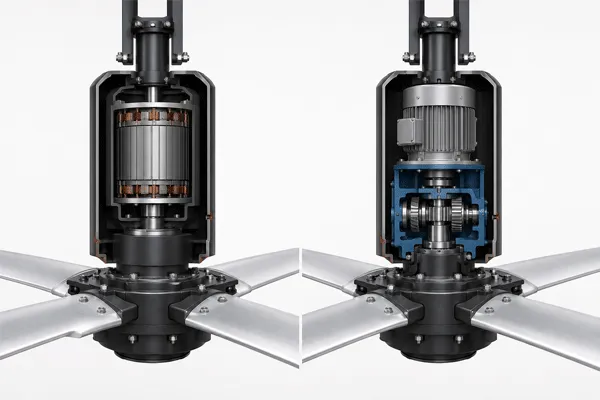
A cutaway comparison of a direct-drive PMSM fan and a conventional geared induction drive. Belt-drive fans use a different transmission, but they also add mechanical components between the motor and fan.
Direct drive vs belt drive fan: the mechanical difference
In a direct-drive arrangement, the motor shaft or integrated rotor is connected to the fan hub. Torque reaches the blades without a belt stage. Large-diameter HVLS designs may pair this layout with a permanent-magnet synchronous motor and electronic speed control.
A belt-drive fan places pulleys on the motor and fan shafts, then uses belt tension to transmit torque. Changing pulley diameters can alter the speed ratio. This architecture can separate the motor from the fan wheel and gives service teams familiar mechanical parts, but it also introduces alignment, tension, guarding, and replacement tasks.
Decision factor
Direct drive fan
Belt drive fan
Power path
Motor acts directly on the hub or wheel
Motor transfers torque through pulleys and belts
Transmission components
No belts or pulleys
Belts, pulleys, shafts, bearings, and guards may be involved
Routine service
Inspect motor, fasteners, electrical connections, controller, and bearings specified by the manufacturer
Add belt condition, tension, alignment, pulley wear, and guard checks
Speed control
Usually electronic through a compatible drive or controller
Can use pulley ratios, electronic motor control, or both
Installation envelope
Compact transmission path, although motor and controller clearances still matter
Needs space and access for belts, pulleys, guards, and tension adjustment
Service strategy
Fewer mechanical wear parts, but trained electrical or controls support may be needed
Mechanical parts are familiar, but periodic adjustment and replacement are expected
Efficiency depends on the complete operating point
Removing a belt stage removes belt slip and flexing from the power path. That can reduce transmission losses, especially when compared with a belt system that is worn, loose, misaligned, or operating outside its intended load. It does not mean every direct-drive fan automatically uses less energy than every belt-drive fan.
Fan diameter, blade design, speed, motor efficiency, controller losses, duty cycle, airflow resistance, and the required air-delivery pattern all affect input power. Compare measured or declared fan performance at the same duty point. The Air Movement and Control Association publishes standards and technical publications for air-system products; a motor label alone is not a complete fan-performance comparison.
For a large-space ceiling fan, overspeeding a smaller unit to chase coverage can undermine the expected efficiency and comfort result. Start with the occupied zone, ceiling height, obstructions, and operating schedule. The Vindus HVLS airflow optimization guide explains why layout and clearance must be checked before selecting diameter or quantity.
Maintenance: fewer parts does not mean no maintenance
Direct drive removes belt inspection and pulley alignment from the routine list. Teams still need a documented inspection plan for blade fasteners, mounting hardware, safety components, motor condition, cables, controller ventilation, unusual vibration, and manufacturer-specified bearings. Access at the fan’s mounting height can be more important than the number of parts.
Belt-drive maintenance adds several mechanical checks:
Isolate the equipment and follow the site’s energy-control procedure before opening guards.
Inspect belts for cracking, glazing, fraying, contamination, and uneven wear.
Check pulley alignment and belt tension with the specified method rather than visual judgment alone.
Inspect bearings, shafts, fasteners, guards, and the surrounding structure.
Run the fan after reassembly and record vibration, noise, temperature, and any change from the baseline.
The U.S. Occupational Safety and Health Administration’s control of hazardous energy guidance applies to maintenance work where unexpected startup or stored energy could injure personnel. A fan’s drive type does not remove the need for site-specific lockout and verification procedures.
Noise and vibration are system issues
A correctly selected direct-drive fan avoids belt slap, pulley noise, and belt-related vibration. Its acoustic result still depends on motor electromagnetic noise, blade loading, structural resonance, mounting stiffness, balance, speed, and the room itself.
A belt drive can operate smoothly when tension, alignment, pulley condition, and bearings are correct. Wear can gradually change its sound and vibration signature, which is why a baseline record is useful. Do not use quiet operation as proof that a belt is correctly tensioned, and do not treat a new noise as a reason to keep running until the next planned service.
Where each drive type can fit
Direct drive is often preferred when
Ceiling access is difficult and reducing routine transmission service has practical value.
The project needs electronic speed control, repeatable setpoints, or integration with a multi-fan control strategy.
A compact drive package helps with clearance around roof structure and building services.
The owner wants to remove belts and pulleys from the replacement-parts plan.
Belt drive can remain practical when
The site already has trained technicians, stocked belts, and a scheduled mechanical maintenance program.
Pulley ratios are used to match an established fan and motor arrangement.
The motor must be positioned away from the fan wheel because of access or environmental constraints.
The complete installed system meets the required airflow, safety, noise, and lifecycle-cost targets.
Compared with common belt-driven industrial fan arrangements, a direct-drive HVLS fan usually trades mechanical adjustment points for greater dependence on the matched motor, controller, and electrical service process. Procurement should evaluate the supplier’s documentation and replacement support, not just the drive label.
P780 Series direct-drive planning reference
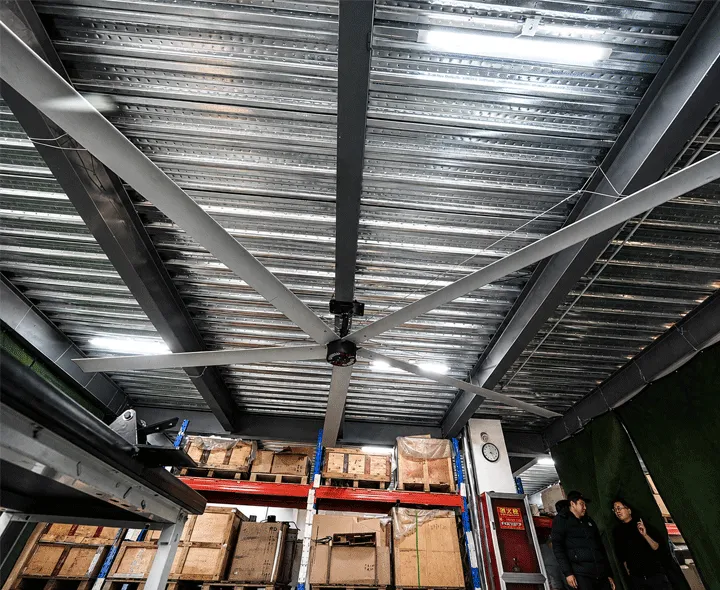
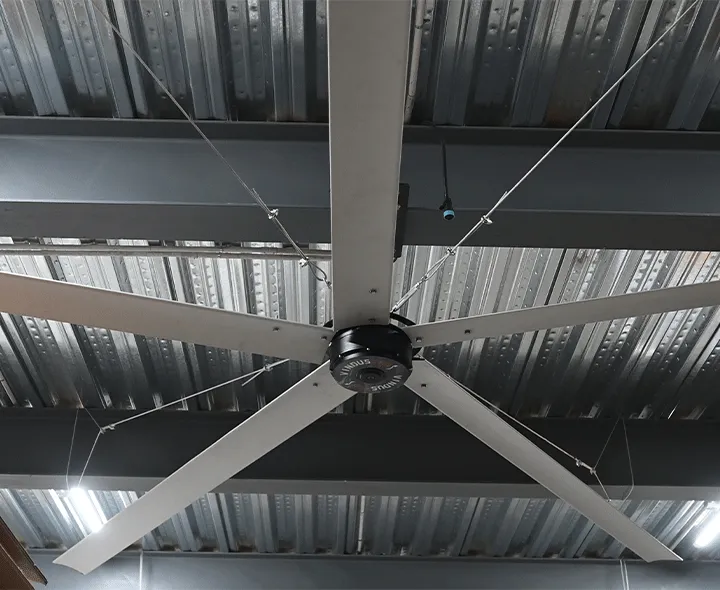
The Vindus P780 Series is a U.S.-market direct-drive HVLS option. Published choices include 20 ft and 24 ft diameters for approximate blade heights of 20-33 ft. The series uses a PMSM, lists maximum-speed input below 1,000 W, and provides a floor-level integrated HMI with a single ceiling-to-floor cable.
Published P780 item
Project check still required
20 ft or 24 ft diameter
Clear span, obstructions, occupied zones, and target circulation path
Approximate blade height 20-33 ft
Roof structure, installation clearances, lights, sprinklers, cranes, and ducts
Direct-drive PMSM
Electrical supply, controller location, service access, and spare-parts plan
Input below 1,000 W at maximum speed
Actual operating speed, schedule, seasonal mode, and measured site result
Floor-level integrated HMI
Operator permissions, setpoint records, and control responsibilities
These are selection inputs, not a guarantee for a specific building. Vindus does not publish a standard price for the P780 Series. Pricing requires a quotation based on model, quantity, controls, electrical requirements, delivery, and project support.
A six-step comparison for procurement
Define the duty: record the target zones, ceiling height, operating hours, seasonal goals, and any required exhaust or supply-air functions.
Request comparable data: compare complete fan performance at the same operating condition, including motor and controller input.
Map maintenance access: identify how technicians will reach the motor, drive components, controls, blades, and mounting hardware.
List service items: document belts, pulleys, bearings, controllers, cables, safety devices, inspection intervals, and expected spare parts.
Review controls: confirm speed range, local controls, network options, permissions, fault response, and restart behavior.
Compare lifecycle cost: include purchase, installation, energy, inspection labor, access equipment, planned parts, and downtime rather than using purchase price alone.
常问问题
Is a direct drive fan always more efficient than a belt drive fan?
No. Direct drive removes belt-related losses, but total input depends on the fan, motor, controller, speed, airflow duty, and operating schedule. Compare complete systems at the same requirement.
Does direct drive eliminate fan maintenance?
No. It eliminates belt and pulley service, but mounting hardware, blades, safety components, motor, cables, controller, balance, and manufacturer-specified bearings still need inspection.
Why would a facility still choose belt drive?
A belt drive may fit an established mechanical service program, allow pulley-ratio changes, or position the motor away from the fan wheel. The extra maintenance points must be included in the decision.
Which drive is better for a high-ceiling warehouse?
The answer depends on fan diameter, clear height, obstructions, access, controls, duty cycle, and service capability. Direct-drive HVLS systems are often attractive where ceiling access is costly and electronic control is important.
Prepare the comparison before requesting a quote
Send a dimensioned floor plan, clear blade height, roof and service layout, photographs, target operating zones, electrical supply, schedule, and control requirements. Use the Vindus contact page to request a P780 Series review and a project-specific quotation.
About the author
Michael Danielsson is CEO of Vindus Fans. His background includes fan product development, production, operations, and customer service, including work on direct-drive HVLS technology.
Updated August 18, 2026 | Michael Danielsson, CEO, Vindus Fans
A direct drive vs belt drive fan comparison starts with the power path. A direct-drive motor turns the fan hub without belts or pulleys. A belt-drive system transfers motor torque through pulleys and one or more belts. That difference changes service work, mechanical losses, speed adjustment, installation space, and failure points.
A cutaway comparison of a direct-drive PMSM fan and a conventional geared induction drive. Belt-drive fans use a different transmission, but they also add mechanical components between the motor and fan.
Direct drive vs belt drive fan: the mechanical difference
In a direct-drive arrangement, the motor shaft or integrated rotor is connected to the fan hub. Torque reaches the blades without a belt stage. Large-diameter HVLS designs may pair this layout with a permanent-magnet synchronous motor and electronic speed control.
A belt-drive fan places pulleys on the motor and fan shafts, then uses belt tension to transmit torque. Changing pulley diameters can alter the speed ratio. This architecture can separate the motor from the fan wheel and gives service teams familiar mechanical parts, but it also introduces alignment, tension, guarding, and replacement tasks.
Decision factor
Direct drive fan
Belt drive fan
Power path
Motor acts directly on the hub or wheel
Motor transfers torque through pulleys and belts
Transmission components
No belts or pulleys
Belts, pulleys, shafts, bearings, and guards may be involved
Routine service
Inspect motor, fasteners, electrical connections, controller, and bearings specified by the manufacturer
Add belt condition, tension, alignment, pulley wear, and guard checks
Speed control
Usually electronic through a compatible drive or controller
Can use pulley ratios, electronic motor control, or both
Installation envelope
Compact transmission path, although motor and controller clearances still matter
Needs space and access for belts, pulleys, guards, and tension adjustment
Service strategy
Fewer mechanical wear parts, but trained electrical or controls support may be needed
Mechanical parts are familiar, but periodic adjustment and replacement are expected
Efficiency depends on the complete operating point
Removing a belt stage removes belt slip and flexing from the power path. That can reduce transmission losses, especially when compared with a belt system that is worn, loose, misaligned, or operating outside its intended load. It does not mean every direct-drive fan automatically uses less energy than every belt-drive fan.
Fan diameter, blade design, speed, motor efficiency, controller losses, duty cycle, airflow resistance, and the required air-delivery pattern all affect input power. Compare measured or declared fan performance at the same duty point. The Air Movement and Control Association publishes standards and technical publications for air-system products; a motor label alone is not a complete fan-performance comparison.
For a large-space ceiling fan, overspeeding a smaller unit to chase coverage can undermine the expected efficiency and comfort result. Start with the occupied zone, ceiling height, obstructions, and operating schedule. The Vindus HVLS airflow optimization guide explains why layout and clearance must be checked before selecting diameter or quantity.
Maintenance: fewer parts does not mean no maintenance
Direct drive removes belt inspection and pulley alignment from the routine list. Teams still need a documented inspection plan for blade fasteners, mounting hardware, safety components, motor condition, cables, controller ventilation, unusual vibration, and manufacturer-specified bearings. Access at the fan’s mounting height can be more important than the number of parts.
Belt-drive maintenance adds several mechanical checks:
Isolate the equipment and follow the site’s energy-control procedure before opening guards.
Inspect belts for cracking, glazing, fraying, contamination, and uneven wear.
Check pulley alignment and belt tension with the specified method rather than visual judgment alone.
Inspect bearings, shafts, fasteners, guards, and the surrounding structure.
Run the fan after reassembly and record vibration, noise, temperature, and any change from the baseline.
The U.S. Occupational Safety and Health Administration’s control of hazardous energy guidance applies to maintenance work where unexpected startup or stored energy could injure personnel. A fan’s drive type does not remove the need for site-specific lockout and verification procedures.
Noise and vibration are system issues
A correctly selected direct-drive fan avoids belt slap, pulley noise, and belt-related vibration. Its acoustic result still depends on motor electromagnetic noise, blade loading, structural resonance, mounting stiffness, balance, speed, and the room itself.
A belt drive can operate smoothly when tension, alignment, pulley condition, and bearings are correct. Wear can gradually change its sound and vibration signature, which is why a baseline record is useful. Do not use quiet operation as proof that a belt is correctly tensioned, and do not treat a new noise as a reason to keep running until the next planned service.
Where each drive type can fit
Direct drive is often preferred when
Ceiling access is difficult and reducing routine transmission service has practical value.
The project needs electronic speed control, repeatable setpoints, or integration with a multi-fan control strategy.
A compact drive package helps with clearance around roof structure and building services.
The owner wants to remove belts and pulleys from the replacement-parts plan.
Belt drive can remain practical when
The site already has trained technicians, stocked belts, and a scheduled mechanical maintenance program.
Pulley ratios are used to match an established fan and motor arrangement.
The motor must be positioned away from the fan wheel because of access or environmental constraints.
The complete installed system meets the required airflow, safety, noise, and lifecycle-cost targets.
Compared with common belt-driven industrial fan arrangements, a direct-drive HVLS fan usually trades mechanical adjustment points for greater dependence on the matched motor, controller, and electrical service process. Procurement should evaluate the supplier’s documentation and replacement support, not just the drive label.
P780 Series direct-drive planning reference
The Vindus P780 Series is a U.S.-market direct-drive HVLS option. Published choices include 20 ft and 24 ft diameters for approximate blade heights of 20-33 ft. The series uses a PMSM, lists maximum-speed input below 1,000 W, and provides a floor-level integrated HMI with a single ceiling-to-floor cable.
Published P780 item
Project check still required
20 ft or 24 ft diameter
Clear span, obstructions, occupied zones, and target circulation path
Approximate blade height 20-33 ft
Roof structure, installation clearances, lights, sprinklers, cranes, and ducts
Direct-drive PMSM
Electrical supply, controller location, service access, and spare-parts plan
Input below 1,000 W at maximum speed
Actual operating speed, schedule, seasonal mode, and measured site result
Floor-level integrated HMI
Operator permissions, setpoint records, and control responsibilities
These are selection inputs, not a guarantee for a specific building. Vindus does not publish a standard price for the P780 Series. Pricing requires a quotation based on model, quantity, controls, electrical requirements, delivery, and project support.
A six-step comparison for procurement
Define the duty: record the target zones, ceiling height, operating hours, seasonal goals, and any required exhaust or supply-air functions.
Request comparable data: compare complete fan performance at the same operating condition, including motor and controller input.
Map maintenance access: identify how technicians will reach the motor, drive components, controls, blades, and mounting hardware.
List service items: document belts, pulleys, bearings, controllers, cables, safety devices, inspection intervals, and expected spare parts.
Review controls: confirm speed range, local controls, network options, permissions, fault response, and restart behavior.
Compare lifecycle cost: include purchase, installation, energy, inspection labor, access equipment, planned parts, and downtime rather than using purchase price alone.
常问问题
Is a direct drive fan always more efficient than a belt drive fan?
No. Direct drive removes belt-related losses, but total input depends on the fan, motor, controller, speed, airflow duty, and operating schedule. Compare complete systems at the same requirement.
Does direct drive eliminate fan maintenance?
No. It eliminates belt and pulley service, but mounting hardware, blades, safety components, motor, cables, controller, balance, and manufacturer-specified bearings still need inspection.
Why would a facility still choose belt drive?
A belt drive may fit an established mechanical service program, allow pulley-ratio changes, or position the motor away from the fan wheel. The extra maintenance points must be included in the decision.
Which drive is better for a high-ceiling warehouse?
The answer depends on fan diameter, clear height, obstructions, access, controls, duty cycle, and service capability. Direct-drive HVLS systems are often attractive where ceiling access is costly and electronic control is important.
Prepare the comparison before requesting a quote
Send a dimensioned floor plan, clear blade height, roof and service layout, photographs, target operating zones, electrical supply, schedule, and control requirements. Use the Vindus contact page to request a P780 Series review and a project-specific quotation.
About the author
Michael Danielsson is CEO of Vindus Fans. His background includes fan product development, production, operations, and customer service, including work on direct-drive HVLS technology.