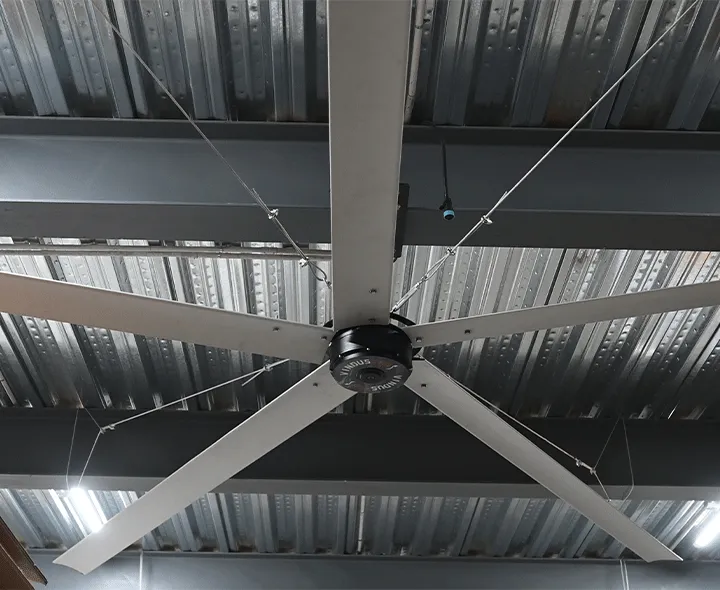
Vindus Fans Engineering Team | Product Engineering & Technical Support | Published July 2026
An HVLS fan manufacturer is worth evaluating on five points: motor type and drive method, the test standard behind any airflow claim, safety certifications valid in your region, actual manufacturing and support locations, and how multi-unit control works. Everything else on a spec sheet is secondary to those five.
Most buyers start by comparing diameter and horsepower, because those numbers are easy to put side by side. They’re also the least useful starting point. Two fans with identical diameters can perform very differently depending on motor design, and a impressive-sounding CFM figure means little without knowing what test method produced it. The checklist below covers what actually separates manufacturers, in the order it’s worth asking about them.
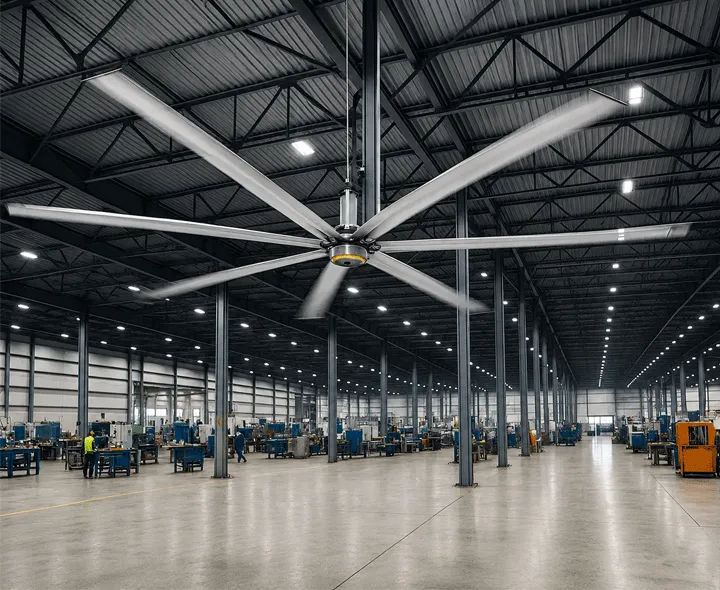
Choosing an HVLS Fan Manufacturer: What to Check Before You Buy
Start With Motor Type: Direct Drive vs. Belt or Gear Drive
Direct-drive fans use a motor built to turn the blades directly, without a gearbox or belt transferring power between motor and blade hub. Belt- and gear-driven systems add mechanical links that lose some energy to friction and introduce parts that wear and eventually need replacement — belts stretch and crack, gearboxes need periodic oil changes.
Vindus builds its P780 和 P730 Series around a permanent magnet synchronous motor (PMSM), a gearless direct-drive configuration. It’s not the only valid approach in the industry, but it’s worth asking any manufacturer directly which drive method they use and why, rather than assuming “motor” means the same thing across product lines.
Check What Standard the Performance Claims Are Tested Against
An airflow number without a cited test method is a marketing claim, not a spec. Two standards matter most for this category: AMCA 230-15, the Air Movement and Control Association’s laboratory airflow test method, and ANSI/ASHRAE 216P, which addresses performance measurement specific to HVLS 风扇 rather than the smaller-fan protocols the industry used before HVLS became common. Vindus states compliance with both.
If a manufacturer can’t point to which standard backs their numbers, treat the numbers as unverified — not necessarily wrong, just unverifiable from the outside.
Verify Safety Certifications Match Your Region
Certifications tell you a product was tested against a defined safety standard by a recognized body, but only if the certification is relevant to where you’re installing. Vindus states compliance with CE, CB, EN, and IEC — a European and international safety framework. If you’re sourcing for a project in a region with different requirements, confirm the manufacturer holds certification specific to that jurisdiction rather than assuming a CE mark covers every market.
One limitation worth naming directly: Vindus’s certification page shows certificate images rather than searchable certificate numbers or the specific issuing body per mark. That’s a gap if your procurement process requires a certificate number on file before purchase — worth raising with the manufacturer directly rather than assuming the documentation will surface later.
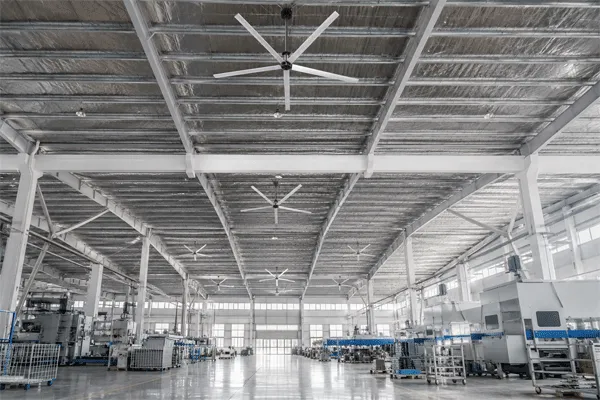
Choosing an HVLS Fan Manufacturer: What to Check Before You Buy
Look at Manufacturing and Support Footprint, Not Just Sales Offices
A sales office is not the same thing as manufacturing capacity or local technical support. Vindus operates manufacturing, assembly, and R&D facilities in Qingdao, China, and Palatka, Florida — meaning U.S. installations aren’t shipped from overseas with no domestic support point. The company has maintained a U.S. market presence since 2021, following a 2019 founding as a small Spain-based operation and a 2020 expansion into Qingdao.
Products from the company ship to 20+ countries and regions, with distribution reaching Sweden, the United Kingdom, the United Arab Emirates, Jordan, Singapore, Thailand, South Korea, Japan, and Australia. That’s a reasonable proxy for operational maturity, though it’s not the same as a published installed-base count — a figure Vindus, like many manufacturers in this space, doesn’t disclose publicly.
Ask How Multi-Unit Control Actually Works
Facilities running more than a handful of fans need centralized control, not individual remotes per unit. This is where the difference between manufacturers gets concrete fast: ask whether control is integrated at the fan (floor-level HMI, in Vindus’s case for the P780 and P730 Series) or requires a separate control panel purchase, and whether multiple units can be grouped and adjusted together or only controlled one at a time.
Understand the Pricing Model Before You Request a Quote
Vindus does not publish list pricing and uses a request-for-quote model, consistent with most HVLS manufacturers in this category — few publish per-unit pricing online given how much installation cost varies by ceiling height, structural requirements, and unit count. If a manufacturer’s site does show a number, confirm whether it includes installation, controls, and shipping, since a bare unit price without those figures in isn’t directly comparable to a full-project quote from a competitor.
What “Case Studies” Should (and Shouldn’t) Tell You
Named customer case studies with measurable results are useful, but their absence isn’t automatically disqualifying — plenty of manufacturers, Vindus included, don’t publish named case studies with quantified outcomes on their sites. What matters more is whether the manufacturer will connect you with a reference project in your industry directly, even if it’s not written up publicly. If a site leans heavily on vague testimonial language instead of specifics, that’s a weaker signal than simply having no public case library at all.
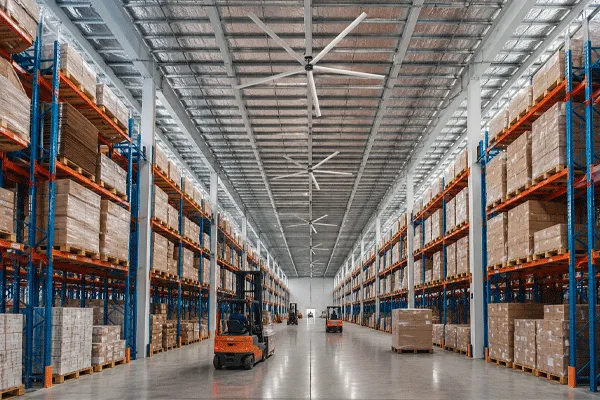
Choosing an HVLS Fan Manufacturer: What to Check Before You Buy
Where This Leaves You
Compared to buying based on a single spec-sheet comparison, working through drive type, test standard, certification scope, manufacturing footprint, and control architecture takes longer up front but avoids the more expensive mistake of discovering a gap after installation — a certification that doesn’t cover your jurisdiction, or a control system that can’t scale past a few units.
Vindus’s position against this checklist: PMSM direct drive across its P780 and P730 Series, stated compliance with AMCA 230-15 and ANSI/ASHRAE 216P, CE/CB/EN/IEC safety certification (with certificate numbers not published online), manufacturing in both Qingdao and Florida, floor-level integrated control per unit, and a request-a-quote pricing model with no published price list. None of that substitutes for a direct conversation about your specific site — ceiling height, floor layout, and jurisdiction all change which questions matter most.
常问问题
Q: What’s the difference between a direct-drive and a gear-driven HVLS fan?
A: Direct-drive motors turn the blades without a gearbox or belt in between, which removes parts that wear over time. Gear- and belt-driven systems use those mechanical links, which can lose some energy to friction and need periodic maintenance the direct-drive design avoids.
Q: Does an HVLS fan need to be tested to a specific standard?
A: There’s no legal requirement, but AMCA 230-15 and ANSI/ASHRAE 216P are the two standards specific to airflow and HVLS performance testing. A manufacturer’s published numbers are far easier to verify when they cite one of these than when they don’t.
Q: Why don’t more HVLS manufacturers publish pricing online?
A: Installation cost depends heavily on ceiling height, structural requirements, and how many units a site needs, which makes a flat per-unit price misleading on its own. Most manufacturers, including Vindus, use a request-a-quote model instead.
Q: Is a manufacturer without public case studies less trustworthy?
A: Not necessarily. Plenty of manufacturers don’t publish named case studies with quantified results. It’s more useful to ask directly whether they can connect you with a reference project in your industry than to treat the absence of a public case library as a red flag on its own.
If your evaluation gets down to a specific building — ceiling height, floor layout, and how many units the space actually needs — that’s a site-specific conversation, not something a general checklist can finish for you.