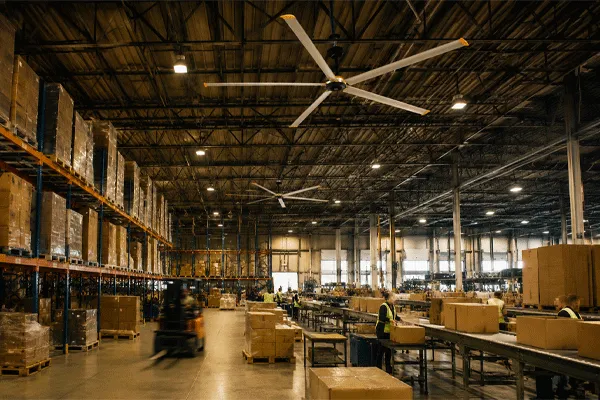
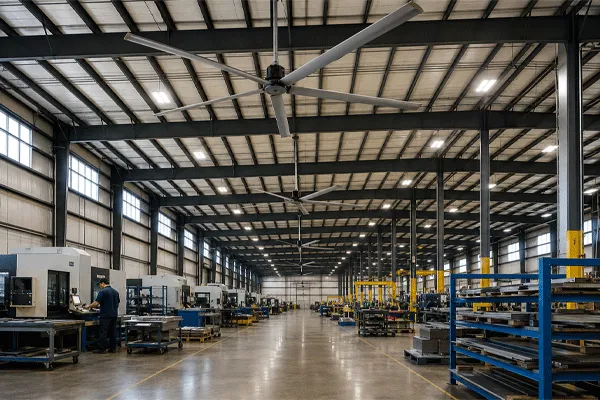
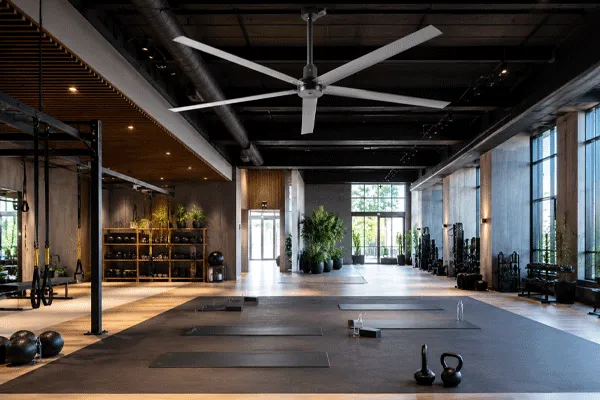
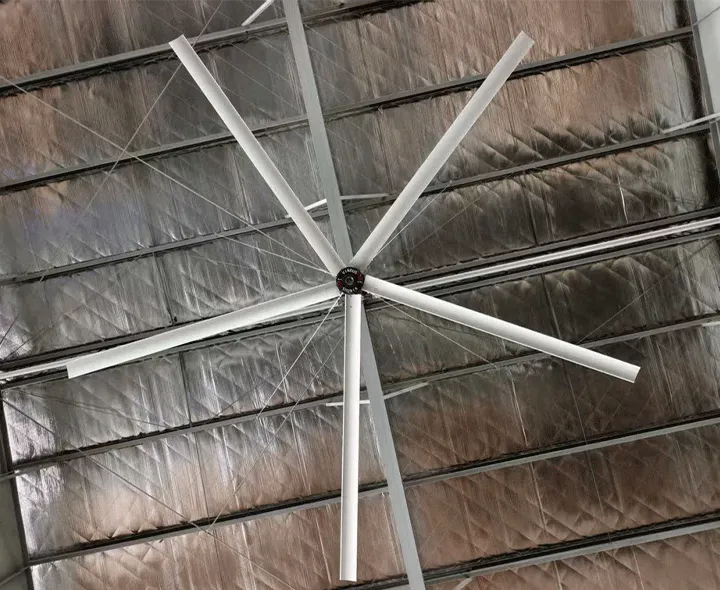
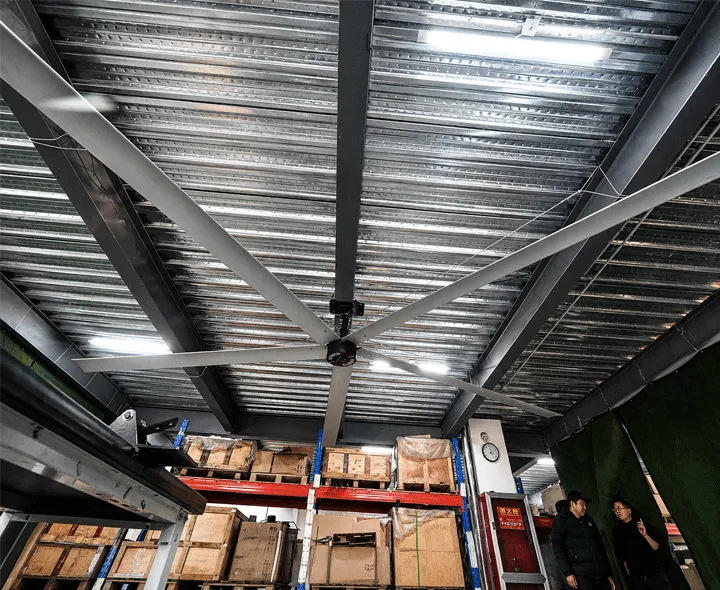
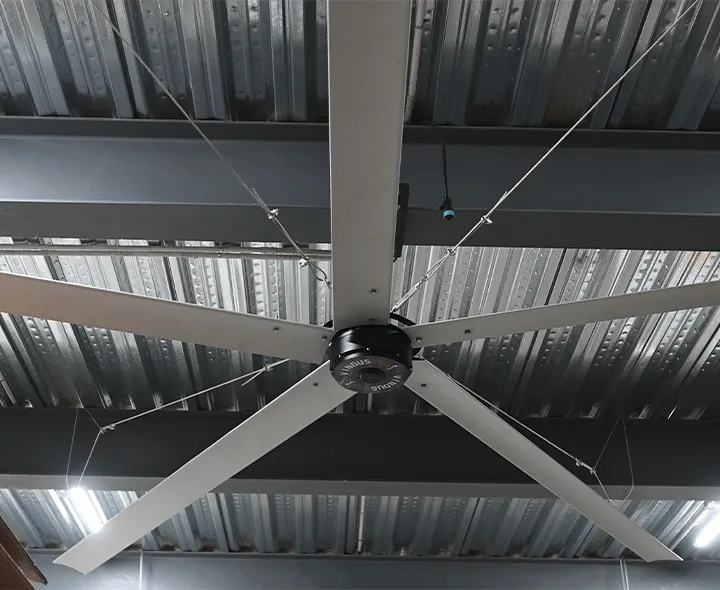
湿热、停滞的空气会迅速使大型畜舍变得令牲畜和工作人员都不舒适。热量积聚在屋顶下方,湿气滞留室内,而普通的小型风扇可能无法覆盖所有区域,形成空气流动死角。设计合理的HVLS风扇系统可以改善气流、促进降温,并使整个建筑内的环境更加均衡。
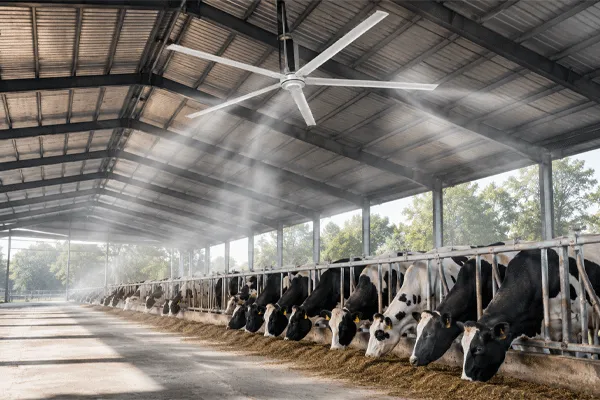
HVLS 风扇通过在广阔区域内缓慢输送大量空气,为大型农业畜棚提供通风支持。它们可在牲畜周围形成持续稳定的气流,减少高温和空气滞留区域,帮助控制湿度,并改善体感降温效果。不过,HVLS 吊扇循环的是室内空气,不能替代排风或新风通风;因此,最佳系统通常会结合空气循环、空气交换和智能控制。
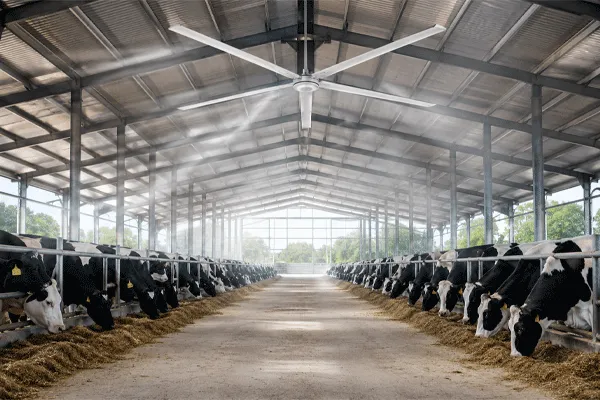
用于大型农业畜棚通风的 HVLS 风扇:改善牲畜舒适度和空气流动
对于农场、仓库、加工区和其他大型建筑而言,有效的空气管理很少只是购买市面上最大的风扇,而是要了解建筑、动物、气候、运行时间安排以及所需的气流条件。
作为一家专注于HVLS风扇、工业吊扇、商用吊扇、大型工业风扇和智能气流控制系统的中美合资制造商及解决方案提供商,我们将农业项目视为完整的气流系统,而不是单独的设备。
为什么通风对大型畜舍如此重要?
大型畜舍的气流组织面临着独特的挑战。动物会释放体热和水分。潮湿的地面、粪便、饮水系统以及室外天气都会带来更多水分。如果通风不足,热量和湿气就会积聚,尤其是在动物休息区和屋顶下方。
良好 畜舍通风 有两项不同的作用:
- 用室外较新鲜的空气置换室内污浊空气;
- 在动物周围及有人活动的区域形成有效气流。
这两种功能不应混为一谈。
威斯康星大学推广部解释说,通风有助于保持空气质量、排出热量和湿气,并营造更舒适的奶牛养殖环境。该机构还区分了循环风扇和排风扇:前者使建筑物内的空气流动,后者则有助于用室外空气替换室内空气。
为畜舍选择风扇时,理解这一区别很重要。如果建筑内的新风交换不足,循环风扇本身无法排除氨气或湿气。同样,强力排风系统虽然可以置换室内空气,却未必能在动物周围产生足够有效的气流速度。
只有两种功能协同发挥作用,才能达到最佳效果。
HVLS风扇如何改善畜牧设施内的空气循环?
HVLS意为大风量、低转速。与许多小型风扇产生狭窄的高速气流不同,HVLS风扇利用大直径扇叶推动大量空气,覆盖更广阔的地面区域。
旋转的扇叶会产生一股大范围向下流动的气流。当气流到达较低位置时,便会向水平方向扩散。这有助于在大面积空间内形成高效的空气循环,而不仅仅是为风扇正下方的区域降温。
这种大范围的气流运动在畜牧设施中很有用,因为动物可能分布在饲喂区、休息区、通道、待留区和开放式栏舍中。
合理布置 HVLS 吊扇 可以帮助:
- 减少空气停滞区域;
- 使大型圈舍内各处的环境条件更加均匀;
- 提高动物周围的空气流速;
- 将暖空气从有人或动物活动区域带走;
- 促进潮湿表面的水分蒸发;
- 改善自然风不稳定区域的空气流通。
宾夕法尼亚州立大学推广部指出,大型高风量低转速风扇如果正确安装在奶牛上方,就能在奶牛所在高度产生有效的气流。该机构还强调,空气交换对于排出热量、湿气、气体和污染物仍然至关重要。
因此,最好将 HVLS 系统视为完整工业气流与空气循环解决方案的一部分。
农业风扇能否帮助减轻牲畜的热应激?
可以,但其作用机制很重要。
吊扇通常不能像制冷设备那样降低空气的实际干球温度。它的作用是让空气流过动物体表,增强对流和蒸发散热,从而帮助动物更有效地散发体热。
这对奶牛尤其重要。
威斯康星大学推广部建议在奶牛休息区上方形成有效的空气流动,并指出快速流动的空气有助于奶牛散热。其奶牛养殖指南还指出,夏季的通风需求可能远高于冬季。
宾夕法尼亚州立大学同样指出,遮阴、充分换气、空气流动、饮用水和蒸发降温都是减轻奶牛热应激的重要手段。
实用的结论很简单:
风扇可以促进热量散发,但良好的降温效果始于整个畜舍的环境。
因此,农业风扇有助于提高动物的舒适度,但风扇的位置、风速、室外温度、相对湿度、饲养密度、饮水供应和建筑设计都很重要。
在炎热气候下,完整的通风解决方案可将大型风扇与排风系统、自然开口、帘幕、蒸发冷却垫、喷淋装置或自动控制系统结合使用。
HVLS 吊扇与小型风扇:哪种更适合大型畜棚?
没有一种风扇在所有情况下都更胜一筹。选择合适的风扇取决于您需要为建筑物的哪个区域通风。
小型高速风扇可以产生集中的高速气流,因此适合用于单个畜栏、饲喂线、挤奶区或其他需要定点送风的区域。
HVLS 吊顶系统采用不同的方法。其目的是以相对较低的速度,在广阔区域内输送大量空气。
| 因素 |
超大节能风扇 |
小型高速风扇 |
| 典型覆盖范围 |
大范围 |
局部区域 |
| 气流模式 |
大范围循环 |
定向气流 |
| 最佳使用场景 |
大面积开放空间 |
定点降温 |
| 设备数量 |
通常更少 |
通常更多 |
| 噪音可能性 |
正常运行速度下通常较低 |
高速运行时可能增加 |
| 安装 |
需要足够的顶部结构支撑和净空 |
安装方式更灵活 |
| 系统作用 |
全区域循环 |
局部送风 |
在实际应用中,大型畜舍可能受益于将这两种技术结合使用。
例如,大型 HVLS 畜棚风扇可负责整体空气循环,而较小的定向牲畜风扇则可为关键区域提供更高的风速。
这种组合方案在结构复杂的建筑中尤其有价值,例如存在隔断、设备、纵深较大的畜栏、天花板高度不一或其他影响气流的障碍物时。
探索我们适用于大型农业和工业空间的 HVLS 工业吊扇系列。
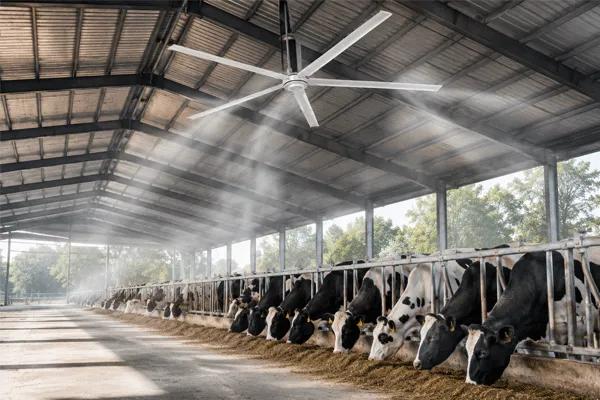
用于大型农业畜棚通风的 HVLS 风扇:改善牲畜舒适度和空气流动
HVLS 风扇如何改善空气质量和湿度状况?
畜舍内的空气质量主要取决于有效的空气交换、卫生状况、粪污管理、湿度控制和建筑设计。
风扇通过保持室内空气流动来促进这一过程。
当空气停滞时,湿气和暖空气可能聚集在动物周围、墙壁和天花板附近,或存放的物料周围。更好的空气循环还有助于更均匀地分布进入室内的新鲜空气,减少局部过热或潮湿的区域。
这一点很重要,因为农业环境中可能存在:
- 动物产生的水分;
- 氨气;
- 粉尘;
- 异味;
- 潮湿的垫料;
- 冷凝水;
- 动物和设备产生的热量。
但是,绝不能将HVLS风扇作为完善排风系统的替代品来销售。
威斯康星大学推广部明确指出,通风可排出热量、水分和污染物,而循环风扇有助于营造更均匀的温度和湿度条件。
因此,如果您的目标是改善空气质量,我们的工程师会首先考察新风通道、排风能力、自然通风口、建筑内部气压和空气循环模式。
然后,我们会确定如何利用农业吊扇,更有效地将空气分配到整个畜舍。
大型畜舍风扇应安装在哪里?
Fan location is just as important as fan size.
Putting one very large fan in the center of a building does not automatically create ideal consistent airflow everywhere. Beams, lights, partitions, equipment, stored materials, sidewalls, stall structures, and neighboring fans can all change the final air pattern.
Before specifying large barn fans, we normally evaluate:
- building length and width;
- barn ceiling height;
- roof shape and structural mounting points;
- animal location;
- feeding and resting zones;
- doors and natural openings;
- exhaust fan positions;
- obstacles below the blades;
- required clearances;
- prevailing outdoor wind conditions.
The objective is not simply to install fans across large floor areas. We want useful air movement where workers and livestock actually spend time.
This is particularly important in a dairy barn, where the airflow experienced at cow level matters more than the airflow measured close to the roof.
Penn State guidance on dairy cooling similarly emphasizes fan location and animal-level air movement rather than relying only on equipment capacity.
A professional layout should therefore consider the complete air path inside the barn.
What Makes a Good Agricultural Fan for Barns and Greenhouses?
Agricultural environments are demanding.
Dust, dirt, moisture, changing temperatures, and corrosive gases can shorten equipment life. That means agriculture fans should be selected for more than airflow alone.
Important features include:
- durable motor and drive technology;
- stable structural mounting;
- corrosion-resistant components;
- suitable blade construction;
- electrical protection;
- low operating noise;
- variable-speed control;
- easy inspection and maintenance;
- safety systems appropriate to the installation.
University of Wisconsin Extension specifically highlights the need for fan components that withstand humidity and corrosive gases commonly found in animal buildings.
For barns and greenhouses, control strategy also matters. A greenhouse may require airflow for crop uniformity, temperature control, and moisture management, while an animal building focuses more strongly on heat removal, fresh-air exchange, and livestock comfort.
The equipment may look similar, but the airflow design is different.
That is why we design durable agricultural airflow systems around the application rather than treating every project like a standard warehouse.
See our commercial and industrial ceiling fan solutions for other large-space applications.
Can HVLS Fans Lower Agricultural Ventilation Energy Costs?
They can contribute to an energy-efficient airflow strategy, particularly when the goal is to circulate air over a large open floor area without operating many smaller circulation fans.
The exact savings cannot be calculated from fan diameter alone.
You need to compare:
Annual Energy Use = Fan Input Power × Operating Hours × Number of Fans
For example, imagine two proposed systems for the same building:
| 系统 |
粉丝数量 |
Input per Fan |
Daily Runtime |
每日能源 |
| 布局 A |
20 |
0.75 kW |
12 h |
180 kWh |
| 布局 B |
5 |
1.5 kW |
12 h |
90 kWh |
This simplified example shows why system-level comparison matters. It does not represent guaranteed savings, because actual fan power, coverage, air velocity, operating schedules, and ventilation requirements vary by project.
Variable-speed operation can provide another advantage. When full output is unnecessary, controls can reduce fan speed instead of running every unit at maximum output.
University of Wisconsin Extension recommends comparing ventilation efficiency when selecting agricultural fans because fan efficiency affects both electricity cost and system performance.
For larger projects, our intelligent control systems can coordinate fan operation based on temperature, humidity, schedules, or defined environmental zones.
Learn more about smart HVLS fan control systems.
How Can Fans Support Health and Productivity in Livestock Buildings?
A better environment supports both animals and people.
High temperatures can change animal behavior, feed intake, resting patterns, and production. Penn State notes that heat-stressed cows can experience reductions in milk production and other performance effects.
Research summarized by Penn State also reported that calves cooled with fans in one study had improved average daily gain and feed efficiency compared with calves that did not receive fan cooling. This should not be interpreted as a universal performance guarantee, but it demonstrates the relationship between environmental control, animal health, and performance.
This is why comfort and productivity should be considered together.
When properly designed, fans provide useful air movement that can support:
- thermal comfort;
- more usable resting areas;
- better working conditions for employees;
- reduced hot-air pockets;
- more uniform environmental conditions.
In other words, barn fans help manage the environment in which animals live and people work.
They do not directly create productivity. They help create conditions that support health and productivity.
How Should You Choose the Right HVLS Fan Solution?
Start with the building, not the catalog.
A 7-meter fan that performs well in one facility may be inappropriate in another facility of similar size because mounting height, roof geometry, obstacles, livestock layout, inlet locations, climate, and operational goals may differ.
A professional evaluation should answer several questions:
- What problem are you trying to solve?
- Is the main issue heat, moisture, poor air, or uneven airflow?
- Is fresh-air exchange already adequate?
- Where are the hottest areas?
- Where do animals rest and feed?
- How high is the ceiling?
- Are sprinklers or evaporative systems installed?
- Does the facility need seasonal speed control?
- Are there corrosive environmental conditions?
- Will multiple fans interfere with each other?
We use these answers to develop fan solutions around the actual building.
Our product and engineering scope covers agricultural facilities, industrial and commercial buildings, factories, logistics centers, sports facilities, shopping malls, and other large-space applications.
For a livestock project, that may mean combining industrial barn fans, exhaust equipment, natural openings, intelligent controls, and targeted circulation units.
For another building, the answer may be completely different.
You can review our custom HVLS fan engineering and project solutions when planning a new building or upgrading an existing airflow system.
用于大型农业畜棚通风的 HVLS 风扇:改善牲畜舒适度和空气流动
Why Intelligent Airflow Control Matters for Agricultural Buildings
Modern ventilation does not have to operate at one fixed speed from morning until night.
Temperature and humidity change during the day. Animal activity changes. Doors open and close. Outdoor wind changes. Seasonal requirements also vary dramatically.
Smart controls allow fans today to respond more precisely to those conditions.
A control strategy may use:
- temperature sensors;
- humidity sensors;
- variable-speed drives;
- scheduled operation;
- multiple ventilation zones;
- centralized control;
- building management integration.
For example, fans can run faster during hot afternoon periods and slow down when temperatures fall. Multiple areas can also operate independently when one section of a building needs more airflow than another.
For livestock buildings, automation should complement—not replace—proper ventilation engineering.
University of Wisconsin Extension notes that variable-speed fans are receiving greater attention because they can improve energy efficiency, reduce noise, and provide more precise airflow control.
This is also where our background in intelligent airflow systems becomes valuable. We are not simply supplying a motor and blades. We help buyers determine how multiple pieces of equipment should operate together.
A Practical Agricultural Barn Ventilation Example
Consider a large cattle facility experiencing uncomfortable summer conditions.
The owner already has open sidewalls and natural barn ventilation, but during low-wind afternoons several interior zones become warm and still. Installing more exhaust capacity may increase air exchange, but it may not guarantee sufficient animal-level air speed in every resting area.
A possible system design could combine:
Stage 1 — Fresh-air strategy
Confirm that outdoor air can enter and leave the building without major restrictions.
Stage 2 — General circulation
Use properly positioned HVLS units to move large volumes of indoor air over broad zones.
Stage 3 — Targeted cooling
Use directional fans where higher localized velocity is required.
Stage 4 — Environmental control
Coordinate fan speed with temperature and humidity conditions.
Stage 5 — Verification
Measure actual air velocity in occupied zones rather than assuming the system works because the fans move.
This example illustrates an important point: fans can make a large difference, but successful agricultural ventilation is a system-design problem.
A fan should solve a measured need.
Frequently Asked Questions About Agricultural Barn Fans
Are HVLS fans suitable for a horse barn?
Yes, an HVLS fan can be used in a horse barn when the ceiling height, structure, safety clearance, stall arrangement, and fresh-air strategy support the installation. Ceiling fans for horse facilities should be positioned so animals cannot contact equipment and airflow reaches occupied zones safely.
Do HVLS fans replace exhaust ventilation fans?
Usually not. Ventilation fans and circulation fans perform different jobs. Exhaust equipment exchanges indoor and outdoor air, while HVLS units mainly circulate air within the building. Many successful systems use both.
Can an HVLS fan reduce barn temperature?
An HVLS fan mainly improves air movement rather than mechanically chilling the air. Moving air can increase convective and evaporative cooling around animals and workers, helping reduce heat stress even when measured room temperature changes little.
How many HVLS fans does a large barn need?
There is no reliable answer based only on floor area. The number depends on fan diameter, mounting height, roof structure, obstacles, target air velocity, building shape, animal location, and existing ventilation. A proper layout is more useful than a simple square-meter rule.
Are agricultural ceiling fans useful during winter?
Yes, in suitable buildings. Warm air naturally rises toward the roof. Carefully controlled slow fan operation can support destratification by mixing warmer upper air with cooler lower air. However, livestock buildings must avoid creating uncomfortable drafts during cold weather.
How often should agricultural fans be maintained?
Maintenance frequency depends on dust, moisture, operating hours, and the fan design. Inspect blades, fasteners, motors, electrical connections, safety systems, and accumulated dirt regularly. University of Wisconsin Extension notes that dirt on agricultural ventilation equipment can significantly reduce airflow and efficiency.
Build the Ventilation System Around Your Barn, Not Around a Fan
Selecting agricultural fans for barns is not simply a matter of choosing the largest diameter or highest advertised airflow.
Every farm is different.
A poultry building, dairy barn, greenhouse, horse facility, livestock shed, and food-processing building may all require different combinations of air exchange, local air velocity, humidity control, temperature management, and automation.
As a Sino-US joint venture manufacturer and airflow solution provider, we supply HVLS fans, 农业吊扇, industrial ceiling fans, commercial fans, large industrial airflow equipment, and intelligent control systems for global B2B projects.
Our goal is straightforward: understand your building first, then design equipment around it.
If you are planning a new facility or trying to improve air conditions in an existing building, provide your building dimensions, ceiling height, application, livestock type, climate conditions, and current ventilation arrangement. Those details allow our engineering team to recommend a more accurate solution.
需要牢记的关键要点
- HVLS fans are designed to move high volumes of air across broad areas at low rotational speed.
- A large ceiling fan mainly supports circulation; it does not automatically replace fresh-air exchange.
- Good agricultural ventilation manages heat, moisture, gases, and stale indoor air.
- Effective airflow should reach animals and workers, not remain near the ceiling.
- Fan position, mounting height, building layout, and obstacles can be as important as fan diameter.
- Combining HVLS units with exhaust systems or directional fans may work better than relying on one technology.
- Variable-speed and intelligent controls can adapt fan operation to changing conditions.
- Durable components matter in humid, dusty, or corrosive agricultural buildings.
- Measure real airflow after installation whenever possible.
- The strongest solution starts with your building requirements—not with a product specification sheet.