Michael Danielsson | Chief Executive Officer, Vindus Fans | Published August 25, 2026
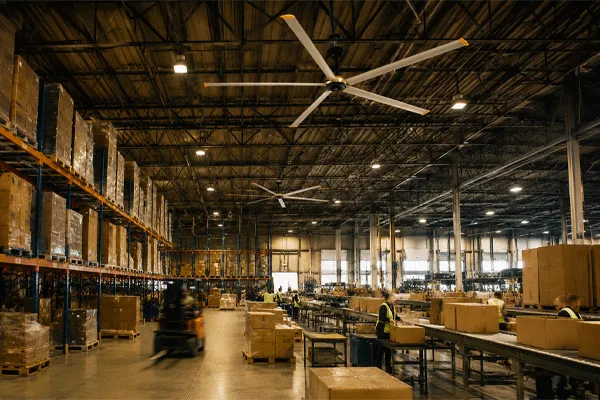
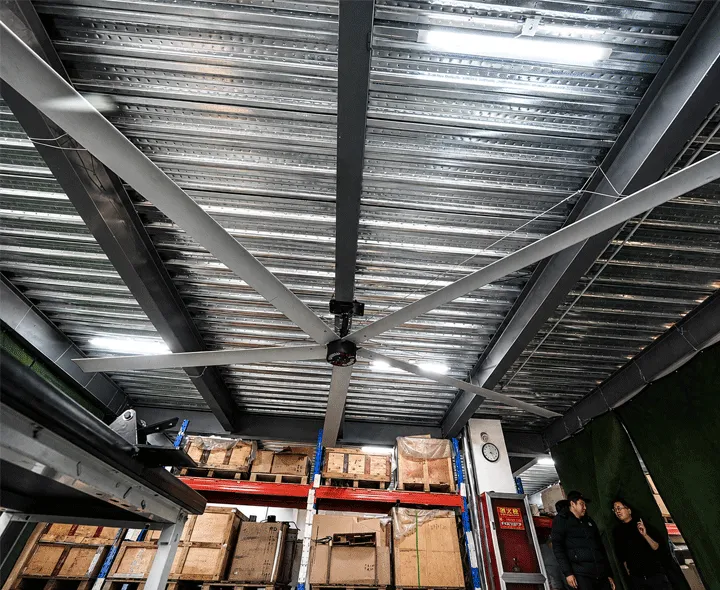
Warm air collects near the ceiling in tall buildings. HVLS fans running slowly push that heat back down without creating a draft at floor level, so heaters cycle less often. In 20–33 ft buildings, this winter role often matters more to the annual energy bill than the summer one.
HVLS Fans for Industrial Air Distribution: Winter Destratification and Year-Round Airflow
The temperature gradient is a building problem, not a comfort preference
Air buoyancy does not negotiate. Heated air is less dense, it rises, and in a building with 30 ft of vertical volume above the working plane it keeps rising until it meets the deck. What sits above your racking in January is the air you already paid to heat. The thermostat, mounted at 5 ft, never sees it, so the unit heater fires again.
Plant engineers usually discover this in one of two ways: the roof deck feels warm to the hand during a winter walk-through, or infrared readings show a floor-to-ceiling spread that widens as outdoor temperatures drop. Manufacturer literature across this category commonly cites gradients in the range of 10–15 °F in high-bay space; treat any single number as a starting hypothesis rather than a design input, because the actual gradient in your building depends on roof insulation, heater type, air changes per hour, and how often the dock doors open.
The gradient costs money three ways at once. Heat loss through the roof scales with the temperature difference across the deck, so a hot ceiling loses heat faster than a warm one. The occupied zone stays under-heated, which pushes setpoints up. And the heating equipment runs longer cycles to satisfy a sensor that is reading the coldest layer in the building.
What destratification actually does — and what it does not
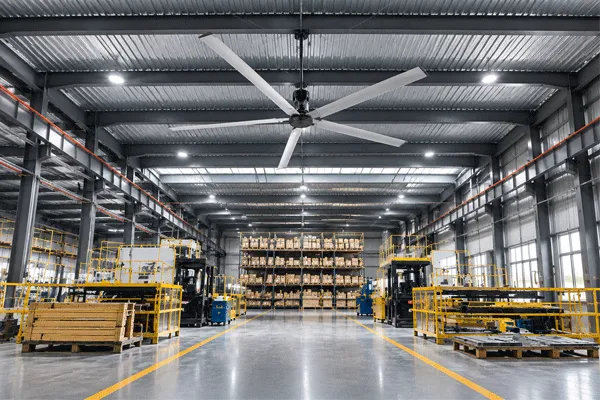
Destratification means mechanically mixing the vertical air layers until the floor-to-ceiling spread narrows. A large-diameter fan turning at low speed produces a broad, slow column of air that reaches the floor and then spreads outward along it, drawing ceiling air down behind it to replace what moved. The mixing is continuous rather than episodic.
Two things this does not do: it does not add heat, and it does not fix an uninsulated roof. A destratification fan redistributes energy that already exists in the building. If your envelope is losing that energy quickly, mixing the air simply delivers it to the roof deck more efficiently. Insulation and infiltration control come first in the sequence; air distribution comes second.
The distinction matters when you evaluate savings claims. Several pages ranking for this topic state that HVLS fans reduce heating costs by up to 20–30%, without naming the building type, climate zone, heater type, or measurement method behind the figure. Vindus does not publish a percentage, because the honest answer is that recoverable savings are a function of your gradient, your run hours, and your fuel price. A fan cannot produce a fixed percentage across buildings that differ by an order of magnitude in heat loss.
One fan, two seasonal jobs
The same P780 unit serves both seasons, but the operating targets are opposite.
| Operating dimension |
Summer mode |
Winter mode |
| Design objective |
Evaporative cooling effect on skin |
Narrow the floor-to-ceiling temperature spread |
| Air speed at occupied zone |
Perceptible airflow across the working plane |
Below the threshold where occupants feel a draft |
| Typical speed setting |
Upper portion of the speed range |
Roughly 15–30% of maximum, tuned on site |
| Rotation direction |
Forward (downward column) |
Forward at low speed in most high-bay layouts; reverse only where floor-level obstructions block the downward column |
| Run pattern |
Cycled with occupancy and outdoor temperature |
Continuous during heating hours |
| Success test |
Reported comfort under load |
Measured gradient at three heights, before and after |
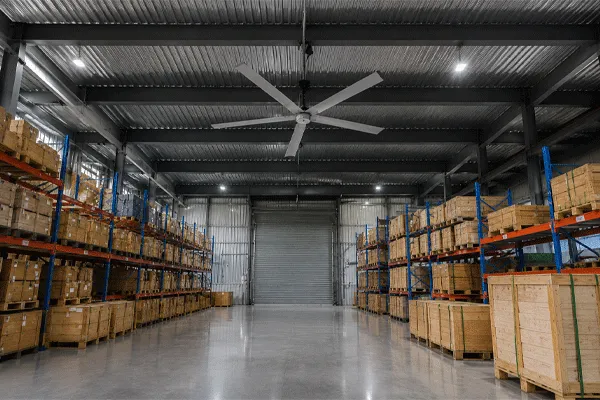
The reverse-rotation question deserves a direct answer, because the category literature treats reversing as automatic. Reverse rotation pulls air up through the blade sweep and returns it down the walls. That path works in spaces where a downward column would blow across occupants or product at close range. In an open 30 ft warehouse aisle, forward rotation at low speed usually moves more total volume for the same power draw and produces a more even gradient, because the column reaches the floor and spreads. Decide by measuring, not by season.
HVLS Fans for Industrial Air Distribution: Winter Destratification and Year-Round Airflow
Ceiling height sets the diameter band before anything else
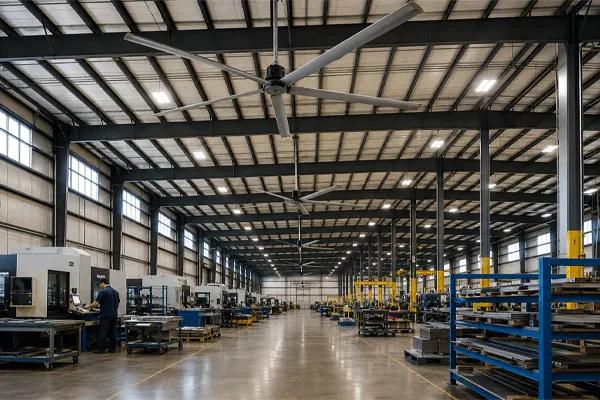
Fan diameter is chosen against mounting height, not against square footage alone. A large fan hung too low produces floor-level air speeds that feel like a draft in winter and disrupt lightweight material on racking. A small fan hung high never develops a column that reaches the floor.
Vindus organizes its U.S. range into two height bands:
- 10–25 ft ceilings— P680 Series, 8–14 ft diameter. Workshops, logistics staging areas, retail floors, restaurants, covered outdoor space.
- 20–33 ft ceilings— P730 Series (16 ft and 18 ft) and P780 Series (20 ft and 24 ft). High-bay warehousing, manufacturing halls, distribution centers, sports and assembly space.
For the high-bay destratification case this article addresses, the P780 sits at the top of that band. Minimum blade-to-floor clearance and blade-to-deck clearance both need checking against local code and against the sprinkler layout before the diameter is fixed; these clearances, not the fan itself, are usually what forces a design revision late in a project.
Direct drive versus gearbox under continuous winter duty
Winter destratification means running for months at low speed, which is exactly where the two drive architectures diverge.
| Dimension |
PMSM direct drive |
Gearbox drive |
| Torque delivery at low speed |
Motor produces full torque at low RPM; no reduction stage between motor and hub |
Reduction gearing designed around a rated operating band; sustained low-speed running is off-design |
| Lubrication service |
None — no gear oil, no oil-change interval, no seal to weep |
Periodic oil change and seal inspection at height |
| Rotating parts in the drive path |
Motor rotor to hub, directly coupled |
Motor, coupling, gear set, output shaft, bearings |
| Failure modes that stop the fan |
Motor or controller |
Motor, controller, gear wear, oil loss, seal failure |
| Leak risk over product or process |
None from the drive |
Oil weep possible; a documented concern in food, pharma, and clean assembly space |
| Speed control granularity |
Electronic control across the range, including the narrow low-speed band winter mode needs |
Coarser practical control; low end may be limited by the drive design |
| Mass at the mounting point |
Lower, no gear housing |
Higher; structural attachment sized accordingly |
Compared with the gearbox-driven fans still common in this category, the practical winter difference is control resolution at the bottom of the speed range. Destratification lives at 15–30% of maximum. A drive that cannot hold a stable, quiet speed there will either be run too fast — creating the draft complaints that get fans switched off — or not run at all.
HVLS Fans for Industrial Air Distribution: Winter Destratification and Year-Round Airflow
| Specification |
P780 Series |
| व्यास |
20 ft and 24 ft |
| Recommended ceiling height |
20–33 ft |
| मोटर |
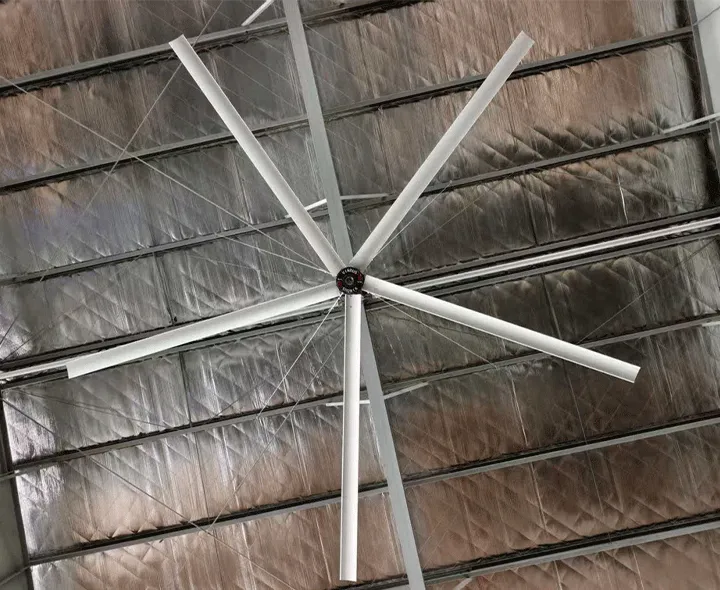
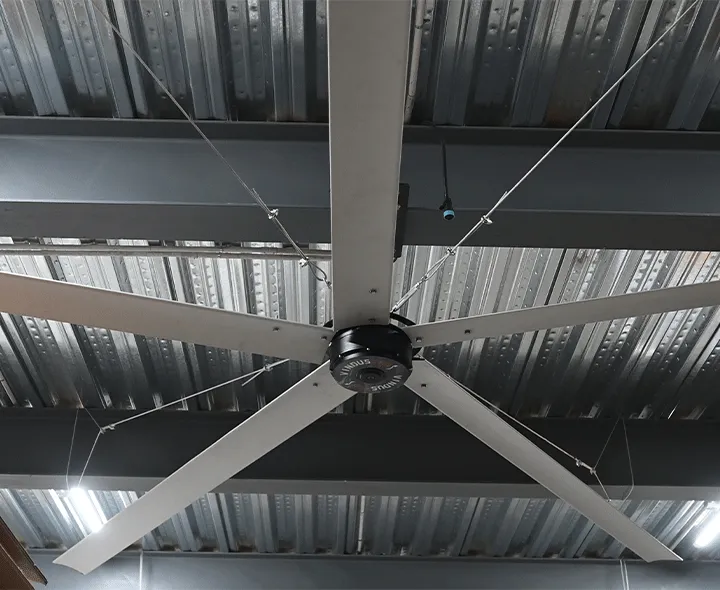
PMSM (permanent magnet synchronous), direct drive, gearless |
| Power draw |
Under 1,000 W at maximum speed |
| Control interface |
Floor-level integrated HMI |
| Wiring |
Single ceiling-to-floor cable |
| Airflow rating (CFM) |
Not published per model; issued with quotation, tested to AMCA 230-15 |
| Sound level |
Not published per model; issued with quotation |
| Safety compliance |
CE, CB, EN, IEC |
| गारंटी |
3 years, covering defective components causing improper operation |
Two of those lines deserve expansion for a winter application.
Under 1,000 W at maximum speed is the ceiling, not the operating point. A destratification setting draws a fraction of that, because fan power falls steeply as speed drops. This is the arithmetic that makes continuous winter operation defensible: the fan runs all heating season and still consumes far less than the heating capacity it helps you avoid using.
Floor-level HMI changes winter commissioning from a lift-truck exercise into a walk-over. Adjusting speed by 3% and re-reading the gradient is something a plant engineer will actually do when the interface is at eye level in the aisle. When the controller sits at the fan, tuning stops after the first attempt, and the fan stays at whatever setting it was left on.
We publish CFM and sound figures per configuration in the quotation rather than on the website, because a single catalog number without the test conditions attached invites a comparison that is not valid. Which brings up the standards.
How to compare airflow claims: AMCA 230-15 and ANSI/ASHRAE 216P
Two documents make cross-brand comparison possible.
AMCA 230-15 is the Air Movement and Control Association’s laboratory method for rating the air performance of circulating fans. It defines how the fan is mounted, how air velocity is traversed, and how the result is reported, so that a number produced under it means the same thing from one manufacturer to the next.
ANSI/ASHRAE 216P addresses performance rating specifically for large-diameter ceiling fans, including how the airspeed field beneath the fan is characterized rather than reduced to a single headline volume.
Practical use: when you receive competing quotations, ask each supplier to state which standard the airflow figure was produced under, at what mounting height, and at what speed setting. A CFM number quoted without those three qualifiers is not comparable to anything. Vindus products follow AMCA 230-15 and ANSI/ASHRAE 216P for performance, and CE, CB, EN, and IEC for safety. Neither standards body endorses any brand; they exist so you can hold brands to the same measurement.
Commissioning a winter destratification setup: nine steps
- Measure the existing gradient.Log temperature at floor level (4–5 ft), mid-height, and within 3 ft of the deck, at the same three locations, on a cold day with the heat running. Do this before any equipment arrives. Without a baseline you cannot demonstrate a result.
- Confirm the mounting height and clearances.Record deck height, obstruction height (lights, sprinkler mains, crane rails, ductwork), and blade-to-floor clearance for each candidate diameter. Check against local code and the sprinkler design.
- Map the obstructions at working height.Racking above roughly 12 ft, mezzanines, and full-height partitions all break the outward floor spread. Fan placement follows the open floor plan, not a uniform grid over the roof steel.
- Set fan count and spacing from coverage, then verify against structure.Coverage per unit depends on diameter and mounting height; spacing that works on paper still has to land on adequate structural steel with the required clearance.
- Verify the structural attachment.Confirm the mounting point and downrod arrangement with a structural engineer, including the dynamic loads, not just the static weight.
- Install and set winter speed low.Start near 15% of maximum. Resist the instinct to run it faster because the airflow is not visible.
- Re-measure the gradient after 48 continuous hours.The building needs time to reach a new equilibrium. Reading it after two hours measures the transient, not the outcome.
- Step the speed up in small increments until the gradient stops narrowing or occupants report draft.Whichever comes first is your ceiling. Record the setting.
- Adjust the heating control strategy.A narrowed gradient means the thermostat now sees representative air. Review setpoints and staging with whoever maintains the heating system; leaving the control strategy untouched forfeits most of the benefit.
Step 9 is the one that gets skipped, and it is where the savings actually live. The fan narrows the gradient; the heating controls are what convert a narrower gradient into less fuel burned.
Edge cases and misconceptions worth checking
Radiant tube heating changes the calculation. Radiant systems heat surfaces and objects rather than air, so the classic ceiling-heat reservoir is smaller. Moving air across warm surfaces can strip heat from them and reduce the radiant effect at the occupant. In radiant-heated buildings, run destratification at the lowest setting that narrows the gradient, and validate with occupant feedback rather than assuming the warehouse case applies.
High-racked warehouses are not open volumes. With racking to 25 ft, the air column reaches a rack top, not a floor. Effective destratification in that layout depends on aisle alignment and fan placement over open cross-aisles. A grid layout copied from an open manufacturing floor will underperform, and the fix is placement, not more fans.
Dock doors during winter operation. In a facility with frequent trailer turns, the loading area exchanges volume with outside air continuously. Running a large fan directly over an open dock face pushes conditioned air out. Zone the control so dock-area units run differently from the interior.
“More speed means more heat recovery” is wrong past a point. Beyond the speed that fully mixes the column, additional speed adds air movement across occupants and creates a wind-chill sensation in a heated space. Workers respond by asking for the heat to be turned up, which reverses the result you were after.
A test on a mild day proves nothing. The gradient is largest when the outdoor-indoor temperature difference is largest. Validate in real winter conditions.
Where this approach underperforms
Destratification fans are not a substitute for a heating system, and there are buildings where the payback case is weak.
Buildings under roughly 18 ft of clear height have a smaller reservoir of ceiling heat to reclaim; the intervention is real but the recoverable energy is modest. Buildings with high air-change rates — heavy dock activity, welding exhaust, process ventilation — lose mixed air before it does much work. Buildings that are unoccupied for most of the heating season have few run hours over which to amortize the installation.
There is also a capital and structural cost. Installing a 24 ft fan requires verified structural attachment, electrical supply to the mounting point, and lift access; in an existing building with congested roof steel, the installation engineering can rival the equipment cost. And because per-model CFM is only issued with the quotation, an apples-to-apples comparison across suppliers takes a deliberate request rather than a website visit.
Finally, the honest limitation on evidence: nobody, including us, can tell you your savings percentage in advance. What we can tell you is how to measure the gradient you have, and how to measure whether it narrowed.
सामान्य प्रश्न
Q: Should HVLS fans run in reverse during winter?
A: Not automatically. Reverse rotation returns air down the walls and suits spaces where a downward column would blow directly across occupants or product. In open high-bay space, forward rotation at 15–30% speed typically produces a more even gradient for the same power. Measure at three heights under both settings and keep the one that narrows the spread further.
Q: How many fans does a 100,000 sq ft warehouse need for winter destratification?
A: There is no single answer, because coverage per unit depends on diameter, mounting height, and how much of the floor is broken up by racking and partitions. A high-bay building with open floor needs far fewer units than the same footprint with 25 ft racking and narrow aisles. Send the roof plan and the rack layout with your inquiry; a layout produced from square footage alone will be wrong.
Q: How much will an HVLS fan cut my heating bill?
A: We do not publish a percentage. Recoverable energy depends on your measured floor-to-ceiling gradient, roof insulation, heating hours, and fuel price. The figures circulating in this category — commonly stated as 20–30% — are published without the building type or measurement method attached, which makes them unusable for a specification decision. Measure your gradient before and after; that number is yours and it is defensible.
Q: Can one fan handle both summer cooling and winter destratification?
A: Yes, provided the drive gives you stable control at the low end of the speed range. Summer operation runs high, winter operation runs at roughly 15–30% of maximum. The P780’s PMSM direct drive and floor-level HMI are specified for that range of adjustment; a drive that cannot hold a steady low speed will effectively be a summer-only fan.