Michael Danielsson | CEO, Vindus Fans | Published July 31, 2026
Matching fan diameter to ceiling height, then spacing units correctly across the floor plan, determines whether a facility gets even airflow or a scatter of hot and cold pockets. Get the sizing wrong and no amount of extra units fixes it later.
HVLS Fans for Airflow Optimization in Industrial Facilities: A Sizing and Placement Guide
Why Airflow Optimization Fails Before Installation Even Starts
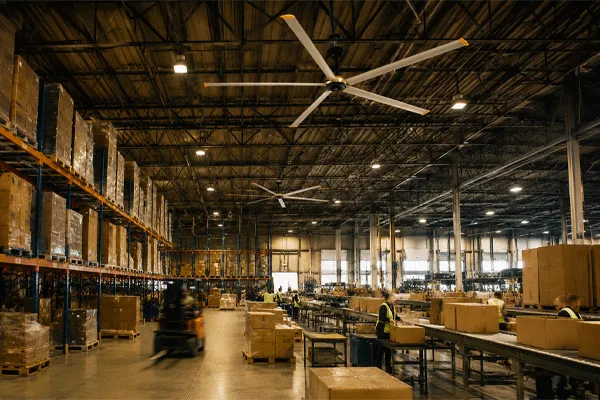
Most airflow problems in large industrial spaces trace back to a decision made before the first fan ever gets mounted: someone picked a diameter based on the room’s square footage alone, without checking ceiling height, obstruction layout, or how air actually moves once it leaves the blade tips. A fan sized correctly for a 30-foot ceiling will underperform in a 22-foot space, and the reverse is just as true.
This guide walks through the process facilities teams use to size and place एचवीएलएस पंखे, using AMCA 230-15 as the airflow testing reference and ANSI/ASHRAE 216P as the performance standard for HVLS-specific applications. Neither claims apply to the fan model in isolation — they’re standards the fan’s tested performance data should be measured against, not a guarantee attached to any single install.
Step 1: Measure Ceiling Height Before Anything Else
Ceiling height, not floor area, is the first constraint. HVLS fans need clearance above the blades and a minimum drop below the ceiling to move air effectively without creating turbulence against the roof deck.
- Measure from finished floor to the lowest point of any obstruction (sprinkler heads, ductwork, conveyor systems, light fixtures) directly beneath the proposed mounting point.
- Confirm the clearance falls within the manufacturer’s rated range for the model under consideration. The P780 Series, for example, is rated for ceiling heights of 20–33 ft.
- If the space has mixed ceiling heights — common in facilities with mezzanines or partial second floors — treat each height zone as a separate sizing calculation rather than averaging across the whole building.
Skipping this step is the single most common reason a fan gets returned or relocated after installation.
Step 2: Match Diameter to the Zone, Not the Whole Building
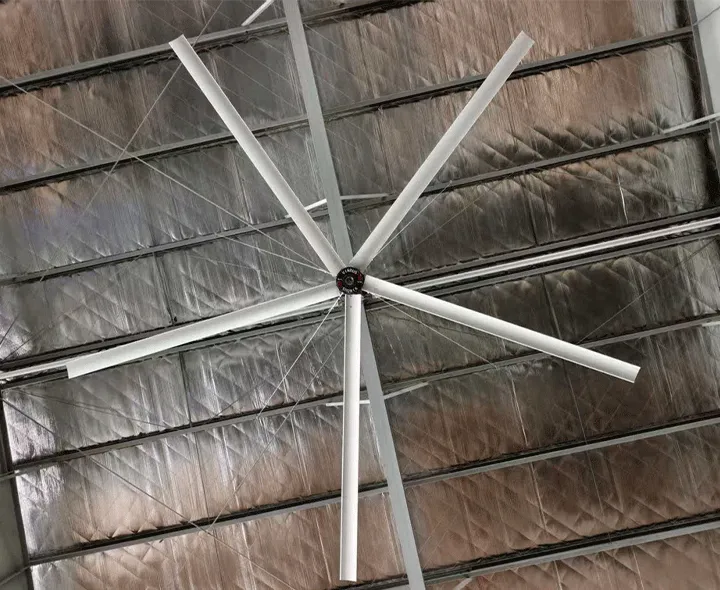
Once ceiling height is confirmed, diameter selection follows. The P780 Series comes in 20 ft and 24 ft configurations, and the right choice depends on how much unobstructed floor area sits under a single unit — not the square footage of the entire building.
A few things worth checking here:
- Does the zone have racking, machinery, or partitions that will block airflow before it reaches the floor?
- Is the zone open to adjacent areas where air can drift, or enclosed by walls that will trap it?
- Will the space eventually be reconfigured (new racking, added mezzanine) in a way that changes the obstruction map?
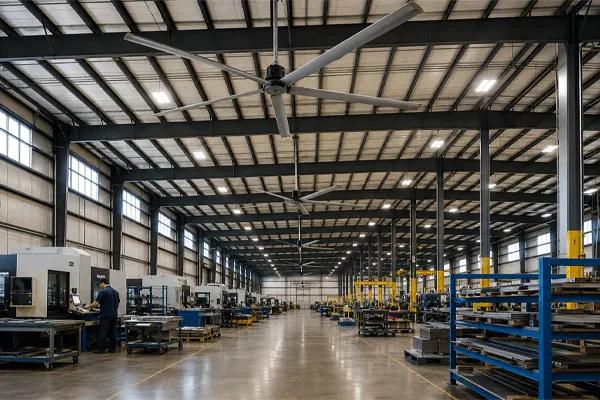
Facilities with irregular layouts — an L-shaped warehouse, say, or a factory floor split by a fixed crane rail — often need two or three diameter/height combinations rather than one size applied uniformly. Uniform sizing is easier to specify, but it usually means some zones are underserved and others are oversized.
HVLS Fans for Airflow Optimization in Industrial Facilities: A Sizing and Placement Guide
Step 3: Set Spacing Based on Coverage Overlap, Not Just Room Count
Spacing is where a lot of the airflow-optimization work actually happens, and it’s the step most often shortcut. The goal is overlapping coverage at floor level without units competing against each other’s downdraft, which happens when two fans are placed too close and their air columns interfere before reaching occupant height.
- Start from the manufacturer’s minimum center-to-center spacing for the selected diameter.
- Adjust spacing tighter in zones with heavier obstruction density, and looser in open zones where air can travel further before losing velocity.
- Keep at least one fan diameter’s distance from exterior walls and permanent structural columns — placing a unit too close to a wall directs its airflow into a vertical surface rather than out across the floor.
- Re-check the layout against any HVAC intake or exhaust points in the space; HVLS airflow and mechanical ventilation can work against each other if placed without coordination.
The Edge Case Most Guides Skip: Seasonal Direction Reversal
One thing that trips up facilities managers who are sizing for the first time: airflow optimization isn’t a single static configuration. In winter, running HVLS fans in reverse at low speed pulls warm air that has risen to the ceiling back down toward occupant level — a process known as destratification — instead of pushing a direct cooling breeze downward as in summer mode.
If a facility sizes and places fans purely for summer cooling coverage, it can end up with placement that works poorly for winter destratification, because the two modes have different effective coverage patterns. Reversible, variable-speed control (built into the PMSM direct-drive design used across the P780 line) is what makes running both modes from the same installed layout practical, but the placement plan still needs to account for both uses from the start, not summer alone.
Direct-Drive vs. Gearbox-Driven Systems: What Changes for Airflow Consistency
Compared with gearbox-driven HVLS systems, direct-drive designs remove a mechanical stage between the motor and the blades. For airflow optimization specifically, that has a few practical effects worth weighing during selection:
| कारक |
Gearbox-Driven |
PMSM Direct-Drive |
| Moving parts between motor and blades |
Gearbox, drive shaft |
None — blades mount directly to motor |
| Maintenance access |
Typically requires roof-level or lift access |
Floor-level HMI panel, no lift required |
| Speed/direction change response |
Slower, mechanical lag |
Near-instant electronic control |
| Power draw at max speed |
Varies by model and gear ratio |
Under 1,000 W (P780/P730 Series) |
| Long-term output consistency |
Can drift as gearbox wears |
No gear wear to compensate for |
This isn’t a universal advantage in every scenario. Direct-drive units cost more upfront in most product lines, and for facilities with very low duty-cycle requirements — a fan that runs a few hours a week — the maintenance-access savings matter less than they would in a facility running fans continuously.
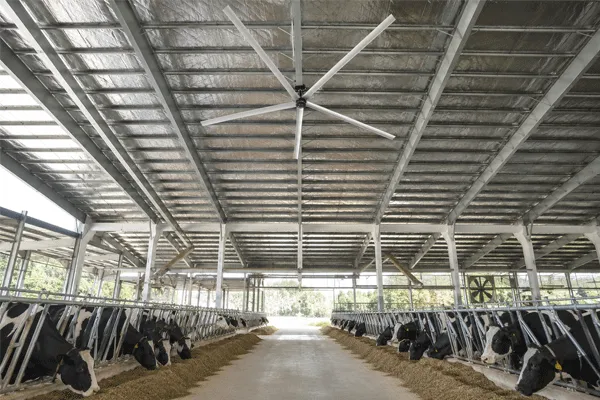
HVLS Fans for Airflow Optimization in Industrial Facilities: A Sizing and Placement Guide
P780 Series Specifications Relevant to Airflow Planning
For teams sizing specifically around this model line, the parameters that affect placement decisions are:
- Diameter options:20 ft and 24 ft
- Rated ceiling height range:20–33 ft
- Motor type:PMSM (permanent magnet synchronous motor), direct-drive
- Power draw:Under 1,000 W at maximum speed
- Control access:Floor-level integrated HMI panel — no roof or lift access needed for speed, direction, or scheduling adjustments
- Installation:Single cable runs from ceiling mount to floor-level control point
Note that Vindus Fans does not publish exact rated CFM or decibel figures for this model on its public materials; anyone specifying airflow volume for engineering documentation should request that data directly rather than relying on third-party estimates.
सामान्य प्रश्न
Q: Can one एचवीएलएस पंखा size work for a facility with varying ceiling heights?
A: Not reliably. Treat each distinct height zone as its own sizing calculation — a fan rated for a 20–33 ft range, like the P780, will still underperform if mounted near the low end of a mixed-height space that also has 18 ft sections.
Q: How close can an HVLS fan be placed to a wall?
A: As a general placement rule, keep at least one fan diameter of clearance from exterior walls and columns so the downdraft has room to spread across the floor instead of hitting a vertical surface directly.
Q: Does the same fan layout work for both summer cooling and winter destratification?
A: Often not without adjustment. Summer mode and reverse-direction destratification mode have different effective coverage patterns, so a layout optimized only for one season’s airflow can underperform in the other unless spacing and reversal capability were planned in from the start.
Q: What’s the price for a P780 Series installation?
A: Vindus Fans does not publish price ranges publicly; pricing is quote-based and depends on the specific configuration and site requirements. Contact Vindus Fans directly for a quote.